The Tyrannosaurus rex dominates popular imagination like no other dinosaur. It looms over movies, museum halls, and childhood nightmares as the ultimate prehistoric monster: massive jaws, bone-crushing bite, and a stare that seems to promise extinction. But the truth is more unsettling. T-rex was terrifying, yes—but it was far from the most frightening creature to ever walk the Earth.
Prehistory was not ruled by a single king. It was a chaotic, brutal world filled with predators that hunted in packs, wielded claws designed for disembowelment, or possessed weapons so extreme that they redefine what “dangerous” means. Some dinosaurs were faster than T-rex. Others were larger. Some were smarter. A few were so alien in their design that imagining an encounter with them feels almost unbearable.
What makes a dinosaur truly terrifying is not size alone. It is behavior, anatomy, strategy, and the environment in which it lived. When all those factors combine, the result can be far more frightening than a single giant predator roaring alone.
Here are ten dinosaurs that, in their own ways, were arguably far more terrifying than the famous Tyrannosaurus rex.
1. Spinosaurus
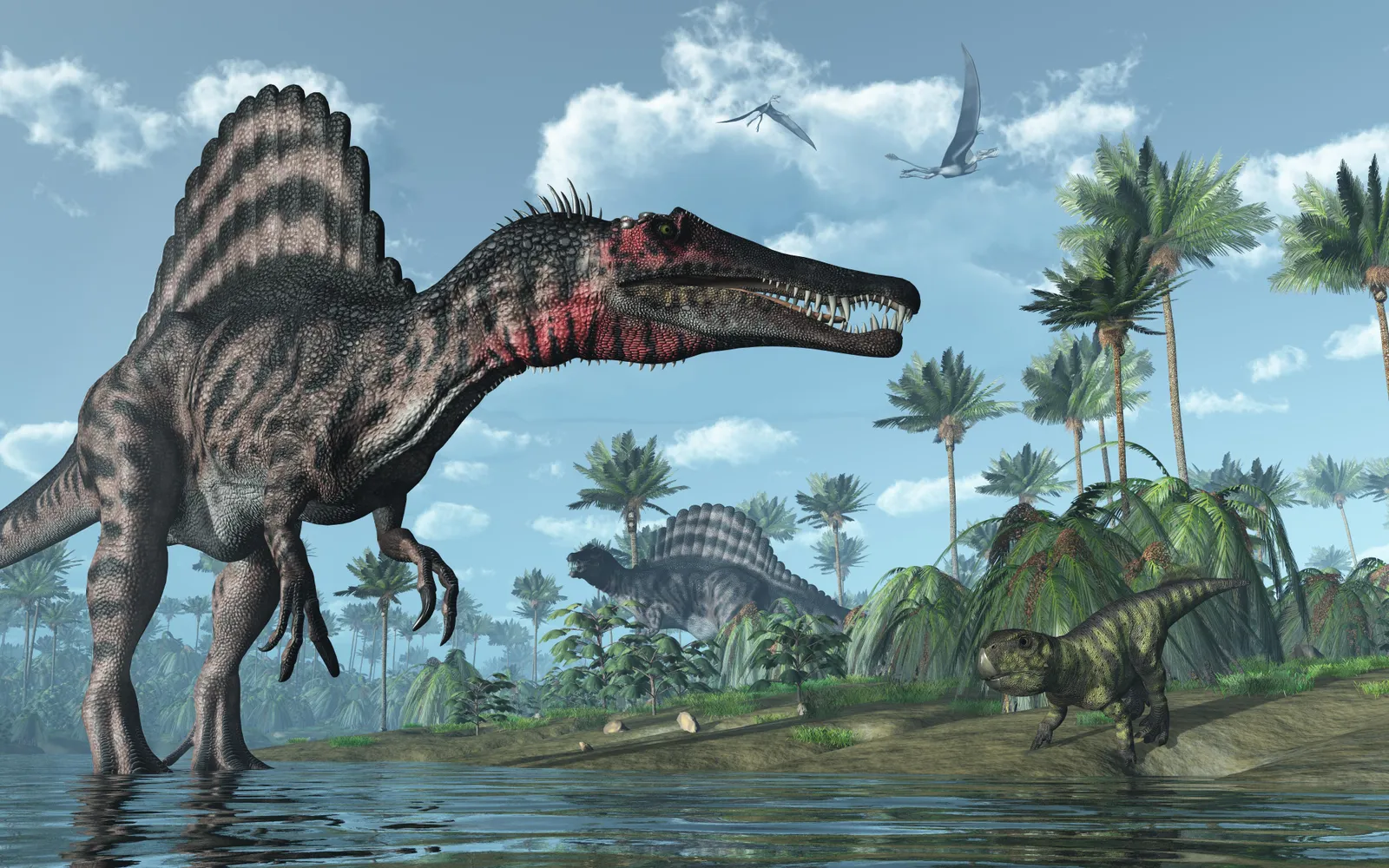
Spinosaurus was not just bigger than T-rex—it was stranger, more unpredictable, and possibly more dangerous in its environment. This colossal predator was the largest known carnivorous dinosaur, stretching longer than a school bus and weighing more than many modern whales. But its terror lies not only in size.
Unlike T-rex, Spinosaurus was adapted for a semi-aquatic lifestyle. Its long, narrow skull was filled with conical teeth designed for gripping slippery prey, much like a crocodile’s. Its nostrils were positioned high on the snout, allowing it to breathe while much of its head was submerged. Dense bones helped it stay stable in water, and its tail, recently discovered to be tall and fin-like, suggests powerful swimming ability.
This means Spinosaurus was not confined to land. It ruled rivers, swamps, and coastlines. Imagine a predator that could ambush you from murky water, drag massive prey beneath the surface, and then haul itself onto land to dominate terrestrial rivals. T-rex was terrifying if you saw it coming. Spinosaurus was terrifying because you might not see it at all.
Its iconic sail—formed by elongated spines along its back—may have been used for display or temperature regulation, making it even more imposing. A creature that large, equally comfortable on land and in water, represents a level of dominance that few predators in Earth’s history could match.
2. Giganotosaurus
If terror were measured by pure killing efficiency, Giganotosaurus would be near the top. This South American giant rivaled or even surpassed T-rex in length and had a skull nearly as large. But while T-rex relied on bone-crushing force, Giganotosaurus was built for slicing.
Its teeth were long, sharp, and serrated like steak knives, designed to slash flesh rather than pulverize bone. This suggests a hunting strategy closer to that of a giant Komodo dragon, inflicting catastrophic wounds and letting prey bleed out. That method is terrifying because it implies prolonged suffering and relentless pursuit.
Evidence suggests Giganotosaurus may have hunted in groups, especially when targeting enormous prey like Argentinosaurus, one of the largest animals to ever live. The idea of multiple predators coordinating attacks on creatures many times larger than themselves is deeply unsettling.
A single T-rex was fearsome. A coordinated group of massive, intelligent, slicing predators would have been a nightmare beyond imagination.
3. Carcharodontosaurus
Named after the great white shark due to its razor-sharp teeth, Carcharodontosaurus was a killing machine built for devastation. Its teeth were thin, blade-like, and designed to tear through flesh with ease. Unlike T-rex, which could crush bone in a single bite, Carcharodontosaurus specialized in opening enormous wounds.
This dinosaur lived in what is now North Africa, a land teeming with massive herbivores and other large predators. To survive in such an ecosystem, it had to be aggressive, dominant, and constantly on the hunt.
Its skull was massive, and its jaws could open wide enough to deliver terrifying slashing bites. One well-placed attack could cause organs to spill out, leading to rapid death. This kind of predator does not need repeated attacks—it needs only one moment of contact.
The terror of Carcharodontosaurus lies in its efficiency. It was not a brute force executioner like T-rex. It was a butcher.
4. Therizinosaurus
At first glance, Therizinosaurus looks almost absurd. Long neck, pot-bellied torso, and a slow, awkward posture make it seem harmless. Then you notice the claws.
Each hand bore three enormous claws, some over a meter long—the longest claws of any known animal to ever live. These were not delicate tools. They were massive, scythe-like weapons capable of inflicting catastrophic damage.
Therizinosaurus was likely a herbivore or omnivore, using its claws to pull down branches. But that does not make it safe. Many modern herbivores are among the most dangerous animals on Earth. When threatened, Therizinosaurus would have been a walking nightmare.
A swipe from those claws could disembowel a predator instantly. Its size alone made it formidable, but combined with its weaponry, it would have been nearly untouchable. T-rex hunted prey. Therizinosaurus was something you did not want to provoke.
Its sheer alien appearance—part dinosaur, part nightmare—makes it one of the most psychologically terrifying creatures ever to exist.
5. Utahraptor
Utahraptor proves that terror does not require massive size. While smaller than T-rex, it was far more agile, intelligent, and potentially more dangerous in close encounters.
This giant raptor was much larger than its famous cousin Velociraptor, standing taller than a human and weighing as much as a polar bear. It possessed a massive sickle-shaped claw on each foot, capable of slashing open prey with a single kick.
Utahraptor likely hunted in groups, using coordination, speed, and strategy. Pack hunting transforms a predator into a force multiplier. It means ambushes, flanking maneuvers, and relentless pursuit.
Facing a T-rex was terrifying, but at least it was one animal. Facing a pack of Utahraptors—fast, intelligent, and armed with killing claws—would have been pure horror.
6. Carnotaurus
Carnotaurus was a predator designed for speed and violence. Its name means “meat-eating bull,” and it earned that title with two horn-like structures above its eyes. While its arms were even smaller than those of T-rex, its legs were long and powerful, suggesting it was one of the fastest large theropods.
Carnotaurus likely relied on quick bursts of speed to ambush prey. Its skull allowed for rapid head movements, meaning it could strike repeatedly in quick succession. Its horns may have been used in combat, either to gore prey or fight rivals.
This dinosaur lived in open environments where speed meant survival. Being chased by a Carnotaurus would not have been a slow, thundering pursuit. It would have been sudden, explosive, and lethal.
T-rex crushed you. Carnotaurus ran you down.
7. Mapusaurus
Mapusaurus was a close relative of Giganotosaurus and shared many of its terrifying traits. What sets it apart is evidence suggesting social behavior. Fossil sites indicate that multiple individuals lived and possibly hunted together.
This implies coordinated attacks on massive prey, potentially overwhelming even the largest herbivores. Group hunting increases efficiency and success, but it also increases fear. A single predator can be avoided or outmaneuvered. A coordinated group closes all exits.
Mapusaurus lived alongside some of the largest dinosaurs ever, and to survive, it had to be aggressive, adaptable, and ruthless. It was not just a predator. It was part of a killing machine.
8. Tyrannotitan
Despite its name, Tyrannotitan was not closely related to T-rex. It belonged to the same terrifying family as Giganotosaurus and Carcharodontosaurus. It was enormous, heavily built, and armed with slicing teeth.
What makes Tyrannotitan particularly frightening is how little we know. Fragmentary fossils suggest a massive predator, but much about its behavior remains a mystery. In paleontology, uncertainty can be terrifying. It means there may be traits we have not yet discovered.
What we do know is that Tyrannotitan lived among giants and survived by killing giants. Any animal capable of that earns its place among the most terrifying predators in history.
9. Allosaurus (In Its Prime)
Allosaurus is often underestimated because it lived earlier than T-rex and was smaller. But terror is not always about size—it is about dominance in context.
For millions of years, Allosaurus was the apex predator of its environment. It lived alongside enormous herbivores like Stegosaurus and Diplodocus and hunted them successfully. Its jaws were designed to open wide and deliver powerful slashing bites.
Evidence suggests Allosaurus may have used a “hatchet” biting technique, swinging its head downward to tear flesh. This would have caused massive bleeding and rapid incapacitation.
In its world, Allosaurus was death incarnate. Every creature knew its shape, its sound, and its smell. In that context, it was every bit as terrifying as T-rex—if not more.
10. Deinosuchus (Not a Dinosaur, But Worse)
Deinosuchus was not a dinosaur, but excluding it would be dishonest. This prehistoric crocodilian lived alongside dinosaurs and hunted them. It was massive, far larger than any modern crocodile, with a bite force capable of crushing bone.
Unlike theropods, Deinosuchus relied on ambush. It lurked in water, invisible until the moment it struck. Fossil evidence shows dinosaur bones with bite marks matching Deinosuchus teeth, proving it preyed on dinosaurs—including large ones.
Imagine surviving in a world where rivers themselves were predators. Where drinking water could mean instant death. T-rex ruled land. Deinosuchus ruled fear.
Why T-Rex Wasn’t the Most Terrifying After All
Tyrannosaurus rex was extraordinary. It was powerful, intelligent, and dominant. But terror is contextual. Many dinosaurs were faster, more versatile, more coordinated, or more unpredictable.
Some hunted in packs. Some attacked from water. Some wielded claws longer than swords. Some ruled environments where escape was impossible.
The prehistoric world was not ruled by one monster, but by many—each adapted perfectly to kill in its own way. T-rex was a king, but it was not alone on the throne.
And in many cases, it was not the most terrifying ruler of all.