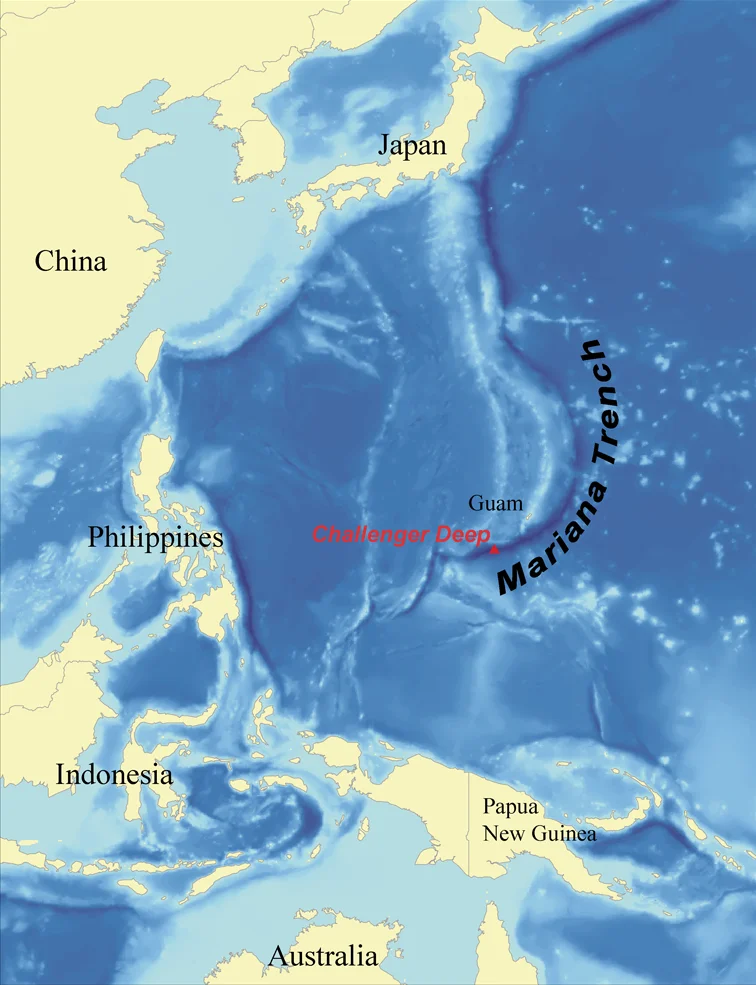
Far beneath the rolling surface of the Pacific Ocean lies a place so alien, so hostile, and so poorly understood that it feels closer to science fiction than to Earth. The Mariana Trench is the deepest known part of the world’s oceans, plunging nearly eleven kilometers down into perpetual darkness. No sunlight reaches its depths. The pressure is crushing beyond imagination. Temperatures hover near freezing, and yet life persists in ways that challenge everything we think we know about biology, geology, and even the limits of existence itself.
The Mariana Trench is not just deep. It is mysterious in a way that unsettles scientists and ignites human fear. We have explored the surface of the Moon more thoroughly than this abyss. Every expedition into the trench uncovers new questions, strange phenomena, and unsettling discoveries. Here are ten of the most terrifying mysteries of the Mariana Trench—each one a reminder of how little we truly know about our own planet.
1. The Crushing Pressure That Should Make Life Impossible
At the bottom of the Mariana Trench, the pressure is more than one thousand times greater than at sea level. To put this into perspective, it is equivalent to having the weight of about fifty commercial airplanes pressing down on a single square inch of your body. Under such conditions, most materials would collapse instantly. Proteins should unravel. Cell membranes should fail. Chemistry itself should break down.
And yet, life exists.
Scientists have discovered fish, crustaceans, and microscopic organisms living comfortably under these conditions. How their bodies function without being destroyed remains a profound mystery. Their cells contain specialized molecules and membrane structures that resist compression, but the full mechanisms are not yet fully understood. Each new species discovered forces scientists to rethink the physical limits of life.
What makes this terrifying is not just the pressure itself, but what it implies: if life can survive here, in conditions that seem fundamentally incompatible with biology, then our understanding of where life can exist—on Earth or beyond—may be deeply incomplete.
2. The Strange, Ghostly Creatures That Live Without Sunlight
The Mariana Trench exists in eternal night. Sunlight cannot penetrate beyond a few hundred meters, leaving the trench in complete darkness. Photosynthesis is impossible. The foundation of most food chains simply does not exist here.
And yet, creatures thrive.
Life in the trench depends on chemical energy rather than solar energy. Microorganisms use compounds like hydrogen sulfide and methane seeping from the seafloor to fuel their metabolism. Larger creatures feed on these microbes or on organic debris that slowly rains down from the surface.
Many trench animals are pale, translucent, or entirely colorless. Some have elongated limbs, gelatinous bodies, or bizarre sensory adaptations. Fish like the Mariana snailfish have soft, fragile bones and flesh that would disintegrate if brought to the surface.
The terror lies in how alien these creatures are. They do not look like life as we intuitively understand it. They are reminders that evolution, given enough time and extreme conditions, can produce forms that feel almost monstrous—life that thrives in darkness, silence, and crushing pressure.
3. The Unknown Depths Beneath the “Bottom”
The deepest known point of the Mariana Trench is called the Challenger Deep. It is often described as the bottom of the ocean. But this description may be misleading.
Sonar mapping of the trench is still incomplete, and the seafloor itself is dynamic. Earth’s tectonic plates are constantly shifting, subducting, and reshaping the trench. Landslides, collapses, and geological movement may create deeper pockets that have never been measured.
Even when submersibles reach the seafloor, visibility is limited. Sediment clouds and rugged terrain make exploration difficult. It is entirely possible that deeper crevices or unexplored chambers exist below what we currently believe to be the deepest point.
The idea that there may be depths deeper than our deepest measurements taps into a primal fear: the fear of the unknown beneath us. The trench may not have a single bottom, but a complex, shifting architecture that we have only barely touched.
4. The Presence of Human Pollution at the Deepest Point on Earth
One of the most unsettling discoveries in the Mariana Trench is not alien life or geological mystery, but evidence of humanity itself. Scientists have found plastic debris, chemical pollutants, and even synthetic fibers at the very bottom of the trench.
These contaminants have no natural origin at such depths. They were carried there by ocean currents, slowly sinking over decades. Some chemicals found in trench organisms are known to be toxic, persistent pollutants created by human industry.
The terror here is existential. Even the most remote, inaccessible place on Earth is not beyond human impact. The Mariana Trench should be pristine, untouched by civilization. Instead, it bears our signature.
This discovery raises haunting questions about the long-term consequences of pollution. If toxins can reach the deepest parts of the ocean, where else might they accumulate? What unseen damage are we inflicting on ecosystems we barely understand?
5. Earthquakes and Silent Catastrophes in the Abyss
The Mariana Trench is located at a major subduction zone, where one tectonic plate is forced beneath another. This process generates immense geological stress, making the region prone to earthquakes.
Some of the most powerful earthquakes on Earth originate near deep ocean trenches. When they occur, they can trigger undersea landslides, shift vast amounts of sediment, and even generate tsunamis that travel across entire oceans.
What makes this terrifying is that much of this activity happens in silence and darkness, completely unseen. Entire sections of the trench floor may collapse or reshape themselves without any human observation. Creatures adapted to stable conditions may be wiped out instantly.
The trench is not a static abyss; it is a restless, unstable wound in Earth’s crust. Its quiet hides immense violence, reminding us that the planet beneath our feet is constantly in motion.
6. The Mystery of Gigantism and Miniaturization
Life in the deep sea often follows strange size rules. Some organisms grow unusually large, while others are remarkably small. In the Mariana Trench, this phenomenon becomes even more extreme.
Certain amphipods found in the trench grow far larger than their shallow-water relatives. At the same time, many fish species are smaller and more fragile than expected. Scientists believe these size differences may be linked to pressure, temperature, food availability, and metabolic efficiency—but no single explanation fits all observations.
The unsettling part is that these size shifts suggest deep-sea life operates under rules we do not fully grasp. Evolution seems to take unexpected paths under extreme conditions, producing bodies that defy familiar biological patterns.
This mystery challenges our assumptions about how life adapts. The trench appears to be a biological laboratory where nature experiments freely, unconstrained by the rules we see at the surface.
7. The Extreme Isolation and Genetic Divergence of Trench Life
The Mariana Trench is not just physically deep; it is biologically isolated. Many species found there exist nowhere else on Earth. They are separated from surface ecosystems by kilometers of hostile water.
This isolation leads to extreme genetic divergence. Trench species may evolve independently for millions of years, developing unique traits that have no counterparts elsewhere. Some organisms may represent entire branches of life that we are only beginning to recognize.
The terrifying implication is that there may be forms of life so genetically distinct that we struggle to classify them using existing biological frameworks. They may operate with biochemical processes subtly different from those we know.
In this sense, the Mariana Trench is not just a place—it is a parallel biological world, evolving in near-total isolation, largely unseen by human eyes.
8. Sounds From the Deep That Defy Easy Explanation
Hydrophones placed in the deep ocean have recorded strange sounds coming from the depths of the Pacific, including regions near the Mariana Trench. Some of these sounds have been explained as ice cracking, seismic activity, or marine animals. Others remain ambiguous.
Low-frequency groans, high-pitched whistles, and long, drawn-out calls echo through the water. Sound travels far more efficiently in the ocean than in air, allowing noises from deep sources to propagate across vast distances.
The fear here is not that these sounds are supernatural, but that we often cannot immediately identify their source. In a place we barely understand, unexplained sounds trigger deep unease. They remind us that massive processes—biological or geological—may be occurring beyond our perception.
The ocean speaks, but we do not always understand its language.
9. The Difficulty of Exploration and the Fragility of Technology
Reaching the Mariana Trench is one of the greatest engineering challenges humanity has faced. Only a handful of crewed and uncrewed missions have ever descended to its deepest point. The pressure can crush steel, shatter glass, and destroy electronics.
Every expedition risks catastrophic failure. A single structural flaw can mean total implosion. Communication delays and limited visibility add to the danger. When a submersible descends, it enters a realm where rescue is virtually impossible.
This makes exploration slow, expensive, and rare. As a result, our knowledge of the trench advances in tiny increments. Vast areas remain completely unexplored.
The terror lies in our vulnerability. Despite our technological achievements, the Mariana Trench reminds us that there are places on Earth where we are still fragile intruders, dependent on thin shells of metal to survive.
10. What the Mariana Trench Reveals About the Limits of Human Knowledge
Perhaps the most terrifying mystery of the Mariana Trench is what it represents philosophically. It is a symbol of how little we know about our own planet. More than seventy percent of Earth is covered by oceans, and the deepest parts remain largely uncharted.
The trench challenges our sense of mastery. We have mapped Mars, sequenced genomes, and built machines that orbit the Sun. Yet just a few kilometers beneath the waves lies a world that resists easy understanding.
Every discovery in the Mariana Trench raises new questions. How did life originate here? How resilient can biology truly be? What unknown processes shape the deep Earth?
The trench confronts us with humility. It reminds us that mystery is not a failure of science, but its fuel. The fear it inspires is not just fear of darkness or depth, but fear of our own limitations.
In the end, the Mariana Trench is terrifying not because it is hostile, but because it is honest. It shows us that the planet is deeper, stranger, and more complex than we imagine—and that there are still places where nature keeps its secrets, waiting patiently for us to ask better questions.