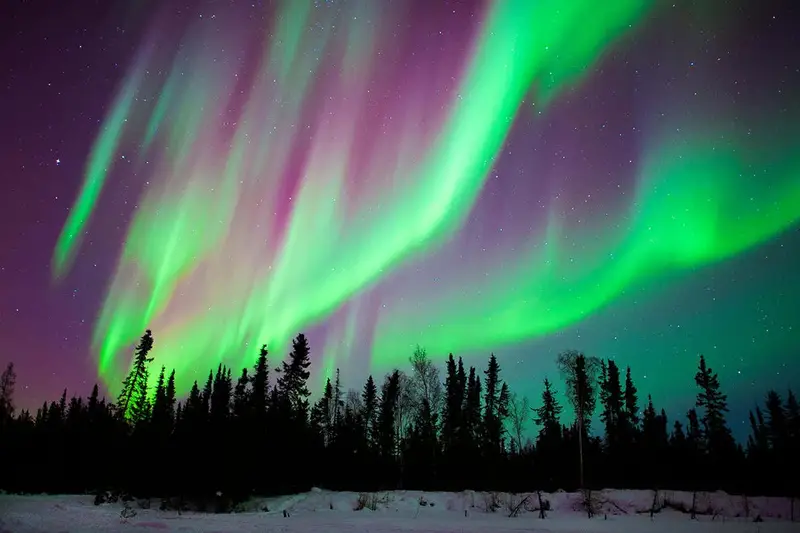
On a cold, silent night near the top of the world, the sky can suddenly come alive. Curtains of green light ripple overhead. Arcs of red glow faintly at the horizon. Purple and blue flickers dance like living things, appearing and vanishing in moments. For those who witness it, the aurora borealis is not just a visual phenomenon; it is an emotional experience, a reminder that Earth is not isolated, but intimately connected to the restless star that gives us life.
The aurora borealis, often called the Northern Lights, is one of nature’s most beautiful displays. It is a meeting point of astrophysics and atmosphere, of invisible cosmic forces and human wonder. To understand how solar winds paint the night sky, we must travel far beyond Earth’s surface, into the dynamic heart of the Sun, then follow streams of energy across millions of kilometers of space, and finally descend back into the thin air above our planet, where light is born from collision and chance.
This is the story of the aurora: a story written in charged particles and magnetic fields, in atomic physics and celestial motion, and in centuries of human curiosity and awe.
Ancient Skies and Human Imagination
Long before science explained the aurora, people living under polar skies watched it with reverence and fear. The lights were too powerful, too otherworldly, to be ignored. They appeared without warning, moved with purpose, and vanished just as mysteriously. To early observers, the aurora felt alive.
Different cultures created their own meanings. Some saw the lights as spirits of ancestors dancing across the heavens. Others believed they were omens of war or famine, reflections of distant fires, or messages from the gods. In the far north, stories warned people not to whistle at the aurora, lest it come down and carry them away. In other traditions, the lights were gentle guides, illuminating the path between worlds.
These myths were not born of ignorance, but of honest engagement with a phenomenon that defied everyday experience. The aurora challenged the boundary between Earth and sky, between the known and the unknowable. Even today, with satellites and equations, that sense of mystery has not entirely faded.
Naming the Lights of the North
The term “aurora borealis” has poetic roots. “Aurora” comes from the Roman goddess of dawn, who renewed herself each morning and flew across the sky to announce the rising Sun. “Borealis” refers to Boreas, the Greek god of the north wind. Together, the name suggests a dawn born of the northern skies, a fitting description for a light that often looks like sunrise unfolding at midnight.
The southern hemisphere has its own counterpart, the aurora australis, or Southern Lights. Though less widely known, it is born from the same processes and can be just as spectacular. Both are manifestations of a single planetary interaction between Earth and the Sun, shaped by geography, magnetism, and chance.
The Sun: A Restless Source of Energy
To understand the aurora, we must first understand the Sun. Though it appears calm and constant from Earth, the Sun is a seething sphere of plasma, where temperatures reach millions of degrees and magnetic fields twist, snap, and reconnect.
The Sun’s immense heat strips electrons from atoms, creating a charged state of matter known as plasma. In this state, particles respond strongly to magnetic forces. The Sun’s magnetic field, generated by the motion of this plasma, is complex and dynamic. It loops and tangles, storing energy that can be released suddenly in powerful events.
Among the most important of these events are solar flares and coronal mass ejections. Solar flares are intense bursts of radiation, while coronal mass ejections involve vast clouds of charged particles hurled into space. Even in quieter times, the Sun continuously releases a steady stream of charged particles known as the solar wind.
This solar wind is the key artist behind the aurora.
The Solar Wind: An Invisible River Through Space
The solar wind flows outward from the Sun in all directions, carrying electrons, protons, and atomic nuclei across the solar system. It travels at hundreds of kilometers per second, filling space with a tenuous but energetic plasma.
Though invisible, the solar wind is far from insignificant. It shapes the environments of planets, sculpts comet tails, and influences the behavior of cosmic radiation. For Earth, it represents both a threat and a source of beauty.
When the solar wind reaches Earth, it encounters an invisible shield: the planet’s magnetic field.
Earth’s Magnetic Shield
Earth behaves like a giant magnet, with field lines emerging near the South Pole and re-entering near the North Pole. This magnetic field extends far into space, forming a protective bubble called the magnetosphere.
The magnetosphere deflects most of the solar wind, preventing it from directly stripping away Earth’s atmosphere. Without this magnetic shield, our planet would be far more vulnerable to solar radiation, and life as we know it might not exist.
However, the magnetosphere is not a perfect barrier. Its shape is compressed on the side facing the Sun and stretched into a long tail on the opposite side. Along certain paths, especially near the magnetic poles, solar particles can gain access to the upper atmosphere.
It is along these magnetic gateways that the aurora is born.
When Solar Winds Meet Earth
As solar wind particles approach Earth, they interact with the magnetosphere in complex ways. Magnetic reconnection can occur, allowing energy and particles from the solar wind to enter the magnetosphere. These particles are guided along magnetic field lines toward the polar regions.
As they spiral downward, they gain speed and energy. By the time they reach the upper atmosphere, typically between 80 and 500 kilometers above the surface, they are moving fast enough to collide with atoms and molecules of gas.
These collisions are the moment when invisible energy becomes visible light.
The Birth of Auroral Light
When a charged particle from the solar wind collides with an atom or molecule in Earth’s atmosphere, it transfers energy. This energy excites the atmospheric particle, pushing its electrons into higher energy states.
Excited states are unstable. Almost immediately, the electrons fall back to their original levels, releasing the excess energy as light. The color of that light depends on the type of atom or molecule involved and the amount of energy released.
Oxygen is responsible for the most common auroral colors. At higher altitudes, excited oxygen emits a red glow. At lower altitudes, it produces the brilliant green light most people associate with the aurora borealis. Nitrogen contributes blue and purple hues, often seen at the edges of auroral curtains or during particularly energetic events.
Each color is a signature, a precise fingerprint of atomic physics playing out on a planetary scale.
Why the Aurora Dances
One of the most captivating aspects of the aurora is its motion. The lights ripple, fold, pulse, and surge across the sky, sometimes slowly and gracefully, sometimes with explosive speed.
This movement reflects the dynamic nature of the magnetic and electric fields guiding the incoming particles. Variations in solar wind intensity, changes in Earth’s magnetic field, and complex interactions within the magnetosphere all influence how and where energy is released.
The aurora is not a static image but a living system, constantly responding to conditions far beyond Earth. Watching it is like watching the visible surface of an invisible storm.
Auroral Shapes and Structures
Auroras appear in many forms, each shaped by physics and perspective. Long arcs stretch from horizon to horizon, tracing lines of constant magnetic latitude. Curtains hang like luminous fabric, their vertical folds aligned with magnetic field lines. Coronas radiate outward from a central point overhead, creating the illusion of light pouring down from the stars.
These shapes are not random. They reveal the geometry of Earth’s magnetic field and the paths along which charged particles travel. Even without instruments, the aurora offers a glimpse into the invisible structure surrounding our planet.
Why Auroras Favor the Poles
Auroras are most commonly seen near the Arctic and Antarctic because Earth’s magnetic field funnels solar particles toward these regions. The magnetic field lines converge near the poles, making it easier for particles to enter the atmosphere there.
This creates two rings of frequent auroral activity, known as auroral ovals, encircling the magnetic poles. When solar activity is low, auroras stay within these ovals. During powerful solar storms, the ovals expand, allowing auroras to be seen at much lower latitudes.
This is why, on rare occasions, people far from the polar regions can witness the Northern or Southern Lights, a reminder that solar events can briefly reshape Earth’s magnetic environment.
Solar Storms and Intensified Auroras
The most dramatic auroras are often linked to intense solar activity. When the Sun releases a strong coronal mass ejection aimed toward Earth, it can trigger a geomagnetic storm.
During such storms, enormous amounts of energy are transferred into Earth’s magnetosphere. Auroras become brighter, faster, and more widespread. Colors intensify, and rare hues can appear. The sky can seem filled with motion, as if the atmosphere itself were alive.
These events are not only beautiful but powerful. The same energy that creates spectacular auroras can disrupt satellites, interfere with radio communications, and even affect power grids on the ground. The aurora is thus both a symbol of cosmic beauty and a visible sign of space weather at work.
The Science of Space Weather
The study of how solar activity affects Earth is known as space weather science. It recognizes that our planet exists within the extended atmosphere of the Sun, influenced by its cycles and outbursts.
Auroras are among the most visible manifestations of space weather, but they are only one part of a larger system. By studying auroras, scientists gain insight into processes that can impact modern technology and infrastructure.
Satellites monitor the Sun and the solar wind, providing early warnings of storms that could trigger intense auroras and potential disruptions. In this way, the ancient wonder of the Northern Lights is now linked to cutting-edge science and global preparedness.
Observing the Aurora from Earth
For those who seek the aurora, patience and luck are essential. Clear, dark skies are necessary, far from city lights that can drown out faint glows. Long winter nights in high-latitude regions offer the best opportunities.
Yet no two auroral displays are ever the same. Some nights bring faint, ghostly arcs barely visible to the eye. Others explode into color and motion, leaving observers speechless. This unpredictability is part of the aurora’s power. It cannot be summoned or controlled; it must be encountered on its own terms.
When it appears, the aurora has a way of commanding silence. People stop talking, stop checking cameras, and simply look up. In that moment, science and emotion merge, and the sky feels close enough to touch.
Auroras Beyond Earth
Earth is not the only planet with auroras. Any planet with an atmosphere and a magnetic field can, in principle, host them. Observations have revealed auroras on Jupiter, Saturn, Uranus, and Neptune, each shaped by unique magnetic environments and atmospheric compositions.
Jupiter’s auroras, for example, are far more powerful than Earth’s, driven not only by the solar wind but also by interactions with its volcanic moon Io. These alien auroras remind us that the phenomenon is universal, a natural consequence of magnetic fields and charged particles throughout the cosmos.
Studying auroras on other planets deepens our understanding of planetary magnetism and space environments, extending the story of the Northern Lights beyond Earth.
The Emotional Power of the Aurora
Despite all that science can explain, the aurora retains an emotional resonance that defies simple description. It is a reminder that the universe is not distant and abstract but actively interacting with our world.
Standing beneath an aurora, one feels both small and connected. The lights originate from the Sun, travel through space, and end their journey in the air above one’s head. They link the human observer to a chain of events spanning millions of kilometers.
This sense of connection can be deeply moving. The aurora turns the sky into a canvas where cosmic forces reveal themselves in color and motion. It invites humility, wonder, and reflection.
The Aurora in Art and Culture
Throughout history, the aurora has inspired artists, writers, and musicians. Paintings attempt to capture its fluid motion. Poems struggle to put its beauty into words. Music seeks to echo its shifting rhythms.
Even today, the aurora influences culture and identity in northern regions. It is woven into local traditions, tourism, and storytelling. Science has explained its mechanism, but it has not diminished its cultural power. Instead, understanding has added a new layer of appreciation, revealing the immense processes behind the fragile beauty.
A Bridge Between Earth and Sun
The aurora borealis is more than a natural light show. It is a visible bridge between Earth and the Sun, a reminder that our planet exists within a dynamic solar system shaped by magnetic fields and flowing energy.
Every auroral display is the result of countless individual particles, each following the laws of physics, each colliding with atoms high above the ground. Together, they create patterns that feel intentional, almost conscious, though they are born purely of natural processes.
This is perhaps the greatest lesson of the aurora. Nature does not need intention to create beauty. Order can arise from interaction, and meaning can emerge from motion.
The Continuing Mystery
Even with modern instruments and theories, the aurora is not fully understood. Scientists continue to study the fine details of particle acceleration, energy transfer, and magnetic interaction. New satellites and models reveal complexities that challenge existing explanations.
This ongoing research reflects the broader truth of science: understanding is never complete. Each answer opens new questions, and each discovery deepens the mystery.
The aurora borealis, shimmering silently above the frozen ground, embodies this truth. It is both explained and unexplained, familiar and alien, simple in its ingredients and complex in its expression.
The Sky as a Storyteller
When the aurora paints the night sky, it tells a story written in light. It speaks of a star that never rests, of a planet protected by invisible forces, and of an atmosphere that glows when touched by cosmic energy.
To watch the aurora is to witness physics made visible, to see equations transformed into motion and color. It is to realize that the universe is not a distant abstraction but an active presence, shaping our skies and our lives.
In the end, the aurora borealis reminds us that we live beneath a dynamic universe, one that reaches down to Earth in streams of light and leaves us standing in awe, looking up, connected to the Sun, the stars, and the vast, unseen forces that bind them all together.