Microplastics are among the most unsettling discoveries of modern environmental science, not because they are spectacular or immediately visible, but precisely because they are silent, tiny, and everywhere. They drift through oceans like synthetic dust, settle into soils, float in the air we breathe, and move unnoticed through the food we eat and the water we drink. In recent years, scientists have found them in places once thought untouched by human activity and, most disturbingly, inside the human body itself. Microplastics are not a distant environmental problem or an abstract concept. They are intimate. They are already part of us.
To understand microplastics is to confront a new chapter in humanity’s relationship with the material world, a chapter written not in towering smokestacks or polluted rivers alone, but in microscopic fragments that blur the boundary between environment and biology.
The Birth of Plastic and the Seeds of an Invisible Crisis
Plastic is one of the defining materials of the modern age. Created to be durable, flexible, lightweight, and cheap, it revolutionized medicine, transportation, food preservation, and daily life. From sterile medical equipment to life-saving devices and affordable consumer goods, plastics have undeniably improved human well-being. Yet the very qualities that made plastic so useful also planted the seeds of a long-term environmental crisis.
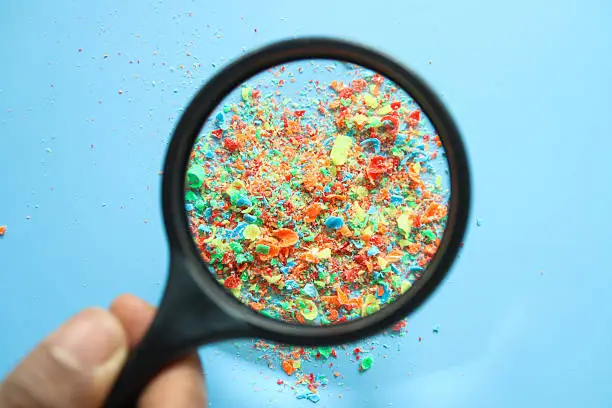
Unlike organic materials, most plastics do not biodegrade in the traditional sense. They do not rot, dissolve, or return to natural chemical cycles. Instead, they fragment. Under the influence of sunlight, heat, mechanical stress, and chemical exposure, larger plastic objects slowly break into smaller and smaller pieces. Over time, bottles, bags, textiles, tires, and packaging shed fragments that become invisible to the naked eye. These fragments are known as microplastics, typically defined as plastic particles smaller than five millimeters.
Some microplastics are born small, intentionally manufactured for use in industrial processes, cosmetics, or cleaning products. Others are the end result of decades of wear and degradation. Together, they form a global, persistent pollution that behaves unlike anything humanity has encountered before.
What Exactly Are Microplastics?
Microplastics are not a single substance but a diverse family of materials. They differ in size, shape, chemical composition, and surface properties. Some are spherical, some fibrous, others jagged or irregular. They are made from polymers such as polyethylene, polypropylene, polystyrene, and polyester, often mixed with additives like plasticizers, stabilizers, pigments, and flame retardants.
Their small size gives them unusual properties. They can be carried long distances by wind and water. They can pass through filtration systems designed to remove larger contaminants. They can interact with living cells in ways that larger plastic objects never could. Microplastics are not inert passengers in the environment; they are active participants in physical, chemical, and biological processes.
As they age, microplastics can absorb pollutants from their surroundings, including heavy metals and persistent organic chemicals. They can also host microbial communities, forming what scientists sometimes call a “plastisphere.” These characteristics complicate their environmental and biological effects, turning each particle into a tiny, mobile platform for chemical and biological interactions.
Microplastics in Water: From Oceans to the Tap
The story of microplastics first captured global attention in the oceans. Scientists studying marine debris realized that plastic pollution did not end with visible trash. Beneath the waves, trillions of microscopic fragments were suspended throughout the water column, from surface waters to deep-sea sediments.
Ocean currents distribute microplastics across the planet, concentrating them in some regions while delivering them to remote coastlines and polar seas. Marine organisms, from plankton to whales, ingest these particles, often mistaking them for food. This ingestion can lead to physical damage, reduced feeding, and exposure to harmful chemicals.
Yet the oceans are only part of the story. Rivers act as major conduits, carrying microplastics from urban centers into lakes and seas. Wastewater treatment plants, though effective at removing many contaminants, are not designed to fully capture microscopic plastic particles. As a result, treated water released back into the environment often contains microplastics, while captured particles accumulate in sewage sludge that may later be applied to agricultural land.
Microplastics have also been detected in drinking water, both bottled and tap. Bottled water, often assumed to be cleaner, can contain microplastics shed from packaging materials during bottling, transport, and storage. Tap water can carry particles from environmental sources or from plastic pipes and fixtures. The act of drinking water, one of the most fundamental human behaviors, has become a subtle pathway for plastic exposure.
Microplastics in Food: Eating the Unseen
Food is another major route through which microplastics enter the human body. Seafood has received particular attention, as marine organisms readily ingest microplastics present in their environment. Shellfish, which are often eaten whole, can contain especially high concentrations. Fish may ingest particles directly or indirectly through their prey.
However, microplastics are not confined to seafood. They have been detected in salt, sugar, honey, fruits, vegetables, and grains. Agricultural soils can accumulate microplastics through the application of contaminated fertilizers, irrigation with polluted water, and atmospheric deposition. Plants grown in such soils may absorb or retain plastic particles on their surfaces or within their tissues.
Food processing and packaging add additional layers of exposure. Plastic cutting boards, containers, wraps, and bottles can shed microplastics during routine use. Heating food in plastic containers, mechanical abrasion, and repeated washing can increase the release of particles. Even the simple act of opening a plastic package may contribute microscopic fragments to the food inside.
Eating, like drinking, becomes an intimate interaction with a synthetic material that was never meant to be part of human nutrition.
Microplastics in the Air: Breathing Plastic
Airborne microplastics represent one of the most surprising and unsettling dimensions of this issue. Fibers shed from synthetic textiles, fragments from tire wear, and particles from degraded materials can become suspended in the air. These particles can travel long distances, settling in urban environments, rural landscapes, and even remote mountain regions.
Indoor air is often particularly rich in microplastics, due to carpets, furniture, clothing, and household dust. Humans spend much of their time indoors, breathing air that carries invisible synthetic fibers. Inhalation provides a direct pathway for microplastics to enter the respiratory system, bypassing many of the barriers that protect the digestive tract.
Once inhaled, some particles may be expelled, but others can lodge in lung tissue. The long-term consequences of this exposure are still being investigated, but the presence of microplastics in air underscores the extent to which plastic pollution has become woven into the fabric of daily life.
From Environment to Body: Microplastics in Human Tissues
Perhaps the most emotionally powerful development in microplastics research is the discovery of plastic particles in human tissues and fluids. Scientists have detected microplastics in human blood, lungs, placentas, and feces. These findings confirm what had long been suspected: microplastics do not merely pass around us; they pass through us.
The presence of microplastics in blood suggests that particles can cross biological barriers, entering the circulatory system and potentially reaching organs throughout the body. Detection in placental tissue raises profound concerns about exposure during the earliest stages of life. The idea that synthetic fragments created by industrial processes can reach developing fetuses challenges deeply held assumptions about protection and separation between the human body and the environment.
At the same time, these discoveries highlight the remarkable sensitivity of modern scientific techniques. Detecting microplastics at such small scales is technically challenging, and researchers are still refining methods to distinguish contamination from true biological presence. Nevertheless, the evidence points toward a reality in which microplastics are not external pollutants alone but internal companions.
How Microplastics Interact with Living Systems
Understanding the health implications of microplastics requires careful study of how these particles interact with living systems. Size matters. Larger microplastics may pass through the digestive system with limited interaction, while smaller particles, especially those approaching the nanoscale, may penetrate tissues and cells.
Surface chemistry also plays a crucial role. Microplastics can carry additives from their original manufacture and absorb pollutants from their environment. When these particles interact with biological tissues, they may act as carriers for substances that would otherwise be less bioavailable. In this way, microplastics can serve as vectors for chemical exposure.
Physical interactions matter as well. Particles lodged in tissues can trigger immune responses, inflammation, or oxidative stress. In laboratory studies, exposure to microplastics has been associated with cellular stress responses and changes in gene expression. Translating these findings to real-world human health effects is complex, but they raise important questions about chronic, low-level exposure over a lifetime.
Microplastics and the Food Web
Microplastics do not remain at the point of entry into ecosystems. They move through food webs, transferred from prey to predator. Small organisms ingest particles directly from water or soil. Larger organisms consume these smaller organisms, accumulating microplastics in their tissues.
This process, known as trophic transfer, means that microplastics can become concentrated at higher levels of the food chain. Humans, as top-level consumers in many ecosystems, are exposed not only to environmental microplastics but also to those that have passed through multiple biological systems.
The ecological consequences extend beyond human health. Microplastics can affect growth, reproduction, and behavior in a wide range of species. Changes at one level of the food web can ripple outward, altering ecosystem dynamics in ways that are difficult to predict.
The Chemical Dimension of Microplastic Pollution
Plastic is rarely pure polymer. During manufacture, plastics are infused with additives designed to improve flexibility, durability, color, or resistance to heat and light. These additives are not always chemically bound to the polymer matrix and can leach out over time.
In addition, microplastics in the environment can absorb other chemicals, including pesticides, industrial pollutants, and hydrocarbons. This ability to concentrate chemicals on their surfaces turns microplastics into mobile chemical reservoirs.
When ingested or inhaled, these particles may release associated chemicals into the body, potentially contributing to toxic effects. The combined exposure to plastic particles and associated chemicals complicates risk assessment, as it is difficult to isolate the effects of each component.
Microplastics and Human Health: What We Know and What We Don’t
One of the most challenging aspects of microplastics research is uncertainty. While the presence of microplastics in the human body is now well documented, the full range of health effects remains unclear. This uncertainty does not imply safety; rather, it reflects the novelty and complexity of the problem.
Short-term exposure to microplastics does not appear to cause acute illness in most people. The concern lies in long-term, cumulative exposure over decades. Chronic inflammation, immune system modulation, and subtle cellular changes may take years to manifest as measurable health outcomes.
Researchers are particularly interested in vulnerable populations, including infants, children, pregnant individuals, and those with compromised health. Early-life exposure could have long-lasting effects, especially if microplastics interfere with developmental processes.
The absence of definitive answers can be emotionally unsettling. It forces society to grapple with a form of pollution that is pervasive yet largely invisible, familiar yet poorly understood.
Environmental Justice and Unequal Exposure
Microplastic pollution is not evenly distributed. Urban areas, industrial regions, and communities near major transportation routes often experience higher levels of plastic contamination. Socioeconomic factors influence exposure, as access to clean water, safe food, and low-plastic living environments is not universal.
Communities that rely heavily on seafood for nutrition may face increased dietary exposure. Workers in industries involving plastics, textiles, or waste management may experience higher inhalation risks. These disparities raise questions of environmental justice, highlighting how the benefits and burdens of plastic production and use are unevenly shared.
Addressing microplastic pollution therefore requires not only scientific and technological solutions but also ethical and social considerations.
Measuring the Invisible: The Challenge of Detection
Studying microplastics is technically demanding. Particles are small, diverse, and ubiquitous, making contamination a constant risk during sampling and analysis. Researchers must use meticulous protocols to distinguish genuine environmental or biological samples from background plastic fibers present in laboratories and equipment.
Different studies use different definitions, methods, and detection limits, making comparisons difficult. As techniques improve, reported concentrations of microplastics often increase, not necessarily because pollution is worsening, but because detection is becoming more sensitive.
This evolving scientific landscape requires careful interpretation of results and clear communication with the public. Sensationalism can obscure nuance, while excessive caution can delay necessary action.
The Psychological Impact of Living with Invisible Pollution
Beyond physical health, microplastic pollution has a psychological dimension. The knowledge that synthetic fragments are present in food, water, air, and blood can evoke anxiety, frustration, and a sense of loss of control. Unlike visible pollution, microplastics cannot be easily avoided through simple behavioral changes.
This emotional response is not irrational. It reflects a deeper unease about the scale and permanence of human impact on the planet. Microplastics symbolize a form of pollution that cannot be cleaned up easily, that persists across generations, and that blurs the boundary between the human-made and the natural.
At the same time, awareness can inspire collective action and innovation. Understanding the problem is the first step toward addressing it.
Reducing Microplastic Pollution at the Source
While removing microplastics from the environment is extremely difficult, reducing their release at the source offers the most promising path forward. Changes in material design, manufacturing practices, and waste management can significantly reduce the generation of microplastics.
Developing more durable products, improving textile design to reduce fiber shedding, and addressing tire wear are active areas of research. Better wastewater treatment technologies can capture more microplastics before they enter natural systems. Policy measures can encourage responsible production and consumption patterns.
Individual actions, though limited in isolation, can contribute to broader change when supported by systemic solutions. Reducing unnecessary plastic use, choosing products designed for longevity, and supporting policies aimed at pollution reduction all play a role.
The Role of Science, Policy, and Society
Microplastic pollution sits at the intersection of science, policy, and society. Scientists provide evidence, identify mechanisms, and quantify risks. Policymakers translate this knowledge into regulations and standards. Society, through collective values and choices, determines priorities.
International cooperation is essential, as microplastics do not respect borders. Air and water currents carry particles across continents and oceans, making local solutions insufficient. Addressing microplastic pollution requires a shared commitment to long-term environmental stewardship.
Rethinking Our Relationship with Plastic
Ultimately, the issue of microplastics forces a reckoning with the role of plastic in modern life. Plastic itself is not inherently evil. It is a tool, powerful and versatile. The problem arises from scale, disposability, and a mismatch between material longevity and product lifespan.
Microplastics reveal the hidden cost of convenience. They show that materials designed to last forever can have unintended consequences when used for moments. This realization invites a cultural shift, one that values durability, responsibility, and foresight.
A Future Written in Small Particles
Microplastics may be tiny, but their significance is vast. They are a reminder that human actions leave traces that persist beyond intention and awareness. They challenge us to think not only in terms of visible impacts but also in terms of subtle, cumulative changes that unfold over time.
The story of microplastics is still being written. As science advances, understanding will deepen, risks will be clarified, and solutions will emerge. The choices made now will shape the legacy left for future generations, determining whether microplastics remain a defining feature of the Anthropocene or a problem that humanity confronted and contained.
In recognizing microplastics as the invisible pollution in our food, water, and blood, we are confronted with both vulnerability and responsibility. The particles may be small, but the challenge they represent is immense, calling for knowledge, compassion, and a renewed commitment to living in balance with the world that sustains us.