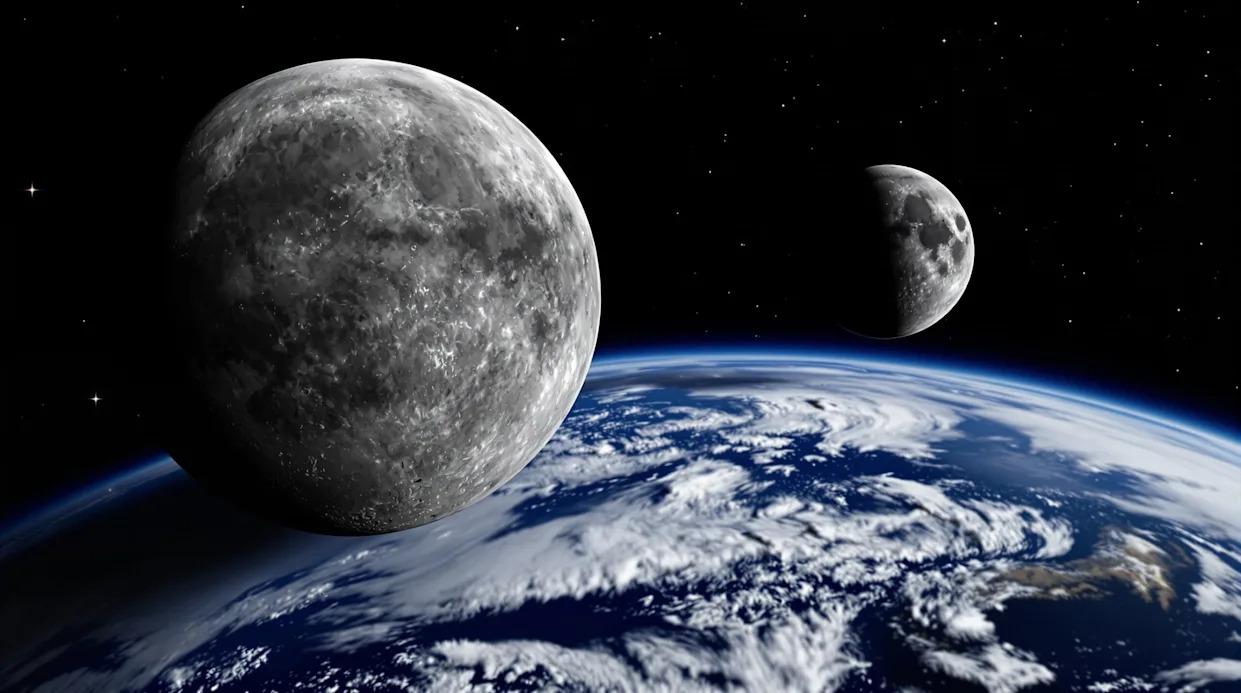
Look up at the night sky as it is now, and the Moon feels familiar, almost comforting. It has been our silent companion for as long as human memory stretches, shaping myths, calendars, tides, and emotions. Now imagine that same sky, but instead of one glowing orb, there are two. Two moons rising at different times, casting overlapping shadows, sometimes chasing each other across the darkness, sometimes standing apart like distant siblings. This is not just a poetic fantasy. It is a question that reaches deep into physics, astronomy, geology, biology, and even human culture. What if Earth had two moons instead of one?
This question is not as simple as adding an extra object to the sky. A second moon would reshape Earth in profound ways. It would alter gravity’s subtle balance, rewrite the rhythms of oceans and life, and transform how humans understand time, seasons, and the cosmos. To imagine such a world accurately, we must take physics seriously, respect celestial mechanics, and follow the consequences wherever they lead, even when they become strange or unsettling.
How Moons Exist and Why Earth Has One
To understand what two moons would mean, we must first understand why Earth has one moon at all. Moons do not simply appear. They are the products of cosmic accidents, gravitational captures, and violent collisions. Earth’s current Moon likely formed from debris after a massive impact early in the planet’s history. Over time, gravity gathered that debris into a single large satellite rather than several smaller ones.
The stability of a moon’s orbit depends on a delicate gravitational balance between the planet, the moon, and the Sun. Too close, and a moon can be torn apart by tidal forces. Too far, and it can drift away or be captured by the Sun’s gravity instead. Earth’s Moon occupies a sweet spot where it remains stable over billions of years.
For Earth to have two moons, nature would have needed to follow a different path. Perhaps the debris from the ancient collision formed two large bodies instead of one. Perhaps Earth captured an additional moon later. Or perhaps one moon formed while another was captured from elsewhere in the solar system. Each possibility comes with consequences, because gravity never acts in isolation.
The Dance of Gravity with Two Moons
Gravity is not just a force; it is a relationship. With one moon, Earth and the Moon orbit a shared center of mass. With two moons, that relationship becomes a complex dance involving three bodies pulling on one another continuously. This is where physics becomes both beautiful and unforgiving.
If Earth had two moons of significant size, their orbits would need to be stable. Stability is not guaranteed. The moons would tug on each other, exchanging energy and altering their paths over time. Depending on their masses and distances, one moon could slowly spiral outward while the other moved inward, or their orbits could become chaotic, eventually leading to a collision or ejection.
For long-term stability, the moons would likely need to be separated by large distances, or one would need to be much smaller than the other. A large primary moon, similar to our current Moon, and a smaller secondary moon could coexist more easily. Even then, their gravitational interactions would subtly affect Earth itself.
A World of Altered Tides
One of the most immediate and dramatic effects of a second moon would be on Earth’s tides. Today, tides are driven primarily by the gravitational pull of the Moon, with the Sun playing a secondary role. The Moon’s gravity stretches Earth’s oceans, creating two tidal bulges that rotate with the planet.
With two moons, tidal patterns would become far more complex. Each moon would raise its own set of tides, and these tidal forces would sometimes reinforce each other and sometimes interfere. Coastal regions could experience stronger tides at certain times and weaker ones at others. In some scenarios, tides might rise higher than anything seen today, reshaping coastlines and influencing erosion on a massive scale.
Tides are not just about water levels. They influence ocean currents, nutrient mixing, and marine ecosystems. A two-moon Earth would have oceans with different rhythms, potentially changing the distribution of life in the seas. The timing of tides could become less predictable, affecting organisms that rely on lunar cycles to breed or migrate.
The Slowing of Earth’s Rotation
Our Moon is gradually slowing Earth’s rotation through tidal friction. As tides move across the ocean floor, they dissipate energy, transferring angular momentum from Earth’s rotation to the Moon’s orbit. This is why days slowly grow longer over geological time.
With two moons, this effect would be stronger. More tidal interaction means more energy loss. Earth’s rotation could slow more quickly, leading to longer days earlier in the planet’s history. This would have consequences for climate, atmospheric circulation, and biological rhythms.
Longer days mean longer periods of sunlight and darkness. This could influence temperature extremes, weather patterns, and even the evolution of life. Plants and animals evolve in response to daily cycles, and altering those cycles could push evolution along different paths.
Nights Bathed in Double Moonlight
Beyond the physics, imagine the emotional experience of a two-moon sky. Night would rarely be truly dark. When both moons were visible, their combined light could rival twilight, casting clear shadows and illuminating landscapes with an eerie glow.
The phases of two moons would create endlessly changing patterns. Sometimes both would be full, dominating the sky with brilliance. Other times one might be full while the other was a thin crescent, or one might be invisible entirely. The visual complexity would be mesmerizing and deeply influential on human imagination.
Moonlight affects behavior. Many animals are sensitive to lunar brightness, altering activity patterns to avoid predators or hunt more effectively. Humans, too, respond emotionally to moonlit nights. With two moons, those emotional and biological responses could be amplified or altered in unpredictable ways.
Calendars, Time, and Human Culture
The Moon has shaped human culture since the dawn of civilization. Months are based on lunar cycles. Festivals, religious observances, and agricultural practices often follow the Moon’s phases. With two moons, timekeeping would be far more complex.
Which moon would define the month? Would cultures choose one and ignore the other, or would they develop intricate calendars tracking both? Different societies might prioritize different moons, leading to cultural divergence in how time is understood and measured.
Mythology would flourish in a two-moon world. One moon might be seen as benevolent, the other as dangerous. Stories would emerge to explain their relationship, their meetings in the sky, and their occasional separations. Art, poetry, and religion would be shaped by the ever-changing dance overhead.
The Sky as a Classroom for Physics
A two-moon Earth would make celestial mechanics visible to the naked eye in ways that are subtle today. The changing positions of the moons relative to each other would reveal orbital resonances and gravitational interactions over human timescales.
Eclipses would become far more frequent and varied. Moons could eclipse each other. One moon could eclipse the Sun while the other hovered nearby. These events would be spectacular and scientifically rich, offering constant reminders that Earth is part of a dynamic cosmic system.
For early scientists, such a sky might accelerate understanding of gravity and motion. Observing complex lunar behavior could inspire deeper questions and earlier breakthroughs in astronomy and physics.
Geological Consequences on Earth
Tidal forces do not stop at the oceans. They also flex Earth’s crust. Today, the Moon causes subtle tidal bulges in the solid Earth itself. With two moons, this flexing would be stronger and more complex.
Increased tidal stress could influence geological activity. Earthquakes and volcanic activity might be affected, not directly caused, but subtly modulated by lunar alignments. Over long periods, this could shape mountain-building processes and the formation of certain geological features.
Coastlines would be different. Stronger and more variable tides would carve landscapes in unique ways. Estuaries, tidal flats, and coastal ecosystems could be more extensive or more volatile, influencing the evolution of life in these regions.
Life Under Two Moons
Life on Earth evolved under the influence of one moon. Its gravitational pull stabilized Earth’s axial tilt, keeping climate relatively stable over long periods. With two moons, this stabilization could be stronger or weaker, depending on their configuration.
If the moons worked together to stabilize Earth’s tilt, climate might be even more stable, potentially supporting long-term ecological balance. If they interfered, Earth’s tilt could vary more dramatically, leading to extreme climate shifts that challenge life.
Biological rhythms tied to lunar cycles would adapt. Some organisms might synchronize with one moon, others with the second. This could create new ecological niches and complex interactions between species.
Human sleep, behavior, and psychology might also be affected. Even today, moonlight and lunar cycles subtly influence human behavior. Two moons could amplify these effects, shaping culture in ways difficult to predict.
The Fate of the Moons Themselves
Moons are not eternal. Over long timescales, gravitational interactions change orbits. Our current Moon is slowly drifting away from Earth. With two moons, the long-term evolution becomes more uncertain.
One moon might eventually escape Earth’s gravity, becoming a wandering object in space. Another might spiral inward, eventually breaking apart and forming rings, or even impacting Earth in a distant future. Such events would be rare on human timescales but inevitable over billions of years.
This impermanence reminds us that celestial systems are dynamic. Stability is often temporary, even on cosmic scales. A two-moon Earth would highlight this truth more dramatically than our current, seemingly serene sky.
The Psychological Impact of a Crowded Sky
Humans are deeply influenced by their environment, and the sky is no exception. A second moon would constantly remind humanity that the universe is more complex than it appears. The sky would feel alive with motion and change.
This could inspire awe, humility, and curiosity. It could also evoke anxiety. Ancient humans might see omens in unusual lunar alignments, attributing meaning to every meeting or separation of the moons.
Over time, science might replace superstition, but the emotional impact would remain. The sky would never feel static or predictable. It would demand attention, inviting contemplation night after night.
A Different Path for Science and Exploration
If Earth had two moons, humanity’s journey into space might unfold differently. Which moon would be visited first? Would one be more accessible than the other? Would their differing gravitational environments offer unique opportunities for science and exploration?
Studying two moons up close would provide invaluable insights into planetary formation and dynamics. Comparing their compositions, histories, and interactions could deepen understanding of how moons form and evolve.
A two-moon system might even make space travel easier in certain respects, offering multiple stepping stones for exploration beyond Earth.
The Fragility of Balance
Perhaps the most important lesson of imagining two moons is an appreciation for balance. Earth’s current configuration is not inevitable. It is the result of chance events and delicate gravitational relationships.
A second moon could make Earth more dynamic, more dramatic, and perhaps more dangerous. Stronger tides, altered climate patterns, and long-term orbital instability could challenge life’s persistence.
At the same time, it could make Earth more beautiful, more inspiring, and more intellectually stimulating. The same forces that create risk also create wonder.
A Universe That Could Have Been
Imagining Earth with two moons is not just a scientific exercise. It is a meditation on contingency. The universe did not have to be the way it is. Small differences in early conditions could have led to a very different sky, a different Earth, and a different humanity.
Physics allows us to explore these alternate possibilities with rigor and imagination. It shows us that reality is shaped by laws, but also by chance. The path that led to one moon instead of two was not preordained.
Living with Two Moons
If humans lived under two moons, they would adapt, as they always do. Culture, science, and technology would evolve in response to the environment. What seems strange to us would feel natural to them.
Children would grow up naming both moons, learning their phases, watching their interactions with fascination rather than surprise. Poets would write of double moonrises. Scientists would calculate orbits as casually as we track the phases of one moon today.
The sky would still inspire questions. Curiosity would remain. Wonder would persist. The presence of two moons would not diminish the mystery of the universe; it would deepen it.
The Singular Beauty of Our Real Moon
In the end, imagining two moons brings us back to appreciation for the one we have. Our Moon is not just a random satellite. It is a stabilizer, a timekeeper, a sculptor of tides, and a source of inspiration.
A second moon would change everything, not necessarily for better or worse, but profoundly. The fact that Earth has one moon is part of what makes our planet the way it is.
Physics teaches us that every configuration has consequences. There is no such thing as a simple change. Add one moon, and the entire story of Earth shifts.
A Final Look at the Sky
The question of two moons invites us to look upward with fresh eyes. It reminds us that the familiar sky we take for granted is the result of deep physical laws and ancient events. It encourages humility, curiosity, and gratitude.
Whether one moon or two, the sky remains a mirror of our desire to understand. Physics gives us the tools to explore these possibilities, but it also leaves room for wonder.
As we stand beneath our single moon tonight, we can imagine another glowing beside it and feel the thrill of realizing how different, and how fragile, our world truly is.