Inside every living cell lies a vast, silent library. Shelves of DNA stretch endlessly, packed with instructions written in a chemical alphabet older than humanity itself. Yet this library is never read all at once. Cells are selective readers. They open only the pages they need, copy just the relevant passages, and close the rest again. The act of copying is called transcription, and without it, life would grind to a halt.
For decades, scientists have known how transcription works in principle. They understood that a molecular machine called RNA polymerase II moves along DNA, reading genes and turning them into RNA, which then guides the production of proteins. What they could not do was watch this process as it happened inside a living body. Transcription was something frozen in time, captured only after stopping cells and chemically treating them. It was like studying a city by looking at photographs taken after everyone had gone home.
That limitation has now been broken. In a world-first achievement, researchers have created a living mouse in which gene activity can be seen directly, glowing softly inside cells as transcription unfolds in real time.
The Hidden Signature of Active Genes
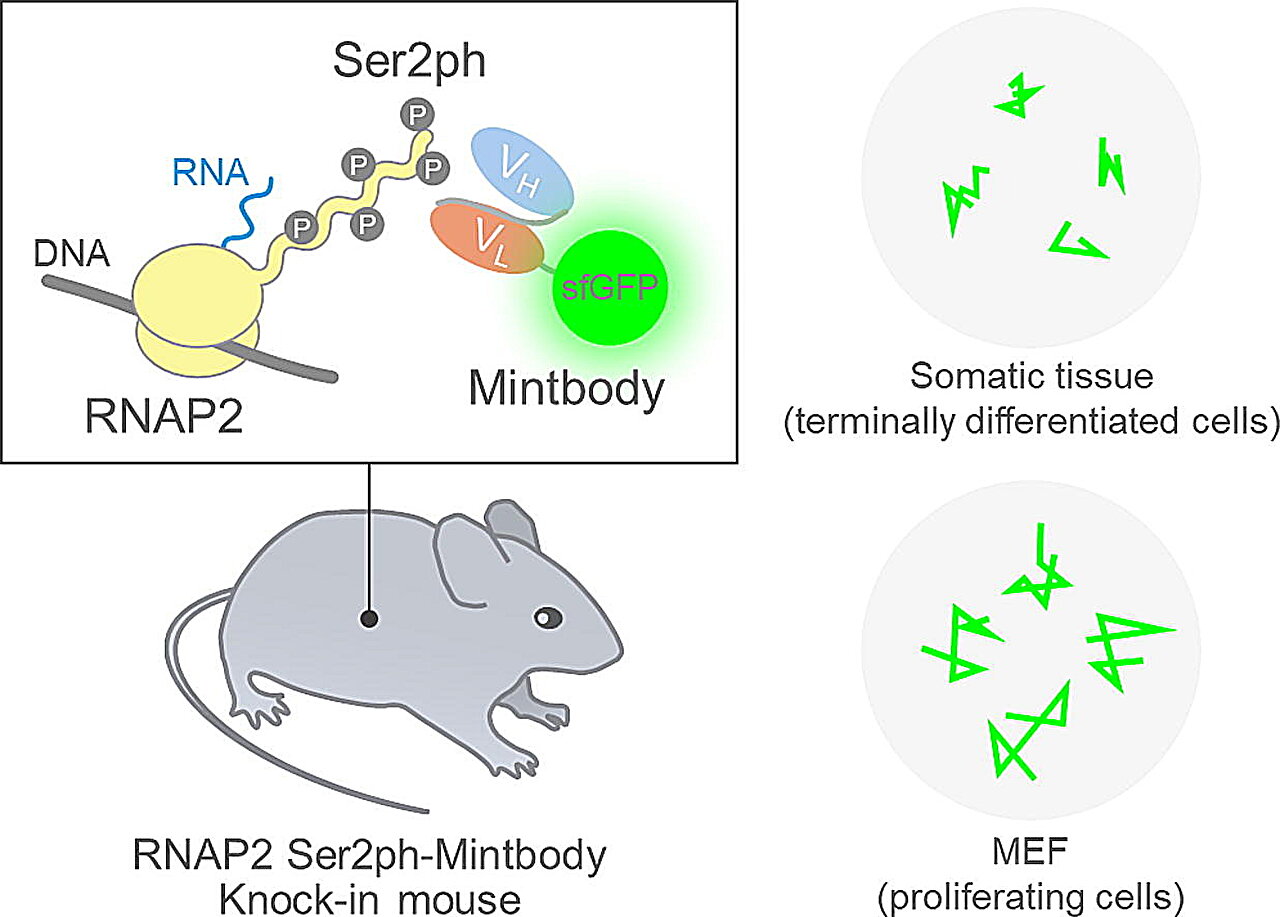
RNA polymerase II does not work quietly. When it starts transcribing DNA, a specific location on its tail, known as Ser2, receives a tiny chemical tag called a phosphate. This tag is not decoration. It is a clear signal that transcription is actively underway.
For scientists, that phosphate is like a flashing sign saying “genes at work.” But until now, the only way to see it was to halt all cellular activity and apply chemical treatments that reveal the phosphate after the fact. Living cells could not be watched while they were alive and functioning. The motion, rhythm, and variation of transcription remained invisible.
This posed a fundamental problem. Transcription is dynamic. It changes from moment to moment, from cell to cell, and from tissue to tissue. Freezing cells erased that living complexity. Researchers could never be sure how closely their snapshots matched reality.
Choosing Motion Over Stillness
At the Institute of Science Tokyo, Professor Hiroshi Kimura and his team decided to abandon the snapshot approach entirely. Instead of stopping time, they wanted to follow it.
Their solution centered on a clever molecular tool called a mintbody. A mintbody is a fluorescent protein engineered from an antibody that binds very specifically to the phosphate that marks Ser2 on RNA polymerase II. When transcription is active, the mintbody attaches itself to the phosphate and emits light.
The idea was simple but bold. If a living organism could be made to produce this mintbody in all its cells, transcription could be seen directly as glowing signals, without stopping life in its tracks.
Turning that idea into reality required creating a mouse that expresses the mintbody throughout its entire body. When Professor Kimura and his colleagues succeeded, they achieved something no one had done before. They made gene activity visible inside a living animal.
A Living Body Lit From Within
When the researchers looked inside this mintbody mouse, the effect was striking. Inside the nucleus of nearly every cell, they saw light. Hundreds to thousands of tiny glowing dots flickered into view, each one representing an RNA polymerase II molecule actively transcribing DNA.
The glow was not confined to one organ or system. It appeared in the brain, liver, kidneys, and many other tissues. Transcription, it became clear, is not an occasional event. It is constant, widespread, and relentless, like countless lights turning on and off in a vast city at night.
Yet the light was not uniform. Different cells told different stories through their brightness.
Immune Cells With Very Different Voices
Among immune cells, the contrasts were especially vivid. T cells, which play a central role in defending the body against viruses and abnormal cells, glowed intensely. Their nuclei were crowded with bright signals, indicating a high level of transcriptional activity.
Nearby, neutrophils, another type of immune cell, told a quieter story. Their glowing spots were far fewer. The difference was not random. It reflected how actively each cell type uses genetic information to fulfill its role.
This was one of the first times scientists could see such differences directly inside living tissues. The mintbody mouse did not just confirm that cells behave differently. It showed exactly how those differences play out at the level of gene activity.
The Restless Energy of Growing Cells
The glow also revealed how transcription changes over time. In developing and differentiating cells, the signals were dynamic and intense. These cells are in flux, building new identities and functions, and their genes are constantly being turned on and off.
In contrast, fully mature cells displayed a steadier pattern. Their transcriptional activity was more stable, reflecting their settled roles in the body.
One of the most dramatic examples came from observations in the testes. As cells progressed toward becoming sperm, the researchers could follow transcription step by step. Eventually, they reached a stage where transcription nearly stopped altogether. Watching this transition unfold in living tissue offered a rare, continuous view of a process that had previously been inferred only indirectly.
Seeing Diversity Where Uniformity Was Assumed
Until now, much of what scientists knew about transcription came from studies of cultured cells grown in laboratory dishes. These systems are valuable, but they lack the complexity of real tissues inside a living body.
The mintbody mouse revealed just how diverse transcription truly is. Even cells that appear similar under a microscope can behave very differently when it comes to gene activity. Tissues are not uniform fields of identical behavior. They are mosaics of activity, with each cell contributing its own rhythm to the whole.
Professor Kimura noted that transcription in living tissues turned out to be far more varied than expected. This diversity had been hidden in plain sight, simply because no one had been able to look directly before.
Why Watching Genes at Work Changes Everything
This breakthrough matters because transcription sits at the heart of biology. It links DNA to everything a cell does. By making transcription visible in a living organism, the mintbody mouse transforms an abstract process into something concrete and observable.
With this tool, researchers can begin to explore how transcription behaves in development, cell differentiation, and other fundamental processes as they happen. They can watch how gene activity shifts from one state to another, rather than guessing based on before-and-after snapshots.
The approach also opens doors to studying disease. By combining the mintbody mouse with disease models, scientists can directly compare transcription in healthy and diseased cells. Changes that were once subtle or hidden may become obvious when seen as patterns of light.
There are practical implications as well. Because transcription responds to many treatments, this technology offers a new way to observe how drugs influence gene activity inside living tissues. That could support research in areas such as drug discovery and immunology, where understanding gene regulation is crucial.
Most of all, this work changes how we relate to the inner life of cells. Genes are no longer just lines of code locked inside DNA. They are active participants in a living drama, switching on and off, glowing briefly, then fading again. Thanks to the mintbody mouse, that drama is no longer hidden. It is visible, dynamic, and unfolding in real time, offering scientists a clearer view than ever before of how life truly works.
Study Details
Chihiro Matsuda et al, Organization and Dynamics of Transcription Elongation Foci in Mouse Tissues, Journal of Molecular Biology (2026). DOI: 10.1016/j.jmb.2025.169395