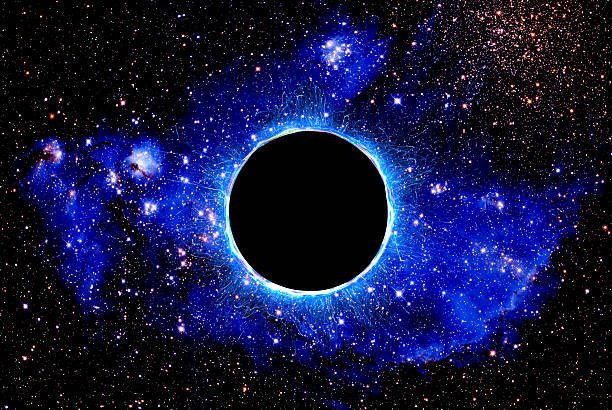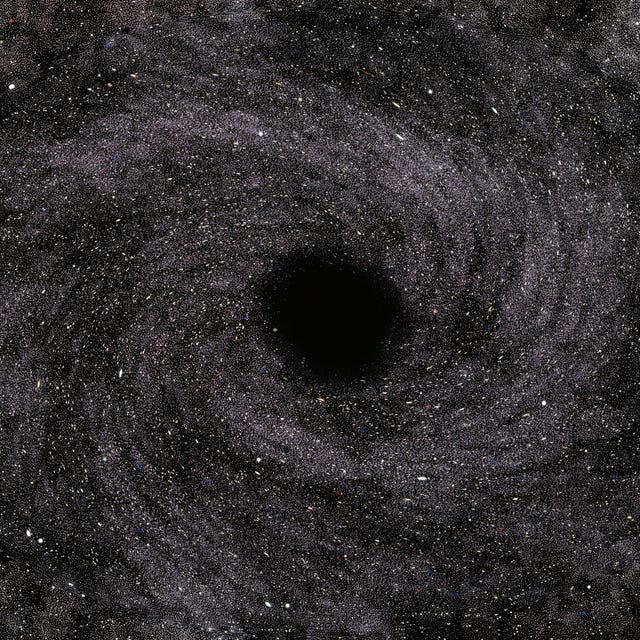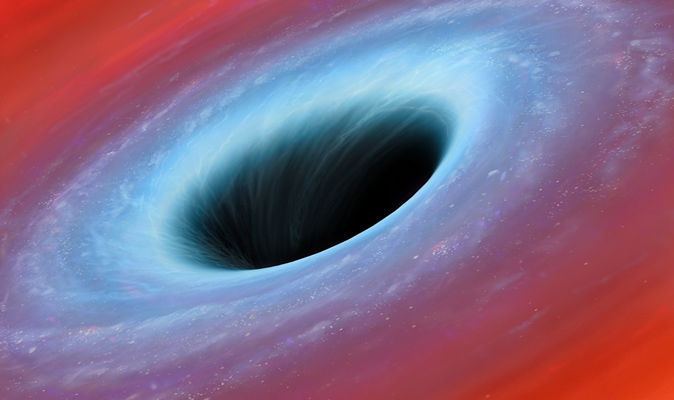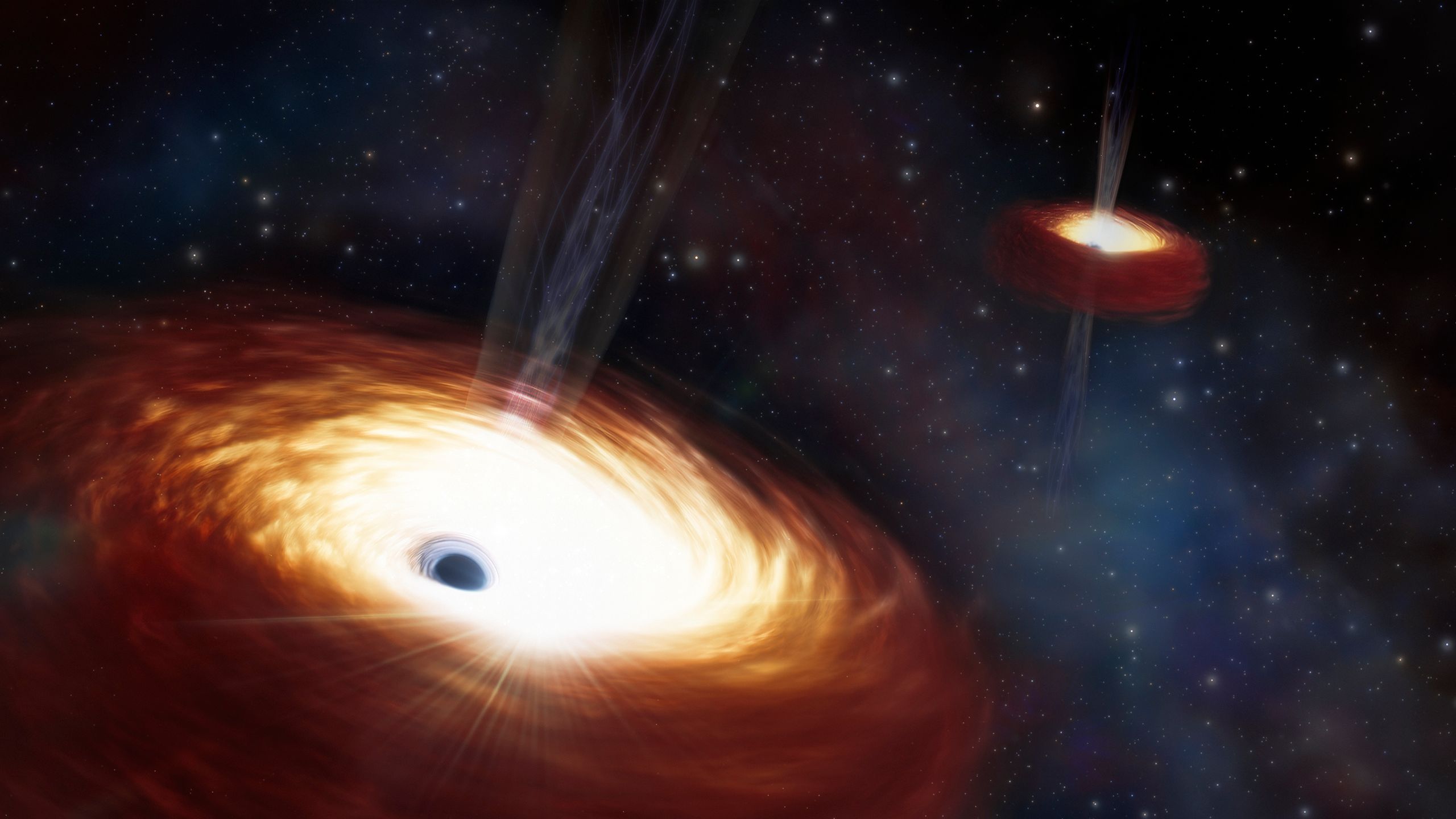
Black holes have become the monsters of modern imagination. They are the villains of science documentaries, the nightmare fuel of space movies, and the ultimate symbol of cosmic doom. Mention the words “black hole” and most people picture a swirling whirlpool in space, sucking in stars, planets, and entire galaxies like a hungry god.
That image is dramatic, but it isn’t the most terrifying part of black holes. In fact, it isn’t even accurate in the way most people think. Black holes are not cosmic vacuum cleaners roaming the universe, devouring everything in sight. They do not lurk like predators waiting to swallow the Earth whole. Most black holes are quiet, invisible objects that can sit in space for billions of years without harming anything at all.
The truth is far stranger. Black holes are terrifying not because they are violent in the way we imagine, but because they expose something much deeper and more unsettling: the limits of reality itself.
The most terrifying thing about black holes is not that they can kill you. The most terrifying thing is what they reveal about the universe, about time, and about the very idea of understanding.
What a Black Hole Really Is
A black hole is a region of space where gravity is so intense that nothing—not even light—can escape once it crosses a certain boundary. That boundary is called the event horizon.
The event horizon is not a physical surface like the crust of a planet. It is more like a point of no return. Once an object crosses it, the paths through spacetime that lead outward no longer exist. All possible future directions point inward.
This idea is difficult to grasp because it is not just about force. It is about geometry. In Einstein’s general theory of relativity, gravity is not simply a pull. Gravity is the bending of spacetime itself. A black hole is what happens when spacetime becomes curved so steeply that escape becomes impossible.
At the center of a black hole, according to classical general relativity, lies a singularity—a point where density becomes infinite and the known laws of physics break down.
That breakdown is where the real terror begins.
The Popular Fear: “It Will Suck Everything In”
The most common fear about black holes is that they pull everything toward them like an unstoppable cosmic vacuum. People imagine a black hole appearing near Earth and instantly swallowing the planet, the Sun, and the entire solar system.
But black holes do not behave like magical drains in space. They obey the same gravitational rules as any other object of the same mass. If the Sun were magically replaced by a black hole of equal mass, Earth would not suddenly be sucked in. Our planet would continue orbiting as it does now, because the gravitational pull at Earth’s distance would remain the same.
What makes black holes dangerous is not that their gravity is special at long distances. What makes them dangerous is how concentrated their mass is.
If you get close enough, the gravitational field becomes extreme. But from far away, a black hole can be gravitationally indistinguishable from an ordinary star.
This means the terrifying part is not some unavoidable cosmic suction. The universe is not full of black holes hunting you down. Most of them are quiet, distant, and invisible.
So if black holes are not the universe’s vacuum cleaners, what is truly frightening about them?
The True Horror: Black Holes Break Reality
The most terrifying thing about black holes is that they are places where physics becomes incomplete.
Science has achieved extraordinary success. We can predict eclipses centuries in advance. We can measure the age of the universe. We can build machines that detect gravitational waves from colliding black holes billions of light-years away. Physics is, in many ways, the most successful intellectual tool humans have ever created.
But black holes expose a crack in that tool.
At the core of a black hole, general relativity predicts a singularity. A singularity is not merely an object with strong gravity. It is a point where curvature becomes infinite, where the equations produce nonsense, and where the normal rules of space and time stop working.
When a theory predicts infinity, it usually means the theory is being pushed beyond its valid range. It is like a map that works perfectly for a continent but becomes useless at the edge of the page. The singularity is the edge of the page.
And the most unsettling part is that we cannot simply ignore it, because singularities are not mathematical curiosities. Black holes appear to be real. They exist in the universe, and they form naturally.
So nature itself contains regions where our best understanding fails.
That is terrifying in a way no monster movie can capture. It means the universe contains places where the laws we rely on collapse, where prediction becomes impossible, and where the concept of “knowing” hits a wall.
Black holes are not just dangerous objects. They are reality’s blind spots.
The Event Horizon: The Universe’s Most Absolute Barrier
The event horizon is perhaps the most eerie boundary in all of physics. It is not simply the edge of a black hole. It is the boundary of communication.
If you cross an event horizon, you cannot send a message back out. No signal can escape. No warning, no scream, no information, no light.
To the outside universe, anything that falls in appears to slow down as it approaches the horizon. Its light becomes redshifted, stretched into longer wavelengths until it fades away. In a sense, the object never appears to cross the horizon. It freezes and dims, becoming ghostlike.
But from the perspective of the falling object, something else happens. It crosses the horizon in finite time, without necessarily noticing anything special at that exact moment, especially if the black hole is massive enough. The event horizon itself is not a solid wall. It is a boundary defined by spacetime’s geometry.
This creates one of the strangest truths in modern science: two observers can disagree about whether something has fallen into a black hole, and both can be correct within their own frames of reference.
Reality becomes perspective-dependent.
This is not a philosophical metaphor. It is physics.
The event horizon is terrifying because it marks the place where the universe becomes fundamentally inaccessible. It is the ultimate censorship line. Beyond it, the universe continues, but the outside world can never know what happens there.
Time Becomes a Trap
The phrase “time dilation” is often used casually, as if it simply means time moves slower near strong gravity. But near a black hole, time dilation becomes something far more disturbing. It becomes a kind of cosmic trap.
In everyday life, you can choose where to go. You can move forward, backward, left, right. You can decide your path.
But near the event horizon, spacetime becomes so warped that time and space exchange roles in a frightening way. In simple terms, moving inward becomes as inevitable as moving into the future.
Outside a black hole, you can choose not to go forward in space, but you cannot choose not to go forward in time. Time is unavoidable. It is the one direction you must travel.
Inside the event horizon, inward motion toward the singularity becomes unavoidable in the same way. You can no more stop yourself from moving inward than you can stop yourself from moving toward tomorrow.
This is not because of a strong pull that you could resist with engines. It is because the structure of spacetime itself forces your future to end at the center.
The black hole does not merely pull you in. It rewrites what “future” means.
That is not just terrifying. It is existentially horrifying. It means there are regions of the universe where destiny is not a poetic idea, but a geometric fact.
Spaghettification: A Real and Violent Death
Of course, black holes can kill you, and they can do it in a way that sounds like science fiction but is physically real.
As you approach a black hole, gravity becomes stronger. But more importantly, gravity becomes uneven. The side of your body closer to the black hole feels a stronger gravitational pull than the side farther away. This difference is called a tidal force.
Tidal forces stretch objects. They are why Earth’s oceans experience tides due to the Moon. But near a black hole, tidal forces become unimaginably extreme.
If you fall feet-first toward a stellar-mass black hole, the gravity at your feet could become drastically stronger than the gravity at your head. The result is that you would be stretched vertically and compressed sideways. Your body would be pulled into a long thin shape.
Physicists call this spaghettification.
It is not a metaphor. It is a real process predicted by general relativity. The stretching would become lethal long before you reached the event horizon in a smaller black hole.
However, for supermassive black holes, like the one at the center of the Milky Way, the event horizon is much larger, and the tidal forces at the horizon are much weaker. In theory, you could cross the event horizon of a supermassive black hole without being immediately torn apart.
But that is not comforting. That means you could survive long enough to realize what has happened.
And you would still be unable to escape.
The Most Disturbing Idea: You Might Never Truly “Fall In”
Black holes create an eerie conflict between observation and reality.
From the viewpoint of an outside observer watching you fall, you never quite cross the event horizon. Your clock appears to slow down. Your movements become sluggish. Your image becomes dimmer and redder. Eventually you fade away, frozen at the edge.
From your own viewpoint, you fall in normally and cross the horizon without noticing anything dramatic. The outside universe, meanwhile, continues accelerating forward in time. Light from distant stars would appear increasingly blueshifted, potentially flooding your vision with intense radiation as the universe ages rapidly in your frame.
This disagreement is not simply about perception. It is a real consequence of relativity.
The terrifying part is that black holes make it unclear what it means for something to “happen.” Did you fall in or not? To you, yes. To the outside universe, you are forever suspended at the horizon.
This hints at something deeply unsettling: reality is not one unified story told the same way everywhere. It depends on where you are and how you move.
Black holes force us to confront the possibility that “objective reality,” at least as we intuitively imagine it, is not as simple as we thought.
Information Loss: The Black Hole Paradox
Here is where the true cosmic nightmare emerges—not the death of the body, but the death of meaning.
In physics, information is sacred. Information is not just data on a hard drive. It is the complete description of a physical system. If you know the information about particles in a system, you can in principle predict the system’s future.
Quantum mechanics insists that information cannot be destroyed. The laws governing particles are reversible in time at the fundamental level. If you know the present perfectly, the past can be reconstructed.
But black holes appear to destroy information.
If you throw a book into a black hole, it is gone forever. The black hole eventually evaporates through a process known as Hawking radiation, slowly losing mass over unimaginable timescales. But Hawking radiation seems to be random, containing no trace of what fell in.
If the black hole evaporates completely, where did the information about the book go?
If the information is destroyed, quantum mechanics is violated. If the information is preserved, then something about black holes must be very different from what general relativity predicts.
This conflict is known as the black hole information paradox. It is not a small technical problem. It is one of the deepest puzzles in modern physics because it suggests that two of our most successful theories—general relativity and quantum mechanics—cannot both be completely correct in the same situation.
That is terrifying because it implies our understanding of the universe is fundamentally fractured.
Black holes are not merely objects in space. They are battlegrounds where the laws of reality fight each other.
Hawking Radiation: The Slow Ghost Fire of a Black Hole
One of the strangest discoveries in physics is that black holes are not truly black.
In the 1970s, Stephen Hawking showed that quantum effects near the event horizon allow black holes to emit radiation. This happens because quantum fields in empty space can produce particle-antiparticle pairs. Normally, these pairs annihilate almost instantly. But near the event horizon, one particle can fall in while the other escapes.
To an outside observer, it looks like the black hole is radiating energy.
This radiation carries away mass. Over time, the black hole shrinks. Given enough time, it could evaporate entirely.
This is an unsettling idea. Black holes, once thought eternal, are actually temporary. They are slowly dissolving, leaking energy into the universe like embers fading in the dark.
But Hawking radiation deepens the terror rather than relieving it. If black holes evaporate, then everything they swallowed might be erased from existence.
Every star, every planet, every human, every memory—reduced to featureless radiation.
That is not simply death. It is obliteration at the level of cosmic history.
The Universe’s Ultimate Eraser
A black hole does not just kill. It deletes.
If you fall into a black hole, you are not merely destroyed physically. Your structure, your atoms, your arrangement, your identity—all of it becomes inaccessible to the outside universe.
Even if information is somehow preserved in subtle ways, black holes still behave like cosmic shredders. They break matter down into its most fundamental components. They remove complexity. They reduce everything into a simpler state.
This is what makes them horrifying on a deeper level than explosions or collisions. An asteroid impact is violent, but it leaves evidence. A star exploding spreads its material outward, enriching the cosmos.
A black hole consumes and hides.
It is a one-way door in the universe.
And in a universe where so much is about transformation and recycling, black holes represent something different: disappearance.
Black Holes and the Death of Time Itself
Perhaps the most chilling aspect of black holes is how they interact with time on cosmic scales.
Black holes can last for enormous lengths of time. A stellar-mass black hole might take far longer than the current age of the universe to evaporate. A supermassive black hole could persist for timescales so long they make human history seem like a blink that never happened.
In the far future, after stars burn out and galaxies fade, black holes may be among the last remaining massive objects. They will drift in darkness, slowly evaporating.
This leads to a haunting vision of the universe’s end: a cold cosmos dominated by black holes, where matter is scarce, light is rare, and time stretches endlessly.
Black holes are not just terrifying because of what they do now. They are terrifying because they may define the final era of the universe.
They are not merely monsters. They are the universe’s long-term destiny.
The Center of Galaxies: A Hidden Giant Watching Everything
Most large galaxies, including our Milky Way, have supermassive black holes at their centers. The black hole in our galaxy, Sagittarius A*, has a mass about four million times that of the Sun.
This means a gravitational monster sits at the heart of the galaxy that contains every human who has ever lived.
It does not threaten us directly. It is far too distant to pull us in. But its existence is unsettling because it reminds us that black holes are not rare. They are not exotic exceptions. They are normal products of cosmic evolution.
Galaxies form around them. Stars orbit them. Entire stellar systems dance around something invisible.
The night sky feels peaceful, but at the center of that sky is a gravity well so deep that even light cannot climb out.
Black holes are woven into the structure of the universe. They are not distant nightmares. They are part of the cosmic architecture.
The Illusion of Safety in the Laws of Nature
Human beings crave stability. We like the idea that the universe is predictable, that the laws of physics are solid, that reality behaves consistently.
Black holes challenge that comfort.
They show that even the most reliable laws can be pushed into regimes where they stop giving answers. They show that space and time are not fixed. They show that matter can collapse into forms we barely understand. They show that information itself might be threatened.
They are proof that the universe contains extreme conditions where our everyday logic fails completely.
This is the deeper terror. Not the fear of being swallowed, but the fear that the universe is not fully knowable.
Black holes are the clearest evidence that nature still holds secrets that may never be fully explained with the tools we have now.
Why Black Holes Are Not the End of the Story
It would be easy to see black holes as symbols of hopelessness—cosmic pits that swallow everything and reduce it to nothing. But physics suggests that black holes may also be keys to understanding the universe more deeply than ever before.
The clash between relativity and quantum mechanics inside black holes is one of the strongest hints that a deeper theory exists. A theory of quantum gravity, one that unifies spacetime with quantum laws, may be waiting beyond our current understanding.
Black holes may contain the clues that lead to this unification. They may reveal what spacetime is made of. They may explain why gravity exists. They may even offer insight into the origin of the universe itself, because the Big Bang also represents an extreme state of density and energy.
In a strange way, black holes are not just terrifying. They are invitations to explore the deepest structure of existence.
But exploration does not eliminate fear. It refines it.
The more we understand black holes, the more we realize that they are not simply objects. They are boundaries between what we know and what we cannot yet know.
The Most Terrifying Thing About Black Holes
So what is the most terrifying thing about black holes?
It is not that they suck everything in. They do not.
It is not that they are everywhere, lurking near Earth. They are not.
It is not even that they can tear you apart, although they can.
The most terrifying thing about black holes is that they are real places in the universe where our understanding breaks. They are regions where space becomes time, where the future points inward, where information may vanish, and where reality itself becomes unreachable.
A black hole is not merely a gravitational trap. It is an epistemological trap. It is a place where knowledge falls in and may never come back out.
That is the deeper horror: not the death of the body, but the death of certainty.
Black holes remind us that the universe is not obligated to be understandable. It does not owe us answers. And even with all our science, all our mathematics, and all our technology, there may be regions of existence forever beyond our reach.
They are not just holes in space.
They are holes in comprehension.
The Dark Beauty of the Unknown
Yet even this terror has a strange beauty.
Black holes represent the edge of what we can know, but they also represent the triumph of human curiosity. We cannot visit them, but we can detect them. We cannot see inside them, but we can measure their influence. We cannot escape their event horizons, but we can use their existence to test the deepest theories of physics.
We have watched black holes collide through gravitational waves. We have photographed the shadow of a black hole in another galaxy. We have mapped the motion of stars orbiting an invisible giant at the center of our own Milky Way.
The universe contains monsters, yes. But the universe also contains minds capable of understanding that those monsters exist.
And perhaps that is the most astonishing contrast of all.
A black hole is the most extreme expression of gravity. It is nature pushed to its limit. It is a place where the universe folds in on itself, where the normal rules collapse into something almost unimaginable.
But it is also a reminder that we are living in a universe that can be questioned.
Even if black holes represent the end of light, they also represent the beginning of deeper thought.
They are terrifying not because they are evil, but because they are honest.
They reveal what the universe truly is: vast, indifferent, mysterious, and capable of producing realities far beyond the comfort of human intuition.
In the face of that truth, the fear is natural.
But so is the wonder.