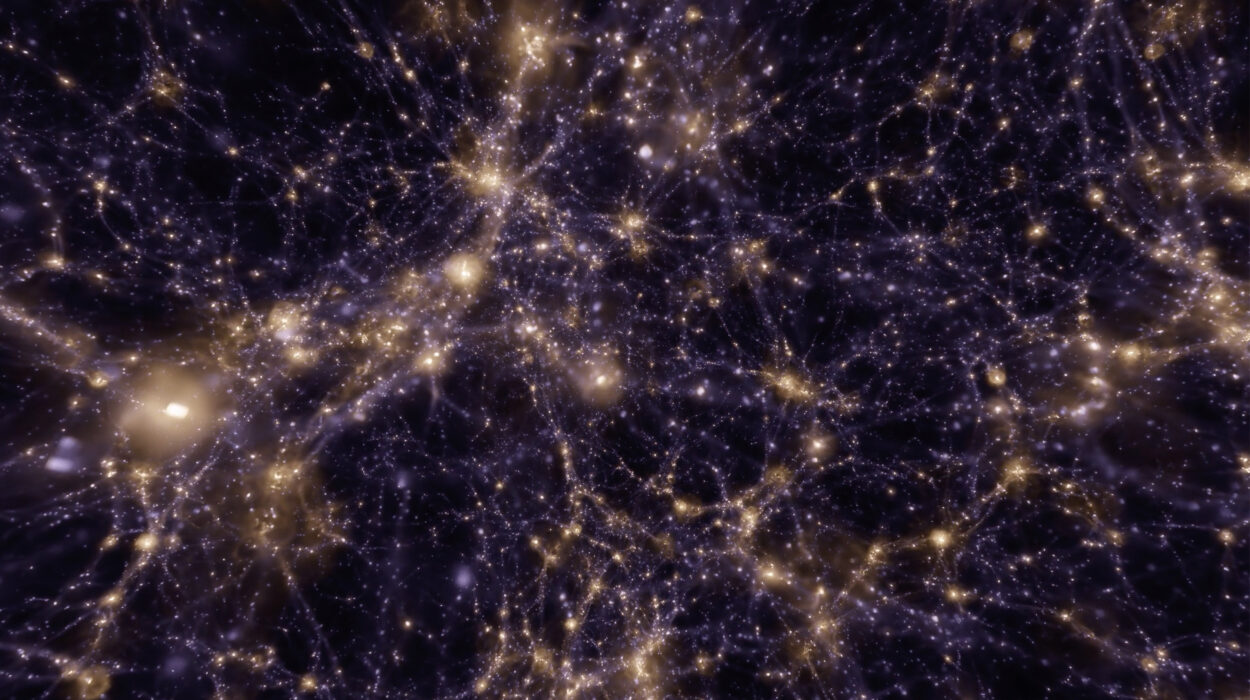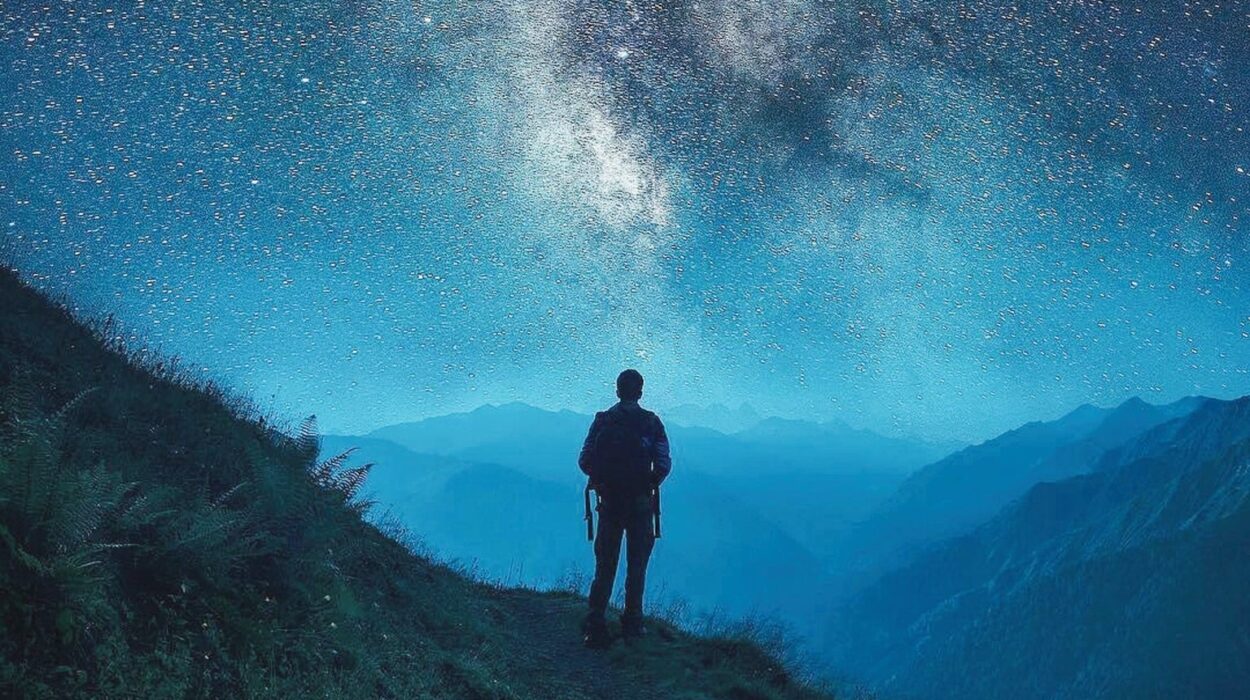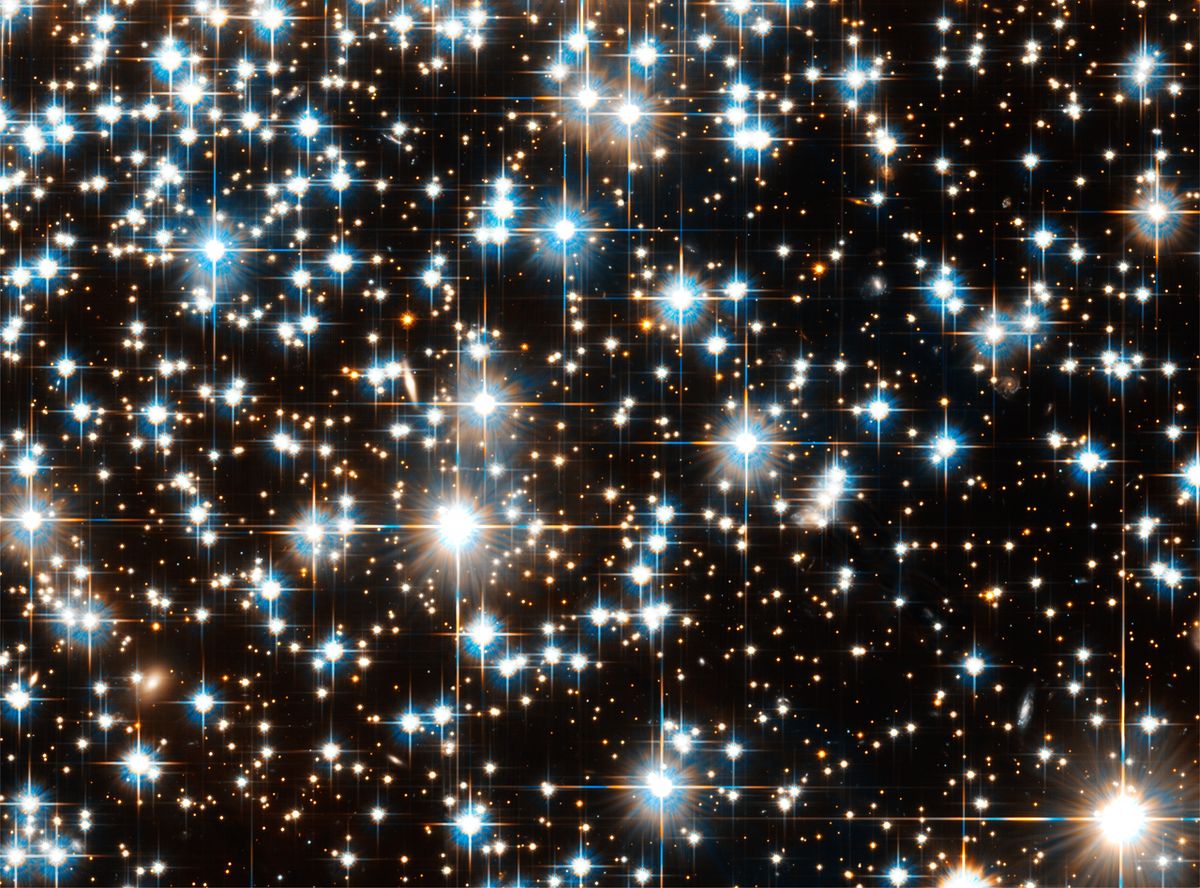
Look up at the night sky on a clear evening, far from city lights, and the question almost asks itself. The stars appear scattered endlessly, like glitter spilled across a black ocean. The Milky Way stretches like a pale river of light, and beyond it—hidden from our eyes—lie billions of other galaxies. The deeper we look, the more the universe seems to expand into infinity.
But the human mind has a strange habit: it wants boundaries. It wants walls. It wants an ending point. Somewhere deep in our imagination, we picture the universe like a giant sphere filled with galaxies, surrounded by… something. A cosmic border. A final line where space simply stops.
And so one of the most haunting questions in astronomy and physics arises: does the universe have an edge?
It sounds like a simple question, almost like asking whether Earth has an edge, as ancient civilizations once did. Yet, like that ancient question, it leads into a reality far stranger than we expect. The truth is that the universe may be finite, or it may be infinite. It may have a boundary, or it may have no boundary at all. And the answer depends on what we mean by “universe,” what we mean by “edge,” and what we mean by “space.”
To explore this question is to step into the deepest mysteries of existence itself.
What Do We Mean by “The Universe”?
Before we can ask whether the universe has an edge, we have to define what “the universe” actually is.
In everyday language, the universe means everything: all space, all time, all matter, all energy, and all the laws of physics that govern them. That is the universe in its total sense.
But in cosmology, scientists often use a more practical meaning. When astronomers talk about “the universe,” they frequently mean the observable universe: the region of space we can, in principle, detect using light, radiation, or other signals.
This distinction is critical. The observable universe is not necessarily the entire universe. It is simply the part we can see, limited by the speed of light and the age of the cosmos.
The universe is about 13.8 billion years old. Light travels at a finite speed, about 300,000 kilometers per second. That means there is a maximum distance light could have traveled since the Big Bang. Anything beyond that distance has not had enough time to send information to us.
So even if the universe continues far beyond what we can observe, it remains hidden—not because it is blocked by a wall, but because time itself has not allowed its light to reach us.
Already, the concept of an “edge” begins to blur.
The Observable Universe: A Horizon, Not a Wall
When scientists map the observable universe, they often describe it as a sphere centered on Earth, with a radius of about 46 billion light-years. This number surprises many people. If the universe is 13.8 billion years old, shouldn’t the radius be 13.8 billion light-years?
The reason it is larger is cosmic expansion. While light has been traveling toward us for 13.8 billion years, the space it traveled through has also been expanding. Galaxies that emitted that ancient light were much closer when the light began its journey, but today they are far farther away.
The boundary of the observable universe is called the cosmic horizon. It represents the farthest distance from which light has had time to reach us since the beginning of the universe.
But this horizon is not a physical edge. There is no barrier there. No wall. No sudden cliff where space ends. It is simply the limit of what we can observe right now.
If you could somehow travel beyond the cosmic horizon, you would not reach a border where the universe stops. Instead, you would still find space filled with galaxies, radiation, and matter—assuming the universe continues beyond our observable region, which most evidence strongly suggests.
The horizon is like the horizon on Earth. When you stand at the beach, you see the ocean meeting the sky at a distant line. That line looks like an edge. But it is not an edge of the ocean. It is an edge of your vision.
The observable universe is an edge of knowledge, not an edge of existence.
Why the Idea of an Edge Feels So Natural
Human beings evolved in a world of boundaries. Rivers have banks. Mountains have peaks. Oceans have shores. Even the sky appears like a dome above us. Our minds are built to interpret the world as a collection of objects with borders.
When we imagine the universe, we instinctively treat it like a giant object. And objects have edges.
But the universe is not necessarily an object in the way a planet is. The universe is not something sitting inside a larger container of space. Space itself is part of the universe. If the universe is “everything,” then there is no external space surrounding it. There is no cosmic room in which the universe is floating.
This is one of the hardest ideas to grasp: the universe does not expand into something. It expands as space itself stretches.
Trying to picture an edge of the universe is like trying to picture an edge of time. You can imagine a last moment, but what comes after? The question becomes tangled in its own assumptions.
To understand whether the universe has an edge, we need to explore what modern physics says about the shape and geometry of space.
The Shape of the Universe: Geometry on the Largest Scale
One of the most powerful tools in cosmology is geometry. Not geometry in the sense of triangles drawn on paper, but geometry in the sense of the curvature of space itself.
According to Einstein’s general theory of relativity, space and time form a unified fabric called spacetime. This fabric can be curved by matter and energy. Gravity, in Einstein’s view, is not a force pulling objects through space. It is the bending of spacetime that guides the motion of matter.
If spacetime can curve locally around planets and stars, then it can also have curvature on the largest possible scale. The entire universe may have a global shape.
Cosmologists describe three broad possibilities for the universe’s geometry.
If the universe has positive curvature, it is like the surface of a sphere. This kind of universe is finite in volume, but it has no edge. You can travel in a straight line long enough and eventually return to your starting point, just as you could on Earth.
If the universe has zero curvature, it is flat. In that case, space extends infinitely in all directions, with no edge and no curvature bending it back on itself.
If the universe has negative curvature, it is like a saddle shape. Such a universe is also infinite, expanding forever, with no boundary.
The astonishing part is that in two of these three scenarios, the universe has no edge at all. Even in the positively curved case, the universe is finite but still edge-less, because it loops back on itself.
This means the universe could be finite without having a boundary.
That statement sounds impossible at first, but it is one of the deepest lessons modern cosmology offers.
Finite Without an Edge: Understanding the Sphere Analogy
To grasp the idea of a universe that is finite but has no edge, imagine the surface of a sphere. Earth is a good example.
The surface area of Earth is finite. You could measure it and get a definite number. Yet if you walk in any direction, you never encounter an edge. There is no cliff where the surface stops. The surface wraps around.
Now, Earth’s surface is two-dimensional. It exists in three-dimensional space. But the universe may be like a three-dimensional version of that concept. Instead of a 2D surface wrapping around in 3D space, the universe could be a 3D space wrapping around in a higher-dimensional geometry.
You would not see an edge. You would not find a wall. Space would simply be self-contained.
If the universe is shaped like a three-dimensional analogue of a sphere, it would be finite in volume but limitless in travel. You could travel straight long enough and return to where you began, without ever turning around.
This possibility is not just philosophical. It is mathematically consistent with general relativity.
However, whether this is the true shape of the universe depends on measurements.
What Observations Tell Us About the Universe’s Curvature
Astronomers can measure the curvature of the universe by studying the cosmic microwave background radiation, often called the CMB. This radiation is the afterglow of the Big Bang, a faint microwave signal filling the universe in every direction. It is essentially a snapshot of the universe when it was only about 380,000 years old.
Tiny fluctuations in the CMB contain clues about the geometry of space. By analyzing how those fluctuations appear across the sky, scientists can determine whether space is curved or flat on the largest scales.
So far, observations strongly suggest that the universe is very close to flat. This does not necessarily prove it is infinite, but it suggests that if it is curved, the curvature is extremely small. A positively curved universe would have to be enormously large—so large that within our observable region it would appear almost perfectly flat.
In practical terms, this means we cannot currently determine whether the universe is infinite or merely extremely large and finite.
But we can say something with confidence: there is no evidence of an edge.
The universe does not appear to have a boundary where matter ends and nothingness begins. The laws of physics appear consistent across the observable cosmos. The distribution of galaxies looks broadly uniform at the largest scales. Everything suggests that space continues.
Expansion and the Misunderstood Idea of “The Edge”
Many people imagine that because the universe is expanding, it must be expanding into something. This leads naturally to the idea of an edge: a growing bubble with a boundary pushing outward.
But this picture is misleading.
The expansion of the universe is not like an explosion where matter moves outward into empty space. Instead, it is the stretching of space itself. The distances between galaxies increase because the fabric of space expands.
A common analogy is a balloon with dots on its surface. As the balloon inflates, the dots move farther apart. From the perspective of a dot, it appears as if all other dots are moving away. Yet none of the dots are at the center of expansion. The surface itself is expanding.
The balloon analogy has limits because the balloon’s surface exists in a larger 3D space. The universe may not require an external space at all. But it captures the key idea: expansion does not require an edge within the space itself.
If the universe is infinite, it can expand without ever developing a boundary. Every region simply becomes more distant from every other region. Space grows everywhere at once.
If the universe is finite and curved, it can expand like the surface of a balloon, still without an edge.
Either way, expansion does not imply a wall.
Could the Universe Have a Physical Boundary?
The idea of a literal boundary is not impossible in principle. Some cosmological models propose scenarios where our universe could be a “bubble” inside a larger multiverse, with other bubble universes beyond it. In such a model, the boundary between universes could be a kind of cosmic wall.
However, even in these theories, the boundary would not necessarily be something you could reach by traveling in a spaceship. Space itself might behave differently near such a boundary, and the laws of physics could become unstable or undefined.
There is also no observational evidence that we are near such a boundary. The cosmic microwave background looks remarkably uniform in all directions. If we were close to an edge, we might expect to see asymmetries or unusual patterns.
Furthermore, if the universe had a true edge where space simply ended, it would raise profound questions. What would exist beyond it? If “nothing” exists beyond it, what does “nothing” even mean? Could there be a region where time does not exist? Could physical laws stop?
Physics is built on describing how things behave in space and time. An edge where those concepts fail might be beyond physics itself.
The simplest conclusion, supported by observation, is that the universe has no physical boundary that behaves like an edge.
The Particle Horizon: The Limit of What We Can See
Even if the universe has no edge, we still face a limit: the particle horizon.
The particle horizon is the farthest distance from which light could have reached us since the beginning of the universe. This is effectively the boundary of the observable universe. Beyond it, there are regions whose light has not yet had time to arrive.
This horizon is not fixed. As time passes, the observable universe grows. Light from more distant regions has more time to reach us, expanding the sphere of what we can observe.
But there is another horizon that complicates the story: the cosmic event horizon.
The Cosmic Event Horizon: The Limit of What We Can Ever See
The universe is not just expanding. It is expanding at an accelerating rate, driven by dark energy. Because of this acceleration, there are galaxies that are currently visible to us, but whose future light will never reach us.
The cosmic event horizon is the boundary beyond which events can never influence us, even given infinite time.
This is not because light is too slow, but because the space between us and those regions is expanding too quickly. The light they emit today may be stretched and dragged by the expansion, never able to overcome the growing distance.
This leads to a haunting conclusion: parts of the universe are not only unobservable now—they are permanently unreachable.
Over trillions of years, distant galaxies will disappear from view as their light becomes too stretched and faint to detect. The universe will seem emptier. The night sky will grow darker, not because the universe has an edge, but because expansion will isolate us.
In the far future, observers in our galaxy might see only their local group of galaxies, surrounded by blackness. The evidence of the Big Bang itself may fade beyond detectability.
The universe will not have an edge, but it will have loneliness.
If the Universe Is Infinite, What Does That Really Mean?
The idea of an infinite universe is both thrilling and unsettling. Infinity is not a number. It is a concept that breaks the usual rules of imagination.
If the universe is infinite, then there is no end to space. No matter how far you travel, there is always more. The distribution of galaxies could continue endlessly. Matter could stretch forever.
In an infinite universe, something else becomes true: the number of possible arrangements of matter might be finite within any given volume, but space itself would contain infinite volumes. This raises strange implications.
In theory, if the universe is truly infinite and matter is distributed somewhat uniformly, then there could be regions of space extremely similar to ours. There could be galaxies arranged in similar patterns. There could be planets almost identical to Earth. Some physicists have argued that in an infinite universe, the repetition of patterns becomes inevitable.
However, these ideas are speculative. Infinity is difficult to handle scientifically because we cannot observe an infinite universe directly. We can only measure the part we see and infer what might lie beyond.
Still, the idea of infinity reminds us of something profound: the universe does not owe us closure. It does not need to fit inside the boundaries of human intuition.
If the Universe Is Finite, Where Is the “Outside”?
Suppose the universe is finite, like a 3D version of a sphere. Then it has a total volume. It is contained in itself. But does it exist “inside” something larger?
This question may be meaningless.
If the universe includes all of space, then there is no external space in which it sits. Asking what lies outside the universe could be like asking what lies north of the North Pole. The question assumes a direction beyond the structure of the system itself.
On Earth, “north” is defined only on the surface. At the North Pole, north ceases to exist. Similarly, “outside” might be defined only within space. If space is all there is, then “outside space” may be a contradiction.
This is not just a word game. It reflects the deep relationship between geometry and meaning. Concepts like distance and direction only make sense within space. If space itself is finite and self-contained, there is no meaningful “beyond.”
This is one of the most difficult things for the human mind to accept. We instinctively imagine a container. But the universe may not be contained.
Could We Ever Reach the Edge?
Even if the universe had some kind of boundary, reaching it might be impossible.
First, the universe is expanding. Distant galaxies are moving away from us, not because they are traveling through space, but because space is stretching. Many regions of space are receding faster than the speed of light, not violating relativity because relativity limits motion through space, not the expansion of space itself.
Second, even at the speed of light, you cannot reach the edge of the observable universe because the observable universe is not a place you can travel to in a conventional sense. It is defined by light travel time. If you move toward it, the horizon shifts.
Third, the accelerating expansion of the universe means that some regions are already beyond our ability to ever reach. Even if we built a ship traveling near light speed, we would still be trapped within a shrinking island of reachable space.
This means the “edge” is not a destination. It is a limit built into the structure of spacetime itself.
What About the Big Bang? Was It an Explosion From a Point?
A major source of confusion about the universe’s edge comes from misunderstanding the Big Bang.
Many people imagine the Big Bang as an explosion that happened at a single point in space, blasting matter outward into emptiness. If that were true, it would be natural to ask where the explosion happened, what it expanded into, and where the outer boundary is.
But the Big Bang was not an explosion in space. It was an expansion of space.
The Big Bang happened everywhere at once. Every region of the universe was once compressed into a hot, dense state. Space itself expanded from that state, and it continues to expand today.
There is no central point. There is no location where the Big Bang happened more than anywhere else. Every observer, no matter where they are in the universe, sees other galaxies moving away and can trace expansion backward to the same early cosmic conditions.
The Big Bang does not imply an edge. It implies a beginning of expansion, not a boundary of space.
The Universe and the Possibility of a Multiverse
Some of the most speculative ideas in modern physics suggest that our universe might be one of many. In inflation theory, the early universe may have expanded extremely rapidly, and this process might still be occurring in distant regions, creating “bubble universes.”
In such a scenario, the universe we inhabit could be one bubble among countless others, each with potentially different physical laws or constants. The multiverse concept is intriguing because it could explain why the laws of physics in our universe appear fine-tuned for the existence of stars, chemistry, and life.
But the multiverse remains unproven. It is difficult to test scientifically because other universes, if they exist, may be causally disconnected from ours. If no information can travel between them, then they may lie permanently beyond observation.
If the multiverse exists, the “edge” of our universe might be more like the boundary of a bubble in a vast cosmic foam. Yet even then, that boundary might not be something you could travel to or perceive directly.
The multiverse is an idea that sits at the border of science and philosophy. It is possible, but not confirmed.
The Edge Might Be a Limit of Human Understanding
When we ask whether the universe has an edge, we may be asking a question shaped by the limits of the human brain. We evolved to navigate landscapes, not to visualize curved spacetime or infinite dimensions.
There may be truths about the universe that are real but fundamentally difficult for human intuition to grasp. Just as a fish cannot imagine a world without water, we may struggle to imagine a world without spatial boundaries.
Physics gives us mathematics to go beyond intuition. The equations of general relativity allow curved spaces that have no edges. Quantum theory allows realities that behave like probabilities rather than certainties. Modern cosmology allows space to expand without expanding into anything.
The universe does not need to match the mental images we prefer.
The universe is under no obligation to be simple.
So Does the Universe Have an Edge?
The best answer science can currently provide is this: the universe almost certainly does not have an edge in the way people imagine.
The observable universe has a boundary, but it is not a physical wall. It is a horizon created by the finite speed of light and the finite age of the cosmos. Beyond it, the universe may continue, but we cannot see it.
The universe itself could be infinite, stretching endlessly. Or it could be finite but unbounded, curved back on itself like a three-dimensional version of a sphere. Current observations suggest the universe is very close to flat, which supports the idea that it is infinite or unimaginably large.
There is no evidence of a cosmic edge where space ends.
If an edge exists, it is not an edge of space, but an edge of knowledge, an edge of observability, an edge imposed by the expansion of spacetime itself.
The Strange Comfort of a Universe Without Boundaries
At first, the idea of an edge feels comforting. It gives the universe a shape we can imagine, like a room we could someday explore completely. But a boundary also feels claustrophobic, like the cosmos is just a giant box.
A universe without an edge is unsettling, but it is also strangely liberating. It means reality is not confined. It means the cosmos is not a closed cage but an open expanse, perhaps endless, perhaps curved into itself, but always without a final wall.
The universe becomes not a place with a border, but a reality that simply is.
And maybe that is the deeper lesson: the universe is not built for our convenience. It is built from laws, geometry, and time, unfolding on scales so immense that the human mind can barely hold them.
Yet we can still ask the question. We can still chase the answer. We can still look into the darkness and wonder what lies beyond what we can see.
In that sense, the universe does have an edge.
Not an edge of space, but an edge of mystery.
And every time science pushes that edge farther back, the universe grows even larger—not just in size, but in meaning.