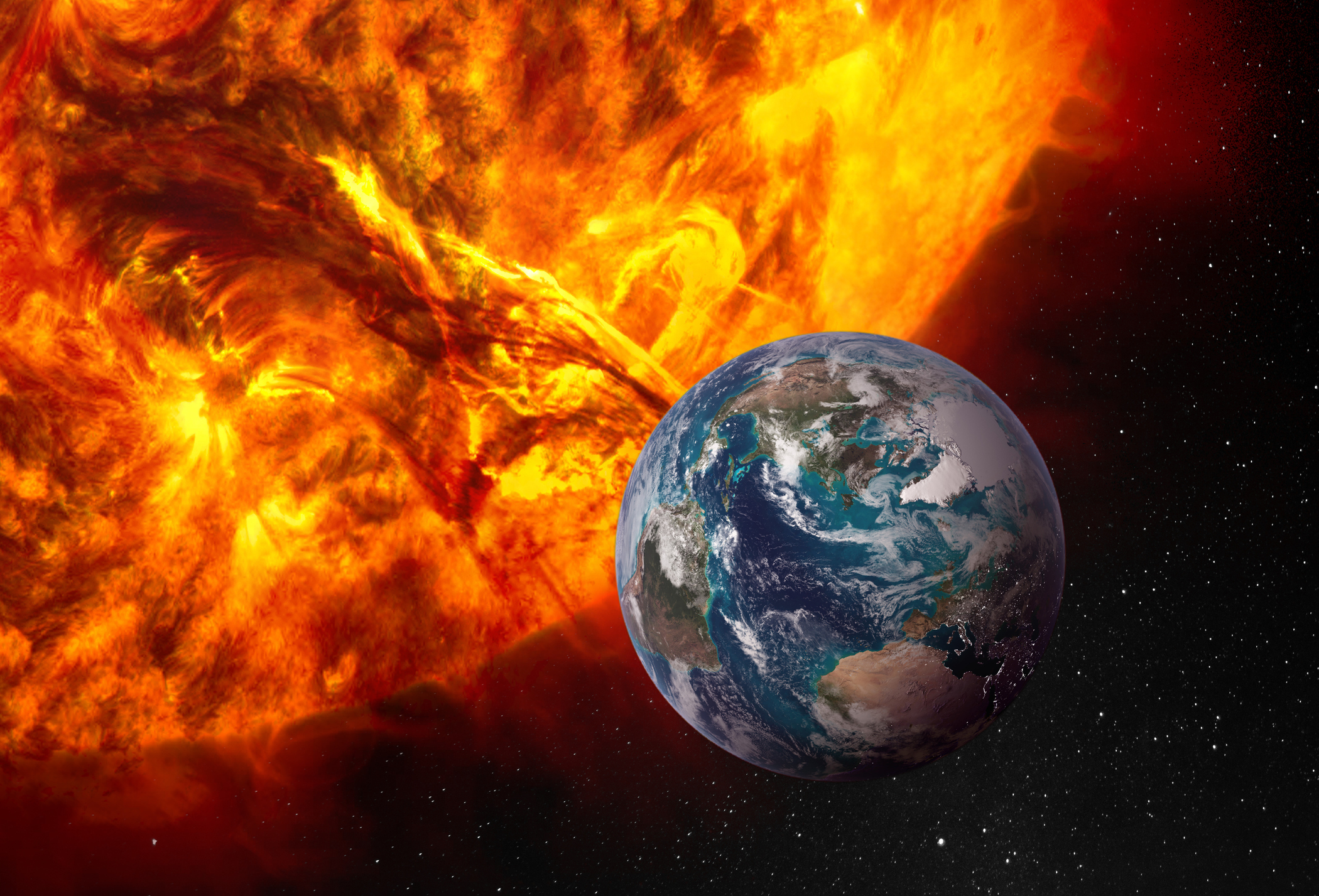
Every morning, the Sun rises with reassuring familiarity. It warms our skin, feeds our crops, lights our days, and quietly sustains life. To most of us, it feels constant, dependable, almost gentle. Yet the Sun is not a calm object. It is a massive, restless star, a roiling sphere of plasma powered by nuclear fusion, capable of unleashing forces so vast that they can reach across 150 million kilometers of space and shake the foundations of our technological civilization. A solar storm is one such expression of the Sun’s hidden fury, and imagining what would happen if a powerful one struck Earth is both scientifically fascinating and deeply unsettling.
A solar storm is not an explosion in the traditional sense, nor is it a single event. It is a complex chain of solar activity that begins on the Sun’s surface and can end with dramatic consequences here on Earth. To understand what such a storm could do to our planet, we must first understand the Sun itself, the invisible threads that connect it to Earth, and the fragile systems upon which modern life depends.
The Living Star at the Center of Our Solar System
The Sun may look serene from Earth, but its surface is anything but peaceful. Beneath its glowing exterior lies an ocean of electrically charged gas, constantly in motion. These movements generate powerful magnetic fields that twist, stretch, and tangle over time. When these magnetic fields become too stressed, they can suddenly snap and rearrange, releasing enormous amounts of energy.
This energy release can take several forms. Solar flares erupt as intense bursts of radiation, traveling at the speed of light. Coronal mass ejections, often abbreviated as CMEs, are vast clouds of magnetized plasma hurled into space at millions of kilometers per hour. When a CME is aimed directly at Earth, it carries not just energy but structure, a magnetic personality that can interact violently with our planet’s own magnetic field.
The Sun goes through cycles of activity, typically lasting about eleven years, during which solar storms become more or less frequent. During periods of high activity, the Sun’s surface is often dotted with sunspots, regions of intense magnetic disturbance that serve as breeding grounds for powerful eruptions. A solar storm capable of seriously affecting Earth is rare, but it is far from impossible.
Earth’s Invisible Shield and Its Vulnerabilities
Earth is not defenseless. Surrounding our planet is a magnetic field generated by the motion of molten iron deep within its core. This magnetic field creates a protective bubble known as the magnetosphere, which deflects most charged particles streaming from the Sun. Without it, Earth’s atmosphere would slowly be stripped away, and life as we know it would be impossible.
However, this shield is not impenetrable. When a strong solar storm arrives, it can compress the magnetosphere and inject vast amounts of energy into it. If the magnetic orientation of the incoming solar material is just right, it can partially merge with Earth’s magnetic field, allowing energy and particles to flow inward. This interaction sets the stage for a geomagnetic storm.
Geomagnetic storms disturb Earth’s magnetic environment, causing fluctuations that can ripple across the planet. These fluctuations are not just abstract measurements for scientists; they have real, tangible effects on technology and infrastructure. The more intense the solar storm, the more severe these effects can become.
The First Signs: Light Without Sound
If a major solar storm were heading toward Earth, the first signs would not be dramatic skies or flickering lights. They would appear quietly, detected by satellites monitoring the Sun. Instruments would observe a powerful solar flare or a massive coronal mass ejection blasting outward. Scientists would calculate its speed and trajectory, determining whether Earth lay in its path.
If the storm were Earth-directed, warnings would be issued hours to days in advance, depending on the speed of the solar material. During this time, nothing on Earth would feel different. People would go to work, children would go to school, airplanes would fly, and satellites would orbit as usual. The danger would be invisible, racing silently through space.
Then, when the storm’s leading edge reached Earth, the interaction would begin. The magnetosphere would be compressed, and the planet would start to feel the Sun’s touch in subtle but profound ways.
The Sky Comes Alive: Auroras Unleashed
One of the most beautiful and immediate effects of a solar storm is the intensification of auroras. Normally confined to high latitudes near the poles, auroras occur when charged particles spiral along Earth’s magnetic field lines and collide with atoms in the upper atmosphere, causing them to glow.
During a powerful solar storm, auroras can spread far beyond their usual boundaries. Skies over regions unaccustomed to such displays could erupt in curtains of green, red, and purple light. For many, it would be a once-in-a-lifetime spectacle, a reminder that Earth is part of a larger cosmic environment.
Yet this beauty would be a sign of something deeper and more dangerous. The same processes lighting up the sky would be injecting energy into Earth’s magnetic and electrical systems, setting the stage for disruptions far below.
The Hidden Threat to Modern Civilization
While auroras capture attention, the real danger of a solar storm lies in its interaction with human technology. Modern civilization is woven together by long electrical conductors, satellites, and sensitive electronics, all of which are vulnerable to geomagnetic disturbances.
As Earth’s magnetic field fluctuates during a geomagnetic storm, it can induce electric currents in long conductors on the ground. Power lines, pipelines, and communication cables can act like giant antennas, channeling these geomagnetically induced currents into systems never designed to handle them.
In power grids, these currents can overload transformers, cause voltage instability, and trigger widespread blackouts. Unlike ordinary power failures, damage to large transformers can take months to repair, as these components are custom-built and difficult to replace quickly. A severe solar storm could therefore lead to prolonged power outages affecting millions of people.
Satellites Under Siege
Above Earth’s atmosphere, satellites would face a different but equally serious threat. Solar storms increase radiation levels in space, exposing satellites to energetic particles that can damage electronics, disrupt onboard computers, and degrade solar panels.
During an intense storm, satellites may experience temporary malfunctions or permanent failures. Navigation systems, communication networks, weather monitoring, and Earth observation satellites could all be affected. For a world that relies heavily on satellite-based services, even a partial loss could have cascading consequences.
The storm can also heat Earth’s upper atmosphere, causing it to expand. This increased atmospheric drag can alter satellite orbits, particularly for those in low Earth orbit. If not corrected, satellites could lose altitude and eventually re-enter the atmosphere.
Aviation and the Human Element
Air travel would not be immune to the effects of a major solar storm. High-energy particles can penetrate aircraft at high altitudes, increasing radiation exposure for passengers and crew, especially on polar routes where Earth’s magnetic shielding is weaker.
During strong solar storms, airlines may reroute flights to lower latitudes or altitudes to reduce radiation risk and avoid communication disruptions. This would lead to delays, increased fuel consumption, and logistical challenges across the global aviation network.
Pilots rely on radio communication and satellite navigation, both of which can be degraded during geomagnetic storms. While backup systems exist, the complexity of managing air traffic under such conditions would test the resilience of aviation systems worldwide.
Communication in a Disturbed World
Modern communication depends on a delicate balance of technologies that extend from ground-based infrastructure to orbiting satellites. Solar storms can disrupt radio signals, particularly those that rely on the ionosphere, a layer of Earth’s atmosphere that reflects certain radio frequencies.
During a geomagnetic storm, the ionosphere becomes turbulent, leading to signal fading, distortion, or complete loss. This can affect everything from amateur radio to military communications. GPS signals can become less accurate, impacting navigation systems used in shipping, aviation, agriculture, and emergency services.
For societies accustomed to constant connectivity, even temporary communication disruptions can feel deeply unsettling. The realization that invisible solar forces can silence our digital voices serves as a humbling reminder of our dependence on fragile systems.
The Psychological Impact of Darkness
If a powerful solar storm caused widespread and prolonged power outages, the effects would go beyond technology. Darkness changes how people feel and behave. Without electricity, cities would fall quiet. Elevators would stop, water pumps could fail, refrigeration would be compromised, and electronic payment systems would cease to function.
In such a scenario, daily routines would be disrupted on a massive scale. Hospitals would rely on backup generators. Supply chains could slow or break down. The sense of security provided by modern infrastructure would be shaken.
Psychologically, uncertainty can be as damaging as physical disruption. Not knowing when power will return or systems will recover can generate fear, frustration, and social tension. A solar storm would remind humanity that progress has not eliminated vulnerability, only transformed it.
Lessons from the Past Written in Light and Iron
Solar storms are not hypothetical. Earth has experienced powerful geomagnetic events before, long before modern technology amplified their consequences. Historical records describe intense auroras and disruptions to early electrical systems, offering glimpses of what the Sun can do.
These past events occurred in a world far less dependent on electricity and electronics. Today, the same level of solar activity would have far greater impact. Studying these historical storms allows scientists to estimate the potential severity of future events and motivates efforts to improve preparedness.
History teaches that the Sun does not need to change for risk to increase. Our growing reliance on technology has raised the stakes.
The Science of Prediction and Preparedness
One of humanity’s greatest advantages is knowledge. Scientists continuously monitor the Sun using space-based observatories that watch for signs of eruptions. When a solar storm is detected, space weather forecasters analyze its properties to estimate its arrival time and potential impact.
While predicting the exact effects of a solar storm remains challenging, warnings can provide critical time to take protective measures. Power grid operators can adjust systems to reduce vulnerability. Satellite operators can place spacecraft into safe modes. Airlines can modify flight plans.
These actions do not eliminate risk, but they can significantly reduce damage. Preparedness transforms a solar storm from an unpredictable catastrophe into a manageable natural hazard.
The Fragile Web of Global Infrastructure
A powerful solar storm would not respect national borders. Its effects would ripple across the globe, revealing the interconnected nature of modern infrastructure. Power grids, communication networks, transportation systems, and financial markets are tightly linked.
A disruption in one region can cascade into others. A prolonged blackout in a major industrial area could affect manufacturing worldwide. Communication failures could hinder coordination and response efforts. The complexity of these systems means that even small disturbances can have large consequences.
Understanding this interconnectedness is essential for resilience. A solar storm would test not just technology but cooperation, planning, and adaptability on a global scale.
Human Health and Biological Resilience
One question often asked is whether a solar storm would directly harm human health. On the ground, Earth’s atmosphere provides strong protection against solar radiation. For people at the surface, even a powerful solar storm would not cause immediate biological harm.
However, astronauts in space would be at greater risk. Increased radiation levels could pose serious dangers to those outside Earth’s protective atmosphere. This is a significant concern for long-duration space missions and future human exploration beyond low Earth orbit.
On Earth, the indirect effects of infrastructure disruption could impact health. Loss of power can affect medical services, food storage, water treatment, and heating or cooling systems. These secondary effects highlight that health in the modern world is closely tied to technological stability.
A Test of Resilience, Not the End of the World
Despite dramatic portrayals, a solar storm would not end civilization. It would not scorch the surface of the Earth or strip away the atmosphere. Life on this planet has endured far more violent cosmic events over billions of years.
What a major solar storm would do is expose weaknesses. It would reveal which systems are robust and which are fragile. It would challenge assumptions about reliability and force societies to adapt, repair, and rethink.
In this sense, a solar storm is less an apocalypse and more a stress test, one imposed not by human conflict but by our place in a dynamic universe.
The Emotional Weight of Cosmic Vulnerability
There is something deeply emotional about the idea that a distant star can influence our lives so profoundly. It reminds us that no matter how advanced our technology becomes, we remain part of nature, not separate from it.
This realization can inspire fear, but it can also inspire humility and wonder. The same Sun that powers life can disrupt our creations. The same cosmic forces that threaten technology also paint the sky with breathtaking beauty.
Acknowledging this duality helps cultivate a healthier relationship with the natural world, one based on respect rather than illusionary control.
Living with the Sun, Not Against It
Humanity cannot stop solar storms, but it can learn to live with them. Investing in resilient infrastructure, improving space weather forecasting, and designing systems that can tolerate disturbances are all steps toward coexistence.
Education plays a role as well. Understanding that solar storms are natural phenomena, not supernatural disasters, can reduce panic and promote rational response. Awareness transforms fear into preparedness.
The Sun has always been active, and it always will be. The challenge is not to tame it, but to understand it well enough to thrive in its presence.
A Quiet Star, a Loud Reminder
Most days, the Sun shines without incident, and life continues uninterrupted. Solar storms are rare reminders that beneath this calm lies immense power. If one were to strike Earth tomorrow, it would illuminate both our vulnerabilities and our strengths.
It would show how deeply connected we are, not just to each other, but to the cosmos itself. It would remind us that our technologies are extensions of nature, subject to the same forces that govern stars and planets.
In imagining a solar storm hitting Earth, we are not indulging in fear. We are acknowledging reality. And in doing so, we take one step closer to resilience, wisdom, and a deeper appreciation of the universe we call home.