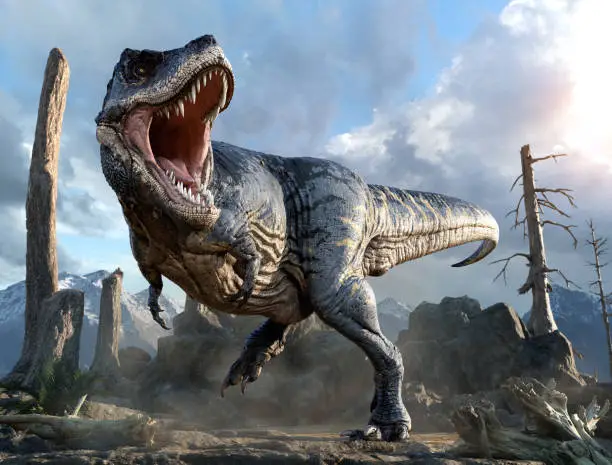
Imagine waking up on a morning where the ground trembles not from distant thunder, but from the footfalls of something alive and immense. The sky is not only crossed by birds, but by vast winged creatures casting moving shadows over forests and coastlines. The rustle in the trees is not caused by deer or monkeys, but by reptilian titans browsing leaves or hunting in silence. This is Earth as it might have been if dinosaurs never went extinct.
The extinction of non-avian dinosaurs around sixty-six million years ago reshaped the destiny of life on Earth. It opened ecological space that mammals slowly filled, eventually allowing humans to evolve. To imagine a world where dinosaurs survived is to imagine an entirely different biological and cultural history, one in which humans might never have existed, or would have emerged in a radically altered form. This thought experiment is not fantasy alone; it is grounded in evolutionary biology, ecology, geology, and climate science. By exploring it carefully, we can better understand not only dinosaurs, but ourselves.
The Moment That Changed Everything
The disappearance of most dinosaurs was sudden on geological timescales, driven primarily by a massive asteroid impact that caused global environmental collapse. In a world where dinosaurs never went extinct, this catastrophic event either never happened or did not have the same devastating consequences. Perhaps the asteroid missed Earth entirely, or perhaps dinosaurs were more resilient to its aftermath. Whatever the reason, ecosystems would have continued without the dramatic reset that defined the end of the Cretaceous period.
Without that mass extinction, ecological dominance would have remained largely in reptilian hands. Dinosaurs were not a single type of creature but an extraordinarily diverse group that had adapted to nearly every environment on land, from polar forests to deserts. Their continued survival would have meant ongoing evolutionary competition, refinement, and diversification, shaping the planet in ways both familiar and alien.
Dinosaurs as Evolving, Changing Animals
A common misconception is that dinosaurs were evolutionary dead ends, massive and inflexible. In reality, they were highly successful, adaptable organisms that thrived for over 160 million years. If they had not gone extinct, they would not have remained frozen in their Cretaceous forms. Evolution never stops. Dinosaurs would have continued to change, responding to shifting climates, continents, and ecological pressures.
Some lineages might have grown larger, others smaller. Feathers, already present in many species, would likely have become more common and more specialized. Intelligence, social behavior, and complex communication could have evolved further in certain groups. Dinosaurs would not simply be ancient monsters roaming a modern Earth; they would be modern animals shaped by millions of years of additional evolution.
Mammals in the Shadow of Reptilian Rulers
In the age of dinosaurs, mammals already existed, but they were generally small, nocturnal, and ecologically constrained. They survived by avoiding competition with dominant reptiles. If dinosaurs had never disappeared, mammals would likely have remained marginal for much longer.
Large mammals such as elephants, whales, and big cats probably would not exist. The ecological niches they occupy today would still be filled by dinosaurs or their descendants. Mammals might have diversified in subtle ways, becoming more specialized burrowers, climbers, or nocturnal foragers, but without the explosive radiation that occurred after the extinction event.
This means that primates, and therefore humans, may never have evolved at all. If they did, they would have emerged into a world already crowded with intelligent, fast, and often dangerous competitors.
The Fate of Birds in a Dinosaur-Dominated World
Birds are technically dinosaurs, the last surviving lineage of theropods. In our world, their success is partly due to the extinction of their larger relatives. In a world where dinosaurs never went extinct, birds would still exist, but their evolutionary path would likely be very different.
Some bird lineages might remain small and specialized, while others could compete directly with larger feathered dinosaurs. Flight would still offer advantages, but airspace would be more crowded, with giant pterosaurs or bird-like dinosaurs dominating skies and coastlines. The diversity of flying animals might exceed anything we see today, reshaping ecosystems from forests to oceans.
Landscapes Shaped by Giants
Large animals transform their environments, and dinosaurs were among the largest land animals ever to exist. Their continued presence would profoundly shape vegetation, soil, and climate on a local scale. Vast herds of plant-eating dinosaurs would trample forests, disperse seeds, and shape plant evolution through selective feeding.
Plants themselves would evolve in response. Tougher leaves, faster growth, and chemical defenses would become more common. Flowering plants might still diversify, but their forms and relationships with animals could differ significantly. Forests might be more open, grasslands shaped by massive herbivores rather than grazing mammals.
Predatory dinosaurs would influence prey behavior, creating landscapes of fear where movement, migration, and social structures are shaped by the constant presence of large hunters.
Climate and Global Ecology
Dinosaurs lived through warmer global climates than today, with higher carbon dioxide levels and no permanent polar ice caps for much of their history. If they had survived into the present, Earth’s climate history might still include ice ages and warming periods, but ecosystems would respond differently.
Large dinosaurs are efficient at retaining heat, and feathered species could thrive in cooler climates. Some might migrate seasonally, while others adapt to cold through insulation and behavior. Polar regions might host unique dinosaur communities, as they already did in parts of the Cretaceous.
The interaction between climate change and dinosaur-dominated ecosystems would be complex, but there is no scientific reason to believe dinosaurs could not survive in many of today’s environments, had they been given the evolutionary time to adapt.
Intelligence Beyond Mammals
One of the most intriguing questions is whether intelligent, tool-using species could evolve from dinosaurs. Intelligence is not exclusive to mammals. Birds today demonstrate problem-solving skills, memory, and social complexity comparable to primates. Some non-avian dinosaurs, particularly small theropods, already showed traits associated with higher intelligence, such as large brain-to-body ratios and advanced sensory systems.
Over millions of years, selective pressures could favor greater intelligence in certain dinosaur lineages. An upright posture, grasping forelimbs, and binocular vision could lead to sophisticated manipulation of objects. Such creatures would not look like humans, but they could develop complex social structures, communication, and perhaps even rudimentary technology.
This possibility forces us to confront a humbling idea: intelligence is not destiny reserved for our lineage alone.
The Absence or Transformation of Humanity
If dinosaurs never went extinct, the probability of humans evolving exactly as we did is extremely low. Our existence depends on a chain of events that began with mammalian expansion after the extinction. Without that opportunity, primates might never arise.
Even if a human-like species did evolve, it would face enormous challenges. Large predatory dinosaurs would make survival on open ground extremely dangerous. Intelligence might evolve faster under such pressure, but technological development would be constrained by constant ecological threat.
Human civilization as we know it, with agriculture, cities, and global dominance, would be unlikely. The Earth might remain largely wild, governed by ecological balance rather than human control.
Disease, Parasites, and Biological Arms Races
In a dinosaur-dominated world, pathogens and parasites would coevolve with their hosts. Diseases specialized for large reptiles would exist, shaping population dynamics just as mammalian diseases do today. Epidemics could still occur, but large, widely distributed populations might be more resilient.
This ongoing biological arms race would influence lifespan, reproduction, and behavior. Social dinosaurs might develop grooming behaviors or immune adaptations similar to those seen in mammals and birds. These invisible battles would be as important to evolution as visible predators and prey.
Oceans Ruled by Reptiles
Dinosaurs lived on land, but their era also included marine reptiles such as mosasaurs and plesiosaurs. If extinction had not occurred, these lineages might still dominate the oceans alongside fish and early marine mammals, which might never gain prominence.
Whales and dolphins may never evolve, leaving the ecological roles of large, intelligent marine animals to reptiles. Ocean ecosystems would look dramatically different, with surface-breaching reptiles, vast predatory forms, and entirely different food webs.
The soundscape of the oceans, shaped today by whale songs, would be replaced by something unfamiliar and perhaps less vocal, but no less complex.
The Night Sky and the Sound of the Earth
A dinosaur world would feel different not only visually, but emotionally. The sounds of life would be deeper, heavier, and more resonant. Calls might carry across kilometers, signaling territory or mating readiness. Nights would be filled with unfamiliar noises, making darkness more threatening than it already was for early mammals.
Even the night sky might feel different to a sentient observer in such a world. Without human cities and artificial light, stars would blaze in clarity. Life would still look upward, perhaps wondering, perhaps not yet capable of asking why.
Evolution Without a Reset Button
Mass extinctions act as reset buttons in evolution, clearing ecological space and accelerating change. Without the dinosaur extinction, evolution would proceed more gradually. Dominant lineages would continue to refine their advantages rather than being abruptly replaced.
This slower pace might result in greater stability, but also less opportunity for radical new forms. Evolution would still innovate, but within existing frameworks. The world might feel older, more continuous, less interrupted by catastrophe.
What This Thought Experiment Teaches Us
Asking what would happen if dinosaurs never went extinct is not merely an exercise in imagination. It reveals how contingent our existence is. Humans are not the inevitable outcome of evolution, but one possible result among countless alternatives.
This scenario also reminds us that extinction is not just loss, but transformation. The disappearance of dinosaurs allowed mammals to rise, reshaping the planet in profound ways. Without that loss, Earth would be no less alive or complex, just profoundly different.
A Planet That Belongs to Life, Not to Us
In a dinosaur-dominated world, humanity, if it existed at all, would not stand at the center of creation. We would be one species among many, vulnerable and constrained by forces larger than ourselves. This perspective is both unsettling and enlightening.
It strips away the illusion that the world was made for us. Instead, it shows that Earth belongs to life itself, shaped by chance, survival, and time.
The Quiet Miracle of Our Reality
The fact that dinosaurs did go extinct allowed mammals, birds, and ultimately humans to flourish. Our ability to ask this question, to imagine alternative histories, is itself a product of that ancient catastrophe.
A world without dinosaur extinction would be no less wondrous, but it would not be our world. The silence of the great reptiles made room for our voices. Understanding this deepens our appreciation of both what was lost and what was gained.
In contemplating a world where dinosaurs never went extinct, we are reminded that existence is fragile, history is contingent, and life’s story could have been written in countless ways. We live in just one version, shaped by chance, survival, and time, on a planet that once thundered under the feet of giants.