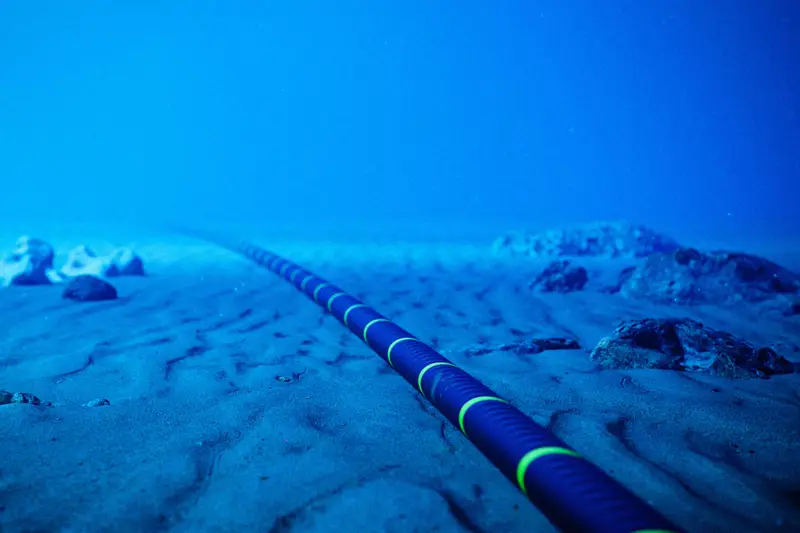
When you send a message across the world, watch a live event from another continent, or scroll endlessly through photos stored in distant servers, it feels almost magical. Information seems to float effortlessly through the air, instant and invisible. The internet, in popular imagination, is often portrayed as something abstract, wireless, and intangible—a cloud hovering above the planet. Yet beneath this illusion lies one of the most extraordinary physical infrastructures humanity has ever built: a vast, silent network of underwater cables stretching across the ocean floor, binding continents together with strands of glass thinner than a garden hose.
These submarine cables are the true backbone of the modern internet. They carry the overwhelming majority of global data traffic, pulsing with light at nearly the speed of physics allows. They cross some of the most hostile environments on Earth, endure crushing pressures, seismic activity, and the slow, grinding movements of tectonic plates. And yet, most people will never see them, think about them, or realize how profoundly their lives depend on these hidden arteries of communication.
This is the story of the physical internet—not as a metaphor, but as a tangible, engineered system. It is a story of science, technology, history, geopolitics, and human ambition, woven together on the dark seabed of the world’s oceans.
The Illusion of a Wireless World
The modern digital experience feels wireless by design. Smartphones, laptops, and smart devices connect through Wi-Fi and cellular signals, creating the impression that information travels through the air from sender to receiver. While this is partly true on a local scale, these wireless connections are only the final, short-distance links in a much larger chain.
Once data leaves your home or phone tower, it enters a physical network of fiber-optic cables, routers, switches, and data centers. When that data needs to cross an ocean, satellites are rarely involved. Instead, the signal dives downward, flowing into submarine cables laid along the seafloor. More than ninety-five percent of intercontinental data traffic travels this way, not through space, but through glass fibers resting miles beneath the waves.
The reason is simple and rooted in physics. Fiber-optic cables offer far greater bandwidth, lower latency, and higher reliability than satellites for continuous, high-volume data transmission. Light traveling through fiber can carry enormous amounts of information with minimal loss, while satellites are constrained by distance, orbital mechanics, and limited capacity. The internet may feel ethereal, but its efficiency depends on something deeply physical and meticulously engineered.
From Telegraph Wires to Global Data Highways
The idea of connecting continents with undersea cables predates the internet by more than a century. In the nineteenth century, the world was already hungry for faster communication. Messages that once took weeks to travel by ship could be transmitted in minutes if a telegraph cable could span the ocean.
The first successful transatlantic telegraph cable was completed in the mid-1800s, after multiple failed attempts. Early cables were crude by modern standards, made of copper conductors wrapped in insulating materials and armored with iron. They carried simple electrical signals, tapping out dots and dashes beneath the Atlantic. Even so, they revolutionized global communication, shrinking the world in a way that must have felt miraculous at the time.
Over the decades, undersea cables evolved alongside communication technology. Telegraph gave way to telephone, and analog signals were eventually replaced by digital ones. The real transformation came with the development of fiber-optic technology in the late twentieth century. Instead of electrical currents, information could now be transmitted as pulses of light, allowing far greater data rates and signal clarity.
This shift laid the foundation for the modern internet. What began as a means of sending brief messages became a global system capable of supporting video streaming, cloud computing, real-time collaboration, and the countless digital interactions that define contemporary life.
The Science of Fiber-Optic Communication
At the heart of underwater internet cables is a deceptively simple scientific principle: total internal reflection. Fiber-optic cables are made of ultra-pure glass or plastic fibers that guide light along their length. When light enters the fiber at the correct angle, it reflects repeatedly off the inner walls, remaining trapped inside the core even as the cable bends and twists.
Information is encoded into this light by modulating it—turning it on and off or altering its properties in precisely controlled ways. Each pulse represents digital data, translated into binary code. Because light travels incredibly fast and experiences minimal resistance in fiber, vast quantities of data can be transmitted over long distances with astonishing efficiency.
Modern submarine cables contain multiple fiber pairs, each capable of carrying terabits of data per second. Advanced techniques allow different wavelengths of light to travel simultaneously through the same fiber, multiplying its capacity. What appears to be a single cable is, in reality, a dense superhighway of information, with countless conversations happening at once, all invisible to the human eye.
Engineering for the Abyss
Laying a cable across an ocean is not simply a matter of dropping it overboard. The ocean floor is a complex, dynamic environment, shaped by mountains, trenches, volcanoes, and shifting sediments. Depths can reach several kilometers, where pressure is immense and temperatures hover near freezing.
Submarine cables are engineered to survive these extremes. At their core are the delicate fiber-optic strands, protected by layers of steel wire, copper, insulation, and waterproofing. Near coastlines, where cables are more vulnerable to human activity like fishing and anchoring, they are heavily armored. In deeper waters, where such threats are minimal, cables can be lighter and more flexible.
Specialized ships are used to lay and maintain these cables. Equipped with massive spools holding thousands of kilometers of cable, these vessels follow carefully planned routes, lowering the cable to the seabed with precision. In shallow areas, the cable may be buried beneath the ocean floor using plows or jets to reduce the risk of damage.
The process is slow, expensive, and requires extraordinary coordination between engineers, marine scientists, and navigators. Yet it is this careful planning that allows cables to function reliably for decades.
A Living Network Beneath the Waves
Once laid, submarine cables do not simply sit idle. They become part of a living global system, continuously monitored and maintained. Sensors track signal strength and integrity, allowing operators to detect faults or disruptions almost instantly.
Damage can occur for many reasons. Fishing trawlers dragging heavy nets across the seabed are among the most common causes. Anchors dropped in the wrong place can sever a cable in seconds. Natural events such as earthquakes, underwater landslides, and volcanic activity can also break or displace cables, sometimes affecting entire regions.
When a cable is damaged, repair ships are dispatched to the site. Using precise location data, crews retrieve the broken ends from the seabed, splice them together, and carefully lower the repaired section back into place. These operations can take days or weeks, especially in rough weather or deep water, but they are essential to keeping the global internet running smoothly.
The Geography of Connectivity
The layout of underwater cables reflects both geography and geopolitics. Certain routes are heavily trafficked, forming dense clusters of cables between major economic centers. Transatlantic cables connect North America and Europe, while transpacific cables link Asia to the Americas. Other cables trace routes through the Indian Ocean, the Mediterranean, and around Africa, knitting together a truly global network.
Not all regions are equally connected. Some countries rely on a small number of cables, making them vulnerable to outages. Others serve as major hubs, where multiple cables converge. These hubs often become strategic assets, influencing economic development and political leverage.
Island nations, in particular, depend heavily on submarine cables. For them, these cables are not just a convenience but a lifeline, supporting communication, commerce, education, and emergency services. A single cable failure can isolate an entire country from the digital world, highlighting the fragility hidden beneath the internet’s apparent resilience.
Power, Politics, and the Seabed
Because submarine cables carry such a large fraction of global data, they have become objects of geopolitical interest. Control over cable routes, landing points, and infrastructure ownership can translate into economic and strategic influence.
Governments are acutely aware of the importance of these cables. Some regulate their construction and operation closely, citing national security concerns. Others invest heavily in expanding cable networks to boost connectivity and economic growth. In recent years, competition over cable projects has intensified, reflecting broader tensions in global politics and trade.
There is also the question of security. While most cables lie in deep waters beyond easy reach, their landing points on shore are more accessible. Protecting these critical nodes is an ongoing challenge, requiring coordination between private companies and public authorities.
The physical internet, for all its technological sophistication, is not immune to human conflict. It reflects the same power dynamics, rivalries, and alliances that shape the surface world.
Environmental Encounters on the Ocean Floor
The interaction between submarine cables and marine environments is a subject of careful study. While cables are generally considered to have a relatively low environmental impact, their presence on the seabed is not entirely neutral.
During installation, cables may disturb sediments and habitats. Over time, however, they often become integrated into the environment. Marine organisms can colonize cable surfaces, turning them into artificial reefs in some areas. In many cases, the footprint of a cable is small compared to other forms of ocean infrastructure.
Engineers and environmental scientists work together to minimize ecological disruption. Routes are planned to avoid sensitive habitats, and installation methods are chosen to reduce disturbance. The goal is to balance humanity’s need for connectivity with the responsibility to protect the oceans that make that connectivity possible.
Data as Light, Speed as Experience
One of the most remarkable aspects of underwater cables is how directly they shape human experience. Latency, the time it takes for data to travel from one point to another, affects everything from online gaming to financial trading to video calls with loved ones across the globe.
Because fiber-optic cables transmit data at speeds close to that of light, they minimize latency compared to satellite links, which must send signals tens of thousands of kilometers into space and back. This difference is not just technical; it is emotional. A delay of even a fraction of a second can make a conversation feel awkward or disconnect human interaction.
The physical placement of cables, their routes, and their technology all influence how “close” the world feels. When you speak to someone on another continent and hear their voice without noticeable delay, you are experiencing the triumph of physics and engineering working seamlessly together.
Redundancy and Resilience in a Fragile System
Despite their importance, submarine cables are surprisingly vulnerable. A single cut can disrupt internet access for millions. To mitigate this risk, the global network is designed with redundancy. Multiple cables often connect the same regions, allowing data to be rerouted if one path fails.
This redundancy is a testament to both foresight and necessity. As global dependence on the internet has grown, so too has the need for resilience. Financial systems, healthcare, transportation, and emergency services all rely on continuous connectivity. The physical internet must be robust enough to withstand accidents, natural disasters, and even deliberate attacks.
Yet redundancy has limits. Some regions lack sufficient alternative routes, and repairs can take time. These vulnerabilities serve as reminders that the digital world is grounded in physical reality, subject to the same uncertainties and constraints as any other human-built system.
The Human Stories Behind the Cables
Behind every submarine cable are human stories of ambition, risk, and cooperation. Engineers design systems that must work flawlessly under extreme conditions. Crews spend weeks or months at sea, laying and repairing cables in challenging environments. Scientists analyze seabed maps and ocean currents to guide safe installation.
There are also stories of failure and perseverance. Early cable projects were plagued by technical problems, financial losses, and public skepticism. Even today, new projects face immense logistical and political challenges. Yet the drive to connect the world continues, fueled by the belief that communication is a fundamental human need.
These cables are monuments not just to technology, but to collaboration across borders and disciplines. They represent what humans can achieve when curiosity, necessity, and ingenuity converge.
The Future of the Physical Internet
As global data demand continues to grow, the physical internet is evolving. New cables are being planned with higher capacity, improved materials, and more efficient technologies. Advances in optical amplification and signal processing promise to push the limits of how much data a single fiber can carry.
There is also growing interest in diversifying routes to improve resilience and reduce dependence on congested corridors. Some projects aim to connect previously underserved regions, narrowing the digital divide and expanding access to information and opportunity.
At the same time, emerging technologies such as low-Earth orbit satellites are being developed to complement, not replace, submarine cables. While satellites offer flexibility and reach, especially in remote areas, the sheer capacity and efficiency of fiber-optic cables ensure that they will remain the backbone of global connectivity for the foreseeable future.
Seeing the Internet as It Truly Is
Understanding the physical internet changes how we perceive the digital world. It replaces the myth of an ethereal cloud with a vision of tangible infrastructure, rooted in physics and geography. It reveals the internet as a human-made extension of the planet’s nervous system, transmitting signals of thought, culture, and commerce across vast distances.
The next time a message crosses an ocean in an instant, it is worth remembering the silent cables beneath the waves. They lie in darkness and pressure, enduring currents and time, carrying light encoded with human meaning. They are the unseen threads that hold the modern world together, a reminder that even in our most advanced technologies, we remain bound to the physical laws of the universe and to the fragile Earth that supports us.
The physical internet is not just a network of cables. It is a testament to humanity’s desire to connect, to share, and to understand—an enduring bridge between minds, continents, and cultures, resting quietly on the ocean floor.