One hundred and fifty million years ago, the Late Jurassic world was loud with giants. Dinosaurs dominated the land, their shadows stretching across fern-filled plains in what is now western Portugal. But beneath those thunderous footsteps lived a hidden cast of characters, small enough to vanish between leaves, fragile enough to be erased by time. For generations, they went unnoticed. Now, one of them has finally stepped into the light.
Scientists have identified a tiny amphibian that once lived alongside dinosaurs, a creature no longer than 5 centimeters whose story was scattered into hundreds of bone fragments. The animal has been given a name, Nabia civiscientrix, and with it comes a glimpse into a mysterious lineage that survived from the age of dinosaurs all the way to the last Ice Age.
This discovery is not just about a fossil. It is about patience, community, and the quiet persistence of life that thrives in the margins of history.
A Creature Small Enough to Be Forgotten
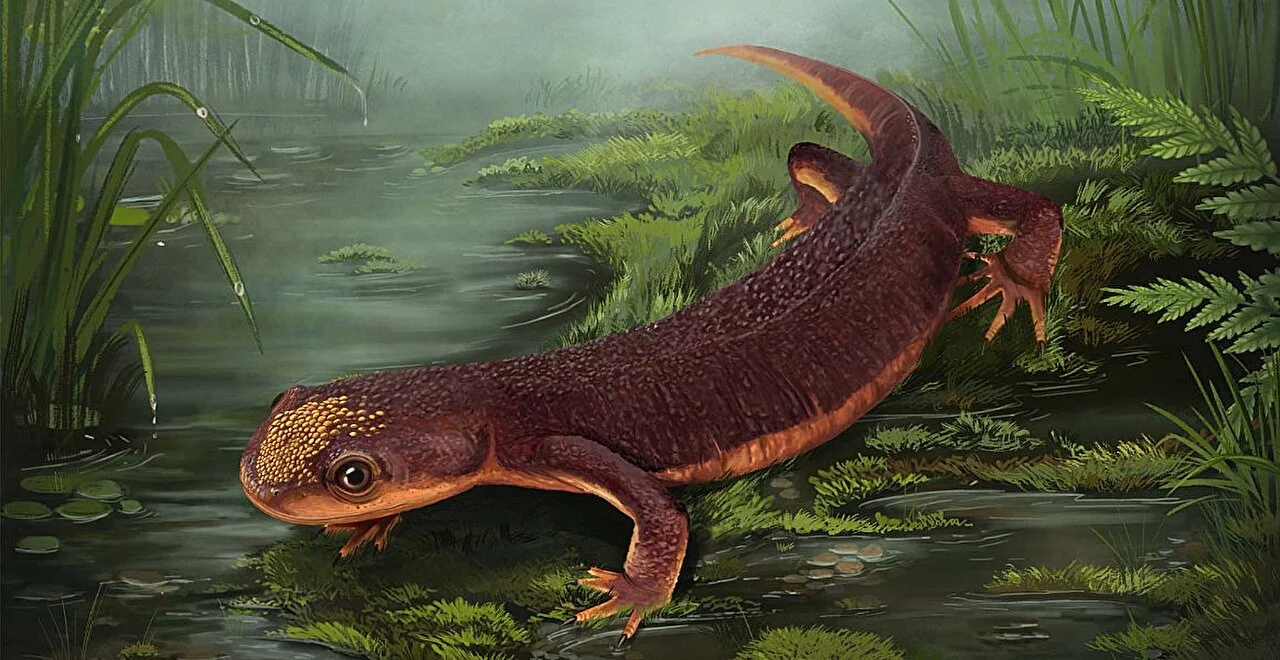
At first glance, Nabia civiscientrix would not have impressed anyone living in the Jurassic. It was tiny, dry-skinned, and scaly, with keratin-like claws and eyelids, features unusual enough to catch the attention of modern scientists. It hunted using a ballistic tongue, shooting it out toward prey in a manner strikingly similar to how chameleons hunt today.
This was not a soft, slippery amphibian clinging to water. It was a compact, well-equipped hunter built for life on land, navigating a world dominated by creatures hundreds of times its size. While dinosaurs claimed the headlines of prehistory, this animal survived by being fast, discreet, and adaptable.
Its remains lay unnoticed for millions of years, buried in the rock of the Lourinhã Formation in Portugal, a region already famous for its dinosaur fossils. The irony is hard to miss. Among the bones of fearsome predators and armored herbivores, one of the most intriguing discoveries turned out to be something almost too small to see.
Bones Like Dust, Stories Like Gold
The discovery did not come from a single skeleton pulled cleanly from the ground. Instead, it emerged from more than 400 individual bones, most of them fragments of skulls and vertebrae, collected painstakingly over time. Many of these pieces are less than 1 millimeter wide, so small they resemble tea leaves rather than fossils.
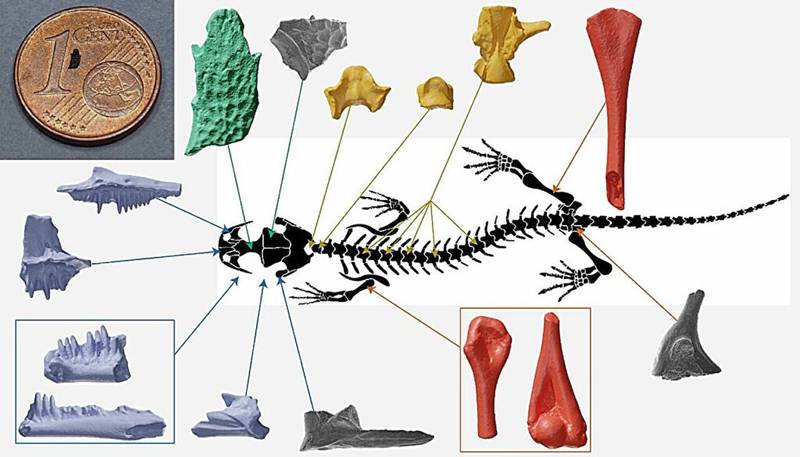
Without magnification, they are easy to overlook. With care, they become extraordinary.
Some of the best-preserved specimens were sent to University College London, where researchers used micro-CT scanners to peer inside them. These scanners rely on X-rays to reveal internal structures and produce detailed 3D models, allowing scientists to study bones that would otherwise be too delicate to handle.
Despite being isolated and sometimes broken, the bones preserved astonishing detail. Joint surfaces, overlapping areas where bones once fit together, and even tiny holes that once carried blood vessels remain visible. These details transformed fragments into a coherent anatomical story, revealing an animal more complex than its size suggests.
A Name That Honors Many Hands
The species name, Nabia civiscientrix, carries a meaning beyond scientific classification. It honors the citizen scientists, many from the local Portuguese community, who helped uncover the remains.
For Dr. Miguel Moreno-Azanza of the University of Zaragoza, this was deeply intentional. He described the joy of seeing local people involved in uncovering their own deep history, turning stones in familiar landscapes into windows onto a forgotten world.
By choosing this name, the researchers acknowledged that this discovery was not the work of distant experts alone. It was the result of shared curiosity, long hours in the field, and a collective effort to bring a piece of Portugal’s ancient past back into view.
A Familiar Place, Seen With New Eyes
The Lourinhã Formation is no stranger to fame. It has yielded iconic Late Jurassic dinosaurs such as the carnivorous Lourinhanosaurus, the ornithopod Hesperonyx, and the stegosaur Miragaia. For decades, these giants shaped how scientists imagined the region’s prehistoric ecosystem.
But Nabia civiscientrix forces a shift in perspective.
As lead author Alexandre R. D. Guillaume explains, this species highlights the herpetofauna of Lourinhã during the Late Jurassic, the amphibians and reptiles that lived in the shadows of dinosaurs. These animals rarely leave behind dramatic fossils, yet they formed an essential part of the ecosystem.
The discovery reminds scientists that understanding ancient worlds requires looking down as well as up. The small animals mattered too.
An Old Puzzle Finally Comes Together
The story of Nabia civiscientrix does not begin and end in Lourinhã. Fossils belonging to the same animal had been found earlier in the Guimarota beds, another Late Jurassic site in Portugal. For years, paleontologists knew these bones represented something new, but their exact identity remained unresolved.
Earlier studies had placed them within the genus Celtedens, but that classification never quite fit. Guillaume and his colleagues revisited the material, questioning old assumptions and comparing the fragments with newly collected bones.
This deeper investigation revealed that the fossils belonged to a distinct species, one that deserved its own name and place in the evolutionary tree. What once seemed like a frustrating puzzle finally began to make sense.
Meeting the Albanerpetontids
Nabia civiscientrix belongs to an extinct group of amphibians known as Albanerpetontidae. These animals are closely related to Lissamphibia, the group that includes all living amphibians today.
What makes this discovery remarkable is its age. The remains represent some of the oldest known albanerpetontid fossils, and the oldest ever found on the Iberian Peninsula. According to Dr. Marc Jones, this gives scientists a rare opportunity to study the early history of a group that persisted for an astonishingly long time.
Albanerpetontids are believed to have lived for more than 160 million years, surviving from the Middle Jurassic all the way to the Pleistocene. That means this lineage endured dramatic changes in climate, geography, and biodiversity, including the rise and fall of dinosaurs.
Until recently, studies of these animals focused on only a handful of easily recognizable bones. The detailed analysis of Nabia civiscientrix opens the door to a fuller understanding of their anatomy and evolution.
Why This Tiny Amphibian Matters
At first, it may seem strange to celebrate a creature so small, known only from fragments, when dinosaur skeletons loom nearby. But Nabia civiscientrix represents something far more profound than its size suggests.
This discovery fills a gap in the fossil record, helping scientists trace the early history of a resilient amphibian lineage. It shows that complex, specialized amphibians were already thriving alongside dinosaurs, quietly adapting to terrestrial life with features like claws, eyelids, and ballistic tongues.
It also demonstrates the power of modern technology, such as micro-CT scanning, to extract rich information from fossils once considered too fragmentary to matter. And it highlights the value of community involvement in science, proving that local curiosity can lead to discoveries of global importance.
Most importantly, this research reminds us that Earth’s history is not only written by giants. It is written by countless small lives, each leaving faint traces behind. When scientists take the time to follow those traces, even the smallest amphibian can reshape our understanding of the ancient world.
Study Details
Alexandre R. D. Guillaume et al, New albanerpetontid species (Lissamphibia) from the Late Jurassic of Portugal, Journal of Systematic Palaeontology (2026). DOI: 10.1080/14772019.2025.2580623