The deep ocean is Earth’s last great wilderness, a realm so alien that even seasoned scientists often struggle to describe it without borrowing the language of science fiction. Sunlight fades within the first few hundred meters, pressure rises to crushing extremes, and temperatures hover near freezing. In this perpetual darkness, life has evolved along pathways so unfamiliar that the creatures inhabiting these depths can seem less like animals and more like visitors from another world. Yet every strange appendage, eerie glow, and improbable body shape is the result of precise evolutionary logic shaped by physics, chemistry, and biology.
Deep-sea organisms are not monsters, nor are they accidents of nature. They are exquisitely adapted survivors, refined over millions of years to thrive where light is absent, food is scarce, and survival depends on efficiency and innovation. To encounter them, even through images or descriptions, is to confront the limits of human intuition about life. The following twelve deep-sea creatures exemplify just how imaginative evolution can be when freed from the constraints of surface environments.
1. Anglerfish
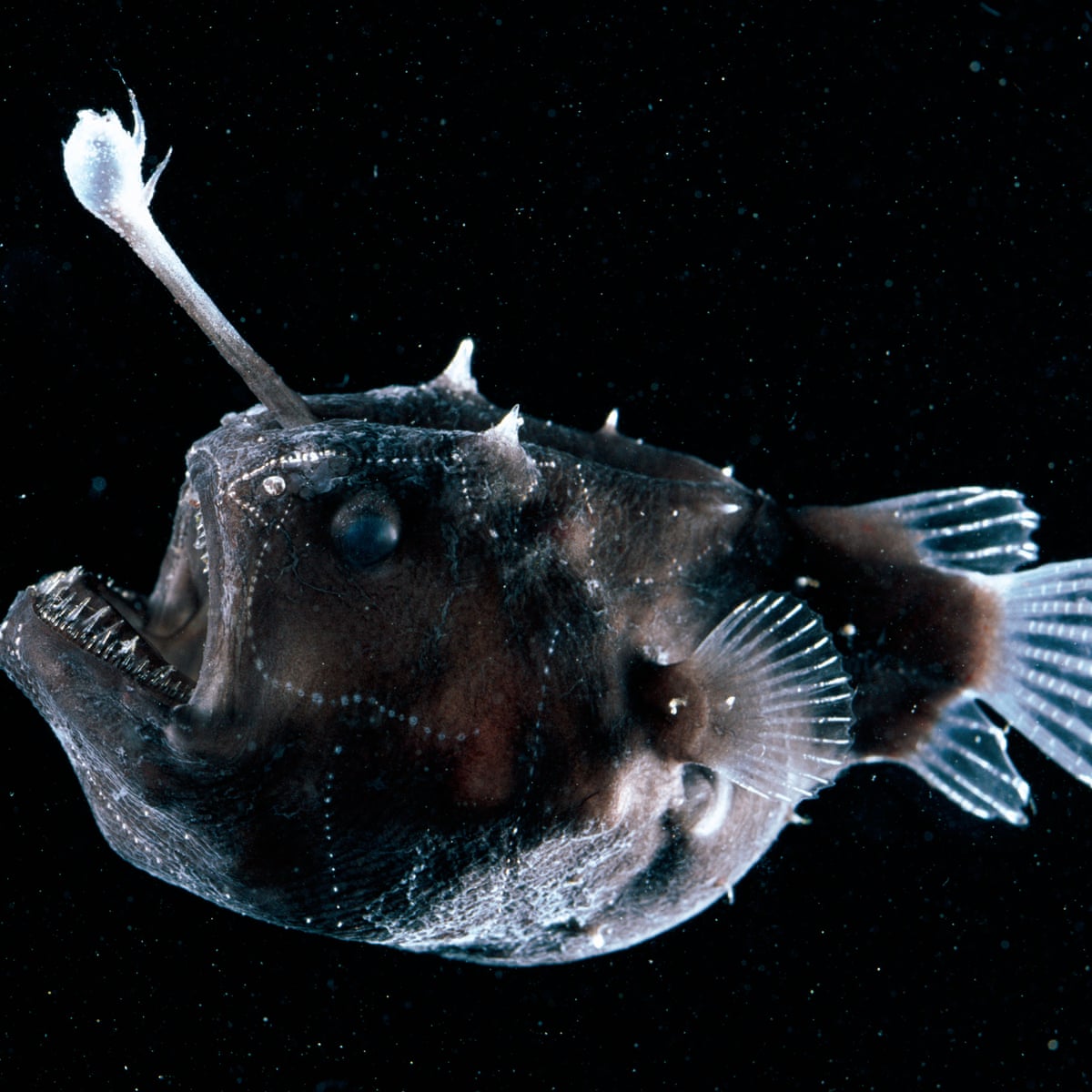
Few deep-sea creatures capture the human imagination quite like the anglerfish. Suspended in black water thousands of meters below the surface, this fish appears almost mythological, defined by its enormous mouth, needle-like teeth, and glowing lure. The anglerfish’s most famous feature is the bioluminescent appendage extending from its head, known as the esca. This glowing structure is not decorative; it is a finely tuned hunting tool.
Bioluminescence in anglerfish is produced by symbiotic bacteria housed within the esca. These bacteria emit light through chemical reactions that release energy in the form of photons. In the darkness of the deep sea, this light acts as a beacon, drawing curious prey close enough for the anglerfish to strike. The fish’s jaws can open wide enough to swallow animals nearly as large as itself, an adaptation essential in an environment where meals are unpredictable.
Perhaps even more alien than its appearance is the anglerfish’s reproductive strategy. In many species, tiny males permanently fuse to much larger females, merging tissues and circulatory systems. The male becomes little more than a living source of sperm, ensuring that reproduction can occur whenever the opportunity arises. This extreme solution reflects the vastness of the deep ocean, where encountering a mate may be a once-in-a-lifetime event.
2. Giant Isopod
At first glance, the giant isopod resembles an oversized pill bug or woodlouse, familiar creatures scaled up to unsettling proportions. Growing over half a meter in length, these crustaceans roam the deep-sea floor, where food is scarce and competition is fierce. Their segmented, armored bodies are built to withstand immense pressure, and their slow metabolism reflects the energy-poor environment they inhabit.
Giant isopods are scavengers, feeding on the remains of dead whales, fish, and other organisms that sink from the surface. When food becomes available, they can gorge themselves, sometimes eating so much that movement becomes temporarily impossible. This feast-or-famine lifestyle is common in the deep sea, where meals are unpredictable and survival depends on conserving energy during long periods of scarcity.
What makes the giant isopod truly otherworldly is not aggression or speed, but endurance. These animals can survive for years without eating, relying on stored energy and an extraordinarily efficient metabolism. In a place where life unfolds at a slower pace, the giant isopod embodies patience as a survival strategy, reminding us that in extreme environments, success often belongs to those who can wait.
3. Vampire Squid
Despite its dramatic name, the vampire squid is neither a true squid nor a bloodthirsty predator. It occupies a unique evolutionary position, representing a lineage that diverged from other cephalopods long ago. Living in oxygen-poor regions of the deep sea, the vampire squid has adapted to conditions that would be lethal to most animals.
Its dark, cloak-like webbing connects its arms, and when threatened, it can wrap itself in this membrane, exposing spiny projections that give it a fearsome appearance. Unlike many deep-sea predators, the vampire squid does not actively hunt large prey. Instead, it feeds on marine snow, a slow, constant rain of organic particles drifting down from the surface.
The vampire squid’s bioluminescence serves defensive rather than predatory purposes. It can emit clouds of glowing mucus, confusing potential predators and allowing the squid to escape in the darkness. This subtle use of light highlights a recurring theme in deep-sea biology: bioluminescence is not just a weapon, but a language of survival in a world without sunlight.
4. Goblin Shark
The goblin shark looks like a creature frozen midway through transformation, its elongated snout and protrusible jaws giving it an unmistakably alien profile. Living at depths of up to 1,300 meters, this shark is rarely encountered, and much of its behavior remains mysterious. What is clear, however, is that its unusual anatomy is perfectly suited to life in the deep.
The goblin shark’s snout is packed with electroreceptors that detect the faint electrical signals produced by other animals. In darkness where vision is limited, this sensory system allows the shark to locate prey with remarkable precision. When a target is detected, the shark’s jaws can rapidly extend forward, snapping shut in a fraction of a second.
This feeding mechanism reduces the need for speed and prolonged pursuit, conserving energy in an environment where efficiency is crucial. The goblin shark’s pale, almost translucent skin further enhances its otherworldly appearance, a reminder that pigmentation offers little advantage in the absence of light.
5. Dumbo Octopus
Named for its ear-like fins that resemble the animated elephant, the dumbo octopus glides through deep water with a gentle, almost whimsical grace. Found at depths exceeding 3,000 meters, this octopus inhabits one of the most extreme environments known to life.
Unlike many shallow-water octopuses, dumbo octopuses lack ink sacs. In total darkness, ink would serve no defensive purpose. Instead, these animals rely on quiet movement and camouflage to avoid detection. Their soft, gelatinous bodies are well-suited to withstanding high pressure, and their slow, energy-efficient swimming conserves precious resources.
The dumbo octopus feeds on small invertebrates, capturing prey with its arms and consuming it whole. Its large eyes, adapted to low-light conditions, provide what little visual information is available. There is something deeply moving about this creature’s existence, drifting silently through eternal night, embodying a delicate balance between fragility and resilience.
6. Barreleye Fish
The barreleye fish challenges our assumptions about what a face should look like. Its most striking feature is its transparent head, through which its barrel-shaped eyes can be seen. These eyes are not fixed in place but can rotate, allowing the fish to look upward for prey or forward to navigate its environment.
This unusual adaptation is a response to the faint traces of light that penetrate the deep ocean. Many potential prey items, such as jellyfish, are silhouetted against the dim glow from above. By looking upward through its transparent head, the barreleye fish can detect these silhouettes with remarkable sensitivity.
The transparency of the head also protects the eyes while allowing maximum light collection. This elegant solution demonstrates how evolution can arrive at designs that seem almost surreal, yet are grounded in optical physics and biological necessity.
7. Frilled Shark
Often described as a living fossil, the frilled shark possesses a body plan that has changed little over millions of years. Its long, eel-like form and frilled gill slits give it an ancient, serpentine appearance. Found in deep waters around the world, this shark moves with slow, sinuous motions that conserve energy.
The frilled shark’s jaws are lined with rows of sharp, trident-shaped teeth, ideal for gripping slippery prey such as squid. Its flexible body allows it to strike quickly when an opportunity arises, despite its generally unhurried demeanor.
The persistence of this ancient design suggests that it is highly effective. In the stable environment of the deep sea, where conditions change slowly, evolutionary pressure favors strategies that work consistently over long timescales. The frilled shark is a reminder that “primitive” does not mean inferior, but rather finely tuned to a specific way of life.
8. Yeti Crab
The yeti crab earned its nickname from the dense patches of hair-like structures covering its claws and legs. Discovered near hydrothermal vents, this crustacean lives in a world shaped by geological energy rather than sunlight. The vents release superheated, mineral-rich water, creating oases of life in the otherwise barren deep.
The yeti crab’s hairy appendages host colonies of bacteria that detoxify harmful chemicals and may also serve as a food source. By farming these bacteria, the crab taps into a chemical energy system independent of photosynthesis. This strategy illustrates one of the most extraordinary truths about deep-sea life: ecosystems can thrive without sunlight, powered instead by Earth’s internal heat.
In appearance and lifestyle, the yeti crab seems utterly alien, yet it follows the same biological principles as all life, adapting to available energy sources with remarkable ingenuity.
9. Deep-Sea Dragonfish
The deep-sea dragonfish looks like a nightmare brought to life, with a slender body, enormous teeth, and glowing organs along its sides. These photophores emit light used for communication, camouflage, and hunting. Some dragonfish species can even produce red light, a wavelength invisible to most deep-sea organisms.
This ability gives the dragonfish a private spotlight, allowing it to illuminate prey without being detected. The physics of light absorption in water makes red light especially rare at depth, turning this adaptation into a powerful evolutionary advantage.
The dragonfish’s translucent teeth prevent light from reflecting and giving away its position. Every aspect of its anatomy reflects a precise understanding, encoded by evolution, of how light behaves in the deep ocean.
10. Blobfish
Often labeled the “ugliest animal in the world,” the blobfish suffers from a misunderstanding rooted in human perspective. In its natural deep-sea habitat, the blobfish looks nothing like the gelatinous caricature seen in photographs taken at the surface. At depth, its body is supported by water pressure, maintaining a more typical fish-like shape.
The blobfish’s gelatinous tissue is less dense than water, allowing it to hover just above the seafloor without expending energy. This buoyancy is an elegant solution to the problem of movement in a high-pressure environment. Muscles and bones are minimized, reducing energy requirements.
What appears grotesque to us is, in reality, a masterpiece of adaptation. The blobfish reminds us that beauty and efficiency are context-dependent, shaped by environmental demands rather than human aesthetics.
11. Glass Squid
Glass squids are nearly invisible, their transparent bodies rendering them ghostlike in the deep. Transparency is a powerful form of camouflage in an environment where light is scarce but predators may still detect silhouettes. By allowing light to pass through their bodies, glass squids reduce their visibility from all angles.
Some species also possess bioluminescent organs that can match the faint light from above, a strategy known as counterillumination. This allows them to erase their shadow when viewed from below, blending seamlessly into the darkness.
The physics of light scattering and absorption underpin this remarkable invisibility. The glass squid’s body is a living demonstration of optical principles applied through biological evolution.
12. Sea Pig
The sea pig, a type of sea cucumber, appears almost comically out of place on the deep-sea floor. With its soft, pink body and stubby tube feet, it looks more like a discarded toy than a marine animal. Yet sea pigs play a crucial ecological role in deep-sea ecosystems.
They feed on organic material in the sediment, recycling nutrients and supporting the broader food web. Their tube feet allow them to move slowly across the seafloor, and they can even float short distances using currents.
The sea pig’s simplicity is deceptive. It is a highly specialized organism, perfectly suited to its niche. In its quiet way, it embodies the deep sea’s capacity to produce life forms that defy expectation while remaining deeply interconnected with their environment.
Conclusion: Alien Worlds Beneath Our Feet
The deep ocean is Earth’s most alien environment not because it is distant, but because it is hidden. These twelve creatures reveal a world governed by different rules of light, energy, and survival, where evolution has produced forms that challenge our sense of what life can be.
Yet for all their strangeness, these organisms are not anomalies. They are expressions of the same natural laws that shape life everywhere. Physics dictates how light travels, chemistry determines how energy flows, and biology finds ways to persist within those constraints. The deep sea is not another planet—it is a reminder that even on Earth, life can be as strange and wondrous as anything imagined among the stars.