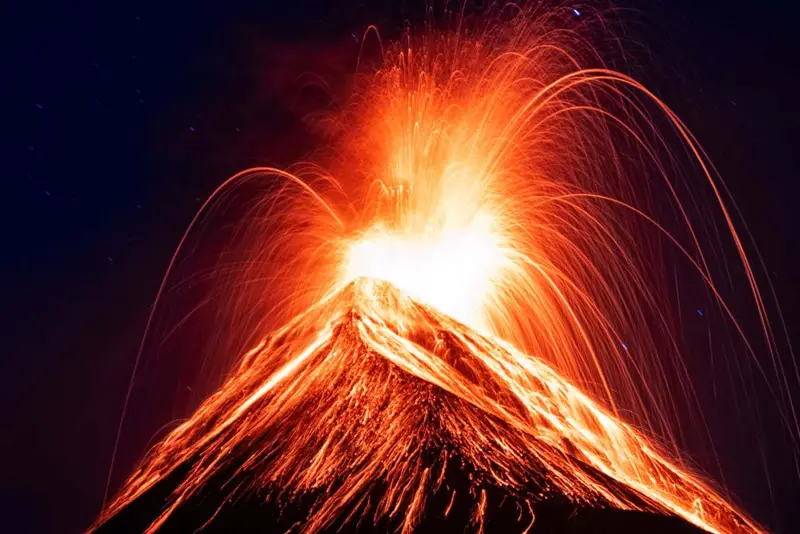
Mega-volcanoes occupy a unique and unsettling place in Earth science. They are not simply larger versions of familiar volcanoes that build conical mountains and erupt lava fountains. Instead, mega-volcanoes represent a fundamentally different scale of geological power, capable of reshaping continents, altering global climate, and influencing the course of biological and human history. Their eruptions are so vast that they challenge human intuition, stretching the limits of what we can imagine nature doing on its own.
Unlike typical volcanic eruptions, which may devastate regions or even nations, a mega-volcanic eruption has the potential to affect the entire planet. These events are rare, unfolding over timescales far longer than human civilizations, yet their consequences are so profound that they remain a persistent subject of scientific study and public anxiety. The terrifying aspect of mega-volcanoes lies not only in their explosive capacity, but also in their unpredictability and the sheer scale at which they operate.
The following eight facts explore why mega-volcanoes are among the most fearsome natural phenomena on Earth, grounding that fear in scientific understanding rather than exaggeration or myth.
1. Mega-Volcanoes Can Erupt With a Force Beyond Human Experience
The defining characteristic of a mega-volcano is the magnitude of its eruptions. Scientists measure volcanic eruptions using the Volcanic Explosivity Index, or VEI, which is a logarithmic scale. A typical explosive eruption might register a VEI of 4 or 5. Mega-volcanic eruptions reach VEI 8, the highest level on the scale, indicating an event that releases more than one thousand cubic kilometers of volcanic material.
To grasp this scale, it helps to think in terms of energy. A VEI-8 eruption releases energy comparable to thousands of the most powerful nuclear weapons detonated simultaneously. However, unlike a single explosion, a mega-eruption unfolds over days or weeks, relentlessly ejecting ash, gas, and molten rock into the atmosphere. The volume of material is so great that the volcano effectively empties a vast underground magma chamber, causing the surface above it to collapse and form a massive depression known as a caldera.
This level of destruction is beyond anything humans have witnessed in recorded history. Even the largest eruptions observed by modern science, such as those in the nineteenth century, are small in comparison. The terror lies in the fact that a mega-eruption is not merely destructive on a local scale; it overwhelms the environment so completely that it redefines what “disaster” means in geological terms.
2. Mega-Volcanoes Do Not Look Like Volcanoes at All
One of the most unsettling facts about mega-volcanoes is that they rarely resemble the iconic volcano shape familiar from textbooks and films. There is no towering cone, no constant plume of smoke, and often no obvious visual warning. Instead, a mega-volcano is typically identified by a broad, low-lying caldera that can span tens of kilometers.
These calderas are the scars left behind by previous mega-eruptions. When a massive magma chamber empties rapidly, the ground above it collapses, creating a vast basin. Over time, this basin may fill with lakes, forests, or even human settlements. To an untrained eye, the landscape may appear peaceful and stable, masking the immense forces beneath.
This invisibility is deeply frightening. Some of the most studied mega-volcanoes exist beneath national parks, farmlands, or populated regions. People may live their entire lives unaware that they reside atop a geological structure capable of global devastation. The threat is not announced by a dramatic mountain or constant activity, but by subtle signals that require careful scientific monitoring to detect.
The idea that one of Earth’s most destructive systems can hide in plain sight challenges human assumptions about danger. Mega-volcanoes remind us that the planet’s most powerful processes do not always advertise themselves.
3. Mega-Eruptions Can Trigger Global Climate Collapse
Perhaps the most terrifying consequence of a mega-volcanic eruption is its ability to alter Earth’s climate on a global scale. When a mega-volcano erupts, it injects enormous quantities of ash and sulfur-rich gases high into the stratosphere. Unlike lower atmospheric particles, which settle out relatively quickly, these materials can remain suspended for years.
Sulfur dioxide reacts with water vapor in the stratosphere to form sulfate aerosols, which reflect incoming sunlight back into space. This reduces the amount of solar energy reaching Earth’s surface, leading to a phenomenon known as volcanic winter. Temperatures can drop dramatically, not just near the eruption site, but across the entire planet.
Climate models and geological evidence suggest that a mega-eruption could lower global average temperatures by several degrees Celsius for years or even decades. Such cooling would shorten growing seasons, disrupt weather patterns, and cause widespread crop failures. The resulting food shortages could trigger famine on a scale unprecedented in human history.
What makes this particularly alarming is the speed of the change. Climate shifts driven by tectonic or orbital factors typically unfold over thousands of years, allowing ecosystems some time to adapt. A mega-eruption imposes abrupt change, compressing climatic upheaval into a few human lifetimes. The planet would survive, but human civilization, as currently structured, would face an existential crisis.
4. Mega-Volcanoes Have Nearly Caused Mass Extinctions
The geological record reveals that mega-volcanic activity has coincided with some of the most dramatic biological crises in Earth’s history. While asteroid impacts often capture public attention, prolonged and massive volcanic events have been equally capable of driving widespread extinction.
Large-scale volcanic eruptions can release not only ash and aerosols, but also vast amounts of carbon dioxide and other greenhouse gases. Over long periods, this can lead to extreme climate instability, oscillating between cooling and intense warming. Combined with acid rain, ocean acidification, and reduced sunlight, these conditions place enormous stress on living organisms.
Evidence from past extinction events suggests that volcanic activity played a significant role in reshaping life on Earth. Entire ecosystems collapsed, while others adapted or evolved to fill newly created ecological niches. In some cases, it took millions of years for biodiversity to recover fully.
This history is terrifying because it demonstrates that mega-volcanoes are not hypothetical threats. They are proven agents of planetary transformation. Humanity exists within the same physical laws and environmental systems that governed those ancient crises. The difference is that our global civilization is intricately interconnected and dependent on stable climate and agriculture, making us uniquely vulnerable to sudden, large-scale disruption.
5. Mega-Volcanoes Are Incredibly Difficult to Predict
Despite advances in geophysics and monitoring technology, predicting a mega-volcanic eruption remains one of the most challenging problems in Earth science. Volcanoes give warning signs, such as ground deformation, seismic activity, and changes in gas emissions, but interpreting these signals is complex.
Mega-volcanoes are especially problematic because their magma systems are vast and deep. Changes may occur slowly over centuries, producing signals that are subtle and easily mistaken for background geological noise. A period of unrest does not necessarily mean an eruption is imminent; some systems can remain restless for thousands of years without erupting.
This uncertainty creates a psychological challenge as well as a scientific one. Declaring an imminent mega-eruption too early could cause unnecessary panic and economic disruption, while missing critical warning signs could leave populations unprepared. Unlike smaller volcanoes, where evacuation zones can be clearly defined, the effects of a mega-eruption extend far beyond the immediate area.
The terrifying reality is that humanity may receive only limited warning of such an event. While scientists continue to refine monitoring techniques and improve models, the inherent complexity of Earth’s interior ensures that absolute certainty remains out of reach.
6. A Mega-Eruption Would Overwhelm Modern Civilization
Modern civilization is built on fragile systems: global trade networks, just-in-time food supply chains, and densely populated urban centers. These systems function efficiently under stable conditions, but they are poorly suited to sudden, global disruption.
A mega-volcanic eruption would strain or break these systems simultaneously. Ash clouds could ground air travel worldwide for extended periods, halting the rapid movement of people and goods. Agricultural collapse in multiple regions would drive food prices upward, exacerbating inequality and political instability. Energy production could be disrupted by damaged infrastructure and reduced solar power output.
Unlike localized disasters, which can be mitigated through international aid and relocation, a mega-eruption affects all nations at once. There would be no unaffected regions capable of providing sufficient assistance. The interconnected nature of modern society, often seen as a strength, becomes a vulnerability in the face of a truly global catastrophe.
This is not a scenario of complete human extinction, but it represents a profound challenge to the continuity of technological civilization. The terror lies in recognizing how dependent modern life is on environmental stability that we often take for granted.
7. Mega-Volcanoes Operate on Timescales That Dwarf Human History
Another unsettling aspect of mega-volcanoes is the timescale on which they operate. The intervals between mega-eruptions are measured in hundreds of thousands of years, far exceeding the span of recorded human history. This rarity can create a false sense of security, leading to the assumption that such events are too distant to matter.
From a geological perspective, however, these eruptions are not anomalies but recurring features of Earth’s dynamic system. The planet’s internal heat continuously drives mantle convection and magma generation. Over immense periods, pressure builds until it is released in catastrophic fashion.
Human civilizations, by contrast, are brief. Agriculture, cities, and written language have existed for only a few thousand years. Our entire technological era occupies a tiny fraction of geological time. A mega-eruption occurring within the next few centuries would be statistically unremarkable from Earth’s point of view, even though it would be unprecedented for humanity.
This mismatch in timescales is terrifying because it highlights how ill-prepared we are to think beyond generational horizons. Mega-volcanoes force us to confront the reality that Earth’s processes are indifferent to human schedules, priorities, or achievements.
8. Mega-Volcanoes Are a Reminder That Earth Is Not a Stable Machine
Perhaps the most profound and unsettling fact about mega-volcanoes is what they reveal about the nature of our planet. Earth is often perceived as a stable platform, a predictable environment upon which human history unfolds. Mega-volcanoes challenge this perception, exposing Earth as a dynamic, restless system driven by immense internal energy.
The continents we inhabit float atop moving tectonic plates. Beneath them, heat from Earth’s formation and radioactive decay continues to reshape the interior. Mega-volcanoes are surface expressions of this deep, ongoing activity. They are not malfunctions, but natural consequences of how the planet works.
This realization can be emotionally destabilizing. It suggests that no amount of technological progress can fully insulate humanity from the forces that built the planet itself. At the same time, it invites a more mature relationship with Earth—one grounded in respect, humility, and scientific understanding rather than illusionary control.
Mega-volcanoes terrify not because they are evil or malicious, but because they reveal the true scale of nature’s power. They remind us that civilization exists at the pleasure of geological stability, and that our long-term survival depends on learning, preparation, and cooperation on a planetary scale.
Conclusion: Fear Grounded in Reality
Mega-volcanoes are terrifying not because they are likely to erupt tomorrow, but because they represent an authentic, scientifically grounded threat that transcends borders and generations. They operate silently beneath the surface, storing energy over immense periods before releasing it in ways that can reshape climate, ecosystems, and civilization itself.
Understanding mega-volcanoes does not mean surrendering to fear. Instead, it offers an opportunity to appreciate Earth’s complexity and to invest in scientific monitoring, global cooperation, and resilience planning. The terror they inspire is a rational response to their power, but it can also be transformed into motivation—an incentive to take seriously the fragile balance upon which human life depends.
In confronting mega-volcanoes, humanity confronts the planet itself, not as a passive home, but as a living, evolving world whose deepest forces continue to shape our destiny.