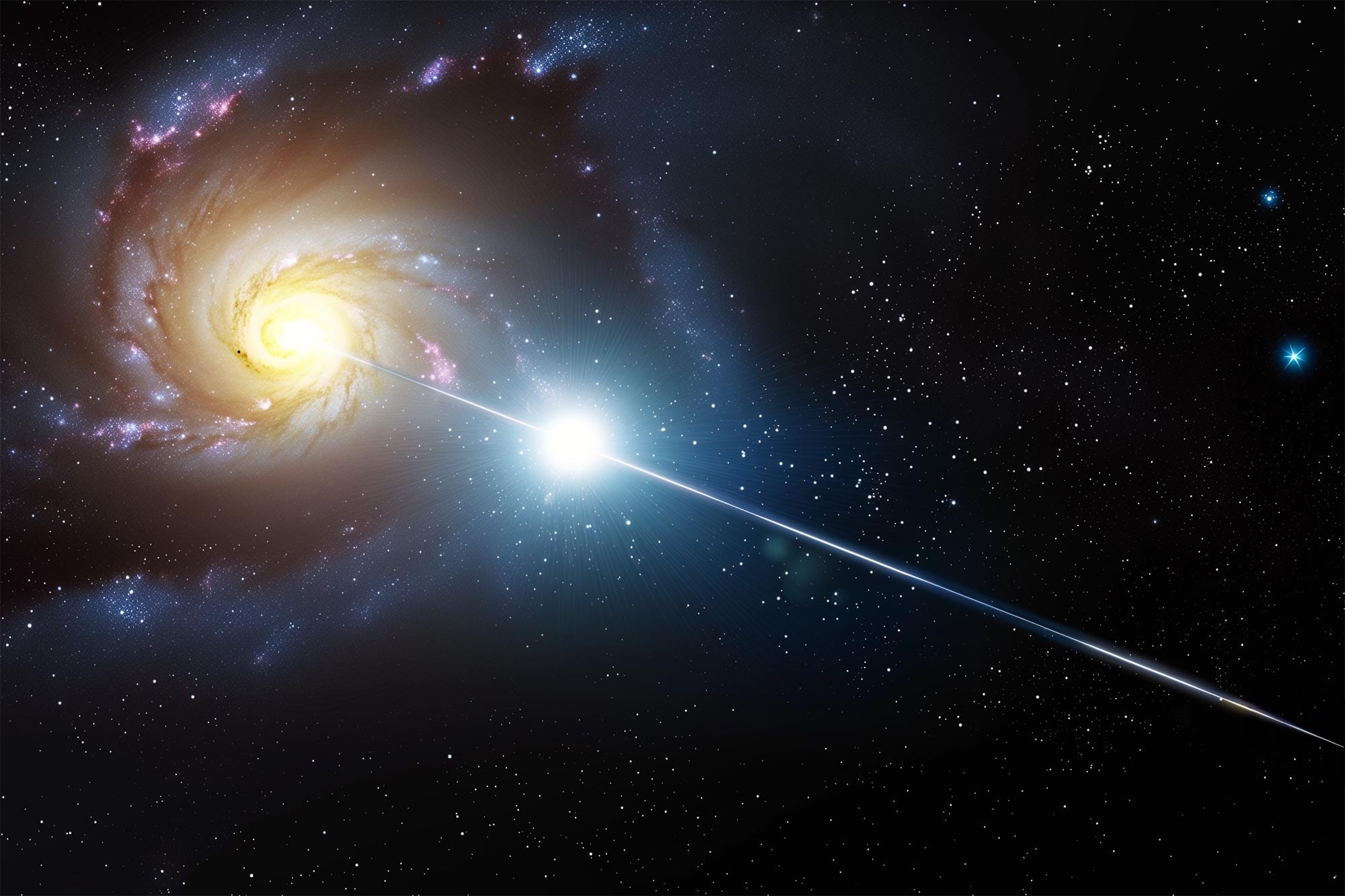
In the vast silence of the cosmos, where light can take billions of years to cross the emptiness between galaxies, there exist signals so brief and so powerful that they momentarily outshine entire galaxies in radio energy. These signals, known as Fast Radio Bursts, or FRBs, last only milliseconds, yet they carry within them clues about some of the most extreme environments in the universe. They arrive without warning, vanish almost instantly, and for years left astronomers puzzled, unsettled, and deeply fascinated. Fast Radio Bursts are not merely astronomical curiosities; they are messages from deep space that challenge our understanding of astrophysics, matter, and the structure of the universe itself.
The story of FRBs is a modern scientific mystery, unfolding in real time. Unlike ancient celestial phenomena that have been studied for centuries, FRBs were discovered only in the twenty-first century. Their sudden appearance in astronomical data forced scientists to confront a new class of cosmic events, ones that did not fit neatly into existing theories. To understand what FRBs are, why they matter, and what they might ultimately reveal, we must explore not only their physical properties but also the human effort to detect, interpret, and explain them.
The First Whisper from the Void
The history of Fast Radio Bursts begins quietly, not with a dramatic observation at the telescope, but with a careful reexamination of archived data. In 2007, astronomers analyzing observations from a radio telescope in Australia identified a brief, intense pulse of radio waves that appeared to originate far beyond our galaxy. This signal, later nicknamed the “Lorimer Burst,” was unlike anything seen before. It lasted just a few milliseconds, yet its characteristics suggested it had traveled billions of light-years to reach Earth.
At first, skepticism dominated the response. Astronomers are trained to distrust single, unexplained signals, especially ones detected only once. The universe is full of noise, and Earth itself is a prolific source of radio interference. It took years of debate, additional observations, and improved detection techniques before the astronomical community accepted that Fast Radio Bursts were real astrophysical phenomena rather than instrumental artifacts or terrestrial interference.
This initial uncertainty is an essential part of the FRB story. It illustrates how science advances not through immediate certainty, but through careful verification and repeated observation. Once additional FRBs were detected by different telescopes around the world, their cosmic origin became undeniable. The universe, it seemed, was producing brief flashes of radio energy on a scale that had gone unnoticed until modern technology made their detection possible.
What Exactly Is a Fast Radio Burst?
At their most basic level, Fast Radio Bursts are extremely short-lived bursts of radio-frequency electromagnetic radiation. Their durations are typically measured in milliseconds, yet during that fleeting moment they can release as much energy in radio waves as the Sun emits over several days or even longer. This combination of brevity and intensity immediately suggests that FRBs originate from compact, highly energetic astrophysical sources.
One of the defining characteristics of FRBs is their dispersion. As radio waves travel through space, they pass through clouds of ionized gas, which cause lower-frequency waves to slow down more than higher-frequency ones. This effect produces a distinctive sweep in frequency over time when the signal is detected on Earth. By measuring this dispersion, astronomers can estimate how much material the signal has passed through, and therefore infer its distance.
For most FRBs, the amount of dispersion observed is far greater than what could be accounted for by the interstellar medium within our own galaxy. This implies that they originate at extragalactic distances, often billions of light-years away. In other words, these millisecond signals have traversed an immense fraction of the observable universe before reaching our instruments.
The Challenge of Detection
Detecting Fast Radio Bursts is a formidable technical challenge. Their extremely short duration means that telescopes must be continuously monitoring large portions of the sky with high time resolution. Unlike stars or galaxies, which can be observed repeatedly at known positions, FRBs appear unpredictably and vanish almost instantly.
Early radio surveys were not optimized for this kind of transient phenomenon. Many FRBs likely passed unnoticed simply because no one was looking for them in the right way. The recognition that the radio sky is dynamic, filled with brief and energetic events, has transformed observational strategies in radio astronomy. Modern instruments are now designed to scan wide areas of the sky, process vast amounts of data in real time, and flag potential FRB candidates for further analysis.
The development of dedicated facilities and sophisticated data-processing algorithms has led to a dramatic increase in the number of known FRBs. What was once a single enigmatic event has become a growing population of cosmic signals, each carrying its own information about its origin and journey through space.
One-Time Events and Cosmic Repeaters
As the catalog of Fast Radio Bursts grew, astronomers made a surprising discovery: not all FRBs are the same. While many appear to be one-off events, detected only once despite extensive follow-up observations, others have been observed to repeat. These repeating FRBs emit multiple bursts over time, sometimes with irregular intervals and sometimes with apparent patterns.
The existence of repeating FRBs has profound implications for their origins. A one-time burst could plausibly result from a catastrophic event that destroys its source, such as the collapse of a massive star or the merger of compact objects. A repeating source, by contrast, must survive the emission of each burst, pointing to a different kind of physical mechanism.
One of the first known repeating FRBs was traced to a small, distant galaxy, allowing astronomers to precisely locate its position in the sky. This localization marked a turning point in FRB research, transforming them from mysterious signals into objects that could be studied in their astrophysical context. It became clear that FRBs are not a single phenomenon with a single cause, but rather a diverse class of events with potentially multiple origins.
Magnetars and Extreme Physics
Among the leading explanations for many Fast Radio Bursts is a type of neutron star known as a magnetar. Neutron stars are the incredibly dense remnants of massive stars that have ended their lives in supernova explosions. A magnetar is a special kind of neutron star with an extraordinarily strong magnetic field, trillions of times stronger than Earth’s.
The environments around magnetars are extreme beyond ordinary human experience. Their intense magnetic fields can twist and fracture the star’s crust, releasing enormous amounts of energy in sudden bursts. These magnetic disturbances can accelerate particles and generate powerful electromagnetic emissions, including radio waves.
In recent years, a breakthrough occurred when astronomers detected an FRB-like radio burst originating from a magnetar within our own galaxy. Although this burst was less energetic than most extragalactic FRBs, its properties were strikingly similar. This observation provided compelling evidence that at least some FRBs can be produced by magnetars, linking these mysterious signals to known astrophysical objects.
However, the magnetar explanation does not necessarily account for all FRBs. The diversity of observed behaviors, including differences in repetition rates, energy output, and polarization, suggests that multiple physical processes may be at work. FRBs may represent a family of phenomena rather than a single, unified class.
The Role of Host Galaxies
Understanding where FRBs occur within the universe is crucial for unraveling their nature. By identifying the host galaxies from which FRBs originate, astronomers can learn about the environments that give rise to these events. Host galaxies vary widely, ranging from small, star-forming dwarf galaxies to large, mature galaxies similar to the Milky Way.
This diversity indicates that FRBs are not confined to a single type of cosmic environment. Some appear to originate in regions with active star formation, where massive stars and their remnants are abundant. Others are found in more quiescent regions, suggesting older stellar populations. The locations of FRBs within their host galaxies, whether near galactic centers or in outer regions, also provide clues about their progenitors.
The study of host galaxies has transformed FRB research from a purely observational puzzle into a broader astrophysical investigation. Each localized FRB becomes a data point in a larger effort to understand how extreme astrophysical processes operate across different cosmic settings.
Signals Shaped by Their Journey
Fast Radio Bursts are not only interesting because of where they come from, but also because of what happens to them along the way. As these signals travel through interstellar and intergalactic space, they interact with diffuse plasma, magnetic fields, and cosmic structures. These interactions leave subtle imprints on the radio waves, encoding information about the medium they have traversed.
One of the most important effects is dispersion, which has already provided evidence for the extragalactic origin of FRBs. Another is scattering, which can broaden the signal in time and reveal the presence of turbulent plasma. Polarization measurements, which describe the orientation of the radio waves’ electric field, can indicate the strength and structure of magnetic fields along the line of sight.
In this way, FRBs function as cosmic probes. They illuminate otherwise invisible material between galaxies, offering a unique method for studying the distribution of matter in the universe. This capability has raised the possibility that FRBs could be used as tools for cosmology, helping to address fundamental questions about the large-scale structure of the cosmos.
Fast Radio Bursts and the Missing Matter Problem
One of the long-standing puzzles in cosmology concerns the location of the universe’s “missing” ordinary matter. Observations suggest that a significant fraction of the matter made of protons and neutrons is not contained within stars or galaxies, but dispersed in a diffuse, ionized form throughout intergalactic space. Detecting this material directly has proven extremely challenging.
Fast Radio Bursts offer a promising solution to this problem. Because their signals are affected by the total amount of ionized material they pass through, precise measurements of their dispersion can be used to estimate the density of matter along their paths. By combining these measurements with information about the distances to FRB sources, astronomers can map the distribution of otherwise invisible matter.
Early studies using FRBs have already provided evidence that much of the missing matter resides in the intergalactic medium. This application transforms FRBs from mysterious phenomena into powerful scientific tools, capable of addressing questions that extend far beyond their own origins.
The Question of Artificial Origins
Given their intensity, brevity, and apparent randomness, Fast Radio Bursts have occasionally inspired speculation about artificial origins. Could they be signals from advanced extraterrestrial civilizations? While such ideas capture the imagination, scientific analysis strongly favors natural explanations.
The energies involved in FRBs are immense, and their properties are consistent with known astrophysical processes occurring under extreme conditions. Moreover, the observed diversity of FRBs, including those linked to magnetars, fits within the framework of natural cosmic phenomena. Science proceeds by favoring explanations that are consistent with established knowledge and supported by evidence, and at present there is no credible indication that FRBs are artificial in origin.
Nevertheless, the very fact that FRBs invite such speculation speaks to their mysterious nature and to the human tendency to wonder whether we are alone in the universe. In this sense, FRBs occupy a space not only in astrophysics but also in the broader cultural imagination.
Technological Advances and the FRB Revolution
The rapid progress in FRB research is inseparable from advances in technology. Modern radio telescopes are equipped with sensitive receivers, wide fields of view, and powerful computing systems capable of processing enormous volumes of data. Machine learning algorithms are increasingly used to identify FRB candidates amid a sea of noise and interference.
New facilities have been designed with transient astronomy in mind, recognizing that the universe is far more dynamic than once believed. These instruments can respond quickly to detected events, coordinating observations across different wavelengths to capture as much information as possible.
This technological revolution has changed how astronomers think about the sky. Instead of viewing it as a static backdrop, they now see it as a constantly evolving landscape, filled with fleeting events that require rapid and flexible observation strategies. Fast Radio Bursts have played a central role in driving this shift.
Theoretical Models and Open Questions
Despite significant progress, many questions about Fast Radio Bursts remain unanswered. What precise physical mechanisms generate the radio emission? Why do some sources repeat while others do not? How are FRBs related to other high-energy phenomena such as gamma-ray bursts or supernovae?
Theoretical models must account for the extreme energies involved, the short timescales, and the observed diversity of behaviors. This is a demanding task, requiring insights from plasma physics, magnetohydrodynamics, and relativistic astrophysics. Competing models continue to be refined and tested against new observations.
The uncertainty surrounding FRBs is not a weakness of science, but a sign of its vitality. Each unanswered question represents an opportunity for discovery, driving further observation, experimentation, and theoretical development.
Fast Radio Bursts and the Nature of Discovery
The story of FRBs highlights how scientific discovery often occurs at the intersection of preparedness and surprise. No one set out specifically to find Fast Radio Bursts. They were discovered because astronomers were collecting data, developing new tools, and remaining open to unexpected results.
This openness is a defining feature of science. It allows researchers to recognize significance in anomalies rather than dismissing them outright. The willingness to question assumptions and to follow evidence wherever it leads has transformed FRBs from a puzzling signal into a rich field of study.
In this sense, FRBs remind us that the universe is always capable of surprising us. Even in an era of sophisticated theories and powerful instruments, there remain phenomena that challenge our understanding and expand our horizons.
A Window into Extreme Cosmic Environments
Fast Radio Bursts provide a rare glimpse into environments that cannot be replicated on Earth. The conditions required to produce such intense, rapid emissions involve densities, magnetic fields, and energies far beyond terrestrial experience. By studying FRBs, physicists and astronomers can test theories of matter and energy under extreme conditions.
These studies have implications beyond astrophysics. They inform our understanding of fundamental physics, including the behavior of plasma and the interaction of radiation with matter. In this way, FRBs connect the largest scales of the universe with the most fundamental laws of nature.
The Human Dimension of the FRB Mystery
Behind every detection of a Fast Radio Burst lies a human story. Teams of scientists work long hours designing instruments, analyzing data, debating interpretations, and refining theories. The excitement of discovery is often accompanied by frustration, uncertainty, and the slow accumulation of evidence.
The collaborative nature of modern astronomy is especially evident in FRB research. Observations and data are shared across international boundaries, reflecting the global nature of the scientific enterprise. This collective effort underscores the idea that understanding the universe is a shared human endeavor.
Looking Ahead into the Cosmic Unknown
As new telescopes come online and existing ones are upgraded, the pace of FRB discovery is expected to accelerate. Larger samples will allow for statistical studies that can reveal patterns and correlations previously hidden by small numbers. Improved localization techniques will connect more FRBs to their host galaxies, deepening our understanding of their origins.
There is reason to believe that FRBs may ultimately illuminate aspects of the universe that are currently inaccessible by other means. Whether as probes of intergalactic matter, tests of fundamental physics, or windows into extreme astrophysical environments, they hold immense scientific promise.
The Enduring Allure of Fast Radio Bursts
Fast Radio Bursts occupy a unique place in modern astrophysics. They are fleeting yet powerful, distant yet detectable, mysterious yet increasingly understood. They remind us that the universe is not only vast, but also dynamic and unpredictable.
To study FRBs is to engage with one of the most exciting frontiers of contemporary science. Each burst is a brief flash of information, a momentary signal from deep space that invites us to listen more closely to the cosmos. In pursuing their secrets, we are continuing a long human tradition of seeking meaning in the patterns of the sky.
The mystery of Fast Radio Bursts is far from resolved. Yet in that uncertainty lies their greatest value. They challenge us to refine our theories, improve our instruments, and expand our imagination. In doing so, they deepen our understanding not only of the universe, but of our own capacity to explore and comprehend it.