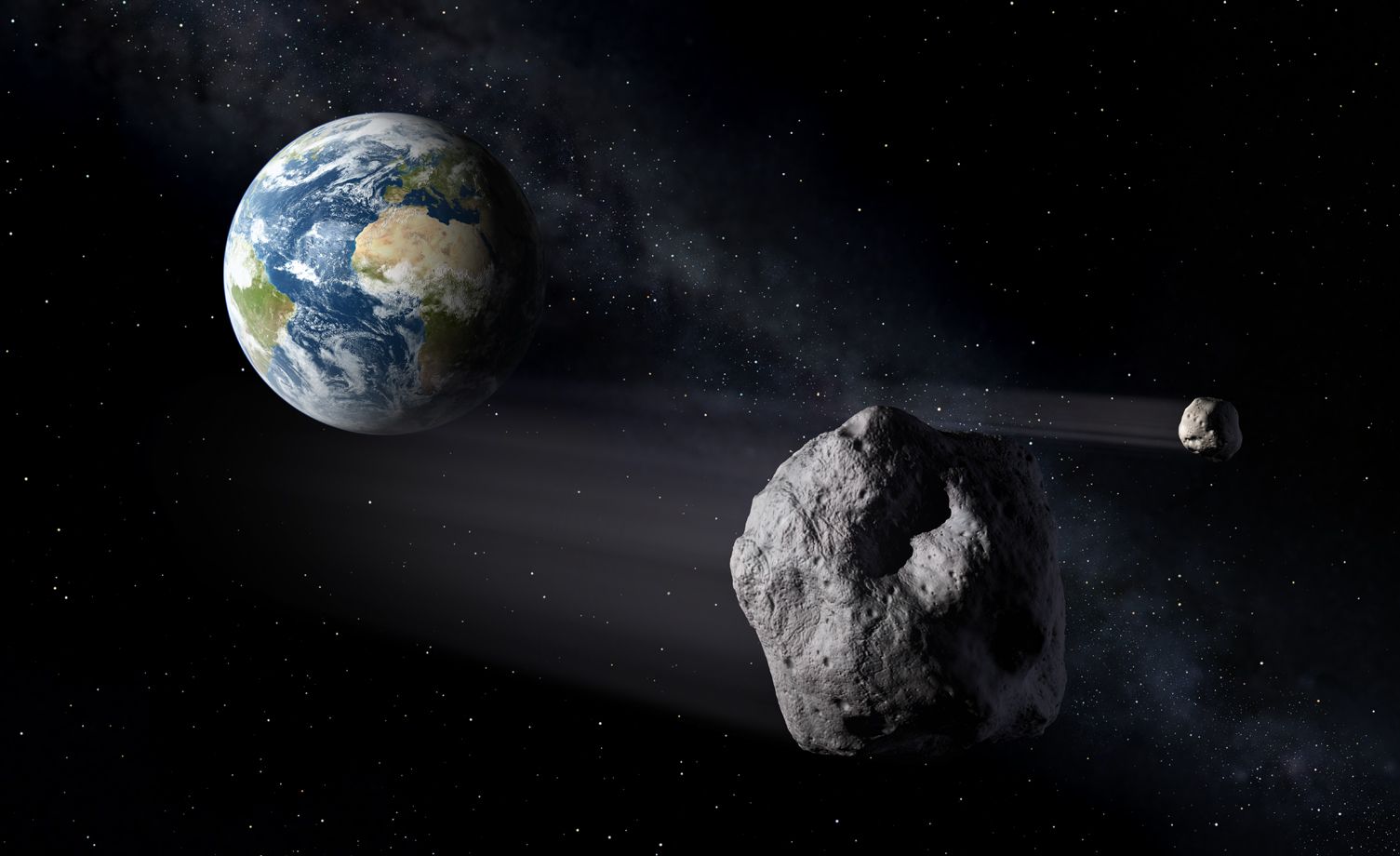
The history of Earth is written not only in mountains and oceans, but in near-misses—moments when cosmic objects passed close enough to remind us how fragile our world really is. Asteroids do not announce themselves with sound or warning. They arrive silently, following the same physical laws that keep planets in orbit, and sometimes those laws bring them terrifyingly close to home.
What makes these stories chilling is not just the proximity of danger, but how recently many of these encounters occurred, how narrowly disaster was avoided, and how often humanity had no idea until after the moment had passed. These are not ancient, abstract threats from a distant past. They are modern reminders that Earth exists in a cosmic shooting gallery.
Here are six scientifically documented times when Earth narrowly escaped an asteroid impact—and what each encounter reveals about our planet, our vulnerability, and our growing awareness of the sky.
1. The 2012 DA14 Flyby That Slipped Between Earth and Satellites
On February 15, 2013, a small asteroid named 2012 DA14 passed extraordinarily close to Earth—closer than many of our own satellites. Measuring roughly 45 meters in diameter, this space rock traveled at a speed of about 7.8 kilometers per second relative to Earth.
At its closest approach, 2012 DA14 passed only about 27,700 kilometers above Earth’s surface. To put that into perspective, geostationary satellites orbit at approximately 35,786 kilometers. This asteroid slipped through the region of space we actively occupy.
What makes this event especially haunting is timing. On the very same day, but hours earlier and on the opposite side of the planet, the Chelyabinsk meteor exploded over Russia. That object was much smaller, about 20 meters wide, yet it injured over 1,500 people due to shattered glass from the shockwave.
2012 DA14, however, would have been far worse. Had it struck Earth, it would not have caused a mass extinction, but the explosion could have devastated a city. The energy released would have been comparable to several hundred kilotons of TNT—many times more powerful than the Hiroshima bomb.
The asteroid was discovered only a year before its close approach. Before modern surveys, such an object might have passed unnoticed until after the fact. Emotionally, this encounter marked a turning point. Humanity realized that the sky was not just beautiful—it was active, populated, and occasionally dangerous.
2. Asteroid 99942 Apophis and the Anxiety of 2029
Few asteroids have ever captured public and scientific attention like Apophis. Discovered in 2004, this near-Earth asteroid is approximately 340 meters wide—large enough to cause continent-scale devastation if it struck Earth.
Initial calculations were alarming. Early orbital predictions suggested a small but non-negligible chance that Apophis could collide with Earth in 2029. For a brief period, it held the highest impact probability ever recorded for an object of its size.
Further observations refined its orbit and ruled out a 2029 impact. But the story didn’t end there. Scientists identified a tiny region of space called a gravitational keyhole. If Apophis passed through this narrow zone during its 2029 flyby, Earth’s gravity would alter its orbit just enough to cause a collision in 2036 or later.
The 2029 flyby will be extraordinarily close—about 31,600 kilometers above Earth’s surface, closer than many satellites. Apophis will be visible to the naked eye from parts of Earth, appearing as a moving star in the night sky.
Subsequent radar observations have now ruled out impact scenarios for at least the next century. Still, the emotional imprint remains. Apophis taught humanity what it feels like to look at a calendar and imagine a date when the sky might fall.
It transformed planetary defense from a theoretical discussion into a practical necessity. The relief that followed did not erase the lesson: we are capable of seeing danger coming—but only if we are looking.
3. The 1972 Great Daylight Fireball That Skipped Off Earth
On August 10, 1972, a massive fireball entered Earth’s atmosphere over Utah and traveled north toward Canada. Unlike most meteors, which plunge downward and burn up, this object skimmed the atmosphere at a shallow angle.
The asteroid—estimated to be around 10 meters in diameter—entered the atmosphere at roughly 15 kilometers per second. Instead of disintegrating completely or impacting the surface, it passed through the upper atmosphere, lost some mass, and then exited back into space.
This event, known as the Great Daylight Fireball, was witnessed by thousands of people and recorded by cameras. It was one of the clearest demonstrations that Earth’s atmosphere is not just a shield, but also a boundary where near-misses can occur.
Had the angle been slightly steeper, the object could have exploded in the atmosphere or reached the ground. Had it been slightly larger, it might have survived atmospheric passage entirely and caused significant damage.
What makes this encounter emotionally unsettling is how little margin existed between spectacle and catastrophe. The difference between a harmless fireball and a destructive impact was a matter of degrees—a subtle geometric detail determined long before humanity existed.
4. Asteroid 2004 FH: A Flyby Closer Than Weather Satellites
Just weeks after the discovery of Apophis, another asteroid delivered a shock. On March 18, 2004, a small asteroid named 2004 FH passed astonishingly close to Earth—only about 43,000 kilometers from the surface.
This asteroid was only about 30 meters wide, but its proximity was extraordinary. It passed well inside the orbit of many weather and communications satellites. Even more alarming, it was discovered just three days before its closest approach.
Had 2004 FH entered Earth’s atmosphere, it would likely have exploded with energy comparable to the Chelyabinsk event or greater. A city beneath its airburst could have suffered extensive damage.
The emotional weight of this encounter lies in ignorance. For nearly all of human history, objects like 2004 FH would have passed unnoticed until they hit—or missed—by sheer chance. Modern detection gave us awareness, but not much time.
This flyby underscored a sobering truth: many potentially dangerous asteroids are small, fast, and difficult to detect. They do not announce themselves with years of warning. Sometimes, survival comes down to luck.
5. The Tunguska-Scale Near-Miss of 2019 OK
On July 25, 2019, an asteroid now known as 2019 OK passed within about 65,000 kilometers of Earth. It was estimated to be between 57 and 130 meters in diameter—large enough to cause regional devastation if it had impacted.
What makes this event particularly disturbing is that it was discovered only hours before its closest approach. The asteroid approached from the direction of the Sun, rendering it nearly invisible to ground-based telescopes until it was almost upon us.
At its largest estimated size, 2019 OK could have released energy comparable to the Tunguska event of 1908, which flattened over 2,000 square kilometers of Siberian forest. A similar event over a populated area today would be catastrophic.
This encounter exposed a blind spot in asteroid detection. Objects approaching from sunward directions are extremely difficult to detect with current systems. It highlighted the urgent need for space-based infrared observatories capable of spotting dark asteroids against the glare of the Sun.
Emotionally, 2019 OK was a wake-up call. It reminded scientists and the public alike that despite technological progress, Earth remains partially blind to the very threats that could change civilization in a single day.
6. The Chelyabinsk Asteroid That Almost Went Much Worse
On February 15, 2013, a 20-meter asteroid entered Earth’s atmosphere over Chelyabinsk, Russia. Traveling at approximately 19 kilometers per second, it exploded at an altitude of about 30 kilometers.
The resulting airburst released energy equivalent to roughly 400–500 kilotons of TNT. The shockwave shattered windows across the region, damaged buildings, and injured more than 1,500 people—mostly from flying glass.
What many people don’t realize is how narrowly this event avoided becoming far worse. Had the asteroid entered at a slightly steeper angle, it could have penetrated deeper into the atmosphere before exploding, concentrating damage over a smaller area. Had it been just a bit larger, the explosion could have caused structural collapse and fatalities.
Even more unsettling is that the Chelyabinsk asteroid was completely undetected before impact. It arrived from the direction of the Sun, invisible to telescopes. Humanity had no warning.
Chelyabinsk stands as a modern reminder that asteroid impacts are not ancient history. They are present-day risks. The fact that this event caused no deaths was not the result of preparation or defense, but chance.
A Planet That Survives by Chance and Vigilance
These six encounters share a common thread: narrow margins. In each case, Earth escaped disaster by distances that sound large in human terms but are tiny on a cosmic scale. A few thousand kilometers, a few degrees of angle, a slight change in timing—these are the factors that separate survival from catastrophe.
Asteroids do not aim. They do not threaten. They simply follow gravity. That indifference is what makes them frightening. There is no malice, no warning, and no negotiation.
Yet there is hope woven into these stories. Each near-miss has sharpened our awareness, improved our detection systems, and strengthened international cooperation. Planetary defense is no longer science fiction. It is a growing scientific discipline grounded in physics, observation, and preparation.
Emotionally, these events invite humility. Earth has survived not because it is protected by fate, but because of probability, physics, and increasingly, human vigilance. The sky is not hostile—but it is active.
Every clear night, countless rocks pass silently through nearby space. Most will miss. Some will burn. A few may one day strike. The difference between disaster and survival lies in knowledge, preparation, and the willingness to keep watching the stars—not just in wonder, but in responsibility.
Because the universe is vast, indifferent, and beautiful. And Earth, fragile and alive, is worth protecting.