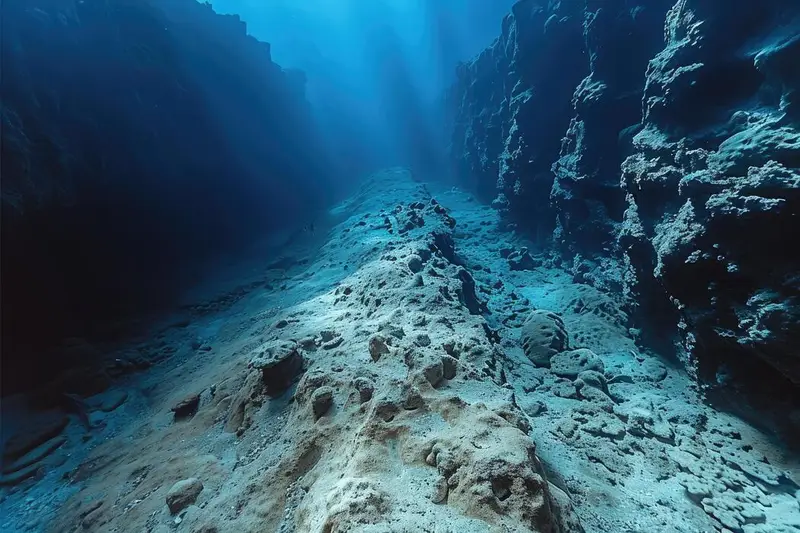
The ocean has always carried a special kind of mystery. Its surface reflects the sky, familiar and beautiful, but beneath that shimmer lies a world so alien that it feels closer to science fiction than to everyday life. At the very heart of this mystery lies the Mariana Trench, the deepest known place on Earth. It is a wound in the planet’s crust, a vast underwater canyon plunging miles below the waves, where sunlight never reaches and pressure becomes almost unimaginable. To ask how deep the Mariana Trench is is not just to ask for a number. It is to ask how far life can be pushed, how resilient nature can be, and how much of our own planet remains unexplored.
The Mariana Trench is not merely a geographical feature. It is a frontier. It challenges our ideas of habitability, survival, and the limits of biology. And astonishingly, even in this crushing darkness, life persists.
Where the Mariana Trench Lies and Why It Exists
The Mariana Trench is located in the western Pacific Ocean, east of the Mariana Islands, near the boundary between two massive tectonic plates. One plate slowly slides beneath the other in a process known as subduction. Over millions of years, this movement has dragged the ocean floor downward, creating a trench of staggering depth.
Unlike mountains, which rise above the Earth’s surface and are easy to see, trenches are hidden scars. They are invisible from space, concealed beneath kilometers of water. Yet the Mariana Trench is longer than many mountain ranges, stretching over 2,500 kilometers, curving like a giant crescent across the ocean floor.
At its deepest point lies a small valley within the trench known as the Challenger Deep. This is the deepest point known in Earth’s oceans and the destination of humanity’s most daring deep-sea explorations.
How Deep Is the Mariana Trench, Really?
The depth of the Mariana Trench is difficult to fully grasp because it exists far beyond normal human experience. Measurements place the Challenger Deep at roughly 11 kilometers below sea level. To put this into perspective, if Mount Everest were placed upside down inside the trench, its peak would still not reach the surface of the ocean.
At this depth, the pressure is over a thousand times greater than atmospheric pressure at sea level. Every square centimeter experiences a force equivalent to having several cars stacked on top of it. Water does not gently surround objects there; it presses in with relentless force.
Temperature in the deepest parts of the trench hovers just above freezing, despite the absence of sunlight. Darkness is absolute. No hint of dawn, no glow of stars, only blackness broken occasionally by the faint light of bioluminescent creatures.
Reaching this depth is extraordinarily difficult. Only a handful of crewed and uncrewed missions have ever descended to the Challenger Deep. Each descent is a technological gamble, a confrontation between human engineering and the immense power of the deep ocean.
The Environment at the Bottom of the World
The conditions in the Mariana Trench are among the harshest on Earth. Sunlight vanishes within the first few hundred meters of the ocean, and by the time one reaches the trench, the world is permanently night. Photosynthesis is impossible. The entire food web depends on material drifting down from above or on chemical energy sources.
The pressure is so intense that it would instantly crush an unprotected human body. Metals behave differently. Plastics become brittle. Even water itself changes subtly under such extreme conditions.
Yet the trench is not a barren void. Sediments collect at the bottom, forming a soft, fine mud that slowly accumulates over time. Organic material from the surface, known as marine snow, drifts down like a ghostly blizzard, providing a steady, if sparse, source of nutrients.
This environment is stable in a strange way. Temperatures change very little, and storms on the surface barely disturb the deep. The greatest challenge is not chaos, but scarcity and pressure.
Life in Total Darkness
For a long time, scientists believed that life could not exist at such extreme depths. The absence of light, crushing pressure, and lack of food seemed insurmountable obstacles. This assumption turned out to be profoundly wrong.
Life in the Mariana Trench does not rely on sunlight. Instead, it survives through a combination of scavenging, predation, and chemical processes. Many organisms feed on falling debris, while others prey on smaller creatures that do the same.
Some life forms rely on chemosynthesis, a process in which bacteria convert chemical energy from compounds like methane or sulfur into usable energy. These bacteria form the base of food webs completely independent of the Sun, revealing that life does not need light, only energy.
The Strange Creatures of the Deepest Ocean
The creatures living in the Mariana Trench are among the most unusual organisms ever discovered. Their bodies tell a story of extreme adaptation, shaped by pressure, darkness, and isolation.
One of the most iconic residents is the hadal snailfish. Translucent and ghostlike, it appears almost fragile, yet it thrives where few vertebrates can survive. Its body lacks rigid bones, which would shatter under pressure, and instead relies on soft tissues and specialized proteins that remain stable in extreme conditions.
Amphipods, shrimp-like crustaceans, are abundant in the trench. Some grow much larger than their shallow-water relatives, a phenomenon known as deep-sea gigantism. These scavengers swarm bait dropped by research vessels, revealing a surprisingly active ecosystem.
There are also sea cucumbers, worm-like creatures, and strange jellyfish drifting through the darkness. Many of these organisms have slow metabolisms, conserving energy in a world where food is scarce.
Adaptations to Crushing Pressure
Pressure is the defining challenge of life in the Mariana Trench. Every cell, every molecule, must function under forces that would destroy surface-dwelling organisms.
Proteins in deep-sea creatures are structured differently, allowing them to maintain their shape and function under pressure. Cell membranes contain unique lipid compositions that prevent them from becoming too rigid.
Some animals lack gas-filled spaces entirely. Without air pockets, there is nothing to compress. This is why many deep-sea creatures appear gelatinous or soft, their bodies adapted to an environment where solidity is a liability.
Even reproduction is affected. Eggs and larvae must develop under the same crushing conditions, requiring extraordinary biological precision.
Bioluminescence in Eternal Night
In a world without sunlight, light becomes a precious tool. Many deep-sea creatures produce their own light through bioluminescence, using chemical reactions within their bodies.
Bioluminescence serves multiple purposes. Some animals use it to lure prey, dangling glowing appendages in the darkness. Others use it to confuse predators or to communicate with potential mates.
The light is often blue, as blue wavelengths travel farthest through water. In the Mariana Trench, a flash of blue light can be the difference between survival and death.
Bioluminescence also adds an eerie beauty to the deep. Imagine a world where darkness suddenly blossoms into living stars, where light pulses and fades in the blackness like silent signals.
The Role of Microbes at Extreme Depths
While large animals capture our imagination, microbes may be the most important life forms in the Mariana Trench. Bacteria and archaea thrive in the sediments, breaking down organic matter and recycling nutrients.
Some microbes have been found living within the deepest sediments, kilometers below the ocean floor itself. These organisms survive with minimal energy, dividing perhaps only once every thousands of years.
Their existence expands our understanding of life’s limits and has profound implications for the search for life beyond Earth. If life can exist here, it may also exist in the subsurface oceans of distant moons or beneath the surfaces of other planets.
Human Exploration of the Mariana Trench
Reaching the deepest parts of the trench is one of the greatest technical challenges in exploration. The first crewed descent occurred in the mid-20th century, when a specially designed submersible carried two explorers to the Challenger Deep.
Since then, only a handful of missions have returned to the bottom. Each descent requires meticulous engineering, pressure-resistant materials, and careful planning. Communication is limited, and rescue is impossible at such depths.
Modern robotic vehicles have expanded our ability to explore, sending back high-resolution images and samples. Yet even today, much of the trench remains unexplored, mapped only in broad strokes.
Every mission reveals surprises, reminding us how little we truly know about the deep ocean.
Pollution Reaches the Deepest Place on Earth
One of the most sobering discoveries in the Mariana Trench is the presence of human-made pollution. Plastic debris and chemical contaminants have been found even at the bottom of the Challenger Deep.
This revelation is emotionally jarring. It means that no place on Earth, no matter how remote or extreme, is untouched by human activity. The deepest ocean reflects the consequences of life on the surface.
These findings raise urgent questions about responsibility and stewardship. The trench may be distant, but it is not disconnected from the rest of the planet.
What the Mariana Trench Teaches Us About Life
The existence of life in the Mariana Trench reshapes our understanding of biology. It shows that life is not fragile in the way we once believed. It can adapt to darkness, pressure, and scarcity in ways that defy intuition.
This resilience challenges assumptions about habitability. It suggests that life may exist in places we once dismissed as impossible, both on Earth and beyond it.
At the same time, trench life is vulnerable. Many deep-sea species are slow-growing and slow-reproducing, making them sensitive to disturbance. What happens in the deep ocean can take centuries to recover.
The Emotional Power of the Deepest Depths
There is something profoundly humbling about the Mariana Trench. It exists beneath our feet, on our own planet, yet it feels more alien than distant galaxies. It reminds us that Earth is not fully known, that mystery still thrives in an age of satellites and sensors.
To imagine creatures living in total darkness, under crushing pressure, surviving quietly for millions of years, is to feel both awe and humility. The trench does not need us, yet our actions affect it.
In confronting the depth of the Mariana Trench, we confront our own smallness and our immense responsibility.
Why the Mariana Trench Still Matters
The Mariana Trench matters not only because it is the deepest place on Earth, but because it expands our sense of what is possible. It is a laboratory for understanding extreme biology, a window into Earth’s geological processes, and a mirror reflecting the impact of human civilization.
Exploring it is not about conquest or domination. It is about listening, learning, and recognizing that our planet still holds secrets capable of changing how we see life itself.
The trench stands as a reminder that even in the darkest, deepest places, life finds a way. And in learning about those places, we may better understand our own fragile, extraordinary existence on this remarkable planet.