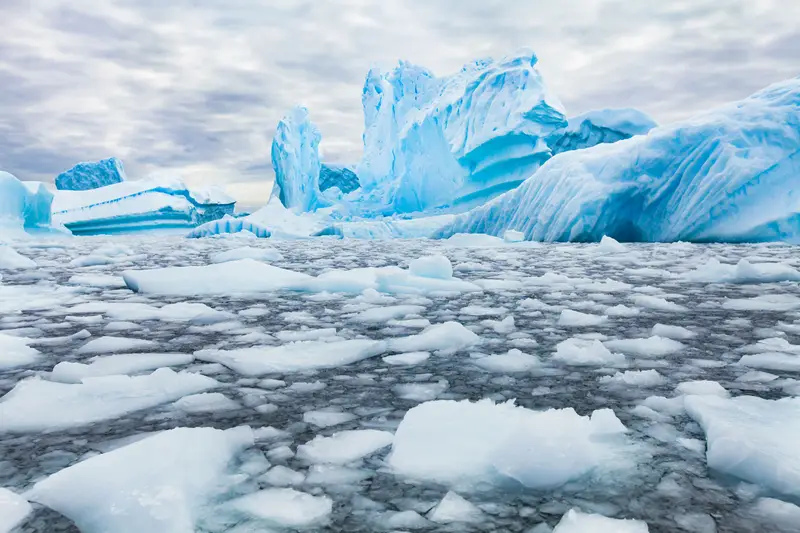
At the very top and bottom of our planet lie two worlds of ice. Both are cold, remote, and seemingly timeless. Both are crucial to Earth’s climate system. Yet one of them is changing far faster than the other. The Arctic, a frozen ocean surrounded by continents, is warming at more than twice the global average. The Antarctic, a vast frozen continent surrounded by ocean, is warming too, but much more slowly and unevenly.
This difference is not a coincidence, nor is it simple. It is the result of geography, physics, ocean circulation, atmosphere dynamics, and feedback loops that amplify change in one region while dampening it in another. To understand why the Arctic is melting faster than the Antarctic, we must look beyond temperature charts and ice maps. We must understand how Earth works as a system, and how delicate balances can tip when disturbed.
This story is not just about ice. It is about energy, motion, and connection. It is about why the same planet can respond so differently to the same global force.
The Arctic and Antarctic Are Not Mirror Images
At first glance, it seems logical to assume that the Arctic and Antarctic should behave similarly. Both are polar regions, both are cold, and both are covered in ice. But beneath this surface symmetry lies a fundamental asymmetry that shapes everything.
The Arctic is an ocean. At its heart is the Arctic Ocean, covered by floating sea ice, surrounded by land masses like North America, Europe, and Asia. The Antarctic is land. It is a massive continent, buried under kilometers of ice, surrounded by the Southern Ocean.
This single difference changes how heat is absorbed, stored, and redistributed. Floating sea ice behaves very differently from ice resting on solid ground. Ocean water moves heat far more efficiently than land. And the way winds and currents circulate around each pole creates entirely different climate responses.
To understand the faster melting of the Arctic, we must first understand what kind of place it is.
Arctic Amplification: Why Warming Accelerates in the North
One of the most important concepts in polar climate science is Arctic amplification. This term describes the phenomenon where temperature changes in the Arctic are larger than the global average. When the planet warms by one degree, the Arctic may warm by two, three, or even four degrees.
This amplification is not caused by a single factor. It emerges from several interacting processes that reinforce each other.
The most powerful of these is the ice–albedo feedback. Ice and snow are bright. They reflect most incoming sunlight back into space. Dark ocean water, by contrast, absorbs sunlight and converts it into heat. When Arctic sea ice melts, it exposes darker water beneath. That water absorbs more solar energy, warms up, and melts even more ice. This creates a self-reinforcing loop that accelerates warming.
Because the Arctic’s ice floats on the ocean, it is especially vulnerable to this feedback. As sea ice thins and retreats, the ocean becomes a heat reservoir that continues to fuel melting even during colder seasons.
The Role of Sea Ice Versus Land Ice
Another key difference between the poles lies in the type of ice they host. Arctic ice is primarily sea ice. It forms from frozen ocean water and floats. Antarctic ice is primarily land ice, locked onto the continent itself.
Sea ice is thin, fragile, and responds quickly to temperature changes. It can form and disappear within a single season. Land ice, especially thick ice sheets like those covering Antarctica, responds much more slowly. It takes far more energy to melt kilometers of compacted ice than a few meters of frozen seawater.
This difference in thermal inertia means the Arctic reacts faster to warming signals. When atmospheric temperatures rise, sea ice melts quickly. In Antarctica, much of the ice is insulated from short-term temperature changes, especially in the interior of the continent.
This does not mean Antarctic ice is safe. It means its response time is slower, masking long-term vulnerability behind short-term stability.
Geography Shapes Climate Fate
The Arctic’s geography traps heat. Being surrounded by continents limits how heat can escape. Warm air masses from lower latitudes can move into the Arctic more easily, while cold Arctic air is less able to spread outward.
In contrast, Antarctica is isolated. The Southern Ocean forms a powerful barrier around the continent, reinforced by strong winds that circulate endlessly around it. This isolation limits the intrusion of warmer air from the north.
These winds form what is known as the Antarctic Circumpolar Current, the strongest ocean current on Earth. It acts like a moat, separating Antarctica from the rest of the planet’s climate system. While not perfect, this barrier slows the transfer of heat toward the continent.
The Arctic has no such defense.
Ocean Circulation and Heat Transport
Oceans are Earth’s great heat movers. They absorb energy near the equator and transport it toward the poles. But the way this heat arrives at each pole is different.
In the Arctic, relatively warm ocean currents carry heat directly into polar regions. Atlantic water enters the Arctic Ocean, bringing warmth beneath the sea ice. As the ice thins, this subsurface heat becomes increasingly effective at melting ice from below.
In the Antarctic, warm water does reach the continent, but the dynamics are more complex. Much of the heat remains at depth, separated from the ice surface by layers of colder water. In some regions, this warm deep water does reach the base of ice shelves, causing melting from below, but the process is uneven and localized.
Overall, the Arctic receives and retains oceanic heat more efficiently, accelerating ice loss.
Atmospheric Circulation and Weather Patterns
The atmosphere behaves differently at each pole. In the Arctic, warming weakens the temperature contrast between the poles and the equator. This affects the jet stream, making it slower and more wavy. These changes allow warm air to penetrate farther north more frequently, delivering pulses of heat that accelerate melting.
In Antarctica, the dominant atmospheric circulation pattern is more stable. Strong circumpolar winds confine cold air over the continent. While parts of Antarctica have experienced warming, especially the Antarctic Peninsula, the interior remains extremely cold, limiting surface melting.
This stability does not mean permanence, but it delays rapid change.
The Influence of Clouds and Water Vapor
As the Arctic warms, it holds more moisture. Water vapor is a greenhouse gas, and increased humidity traps additional heat. Clouds also play a complex role. In the Arctic, clouds tend to enhance warming by trapping heat near the surface, especially during long polar nights.
This creates another feedback loop. Warmer air leads to more moisture, which leads to more heat retention, which leads to further warming.
Antarctica’s air remains much drier, especially in the interior. With less water vapor, this feedback is weaker, contributing to slower warming.
Seasonal Extremes and the Power of Sunlight
The Arctic experiences extreme seasonal variation. During summer, the Sun can shine continuously for months. When sea ice retreats during this period, the exposed ocean absorbs enormous amounts of solar energy.
This absorbed heat does not disappear when winter arrives. It remains in the ocean, delaying ice formation and thinning new ice. Over time, this leads to a younger, thinner ice pack that melts more easily each summer.
Antarctica’s ice cover is less affected by this seasonal sunlight feedback because much of its ice sits on land and remains snow-covered even during summer. The reflective surface persists, limiting solar absorption.
Human Influence and Global Warming Signals
Both poles are affected by human-driven climate change. Greenhouse gases trap heat globally, raising average temperatures everywhere. But the Arctic is more sensitive to these changes due to the feedbacks already described.
This sensitivity does not mean Antarctica is immune. It means its response is more complex and delayed. Some parts of Antarctica are warming rapidly, especially regions exposed to ocean-driven melting. Others remain cold for now.
The danger lies in this delay. Slow change can suddenly accelerate once thresholds are crossed.
Ice Sheets, Sea Level, and Hidden Risk
The Arctic contains relatively little land ice compared to Antarctica. Most of its ice is floating sea ice, which does not directly raise sea levels when it melts. Antarctica, by contrast, holds enough land ice to raise global sea levels by many meters.
This creates a paradox. The Arctic is melting faster, but Antarctica poses a greater long-term threat.
The stability of Antarctic ice sheets depends heavily on ice shelves, which act like braces that slow the flow of land ice into the ocean. As warm water melts these shelves from below, the glaciers behind them can accelerate, leading to irreversible ice loss.
This process is slower and harder to observe than Arctic sea ice decline, but its consequences are far greater.
Ecological and Human Consequences of Arctic Melting
The rapid melting of the Arctic is already transforming ecosystems and human lives. Species adapted to ice-dependent environments are losing habitat. Indigenous communities face eroding coastlines, unstable ice, and disrupted food sources.
Melting permafrost releases greenhouse gases, further accelerating global warming. New shipping routes and resource access create political and environmental challenges.
The Arctic is not a distant place. What happens there influences weather patterns, sea levels, and climate stability across the globe.
Why the Difference Matters
Understanding why the Arctic melts faster than the Antarctic is not an academic exercise. It reveals how climate systems respond to disturbance. It shows how feedback loops can amplify small changes into dramatic transformations.
It also reminds us that climate change is not uniform. It unfolds differently in different places, shaped by geography, physics, and history. This unevenness can lull us into false security, making slow change seem safe until it suddenly is not.
A Future Written in Ice and Water
The Arctic’s rapid melting is a warning written in disappearing ice. It tells us that Earth’s systems are sensitive, interconnected, and capable of change far faster than human societies are prepared for.
The Antarctic’s slower response is not reassurance. It is a reminder that inertia can hide vulnerability. When change comes to Antarctica, it may arrive with consequences that unfold over centuries.
Both poles are part of the same story. One shows us the speed of climate feedbacks. The other shows us the weight of long-term risk.
The Deeper Meaning of Polar Imbalance
Why is the Arctic melting faster than the Antarctic? Because Earth is not symmetrical. Because oceans move heat unevenly. Because ice reflects light and water absorbs it. Because feedback loops magnify change. Because geography shapes destiny.
But beneath these scientific reasons lies a deeper truth. The planet responds to what we do, not evenly, not gently, but according to the rules of physics. The Arctic is simply the place where those rules reveal themselves first and most dramatically.
In watching the Arctic change, we are watching the future arrive early.