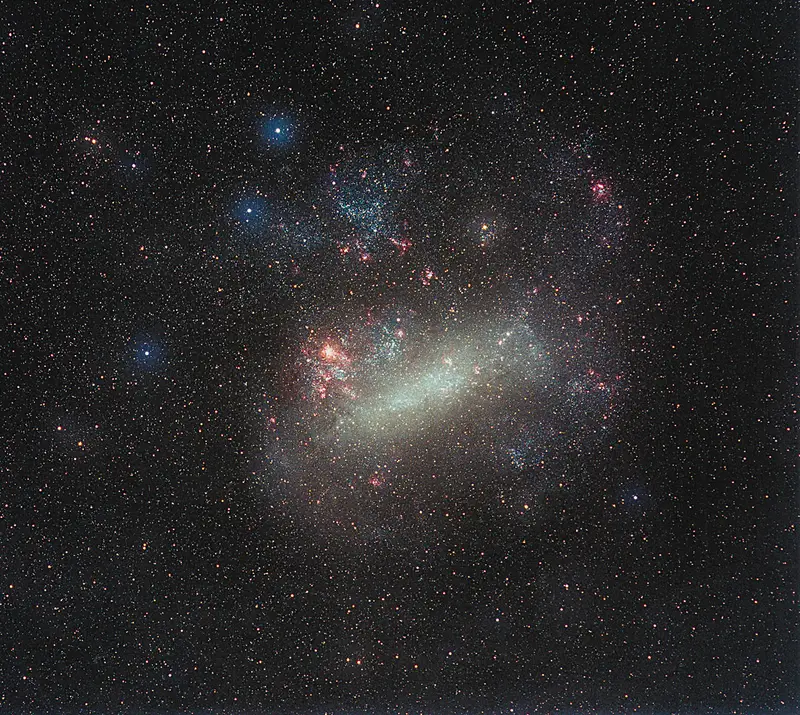
Hanging like ghostly smudges in the southern night sky, the Magellanic Clouds have fascinated humanity for centuries. To the naked eye, they look like torn fragments of the Milky Way, luminous clouds adrift in darkness. But these are not clouds at all. They are entire galaxies—the Large Magellanic Cloud and the Small Magellanic Cloud—our closest galactic neighbors and some of the most scientifically intriguing objects in the cosmos.
These dwarf galaxies are near enough to study in extraordinary detail, yet distant enough to preserve deep cosmic secrets. They are laboratories for understanding how galaxies form, evolve, collide, and sometimes die. Despite decades of observation with ground-based telescopes and space observatories, the Magellanic Clouds remain full of mysteries that challenge astronomers and reshape our understanding of the universe.
What follows are ten of the most compelling mysteries of the Magellanic Clouds—questions that reach from the behavior of dark matter to the fate of our own galaxy.
1. Are the Magellanic Clouds Truly Bound to the Milky Way?
For much of modern astronomy, scientists assumed the Magellanic Clouds were long-term satellites of the Milky Way, orbiting our galaxy for billions of years like loyal companions. This assumption shaped countless models of galactic evolution. But recent measurements of their motion have thrown that idea into serious doubt.
Precise observations show that both the Large and Small Magellanic Clouds are moving surprisingly fast—fast enough that they may not be bound to the Milky Way at all. Instead of being ancient companions, they might be newcomers, plunging past our galaxy for the first time in cosmic history.
If this is true, it radically changes how astronomers interpret the distortions, gas streams, and star formation within these galaxies. Many features once attributed to repeated gravitational interactions with the Milky Way may need entirely new explanations. The mystery of whether the Magellanic Clouds are longtime residents or fleeting visitors remains unresolved, and its answer could rewrite the story of our galactic neighborhood.
2. The Origin of the Magellanic Stream
Trailing behind the Magellanic Clouds like a torn ribbon of cosmic smoke is the Magellanic Stream—a massive arc of hydrogen gas stretching across more than half the sky. This structure is one of the largest known gaseous features associated with galaxies, and yet its origin is still debated.
One possibility is that the stream was stripped from the Clouds by the gravitational pull of the Milky Way, torn away as they passed too close. Another suggests that the stream formed through interactions between the Large and Small Magellanic Clouds themselves, long before the Milky Way entered the picture.
What makes this mystery particularly compelling is that the Magellanic Stream contains no stars—only gas. This suggests a delicate process that removed gas without dragging stars along with it. Understanding how such a massive, starless structure formed challenges existing models of galactic interactions and raises new questions about how galaxies lose material over time.
3. Why Is Star Formation So Intense in the Large Magellanic Cloud?
The Large Magellanic Cloud is a cosmic furnace of star formation. Regions like the Tarantula Nebula are producing stars at rates that seem extreme for a galaxy of its size. Massive stars blaze into existence, flood their surroundings with radiation, and explode as supernovae in rapid succession.
This level of activity is puzzling. The Large Magellanic Cloud is relatively small and irregular, lacking the well-defined spiral structure often associated with sustained star formation. Yet it outperforms many larger galaxies in stellar birthrate.
Astronomers suspect that gravitational interactions—either with the Small Magellanic Cloud, the Milky Way, or both—may compress gas and trigger waves of star formation. But the precise mechanism remains elusive. Why certain regions ignite so dramatically while others remain quiet is one of the central mysteries of this nearby galaxy.
4. The Strange Chemical Composition of the Magellanic Clouds
Compared to the Milky Way, the Magellanic Clouds are chemically primitive. They contain fewer heavy elements—those formed in the hearts of stars and spread through supernova explosions. This low metallicity gives astronomers a rare glimpse into conditions similar to those of the early universe.
Yet the mystery lies in how uneven this chemical makeup is. Different regions of the Clouds show surprising variations in composition, even when they appear similar in age and structure. Some areas seem enriched far beyond expectations, while others remain almost untouched by stellar processing.
These inconsistencies raise questions about how gas flows through dwarf galaxies, how efficiently supernovae distribute elements, and whether external forces are stirring or stripping material in unpredictable ways. The chemical fingerprints of the Magellanic Clouds tell a complex story that scientists are still learning how to read.
5. The Enigma of Dark Matter in the Magellanic Clouds
Dark matter is the invisible scaffold that holds galaxies together, yet its distribution within the Magellanic Clouds remains uncertain. Observations suggest that these galaxies are dominated by dark matter, but the exact shape and density of their dark matter halos are unclear.
Some models predict smooth, spherical halos, while others suggest elongated or distorted structures caused by gravitational interactions. The Clouds’ irregular shapes and motions make it difficult to disentangle the influence of dark matter from visible matter.
Understanding dark matter in the Magellanic Clouds is especially important because their proximity allows astronomers to test theories with unprecedented detail. If the behavior of dark matter here differs from expectations, it could point to new physics or force revisions to existing cosmological models.
6. The Puzzling Relationship Between the Large and Small Magellanic Clouds
The Large and Small Magellanic Clouds appear to be a pair, locked in a gravitational dance. But how long have they been together? Were they born as companions, or did they meet later in cosmic history?
Their structures show clear signs of interaction. Bridges of gas connect them, and both galaxies exhibit distortions that suggest close encounters. Yet simulations struggle to reproduce all observed features with a single, consistent history.
This mystery is more than academic. The nature of their relationship affects how astronomers interpret everything from star formation patterns to the creation of the Magellanic Stream. Untangling their shared past is like reconstructing a long-lost choreography from scattered footprints in the dark.
7. Why Do the Magellanic Clouds Lack Well-Defined Spiral Arms?
Spiral arms are iconic features of many galaxies, including the Milky Way. They organize stars and gas into graceful patterns that persist for hundreds of millions of years. The Magellanic Clouds, however, defy this order.
The Large Magellanic Cloud shows hints of spiral structure, but it is asymmetric and distorted. The Small Magellanic Cloud lacks spiral arms almost entirely, appearing chaotic and fragmented.
This irregularity raises fundamental questions about what conditions are necessary for spiral arms to form and endure. Are the Magellanic Clouds too small? Too disturbed? Or do interactions prevent stable patterns from emerging? Their disorder may hold clues to how galaxies transition between different structural states.
8. The Role of the Magellanic Clouds in Feeding the Milky Way
The gas flowing from the Magellanic Clouds toward the Milky Way may eventually become part of our galaxy. If so, these dwarf galaxies could play a role in sustaining star formation in the Milky Way long into the future.
The mystery lies in how much material will actually make the journey and how it will integrate into the galactic disk. Will it settle gently, or trigger bursts of star formation? Will it alter the Milky Way’s chemical composition in measurable ways?
This question transforms the Magellanic Clouds from passive neighbors into active participants in our galaxy’s future. Understanding this exchange of matter connects local observations to long-term cosmic evolution.
9. The Unexpected Population of Ancient Stars
While the Magellanic Clouds are famous for youthful, massive stars, they also contain surprisingly old stellar populations. Ancient stars, some nearly as old as the universe itself, are scattered throughout these galaxies.
The coexistence of such old stars with intense modern star formation presents a puzzle. How did these galaxies maintain gas and structure over billions of years without either exhausting their fuel or being torn apart?
This mystery touches on the resilience of dwarf galaxies. The Magellanic Clouds appear capable of sustaining star formation across vast spans of time, defying simple models that predict rapid decline or destruction.
10. The Ultimate Fate of the Magellanic Clouds
Perhaps the most haunting mystery of all is what will eventually happen to the Magellanic Clouds. Will they merge with the Milky Way, dissolving into its halo and disk? Will they survive as distinct galaxies, orbiting indefinitely? Or will tidal forces tear them apart completely?
Simulations offer conflicting predictions. Some suggest a slow, inevitable merger. Others propose that the Clouds may escape after a close encounter, flung back into intergalactic space.
The answer depends on factors still uncertain, including their true masses, velocities, and dark matter content. Their fate is entwined with that of the Milky Way itself, making this mystery deeply personal on a cosmic scale.
Why the Magellanic Clouds Matter
The Magellanic Clouds are not just beautiful objects in the sky. They are keys to understanding the universe. Their proximity allows astronomers to test theories that would otherwise remain abstract. They reveal how galaxies interact, how stars are born, how matter flows across cosmic distances, and how structure emerges from chaos.
Emotionally, they remind us that even the nearest things can remain profoundly mysterious. We can see them with our eyes, yet they still resist full understanding. They are both familiar and alien, neighbors and strangers.
As telescopes grow more powerful and simulations more precise, some of these mysteries will surely be solved. Others may deepen, leading to new questions we have not yet imagined. The Magellanic Clouds will continue to glow in the southern sky, silent witnesses to cosmic history, inviting us to look up, wonder, and keep asking questions.
In their drifting light, we see not only the story of distant galaxies, but the unfolding story of human curiosity itself.