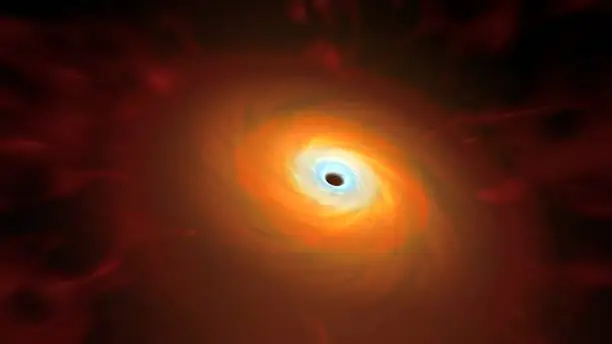
At the heart of the Milky Way, hidden behind clouds of gas, dust, and unimaginable distance, lies one of the most extreme objects in the known universe. It is silent, invisible, and yet overwhelmingly powerful. Every star in our galaxy, including our Sun, moves under its gravitational influence. This object is the supermassive black hole known as Sagittarius A*, and its existence reshapes how we understand space, time, gravity, and our own place in the cosmos.
For centuries, humans looked toward the center of the Milky Way without knowing what lived there. Today, thanks to decades of careful observation and theory, we know that a colossal black hole dominates the galactic core. What follows are ten deeply fascinating, scientifically accurate facts about this cosmic giant—facts that reveal not only what Sagittarius A* is, but why it matters so profoundly.
1. The Black Hole at the Milky Way’s Center Is Enormous Beyond Human Imagination
Sagittarius A* is a supermassive black hole with a mass about four million times greater than that of our Sun. This number alone is staggering, but it becomes even more astonishing when you realize that all of that mass is packed into a region smaller than the orbit of Mercury around the Sun.
Black holes are defined by their event horizons, the boundary beyond which nothing—not even light—can escape. For Sagittarius A*, this boundary has a radius of roughly 12 million kilometers. While that sounds large, it is astonishingly compact for something with millions of solar masses. If you could somehow replace our Sun with Sagittarius A*, the planets would continue orbiting much as they do now, but the sky would turn dark and lifeless.
This immense mass is what allows Sagittarius A* to dominate the gravitational dynamics of the entire galaxy. It is not just another object in space; it is the anchor point around which the Milky Way is organized.
2. We Cannot See the Black Hole Directly, But We Know It’s There
Black holes emit no light of their own, making them invisible against the darkness of space. Sagittarius A* is especially difficult to observe because it lies behind dense clouds of interstellar dust that block visible light. For a long time, astronomers could only infer its presence indirectly.
What convinced scientists was the behavior of stars near the galactic center. Over decades, astronomers tracked stars moving at incredible speeds around an unseen central point. Some of these stars complete full orbits in just a few years, moving at thousands of kilometers per second. The only object capable of exerting such immense gravitational force in such a small volume is a supermassive black hole.
This method—watching how gravity shapes motion—has become one of the most powerful tools in astrophysics. Sagittarius A* revealed itself not by shining, but by bending the universe around it.
3. Stars Orbit the Black Hole Like Planets Around the Sun—But Far More Violently
The stars closest to Sagittarius A* behave in ways that would seem impossible anywhere else in the galaxy. One star, often referred to as S2, completes an elongated orbit around the black hole in just about 16 years. At its closest approach, it comes within a few billion kilometers of the event horizon and reaches speeds exceeding 7,000 kilometers per second.
These orbits are not gentle circles. They are extreme, stretched paths dictated by intense gravity. The stars experience relativistic effects predicted by Einstein’s theory of general relativity, including time dilation and orbital precession. In these motions, astronomers see gravity not as a mild force, but as a warping of spacetime itself.
These stellar dances provide some of the strongest evidence that general relativity holds true even in the most extreme environments.
4. Sagittarius A* Is Relatively Quiet Compared to Other Galactic Black Holes
Despite its enormous mass, Sagittarius A* is surprisingly calm. Many supermassive black holes actively consume surrounding gas and dust, glowing brilliantly as quasars or active galactic nuclei. Sagittarius A*, by contrast, is currently in a low-activity state.
It does accrete material, but at a very slow rate. Most of the gas near the galactic center either falls in inefficiently or is blown away by magnetic fields and energetic processes. As a result, Sagittarius A* emits relatively little radiation compared to similar black holes in other galaxies.
This quietness may be one reason life has been able to develop in the Milky Way. A more active black hole could flood the galaxy with radiation, disrupting planetary systems and sterilizing regions of space.
5. The Black Hole Shapes the Entire Structure of the Milky Way
Although Sagittarius A* occupies a tiny fraction of the galaxy’s volume, its influence extends far beyond its immediate surroundings. It plays a crucial role in the formation and evolution of the Milky Way’s central region.
The black hole’s gravity affects how stars form and move near the galactic core. It also influences the behavior of vast clouds of gas that feed star formation and galactic dynamics. Over cosmic time, interactions between the black hole and its environment help regulate the growth of the galaxy itself.
In this sense, Sagittarius A* is not just a passive object. It is a central player in the story of how our galaxy became what it is today.
6. Time Behaves Differently Near the Black Hole
One of the most haunting consequences of extreme gravity is its effect on time. According to general relativity, the stronger the gravitational field, the more slowly time passes relative to distant observers. Near Sagittarius A*, this effect becomes profound.
If a hypothetical astronaut could orbit safely near the black hole without being torn apart, time would pass more slowly for them than for someone far away in the galaxy. From the astronaut’s perspective, distant stars would appear to age faster. This is not science fiction—it is a measurable consequence of gravity’s influence on spacetime.
These effects have been observed indirectly through the motion of stars near the black hole, confirming predictions made over a century ago and reminding us that time is not universal, but flexible.
7. Sagittarius A* Likely Grew Through Cosmic Mergers and Feeding Frenzies
Supermassive black holes are not born large; they grow. Sagittarius A* likely began as a much smaller black hole early in the galaxy’s history. Over billions of years, it gained mass by consuming gas, dust, and possibly other black holes during galactic mergers.
Evidence suggests that the Milky Way has collided with and absorbed smaller galaxies in the past. During these events, their central black holes may have merged with Sagittarius A*, increasing its mass. These mergers would have released tremendous energy in the form of gravitational waves, ripples in spacetime that propagate across the universe.
The calm black hole we observe today is the end result of a violent and dramatic cosmic history.
8. The Black Hole Is Surrounded by Extreme Physics We Cannot Fully Replicate on Earth
The region around Sagittarius A* is a natural laboratory for extreme physics. Temperatures soar, magnetic fields twist violently, and particles are accelerated to near-light speeds. These conditions cannot be recreated in any terrestrial experiment.
By studying emissions from this environment—especially in radio, infrared, and X-ray wavelengths—scientists can test theories of plasma physics, magnetohydrodynamics, and relativity. Every observation pushes the limits of current models and often reveals unexpected complexity.
In this way, Sagittarius A* helps us understand not only black holes, but fundamental laws of nature that govern the entire universe.
9. The Event Horizon Was Imaged Through a Global Scientific Effort
In recent years, astronomers achieved a historic milestone by capturing an image of the shadow of Sagittarius A*. This was accomplished using a global network of radio telescopes working together as a single Earth-sized instrument, a technique known as very long baseline interferometry.
The image revealed a glowing ring of hot material surrounding a dark central region—the shadow cast by the event horizon. This observation provided direct visual confirmation of a supermassive black hole and matched predictions made by general relativity with remarkable precision.
Seeing this image was not just a technical triumph; it was an emotional one. Humanity had, for the first time, gazed upon the silhouette of the gravitational abyss at the center of its home galaxy.
10. The Black Hole Raises Profound Questions About Reality Itself
Beyond its physical properties, Sagittarius A* forces us to confront the limits of knowledge. Inside the event horizon, known laws of physics break down. Concepts of space and time lose meaning, and singularities—points of infinite density—challenge our understanding of reality.
Black holes sit at the intersection of gravity, quantum mechanics, and cosmology. Understanding them fully may require a new theory that unifies these domains. In this sense, Sagittarius A* is not just an object of study, but a gateway to deeper truths about the universe.
Emotionally, it reminds us of both our insignificance and our power. We are tiny beings orbiting an unremarkable star in a spiral arm of a vast galaxy, yet we are capable of discovering, understanding, and imaging the monster at its heart.
A Silent Giant at the Center of Everything We Know
Sagittarius A* is more than a scientific curiosity. It is a central character in the cosmic story of the Milky Way, shaping the motion of stars, influencing galactic evolution, and testing the limits of human understanding. It is ancient, powerful, and indifferent, yet its existence has guided some of the greatest achievements in modern astronomy.
Every night, as you look up at the Milky Way stretching across the sky, remember that at its center lies a gravitational titan—quiet for now, but eternal in its influence. The massive black hole at the center of our galaxy is a reminder that the universe is far stranger, deeper, and more beautiful than our everyday lives suggest, and that even in darkness, there is knowledge waiting to be found.