Albert Einstein’s theory of relativity has a reputation that precedes it. For many people, just hearing the word “relativity” conjures images of incomprehensible equations, warped grids of space, and genius-level intellects scribbling symbols on blackboards. It feels distant, cold, and inaccessible. Yet at its core, relativity is a deeply human theory. It was born from curiosity, imagination, and a willingness to question everyday assumptions about time, space, and reality itself.
Relativity is not just about physics. It is about perspective. It asks us to let go of comfortable ideas and accept that the universe is stranger, more beautiful, and more interconnected than we ever imagined. You don’t need advanced mathematics to grasp its essence. You need stories, intuition, and a little patience.
Here are ten simple, emotionally grounded ways to understand Einstein’s theory of relativity and why it changed how humanity sees the universe forever.
1. There Is No Absolute “Now”
One of the most unsettling ideas in relativity is that there is no universal present moment. We instinctively believe that “now” is the same everywhere, that the universe shares a single ticking clock. Einstein showed this is not true.
Time depends on motion. Two observers moving relative to each other can disagree on whether events happened at the same time. Both observers are correct from their own perspective. This is not a flaw in perception; it is a fundamental feature of reality.
Imagine two lightning bolts striking opposite ends of a train track. A person standing midway between them sees both flashes at the same time. A person riding a train moving toward one flash and away from the other will see one first. There is no cosmic referee to declare who is right. Simultaneity itself depends on motion.
This idea shakes our emotional sense of reality. It means the universe does not share a single timeline. Each observer carries their own version of “now,” shaped by how they move through space.
2. Time Is Not Fixed—It Can Slow Down
Time feels constant. Seconds pass at the same rhythm whether we are bored, excited, or afraid. But relativity reveals that time is flexible.
When you move faster, time slows down for you relative to someone who is moving more slowly. This is called time dilation. At everyday speeds, the effect is tiny and unnoticeable. But as you approach the speed of light, time dilation becomes dramatic.
Astronauts aboard fast-moving spacecraft age slightly less than people on Earth. This has been measured using extremely precise clocks. Even GPS satellites must correct for relativistic time effects to work accurately.
This idea is emotionally powerful because it challenges the universality of aging and experience. Time is no longer a shared river flowing evenly for everyone. It becomes personal, shaped by motion and gravity. In relativity, time is not a backdrop—it is an active participant in the story of the universe.
3. Space and Time Are One Thing: Spacetime
Before Einstein, space and time were treated as separate entities. Space was where things happened. Time was when they happened. Relativity merged them into a single fabric called spacetime.
In spacetime, you do not simply move through space while time ticks along independently. You move through both together. How fast you move through space affects how fast you move through time.
This unification explains why time dilation exists. Motion through space comes at the expense of motion through time. Everything moves through spacetime at a constant “speed,” but that speed is divided differently depending on how fast you travel through space.
Thinking of spacetime helps make relativity less abstract. It turns time from an invisible clock into a dimension you travel through, just like length or width. This idea transforms how we understand existence itself. You are not just in time. You are moving through it.
4. The Speed of Light Is the Same for Everyone
One of Einstein’s boldest insights was that the speed of light in a vacuum is constant for all observers, no matter how fast they are moving. This seems impossible from an everyday perspective.
If you throw a ball from a moving car, someone standing still sees the ball move faster than the car alone. Light does not behave this way. Whether you are standing still or chasing a beam of light at incredible speed, you will always measure light traveling at the same speed.
To preserve this cosmic speed limit, space and time must adjust. Lengths contract, and time dilates. Reality bends itself to keep the speed of light constant.
Emotionally, this reveals a universe with firm rules, not centered on human intuition. Light is not just illumination; it is a structural pillar of reality, setting the maximum speed at which cause and effect can propagate.
5. Gravity Is Not a Force, but Curved Spacetime
In everyday life, gravity feels like a force pulling objects downward. Einstein replaced this idea with something far more elegant and strange.
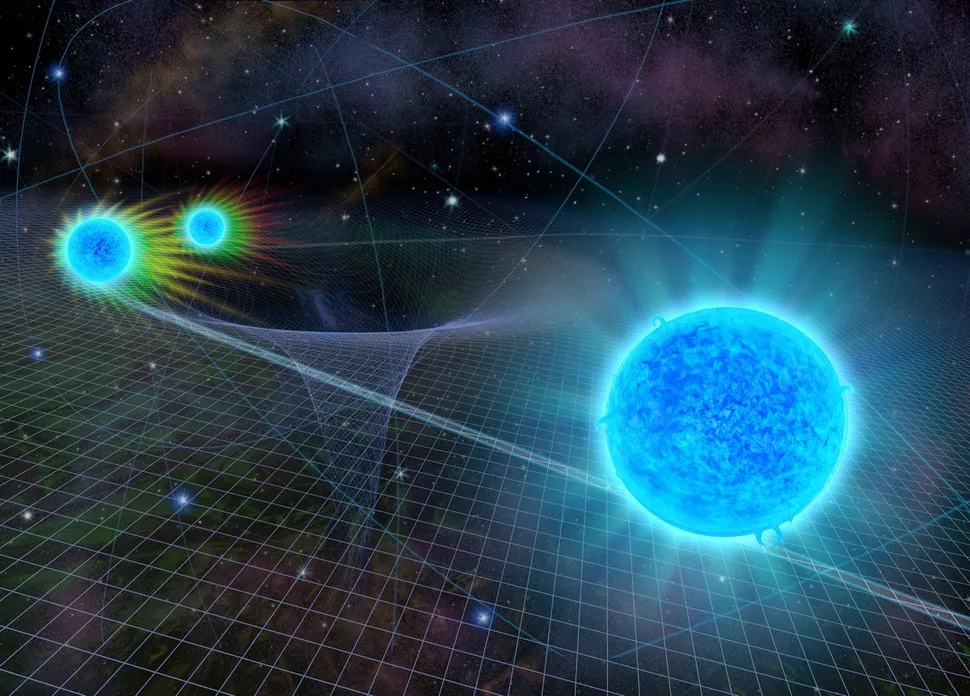
According to general relativity, mass and energy curve spacetime. Objects move along the curved paths created by this distortion. Planets orbit stars not because they are pulled by an invisible force, but because spacetime around the star is curved.
A common analogy is a heavy ball placed on a stretched rubber sheet. The sheet curves, and smaller balls roll toward it. While imperfect, this image helps convey the idea that gravity emerges from geometry, not pulling.
This reframing of gravity is emotionally profound. It means the universe is not governed by invisible tugs, but by shape. Space itself participates in motion. The ground beneath your feet is curved spacetime guiding you toward Earth’s center.
6. Massive Objects Slow Down Time
General relativity reveals that gravity affects time. The stronger the gravitational field, the slower time passes.
Clocks run slightly slower on Earth’s surface than they do high above the planet. Near extremely massive objects, like black holes, time slows dramatically. To an outside observer, time near a black hole can appear to nearly stop.
This phenomenon, called gravitational time dilation, has practical consequences. GPS satellites must account for it to provide accurate positioning. Without relativistic corrections, navigation systems would drift quickly.
Emotionally, this idea reshapes how we think about time’s relationship with matter. Time is not immune to the weight of the universe. It bends, stretches, and responds to mass. Time is no longer an abstract flow—it is physically entangled with the cosmos.
7. Nothing Can Travel Faster Than Light
The speed of light is not just a speed. It is a boundary. According to relativity, nothing with mass can reach or exceed the speed of light.
As an object accelerates closer to light speed, it requires more and more energy. At light speed, it would require infinite energy, making it unreachable. This rule preserves causality, ensuring that effects do not precede causes.
This cosmic speed limit shapes the universe. It defines horizons, limits communication across vast distances, and influences how galaxies interact. It also gives light a special role as the fastest messenger in existence.
Emotionally, this limit reminds us that the universe has structure and constraints. We are free to explore, but not without boundaries. The speed of light is nature’s way of saying that some limits are fundamental.
8. Mass and Energy Are Two Forms of the Same Thing
Perhaps the most famous equation in physics expresses one of relativity’s deepest truths: mass and energy are interchangeable.
Mass is a form of energy. Energy has mass. This equivalence explains why nuclear reactions release enormous amounts of energy from small amounts of matter. It also reveals that everyday objects contain vast reserves of energy, locked away by physical laws.
This idea bridges the tangible and the abstract. Matter, which feels solid and permanent, becomes a condensed expression of energy. The distinction between “stuff” and “action” dissolves.
Emotionally, this concept connects humans to stars. The same principle that powers the Sun operates in every atom of your body. You are not just made of matter—you are structured energy, shaped by cosmic rules.
9. Motion Is Relative, Not Absolute
Relativity teaches that there is no preferred state of rest. Motion only makes sense relative to something else.
You may feel stationary sitting in a chair, but you are moving with Earth’s rotation, orbiting the Sun, and traveling through the galaxy. None of these motions are more “real” than the others. Physics works the same in all inertial frames.
This principle removes the idea of a cosmic center or absolute viewpoint. There is no universal reference frame against which all motion is measured.
Emotionally, this idea humbles us. It strips away the notion that humans occupy a privileged position in the universe. Instead, we are participants in a vast, dynamic system where perspective matters.
10. Relativity Is About Reality, Not Illusion
A common misunderstanding is that relativity is about perception or illusion. In truth, it describes how reality actually behaves.
Time dilation and length contraction are not tricks of the senses. They are measurable, physical effects confirmed by experiments and technology. Relativity does not say “everything is relative” in a philosophical sense. It says that certain quantities depend on motion and gravity in precise, predictable ways.
Einstein’s theories are among the most tested ideas in science. They underpin modern technology and guide our understanding of the universe at every scale.
Emotionally, this final point brings clarity. Relativity is not chaos. It is order deeper than intuition. It reveals a universe governed by elegant rules, even when those rules defy common sense.
Why Relativity Still Matters
Einstein’s theory of relativity did more than revise physics. It changed humanity’s self-image. It taught us that time is flexible, space is dynamic, and reality depends on perspective. It replaced absolute certainty with relational truth, without abandoning rigor or objectivity.
Relativity invites us to be humble and curious. It reminds us that the universe is not obligated to match human intuition. Yet it also shows that human imagination, guided by reason and evidence, can uncover astonishing truths.
You do not need to solve equations to feel the impact of relativity. Every GPS signal, every image of a black hole, every glimpse into the early universe carries Einstein’s legacy. Relativity lives quietly in your daily life, shaping technology, thought, and our understanding of existence.
At its heart, relativity is a love letter to curiosity. It tells us that asking simple questions—about light, motion, and time—can lead to revolutions in understanding. And it reminds us that the universe, though strange, is deeply knowable to minds willing to question the obvious and embrace wonder.