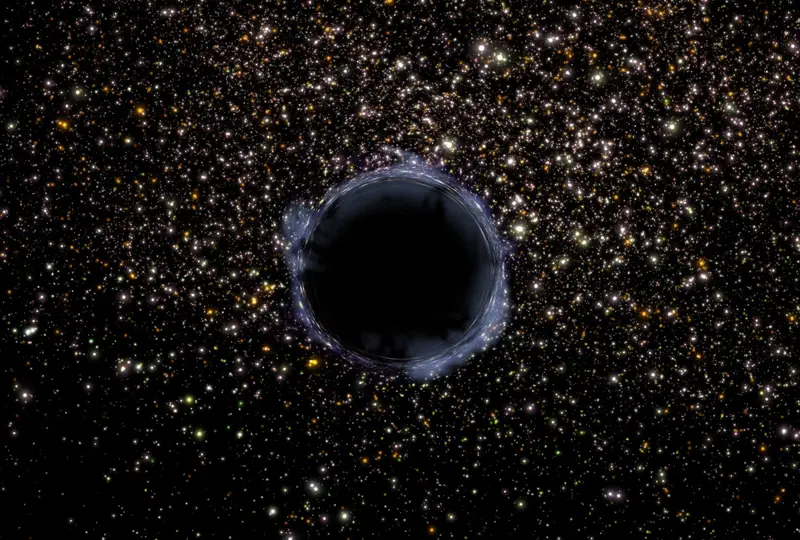
Black holes are often imagined as the dramatic corpses of massive stars—cosmic monsters born from stellar death, lurking in the hearts of galaxies or drifting invisibly through space. Yet this familiar picture may be incomplete. For decades, physicists and cosmologists have explored a more radical possibility: that some black holes did not form from stars at all, but instead emerged in the very first moments of the universe, forged directly by the extreme conditions of the Big Bang itself. These hypothetical objects, known as primordial black holes, occupy a unique intersection of cosmology, particle physics, and gravity. They challenge our understanding of how structure formed in the early universe and invite us to reconsider what black holes truly are.
The idea of primordial black holes is emotionally compelling because it reaches back to the dawn of time. If they exist, these objects would be fossils of the infant universe, carrying information about energies and processes far beyond anything we can reproduce on Earth. They would represent a bridge between the smallest scales of quantum physics and the largest scales of cosmology, uniting themes that usually remain separate. Asking whether small black holes formed during the Big Bang is therefore not just a technical question; it is a question about the universe’s earliest memories and the hidden possibilities still woven into its fabric.
The Early Universe and the Conditions of Creation
To understand why primordial black holes are even plausible, one must first appreciate how extreme the early universe was. According to modern cosmology, the universe began in a hot, dense, rapidly expanding state approximately 13.8 billion years ago. In the earliest fractions of a second after the Big Bang, temperatures and energies were unimaginably high, and matter existed in forms radically different from those we observe today. Space itself was dynamic, expanding and cooling as time progressed.
During these early moments, tiny regions of the universe could have experienced slight variations in density. While the universe was, on average, remarkably uniform, small fluctuations were present. These fluctuations are not speculative; they are directly observed today in the cosmic microwave background, the faint afterglow of the Big Bang. In most cases, such density variations later grew into galaxies and clusters of galaxies under the influence of gravity. But under certain conditions, a fluctuation could have been so dense that it collapsed immediately into a black hole.
Unlike stellar black holes, which form when nuclear fuel is exhausted and gravity overwhelms pressure inside a star, primordial black holes would have formed purely from density and gravity. No stars, no atoms, and no chemical elements were required—only intense compression in a rapidly evolving spacetime. This difference in origin makes primordial black holes fundamentally distinct from all other known black holes.
Defining Primordial Black Holes
Primordial black holes are hypothetical black holes that may have formed in the early universe, before the first stars and galaxies existed. Their defining feature is not their size but their origin. In principle, primordial black holes could span an enormous range of masses, from extremely small—far lighter than a mountain—to enormously massive, rivaling or exceeding stellar black holes.
What makes them particularly intriguing is that their mass is not tied to stellar processes. A stellar black hole has a minimum mass determined by the physics of stars, typically several times the mass of the Sun. A primordial black hole, by contrast, could have formed with a mass comparable to that of an asteroid, a planet, or even much smaller. This opens a vast and largely unexplored parameter space, where gravity, quantum effects, and cosmology intersect.
From a theoretical standpoint, primordial black holes are consistent with general relativity. Einstein’s equations allow black holes to form whenever mass or energy is compressed into a sufficiently small region. The Big Bang, with its extreme conditions, provides a natural setting where such compression could occur without the intermediary step of stellar evolution.
Density Fluctuations and Gravitational Collapse
The key mechanism behind primordial black hole formation lies in density fluctuations in the early universe. In standard cosmology, the early universe contained tiny variations in density caused by quantum fluctuations that were stretched to cosmic scales during a period of rapid expansion known as inflation. These fluctuations seeded all later structure in the universe.
Most fluctuations were small, leading to regions that were only slightly denser than average. Over billions of years, gravity slowly amplified these differences, eventually producing galaxies and clusters. However, if a fluctuation was large enough at the moment it re-entered the cosmic horizon—the scale at which causal interactions become possible—it could collapse almost immediately.
For collapse into a black hole to occur, the density contrast must exceed a critical threshold. If the region is too diffuse, pressure and expansion prevent collapse. If it is sufficiently overdense, gravity wins, and a black hole forms. The exact threshold depends on the equation of state of the early universe, which describes how pressure relates to energy density at that time.
This process would have been extraordinarily fast, unfolding in fractions of a second. In this sense, primordial black holes would be among the first bound objects ever to exist, predating atoms, nuclei, and even stable particles as we know them.
Inflation and the Seeds of Primordial Black Holes
Inflation plays a central role in modern theories of primordial black hole formation. Inflation refers to a brief period of extremely rapid expansion thought to have occurred very early in the universe’s history. During inflation, quantum fluctuations were stretched to macroscopic scales, becoming the seeds of cosmic structure.
Most inflationary models predict fluctuations that are small and nearly scale-invariant, meaning their strength does not vary dramatically with size. However, some models allow for enhanced fluctuations on specific scales. If inflation produced unusually large density variations at certain wavelengths, these could later collapse into primordial black holes when the universe cooled and expanded.
This connection makes primordial black holes powerful probes of inflationary physics. If such black holes exist, their masses and abundance could reveal information about inflation that is otherwise inaccessible. Conversely, the absence of primordial black holes places constraints on inflationary models, ruling out scenarios that would have produced too many of them.
In this way, primordial black holes serve as a kind of cosmic test particle, silently encoding the physics of the universe’s earliest moments.
Mass Scales and Cosmic Time
One of the most fascinating aspects of primordial black holes is the relationship between their mass and the time at which they formed. In the early universe, the mass contained within a region of a given size depended strongly on cosmic time. Regions entering the horizon earlier contained less mass, while those entering later contained more.
As a result, primordial black holes formed at different times would have very different masses. Those forming fractions of a second after the Big Bang could be extremely small, while those forming later could be much larger. This time–mass connection creates a natural spectrum of possible primordial black hole masses, each corresponding to a different epoch in the universe’s infancy.
This idea adds emotional depth to the subject. Each potential primordial black hole mass tells a story about a specific moment in cosmic history. To study them is to read a fragmented archive of the universe’s earliest chapters, written not in light but in gravity.
Hawking Radiation and the Fate of Small Black Holes
A crucial aspect of primordial black holes, especially small ones, is their relationship to quantum physics. In the 1970s, Stephen Hawking showed that black holes are not entirely black. Due to quantum effects near the event horizon, black holes emit radiation, now known as Hawking radiation, and gradually lose mass over time.
The rate of this evaporation depends on the black hole’s mass. Large black holes lose mass extremely slowly and can survive for times far longer than the current age of the universe. Very small black holes, however, evaporate rapidly. A primordial black hole with sufficiently low mass would have completely evaporated long ago, possibly leaving behind observable signatures in the form of high-energy particles or radiation.
This raises a profound question: if primordial black holes formed in the early universe, do any still exist today? The answer depends on their initial masses. Those above a certain mass threshold could survive to the present day, while smaller ones would have vanished, leaving only indirect traces.
The interplay between gravity and quantum mechanics embodied in Hawking radiation makes primordial black holes especially significant. They represent one of the few contexts in which both theories are essential, highlighting the incomplete nature of our current understanding of fundamental physics.
Primordial Black Holes and Dark Matter
One of the most provocative ideas in modern cosmology is the possibility that primordial black holes could account for some or all of the universe’s dark matter. Dark matter is an invisible form of matter inferred from its gravitational effects on galaxies and cosmic structure. Despite decades of searching, its true nature remains unknown.
Primordial black holes are appealing dark matter candidates because they interact primarily through gravity, just like dark matter appears to do. If a sufficient number of primordial black holes formed with the right mass range, they could collectively behave as dark matter, influencing galaxy formation and cosmic evolution.
However, this idea faces strong observational constraints. Astronomers have searched for evidence of primordial black holes through gravitational lensing, dynamical effects, and radiation signatures. While certain mass ranges are strongly ruled out, others remain viable. The situation is complex and evolving, reflecting both the difficulty of detecting dark matter and the subtlety of black hole physics.
The emotional tension here is palpable. Primordial black holes offer a tantalizing solution to one of the deepest mysteries in physics, yet they remain elusive. They sit at the boundary between what is known and what is merely possible, challenging researchers to refine both theory and observation.
Observational Signatures and Searches
Detecting primordial black holes is extraordinarily challenging, precisely because they are black holes. They emit no light of their own and reveal themselves only through gravitational effects or, in the case of small black holes, through Hawking radiation.
One possible signature is gravitational lensing, where a massive object bends the light from a background source. Even a relatively small black hole can produce measurable lensing effects under the right conditions. Surveys that monitor millions of stars can search for brief, subtle changes in brightness caused by such lensing events.
Another approach involves studying the dynamics of astrophysical systems. If primordial black holes are abundant, they would influence the motion of stars, gas, and galaxies. Precise measurements of these motions can place limits on how many primordial black holes can exist in different mass ranges.
High-energy astrophysics also offers clues. The final stages of black hole evaporation could produce bursts of energetic particles or radiation. Searching for unexplained gamma-ray signals or cosmic rays provides another way to test the existence of small primordial black holes.
So far, no definitive detection has been made. Yet the absence of evidence is itself informative, narrowing the range of possibilities and sharpening our theoretical understanding.
Primordial Black Holes and Cosmic Structure
Beyond dark matter, primordial black holes could influence the formation of cosmic structure in subtler ways. If present in significant numbers, they could act as seeds for galaxy formation, providing gravitational wells around which matter accumulates. In some scenarios, they might even contribute to the growth of supermassive black holes found at the centers of galaxies.
These ideas remain speculative, but they highlight the potential role of primordial black holes as active participants in cosmic history rather than mere relics. Their gravitational influence could ripple outward, shaping structures on scales vastly larger than the black holes themselves.
This possibility reinforces the emotional resonance of the topic. Objects formed in the universe’s first moments might still be shaping its large-scale appearance billions of years later, linking the beginning of time to the present in a continuous gravitational thread.
Theoretical Challenges and Open Questions
Despite their appeal, primordial black holes raise many unresolved theoretical questions. The precise conditions required for their formation depend sensitively on the physics of the early universe, including inflation, phase transitions, and the behavior of matter at extreme energies. Small changes in assumptions can lead to large differences in predicted black hole abundance.
There are also deep questions about the end state of black hole evaporation. Does a black hole completely disappear, or does it leave behind a stable remnant? This question touches on fundamental issues in quantum gravity and information theory, areas where our current understanding remains incomplete.
Primordial black holes thus sit at the frontier of theoretical physics. They expose the limits of established theories while offering rare opportunities to test ideas about gravity, quantum mechanics, and cosmology in a unified framework.
Emotional Meaning and Scientific Imagination
Beyond equations and observations, primordial black holes capture the imagination because they embody the universe’s capacity for surprise. The idea that tiny black holes might have flickered into existence during the Big Bang challenges intuitive notions of scale and permanence. It suggests that even the most extreme objects can arise naturally from the laws of physics under the right conditions.
This perspective encourages humility. The universe may contain relics of its earliest moments that remain hidden from us, not because they are impossible to detect in principle, but because our tools and theories are still evolving. Studying primordial black holes reminds us that science is a journey, not a finished map.
Conclusion: Echoes from the Beginning of Time
Did small black holes form during the Big Bang? The honest scientific answer is that we do not yet know. Theoretical physics allows for their existence, and observational astronomy has not ruled them out entirely. They remain a compelling possibility, supported by sound reasoning and constrained by careful measurement.
Primordial black holes occupy a unique place in modern science. They connect the universe’s earliest moments to its present structure, unite gravity with quantum physics, and offer potential insights into dark matter and cosmic evolution. Whether they exist or not, the effort to understand them has already enriched our knowledge, sharpening our theories and expanding our sense of what the universe might contain.
In this way, primordial black holes serve as both scientific hypothesis and philosophical mirror. They reflect our desire to understand origins, to trace the present back to the beginning, and to find coherence in the vast complexity of the cosmos. Even as they remain hypothetical, they remind us that the universe is deeper, stranger, and more emotionally resonant than our everyday experience suggests—and that physics, at its best, is the art of listening to those deep cosmic echoes.