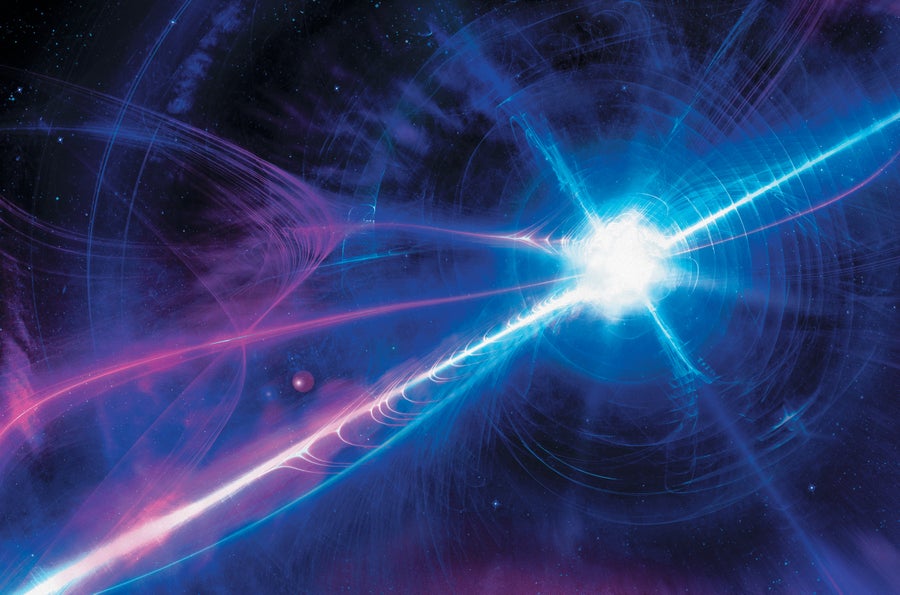
In the quiet moments between human-made transmissions, when radio telescopes listen to the universe with extraordinary patience, something unexpected sometimes happens. A sharp, brilliant flash of radio energy appears, lasts for only a few thousandths of a second, and then vanishes forever. It does not repeat on schedule. It does not announce itself in advance. It leaves behind only data, questions, and a lingering sense of awe. These events are known as Fast Radio Bursts, or FRBs, and they represent one of the most intriguing mysteries in modern astrophysics.
Fast Radio Bursts are among the most powerful signals ever detected from beyond our galaxy, yet they are also among the briefest. In the time it takes to blink, an FRB can release as much energy in radio waves as the Sun emits over days or even longer. They arrive from across the cosmos, distorted by the vast oceans of plasma they pass through, carrying with them clues about the universe’s structure, composition, and violent extremes. Despite years of study and dramatic progress, their true origins remain elusive.
To understand why FRBs matter so deeply, and why they have captured the imagination of scientists around the world, one must follow their story from accidental discovery to the frontiers of cosmic research.
The Accidental Discovery That Changed Radio Astronomy
The story of Fast Radio Bursts begins not with a deliberate search, but with curiosity and persistence. In the early twenty-first century, astronomers analyzing archival data from radio telescopes noticed something odd. Buried within recordings originally collected for other purposes was a single, unusually bright pulse of radio waves. It lasted only milliseconds, yet its signal was unmistakable.
At first, the burst seemed almost too strange to be real. It was far brighter than most known radio sources, and its signal showed a distinctive frequency-dependent delay, a signature that suggested it had traveled through vast amounts of ionized gas. This dispersion implied an origin far beyond the Milky Way. The universe itself appeared to have stretched and filtered the signal during its long journey to Earth.
Skepticism was natural. Radio telescopes are sensitive instruments, vulnerable to interference from satellites, aircraft, and even microwave ovens. Yet careful analysis ruled out terrestrial sources. The burst was cosmic. It had crossed billions of light-years, only to appear in human data as a fleeting anomaly.
That first detection marked the birth of a new field. What had once been an oddity became the prototype of an entirely new class of astrophysical phenomena.
What Makes a Fast Radio Burst Fast and Powerful
Fast Radio Bursts are defined by two central characteristics: their extreme brevity and their extraordinary intensity. Most last only a few milliseconds, and some are even shorter. During that fleeting instant, they emit an enormous amount of energy concentrated in radio frequencies.
The sheer power of FRBs is difficult to fully grasp. Although they are observed as faint signals by the time they reach Earth, this faintness is deceptive. The distances involved are so vast that only an intrinsically powerful event could remain detectable. An FRB occurring in a distant galaxy must be releasing energy on a scale comparable to some of the most violent processes in the universe.
Equally important is their dispersion. As radio waves travel through space filled with free electrons, lower frequencies are delayed more than higher ones. This produces a characteristic sweep in the signal, allowing astronomers to estimate how much material the burst passed through. For many FRBs, the dispersion is far greater than what the Milky Way alone can account for, confirming their extragalactic origin.
These properties together make FRBs both fascinating and frustrating. They are powerful enough to study across cosmic distances, yet brief enough that catching them requires both luck and sophisticated instrumentation.
From Rarity to Abundance: A Growing Population
In the early years following their discovery, Fast Radio Bursts appeared to be rare. Only a handful were known, each detected in archival data or by chance during unrelated observations. This scarcity fueled speculation and debate. Were FRBs truly rare cosmic events, or were they simply difficult to detect?
As radio telescopes improved and surveys became more systematic, the answer emerged. FRBs are not rare at all. They are happening constantly across the universe. The challenge lies in detecting them, given their short duration and unpredictable timing.
Modern surveys suggest that thousands of FRBs may occur across the sky every day. Most go unnoticed, their signals passing through Earth without intersecting a telescope’s narrow field of view. This realization transformed FRBs from curiosities into a significant component of the radio sky.
With more detections came patterns, and with patterns came deeper questions.
Repeating and Non-Repeating Bursts: A Crucial Distinction
One of the most surprising developments in FRB research was the discovery that some bursts repeat. For years, all known FRBs appeared to be one-time events. This led many scientists to favor catastrophic origins, such as stellar explosions or mergers, which would naturally produce a single burst.
The detection of a repeating FRB challenged that assumption. Here was a source that produced multiple bursts over time, sometimes with irregular intervals, sometimes with periods of heightened activity followed by silence. This behavior ruled out certain one-off scenarios and suggested that at least some FRBs originate from objects capable of surviving the emission process.
The existence of both repeating and apparently non-repeating FRBs raised a profound question. Are all FRBs produced by the same kind of object under different conditions, or are there multiple types of sources? The answer remains uncertain, but the diversity of observed behaviors hints at a rich and complex underlying reality.
Repeating FRBs have become especially valuable to astronomers because they can be studied in detail. By observing multiple bursts from the same location, scientists can pinpoint their host galaxies and examine the environments in which they occur.
Pinpointing Origins: Host Galaxies and Cosmic Neighborhoods
Localizing Fast Radio Bursts is one of the greatest challenges in the field. Because bursts are so brief, traditional radio telescopes often cannot determine their precise position in the sky. Early detections could only be localized to large regions, containing countless galaxies.
Advances in radio interferometry changed this. By using networks of telescopes working together, astronomers can achieve far higher resolution. This has allowed several FRBs to be traced back to specific galaxies, sometimes even to particular regions within those galaxies.
The host galaxies of FRBs are diverse. Some are small, star-forming galaxies rich in gas and young stars. Others are larger and more mature. This diversity suggests that FRBs are not confined to a single type of cosmic environment.
In some cases, FRBs appear to originate from regions associated with intense magnetic fields or energetic processes. These clues have fueled leading theories about their sources, particularly those involving exotic stellar remnants.
Magnetars and Extreme Physics
Among the most compelling candidates for the origin of many Fast Radio Bursts are magnetars. Magnetars are a rare type of neutron star, the ultra-dense remnants left behind after massive stars explode. What sets magnetars apart is their magnetic fields, which are trillions of times stronger than Earth’s and among the most powerful known in the universe.
These extreme magnetic fields can store enormous amounts of energy. When they rearrange or fracture the star’s crust, they can release sudden bursts of radiation. Such events are already known to produce intense X-ray and gamma-ray flares.
The idea that magnetars could also produce FRBs gained significant support when a burst with FRB-like properties was detected from within our own galaxy, coinciding with activity from a known magnetar. While this galactic burst was weaker than typical extragalactic FRBs, it demonstrated that magnetars are capable of generating fast, bright radio flashes.
This connection does not solve the mystery entirely. Not all properties of FRBs are easily explained by current magnetar models, and some bursts exhibit features that remain puzzling. Still, magnetars represent a powerful link between FRBs and known astrophysical objects.
The Role of Plasma and Propagation Effects
Fast Radio Bursts do not travel through empty space. On their journey to Earth, they pass through the interstellar medium of their host galaxies, the intergalactic medium between galaxies, and the Milky Way’s own plasma. Each region leaves its imprint on the signal.
These propagation effects are not merely complications; they are opportunities. By studying how FRB signals are distorted, astronomers can learn about the otherwise invisible matter between galaxies. The dispersion measure reveals the total amount of free electrons along the line of sight, offering insights into the distribution of baryonic matter in the universe.
Some FRBs also show scattering, polarization, and rotation effects, indicating interactions with magnetic fields and turbulent plasma. In certain cases, these effects are so extreme that they suggest the burst originated in a highly magnetized environment.
In this way, FRBs serve as cosmic probes, illuminating the structure of the universe on the largest scales.
The Challenge of Explaining the Brightness
One of the most persistent puzzles surrounding Fast Radio Bursts is how they can be so bright in radio wavelengths. Producing such intense radio emission requires coherent processes, in which many charged particles act in unison. This is very different from most astrophysical radiation, which is produced incoherently by individual particles.
Coherent emission is known in some contexts, such as pulsars, which are rotating neutron stars emitting regular radio pulses. However, the intensity and briefness of FRBs push these mechanisms to extremes.
Theoretical models must account not only for the energy involved but also for how that energy is converted so efficiently into radio waves. This requirement places strong constraints on any proposed source and continues to challenge physicists.
FRBs and the Question of Catastrophe
For non-repeating FRBs, catastrophic scenarios remain plausible. These include the collapse of massive objects or sudden, violent events that destroy their source. Such models naturally explain why some FRBs are seen only once.
However, the diversity of observed properties complicates this picture. Some apparently non-repeating FRBs may simply be repeating sources that have not yet been observed again. The line between repeating and non-repeating may not be as clear as once thought.
Understanding whether there are truly one-time FRB sources is essential for unraveling their origins. It may be that the universe produces fast radio bursts through multiple pathways, reflecting the varied and dynamic nature of cosmic evolution.
FRBs as Tools for Cosmology
Beyond their intrinsic mystery, Fast Radio Bursts hold enormous promise as tools for studying the universe. Because they are bright, brief, and detectable across vast distances, they can be used to probe regions of space that are otherwise difficult to study.
One of the most exciting applications is the measurement of the universe’s missing matter. Observations suggest that a significant fraction of ordinary matter exists not in stars or galaxies but in diffuse gas between galaxies. FRBs, with their dispersion signatures, provide a direct way to measure this hidden component.
By comparing FRB dispersion measures with their distances, astronomers can map the distribution of matter across cosmic scales. This turns each burst into a kind of lighthouse, illuminating the invisible structure of the universe.
Technology and the New Era of Discovery
The rapid progress in FRB research has been driven by technological innovation. New radio telescopes and upgrades to existing ones have dramatically increased sensitivity, field of view, and time resolution.
Instruments designed to monitor large portions of the sky continuously have been particularly effective. By increasing the chances of catching bursts in real time, these observatories allow for immediate follow-up observations across the electromagnetic spectrum.
Real-time detection has opened the door to multiwavelength studies, searching for counterparts in optical, X-ray, or gamma-ray light. Although such counterparts are rare or faint, their detection would provide crucial clues about the physical processes involved.
Human Wonder and the Emotional Pull of FRBs
There is something deeply moving about Fast Radio Bursts. They are messages from the deep universe, arriving without warning, carrying energy released in distant galaxies long before life on Earth had taken its current form. Their brevity reminds us of the fleeting nature of cosmic events and of human observation itself.
FRBs also embody the spirit of scientific discovery. They were found unexpectedly, studied skeptically, and gradually understood through collaboration and persistence. Each new burst is a reminder that the universe still holds surprises, that even in an age of advanced technology, nature can still astonish us.
For scientists, FRBs are not just data points but invitations. They invite us to rethink assumptions, refine theories, and push instruments to their limits. They invite us to listen more carefully to the universe’s quietest whispers and its loudest shouts.
The Road Ahead: Mystery as Motivation
Despite remarkable progress, Fast Radio Bursts remain only partially understood. We know they are real, extragalactic, and extraordinarily powerful. We have identified plausible sources and begun to classify their behaviors. Yet a complete, unified explanation remains out of reach.
This uncertainty is not a failure. It is a sign of a healthy and evolving field. The history of physics and astronomy shows that mysteries often lead to profound breakthroughs. FRBs may ultimately reveal new aspects of extreme physics, deepen our understanding of cosmic matter, or even uncover phenomena not yet imagined.
As new telescopes come online and data accumulates, the picture will sharpen. Patterns will emerge, theories will be tested, and some will fall away. Through this process, Fast Radio Bursts will move from the edges of mystery toward understanding, even if they never lose their sense of wonder.
Listening to the Universe
Fast Radio Bursts teach us an essential lesson about science and humanity’s place in the cosmos. The universe is not obligated to be familiar or comfortable. It speaks in signals that can be fleeting, intense, and strange. Our task is to listen, interpret, and remain open to being surprised.
In those few milliseconds when an FRB flashes across a radio telescope’s detectors, billions of years of cosmic history converge with human curiosity. A distant event, born of extreme conditions, briefly touches our instruments and our minds.
Fast Radio Bursts are reminders that the universe is alive with activity beyond our everyday perception. They are brief, intense signals, and though we still can’t fully explain them, they have already expanded our sense of what is possible. In chasing their origins, we are not only solving a scientific puzzle. We are deepening our connection to the vast, dynamic cosmos that surrounds us.