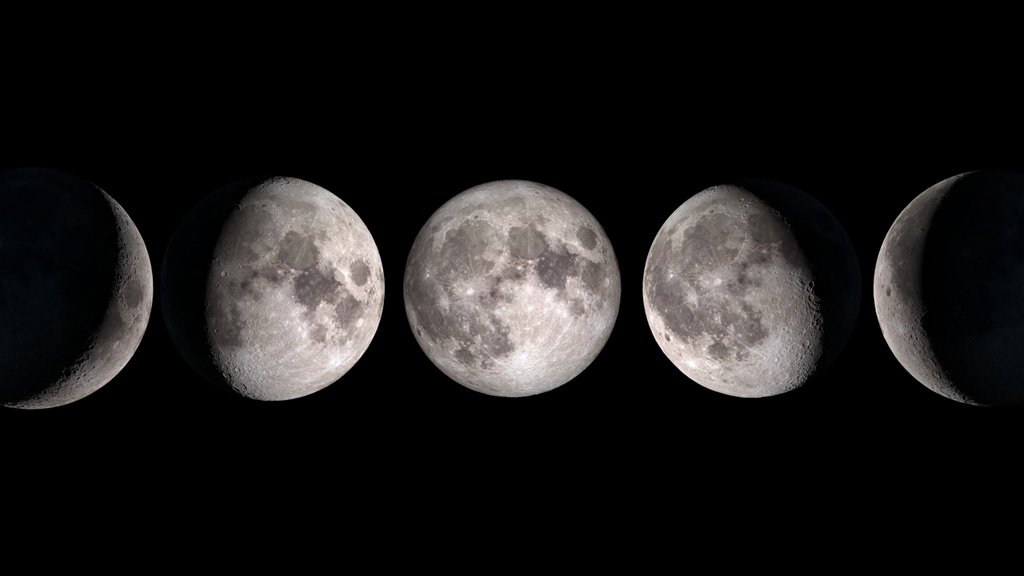
Every night, the Moon tells a different story. Sometimes it rises as a thin sliver of silver light, barely visible against the fading glow of sunset. On other nights, it dominates the sky as a brilliant, full circle, casting shadows on the ground and illuminating landscapes with a gentle, otherworldly glow. This steady transformation is known as the lunar phase cycle, a rhythm of light and shadow that has fascinated humanity for thousands of years.
The changing appearance of the Moon is not random. It follows a predictable pattern that repeats over roughly 29.5 days, often rounded to about 28 days in everyday understanding. This cycle reflects the dynamic relationship between the Moon, the Earth, and the Sun. As the Moon orbits Earth, different portions of its surface are illuminated from our perspective, creating the sequence of phases we observe.
Understanding lunar phases is not only a matter of astronomy. It connects us to timekeeping traditions, cultural practices, and the fundamental mechanics of our solar system. The Moon’s cycle is a visible reminder that we live within a system of motion, light, and gravity, where even the simplest nightly observation reveals deeper cosmic truths.
The Geometry of Light and Shadow
The phases of the Moon are created by the interplay of sunlight and perspective. The Moon does not produce its own light. Instead, it reflects sunlight, much like a mirror. At any given moment, half of the Moon is illuminated by the Sun, while the other half remains in darkness.
However, from Earth, we do not always see the fully illuminated half. The portion we observe depends on the Moon’s position relative to Earth and the Sun. As the Moon travels in its orbit around Earth, the angle between these three bodies changes, altering how much of the sunlit side is visible to us.
When the Moon is positioned between Earth and the Sun, the side facing us is mostly in shadow, making it nearly invisible. As it moves along its orbit, more of the illuminated side becomes visible, gradually increasing the amount of light we see. Eventually, when the Moon is on the opposite side of Earth from the Sun, its entire sunlit face is visible, creating a full Moon. After that, the visible illumination decreases again, returning to darkness as the cycle completes.
This constant shifting of light and shadow is not caused by Earth’s shadow falling on the Moon. That phenomenon occurs only during a lunar eclipse. The phases are instead the result of our changing viewpoint of the Moon’s illuminated half.
The Length of the Lunar Cycle
The complete sequence of lunar phases, known as a synodic month, takes approximately 29.5 days. This is slightly longer than the time it takes the Moon to complete one orbit around Earth relative to the stars, which is about 27.3 days. The difference arises because Earth is also moving around the Sun, so the Moon must travel a bit farther to reach the same alignment with the Sun and Earth.
In many traditional systems, the lunar cycle is approximated as 28 days. This simplification makes it easier to divide the cycle into equal parts and has influenced calendars, rituals, and cultural interpretations throughout history. While not exact, the 28-day approximation captures the essence of the Moon’s rhythmic changes.
Each cycle is a continuous flow rather than a series of abrupt steps. The phases blend smoothly into one another, creating a gradual transition from darkness to light and back again.
The New Moon and the Beginning of the Cycle
The lunar cycle begins with the new Moon, a phase that is often invisible to the naked eye. During this time, the Moon is positioned between Earth and the Sun. The side facing Earth is in shadow, while the illuminated side faces away from us.
Although the new Moon cannot usually be seen, it marks an important moment in the cycle. It represents the starting point from which the Moon begins to reveal itself again. In the days following the new Moon, a thin crescent of light appears in the sky shortly after sunset.
This early crescent is delicate and fleeting. It hangs low on the horizon, visible only for a short time before setting. Observing it requires clear skies and careful attention, making it a moment that has inspired both scientific observation and cultural significance.
The Waxing Crescent and Growing Light
As the Moon continues its journey, the illuminated portion visible from Earth begins to increase. This phase is known as the waxing crescent. The word “waxing” refers to the growth of light, while “crescent” describes the curved shape of the illuminated portion.
Each evening, the crescent becomes slightly thicker and remains visible for a longer period after sunset. The Moon gradually moves higher in the sky and sets later each night. This steady growth is a visible expression of the Moon’s motion around Earth.
The waxing crescent phase is a time of transition. It marks the shift from darkness toward increasing brightness. The Moon’s gentle curve becomes a familiar sight in the evening sky, signaling the progression of the lunar cycle.
The First Quarter and Half Illumination
About a week after the new Moon, the Moon reaches the first quarter phase. Despite its name, this phase does not mean that only a quarter of the Moon is illuminated. Instead, it indicates that the Moon has completed roughly one quarter of its orbit around Earth.
At this stage, half of the Moon’s visible surface is illuminated. The line dividing light and shadow, known as the terminator, runs straight down the middle of the Moon’s face. This creates a striking visual contrast between the bright and dark halves.
The first quarter Moon is visible in the afternoon and evening, reaching its highest point in the sky around sunset. It sets around midnight, making it a prominent feature of the early night sky.
The sharp boundary between light and shadow during this phase highlights the Moon’s surface features. Craters, mountains, and valleys cast long shadows, revealing details that are less noticeable during fuller phases.
The Waxing Gibbous and Approaching Fullness
Following the first quarter, the Moon enters the waxing gibbous phase. The term “gibbous” refers to a shape that is more than half illuminated but not yet fully round. During this phase, the illuminated portion continues to grow, covering most of the Moon’s visible surface.
The waxing gibbous Moon rises in the afternoon and becomes increasingly prominent in the evening sky. Its brightness intensifies as more of the sunlit surface becomes visible. Night by night, it approaches the fullness that marks the midpoint of the cycle.
This phase represents anticipation. The Moon is nearly complete, yet still changing. Its gradual transformation reminds observers of the continuous nature of celestial motion.
The Full Moon and Complete Illumination
The full Moon occurs when Earth is positioned between the Sun and the Moon. In this alignment, the entire sunlit side of the Moon faces Earth, making it appear as a complete, glowing circle.
The full Moon rises at sunset and sets at sunrise, remaining visible throughout the night. Its brightness can illuminate landscapes, casting shadows and revealing details that are otherwise hidden in darkness.
At this stage, the Moon’s surface appears evenly lit, with fewer visible shadows compared to earlier phases. While this reduces the contrast of surface features, it enhances the overall brilliance of the Moon.
The full Moon has held deep cultural and symbolic meaning across civilizations. It has been associated with calendars, festivals, and storytelling. From a scientific perspective, it represents a precise alignment within the Earth-Moon-Sun system.
The Waning Gibbous and Declining Light
After the full Moon, the cycle begins to reverse. The illuminated portion starts to decrease, marking the waning gibbous phase. The term “waning” indicates a reduction in light.
During this phase, the Moon rises later each night, appearing in the evening and remaining visible into the morning. The once-full circle gradually loses its symmetry as darkness begins to encroach from one side.
The waning gibbous phase mirrors the waxing gibbous, but in reverse. It reflects the ongoing motion of the Moon as it continues its orbit, moving toward the next stages of the cycle.
The Last Quarter and Another Half Moon
Approximately three weeks into the cycle, the Moon reaches the last quarter phase. Like the first quarter, half of the visible surface is illuminated. However, the opposite half is now lit, creating a reversed appearance.
The last quarter Moon rises around midnight and is visible during the morning hours. It reaches its highest point in the sky near sunrise and sets around midday.
This phase marks another key point in the cycle, emphasizing the symmetry of the Moon’s changing appearance. The balance of light and shadow once again highlights the geometry of the Earth-Moon-Sun system.
The Waning Crescent and Return to Darkness
In the final phase of the cycle, the Moon becomes a waning crescent. The illuminated portion shrinks to a thin curve, visible in the early morning sky before sunrise.
This phase is often subtle and easy to miss. The crescent grows thinner each day, eventually disappearing from view as the Moon approaches the new Moon phase once again.
The waning crescent represents closure. It signals the end of one cycle and the approach of another. The Moon returns to darkness, completing its journey through light and shadow.
Why the Cycle Matters
The lunar phase cycle is more than a visual phenomenon. It reflects the fundamental principles of motion and light that govern our solar system. By observing the Moon’s phases, we gain insight into the mechanics of orbits, the behavior of light, and the relationships between celestial bodies.
The cycle has also played a crucial role in human history. Many early calendars were based on lunar phases, using the Moon as a natural timekeeper. Agricultural practices, religious observances, and cultural traditions have all been influenced by the rhythm of the Moon.
Even today, the lunar cycle continues to shape our understanding of time and nature. It provides a connection between scientific knowledge and everyday experience, reminding us that the universe is not static but constantly in motion.
The Subtle Variations in Observation
While the basic pattern of lunar phases is consistent, the way we observe them can vary depending on location and time. The angle of the Moon’s path across the sky changes with the seasons, affecting how the phases appear.
In different parts of the world, the orientation of the crescent may differ. In some regions, the crescent appears tilted, while in others it may look more vertical. These variations arise from the geometry of Earth’s rotation and its position relative to the Moon.
Atmospheric conditions also influence visibility. Clear skies provide sharp views of the Moon’s surface, while clouds and pollution can obscure details. The brightness of the Moon can vary slightly depending on its distance from Earth, as its orbit is not perfectly circular.
The Endless Cycle of Light and Shadow
The lunar phases are a continuous, repeating cycle that has persisted for billions of years. Each phase flows into the next, creating a seamless pattern of change. There is no true beginning or end, only an ongoing rhythm that connects the Moon, Earth, and Sun.
This cycle is both simple and profound. It can be understood through basic geometry, yet it also represents the complex interactions of celestial mechanics. It is visible to anyone who looks up at the sky, yet it reflects the deep laws of physics that govern the universe.
In watching the Moon change from a faint crescent to a brilliant full disk and back again, we witness a story written in light and shadow. It is a story of motion, perspective, and the enduring connection between our planet and its closest celestial companion.
The Moon’s phases remind us that change is a fundamental part of nature. They show that even in the vastness of space, patterns exist—patterns that can be observed, understood, and appreciated. Through the simple act of watching the Moon, we become participants in a cosmic dance that has been unfolding long before human history began and will continue far into the future.