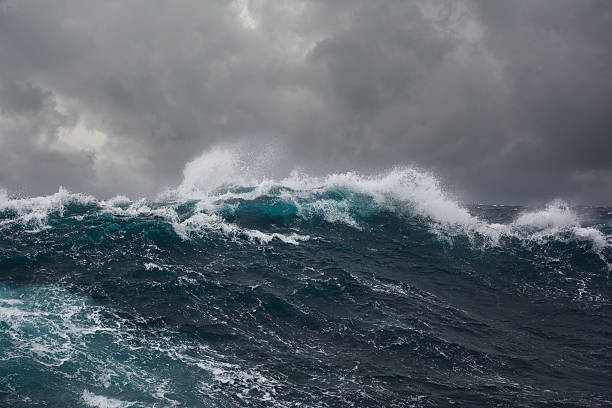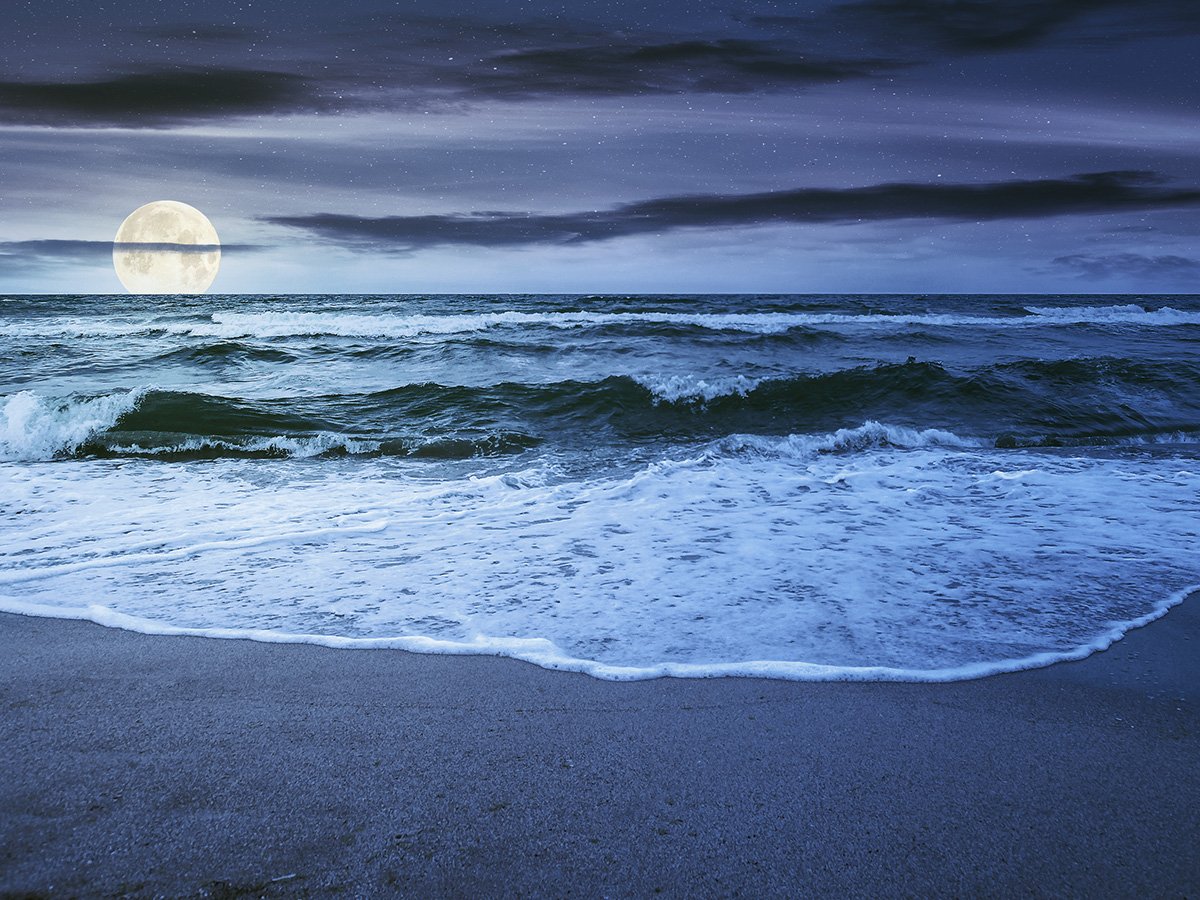
Along coastlines across the planet, the ocean breathes. Water creeps up beaches, floods tidal flats, then slowly retreats, revealing rocks, shells, and shimmering sand. This motion feels ancient and almost alive, as if the sea itself is responding to some deep rhythm. For thousands of years, humans have watched tides with awe and dependence, timing voyages, harvests, rituals, and lives around their predictable pulse. Long before we understood gravity, we knew that the ocean was being moved by something beyond itself.
At the heart of tides lies a profound and elegant truth: the Moon, distant and silent, is physically pulling on Earth’s oceans. This is not poetry or metaphor. It is a real force acting across space, shaping coastlines, ecosystems, and human history. Tides are a daily reminder that Earth does not exist in isolation. Our planet is locked in an intimate gravitational dance with its celestial companions, and the oceans respond like a vast, sensitive instrument tuned to the Moon’s pull.
Understanding tides means understanding gravity, motion, and the subtle interplay between Earth, Moon, and Sun. It is a story of invisible forces made visible in water, of cosmic relationships expressed in waves and currents. It is also a deeply emotional story, because tides link the everyday experience of standing on a beach to the grand mechanics of the universe.
Gravity: The Invisible Hand Reaching Across Space
To understand how the Moon pulls on the oceans, we must first understand gravity. Gravity is not a force we feel directly in the same way we feel wind or heat. It is a constant presence, shaping motion silently and relentlessly. Every object with mass attracts every other object with mass. The larger the masses and the closer they are, the stronger the attraction.
The Moon, though much smaller than Earth, is still massive enough to exert a significant gravitational pull. That pull extends across the distance separating the two bodies, reaching Earth and acting on everything here: land, atmosphere, and oceans alike. But the oceans, fluid and mobile, respond most dramatically.
Gravity does not pull equally on every part of Earth. The side of Earth facing the Moon is slightly closer to it than the center of Earth, and much closer than the far side. This difference in distance means there is a difference in gravitational pull across the planet. That difference is the key to tides.
The Tidal Force: Stretching Earth’s Waters
The phenomenon that creates tides is known as the tidal force. It arises not from gravity itself, but from the variation of gravity across an object. On the side of Earth nearest the Moon, the Moon’s gravitational pull is strongest. Water there is pulled slightly more strongly toward the Moon than the solid Earth beneath it. This causes the ocean to bulge outward, forming a high tide.
On the far side of Earth, something equally fascinating happens. There, the Moon’s gravitational pull is weaker than the pull it exerts on Earth’s center. As Earth is pulled slightly toward the Moon, the water on the far side is left behind, creating another bulge. This second bulge is not pulled toward the Moon but results from the Earth being pulled away from the water.
These two bulges, on opposite sides of the planet, are the fundamental shape of the tidal system. As Earth rotates, different regions pass through these bulges, experiencing high tides. Regions between the bulges experience low tides.
This stretching of Earth’s oceans is subtle. The tidal bulges are only a few meters high in the open ocean. Yet when these small differences interact with coastlines, continental shelves, and ocean basins, they can produce dramatic tidal ranges.
Earth’s Rotation and the Daily Rhythm of Tides
Earth rotates once every 24 hours, while the Moon orbits Earth roughly once every 27.3 days. Because the Moon is moving in its orbit while Earth spins, the timing of tides is not exactly synchronized with the solar day. Instead, the Moon rises about 50 minutes later each day, and tides follow this lunar schedule.
Most coastal locations experience two high tides and two low tides each lunar day, a pattern known as semidiurnal tides. These tides are not always equal in height. The tilt of Earth’s axis and the inclination of the Moon’s orbit cause variations that lead to mixed tides in many places, where one high tide is higher than the other.
This daily rhythm is not imposed by the ocean itself. It is imposed by celestial mechanics. The ocean is responding continuously to the Moon’s pull, reshaping itself moment by moment as Earth turns beneath the tidal bulges.
The Sun’s Role: A Powerful Partner in the Dance
Although the Moon is the primary driver of tides, the Sun also plays a significant role. The Sun is vastly more massive than the Moon, and its gravitational pull on Earth is much stronger overall. However, because the Sun is so far away, the difference in its gravitational pull across Earth is smaller than that of the Moon. Tidal forces depend on differences, not absolute strength.
When the Sun, Moon, and Earth align during new and full moons, their tidal forces combine. The result is higher high tides and lower low tides, known as spring tides. These tides are not related to the season of spring; the name comes from the idea of water “springing” higher.
When the Sun and Moon are at right angles relative to Earth during the first and third quarters of the Moon, their tidal forces partially cancel each other out. This produces neap tides, with less extreme differences between high and low water.
This interplay between Moon and Sun adds a slower rhythm to the tides, superimposed on the daily cycle. Coastal environments, marine organisms, and human activities all respond to these longer-term patterns.
The Ocean Basins: Shaping and Amplifying Tides
In the open ocean, tidal bulges are smooth and gentle. Near coastlines, however, the situation becomes far more complex. Continents block the free movement of water, forcing tides to follow coastlines and interact with ocean basins. The shape and depth of these basins can amplify or dampen tidal motion.
In some regions, the natural period of oscillation of a bay or sea matches the tidal forcing. When this happens, resonance occurs, and tides can become extraordinarily large. The Bay of Fundy, for example, experiences some of the highest tides in the world because its shape and depth align with the timing of the tidal cycle.
Elsewhere, narrow channels and shallow waters accelerate tidal currents, creating powerful flows that shape coastlines and ecosystems. These local effects remind us that tides are not just a global phenomenon but a deeply regional one, shaped by the geography of Earth itself.
Tides as Sculptors of the Coast
Over geological time, tides have played a major role in shaping coastlines. The repeated rise and fall of water erodes rock, transports sediment, and creates distinctive landforms such as tidal flats, salt marshes, and estuaries.
These environments are among the most biologically productive on Earth. The regular flooding and draining of tides bring nutrients, oxygen, and life. Many species have evolved to synchronize their behavior with tidal cycles, timing feeding, reproduction, and migration to the rhythm of the sea.
For humans, tides have been both a resource and a challenge. They have enabled navigation and trade while also posing risks through flooding and strong currents. Coastal cultures have long developed an intimate knowledge of tides, embedding them into language, folklore, and daily life.
The Moon’s Distance and the Long-Term Evolution of Tides
The Moon is not stationary. It is slowly moving away from Earth at a rate of a few centimeters per year. This gradual recession is caused by tidal interactions themselves. As tides move water across Earth’s surface, they dissipate energy through friction. This energy loss slightly slows Earth’s rotation and transfers angular momentum to the Moon, pushing it outward.
In the distant past, the Moon was much closer to Earth, and tides were significantly stronger. Days were shorter, and tidal ranges were larger. These stronger tides may have played a role in the early development of life, creating dynamic coastal environments where complex chemistry could occur.
In the distant future, tides will weaken as the Moon moves farther away. Earth’s rotation will slow further, lengthening days. The familiar tidal rhythms we experience today are a snapshot in a much longer cosmic story.
Solid Earth Tides: The Planet Itself Responds
While ocean tides are the most visible, the Moon’s pull affects the entire planet. Earth’s solid body also experiences tides, rising and falling by small but measurable amounts. These solid Earth tides are typically on the order of tens of centimeters.
Even the atmosphere responds, with subtle pressure variations tied to tidal forces. These effects are less obvious than ocean tides, but they demonstrate that the Moon’s influence is truly global. Earth is not a rigid, unchanging sphere. It is a responsive, dynamic system, constantly flexing under gravitational forces.
Measuring Tides and Unlocking Their Patterns
Modern science has transformed tides from a mystery into a precisely understood phenomenon. Satellites measure sea level changes across the globe, revealing the complex patterns of tidal motion in astonishing detail. Mathematical models simulate the interaction of gravitational forces, Earth’s rotation, and ocean basin geometry.
These tools allow scientists to predict tides far into the future with remarkable accuracy. Tide tables, once based on generations of observation, are now computed using physics and data. Yet even with this precision, tides retain an element of wonder. Knowing the equations does not diminish the emotional impact of watching the sea rise under a full Moon.
Tides and Human Civilization
Throughout history, tides have shaped human settlement and activity. Coastal communities learned to read the tides to fish, farm, and travel. Ports were built where tides allowed ships to enter and leave. Some of the world’s great cities grew in tidal estuaries, where freshwater and seawater mix.
Tides also influenced exploration. Navigators relied on tidal knowledge to avoid grounding ships and to harness currents. In some regions, tides determined when entire landscapes were accessible, transforming islands into peninsulas and back again.
Even today, tides affect global commerce, coastal engineering, and energy production. Tidal power harnesses the predictable motion of water to generate electricity, offering a renewable energy source rooted directly in celestial mechanics.
Emotional Resonance: Why Tides Move Us
There is something profoundly moving about tides. They are gentle yet unstoppable, predictable yet endlessly variable. Standing at the shoreline, watching the water advance and retreat, one feels connected to something larger than oneself.
This emotional resonance comes from the realization that tides link our immediate experience to the Moon hanging in the sky. The same force that guides the Moon in its orbit is lifting the water at our feet. In a very real sense, the universe is touching us through the ocean.
Tides remind us that we live on a planet embedded in a vast cosmic system. They blur the boundary between Earth and space, between the familiar and the infinite. They show that even the most ordinary experiences can have extraordinary origins.
Misconceptions and the Beauty of the True Explanation
Many people imagine tides as the ocean being pulled directly toward the Moon in a simple, one-sided way. While this idea captures part of the truth, it misses the subtlety of the tidal force. The existence of two tidal bulges, one facing the Moon and one opposite, often surprises those encountering the explanation for the first time.
This complexity does not make tides less beautiful. On the contrary, it reveals a deeper elegance. The fact that tides arise from differences in gravitational pull rather than sheer strength shows how sensitive and interconnected physical systems can be.
Understanding tides properly enhances appreciation rather than diminishing mystery. It shows that nature’s behavior, while governed by precise laws, can still inspire awe.
Tides Beyond Earth: A Universal Phenomenon
Tides are not unique to Earth. Wherever there are extended bodies in gravitational interaction, tidal forces operate. Moons raise tides on planets, planets raise tides on stars, and stars raise tides on each other in close binary systems.
In some cases, tidal forces are extreme. They can stretch and heat moons, driving volcanic activity. They can distort stars and influence the evolution of planetary systems. Studying tides elsewhere in the universe helps scientists understand the dynamics of distant worlds and the conditions that may support life.
By studying tides on Earth, we gain insight into processes that operate throughout the cosmos. The oceans become a laboratory for understanding gravity itself.
The Ongoing Relationship Between Earth and Moon
The Earth-Moon system is a partnership forged billions of years ago. Over that immense span of time, the Moon has stabilized Earth’s rotation, influenced its climate, and shaped its tides. In turn, Earth has shaped the Moon’s orbit and rotation.
This relationship is not static. It is evolving, slowly but inexorably. Tides are the visible expression of this ongoing exchange of energy and momentum. Each rise and fall of the sea is a tiny step in a cosmic process unfolding over eons.
Why Tides Matter in a Changing World
As sea levels rise due to climate change, tides take on new significance. Higher baseline sea levels mean that high tides can cause flooding in places where it was once rare. Understanding tidal dynamics becomes crucial for coastal planning and resilience.
At the same time, tides remain one of the most predictable natural phenomena. Unlike weather, they follow celestial cycles that can be calculated centuries in advance. This predictability offers both comfort and opportunity in an uncertain world.
The Enduring Wonder of the Tides
Tides are physics made visible. They are gravity translated into motion, celestial mechanics expressed in water and shoreline. They show how distant objects can exert intimate influence, how the Moon can shape our daily experience without ever touching Earth.
To watch the tide come in is to witness the universe at work on a human scale. It is to see the pull of the Moon written across the surface of the sea. In that moment, science and emotion meet. Knowledge deepens wonder, and wonder invites knowledge.
The next time you stand by the ocean and feel the tide turning, remember that you are watching a cosmic relationship unfold. The Moon is there, silently pulling, and the Earth is responding, just as it has for billions of years. The tides rise, the tides fall, and in their rhythm, the universe whispers its laws to the shore.