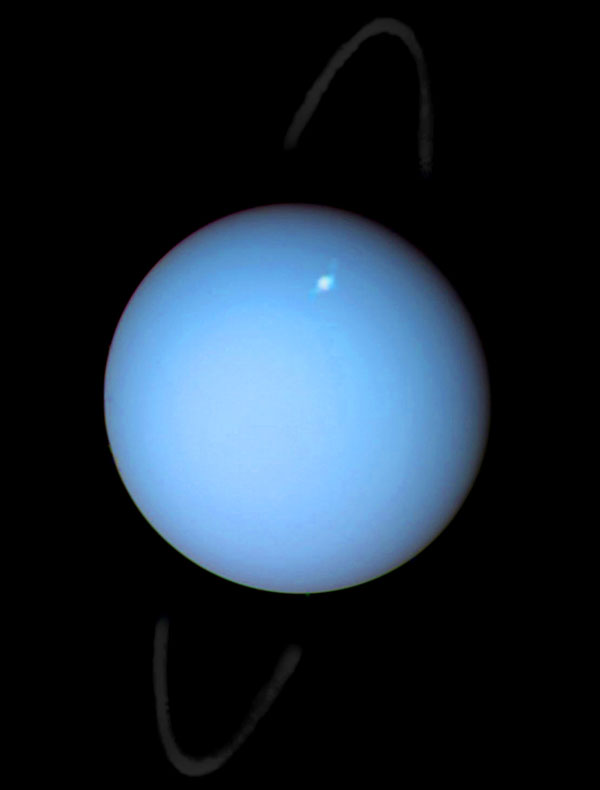
Among the many worlds that orbit our Sun, few are as strange and misunderstood as Uranus. At first glance, it may appear quiet and unremarkable—a pale blue sphere drifting through the cold outer reaches of the solar system. Yet beneath this calm appearance lies one of the most unusual planets ever discovered.
Uranus challenges many assumptions about how planets behave. Its rotation is bizarre, its seasons are extreme, its atmosphere hides powerful storms, and its magnetic field behaves in ways that scientists still struggle to fully understand. Even the story of its discovery marked a turning point in human history, as it became the first planet ever found with a telescope rather than observed by ancient civilizations.
When astronomers study Uranus, they are not just looking at another distant planet. They are looking at a world that forces us to rethink what planets can be like.
The following ten strange facts reveal why Uranus is one of the most fascinating objects in our solar system—and why it continues to surprise scientists even centuries after its discovery.
1. Uranus Rotates on Its Side
One of the most astonishing characteristics of Uranus is the way it spins. Most planets rotate in a relatively upright orientation. For example, Earth tilts only about 23.5 degrees relative to its orbit around the Sun. This tilt is what creates our seasons.
Uranus, however, is tilted by about 98 degrees.
This means the planet essentially rotates on its side. Instead of spinning like a top, Uranus rolls around the Sun like a ball.
As a result, its poles sometimes point almost directly at the Sun, while its equator faces deep space. From a cosmic perspective, Uranus appears to be lying sideways as it travels along its orbit.
Scientists believe this extreme tilt was caused by a colossal collision early in the planet’s history. A massive object—possibly a young planet several times the size of Earth—may have slammed into Uranus billions of years ago, knocking it onto its side.
That ancient impact permanently altered the planet’s orientation and created one of the most bizarre rotations in the solar system.
2. Uranus Has the Most Extreme Seasons in the Solar System
Because Uranus is tilted so dramatically, its seasons are unlike anything found on other planets.
Each pole experiences about 42 years of continuous sunlight followed by 42 years of darkness. This occurs because Uranus takes about 84 Earth years to complete a single orbit around the Sun.
Imagine a world where the Sun rises once every four decades and then disappears for another four decades.
During summer at one pole, the Sun never sets. It circles around the sky continuously for decades. Meanwhile, the opposite pole remains in complete darkness.
These extreme conditions create complex atmospheric changes as the planet slowly rotates and different regions receive sunlight after decades of darkness.
Studying these seasonal shifts provides scientists with valuable insight into atmospheric physics on distant worlds.
3. Uranus Was the First Planet Discovered with a Telescope
Unlike planets such as Mars or Jupiter, which were known since ancient times, Uranus was discovered relatively recently.
In 1781, the astronomer William Herschel observed a faint object moving slowly across the sky through his telescope. At first, he believed it might be a comet.
Further observations revealed something remarkable: the object followed a nearly circular orbit around the Sun. It was not a comet at all.
It was a previously unknown planet.
This discovery doubled the known size of the solar system almost overnight. Until that moment, Saturn had been considered the outermost planet.
The discovery of Uranus demonstrated that the solar system was larger and more complex than anyone had imagined.
It also marked the beginning of modern planetary discovery.
4. Uranus Is an Ice Giant, Not a Gas Giant
Uranus is often grouped with giant planets like Jupiter and Saturn, but it actually belongs to a different category known as ice giants.
While planets such as Jupiter are composed mainly of hydrogen and helium gas, Uranus contains large amounts of water, ammonia, and methane in the form of hot, dense fluids.
These materials exist under immense pressure deep within the planet’s interior.
Because of this composition, scientists classify Uranus—and its neighbor Neptune—as ice giants.
Despite the name, the interior of Uranus is not cold in the traditional sense. Temperatures inside the planet can reach thousands of degrees.
However, the term “ice” refers to molecules like water and ammonia that formed as ices during the early formation of the solar system.
Understanding ice giants is crucial because similar planets appear to be extremely common around other stars.
5. Uranus Is One of the Coldest Planets in the Solar System
Despite not being the farthest planet from the Sun, Uranus holds the record for the coldest planetary atmosphere in the solar system.
Temperatures in its upper atmosphere can drop to around −224 degrees Celsius.
This extreme cold puzzles scientists because Uranus should theoretically be warmer than Neptune. However, Uranus emits very little internal heat compared with other giant planets.
Planets like Jupiter radiate large amounts of energy left over from their formation. Uranus, on the other hand, appears to release almost no extra heat into space.
Some researchers believe the ancient collision that tilted Uranus may also have disrupted its internal structure, trapping heat deep inside the planet.
If true, that same catastrophic impact may have shaped both Uranus’s unusual tilt and its surprisingly cold atmosphere.
6. Uranus Has a Strange Magnetic Field
Planetary magnetic fields are usually aligned roughly with a planet’s rotation axis.
For example, Earth’s magnetic field emerges near the geographic poles.
Uranus, however, breaks this rule in dramatic fashion.
Its magnetic field is tilted by about 59 degrees relative to its rotation axis and is also significantly offset from the center of the planet.
This means the magnetic field behaves in a highly irregular way.
As Uranus rotates, its magnetic field swings wildly through space, producing a twisted and dynamic magnetic environment.
Scientists suspect this unusual field may be generated in a layer of electrically conducting fluids inside the planet rather than deep in its core.
Understanding Uranus’s magnetic field may help scientists learn more about how magnetic fields form on other planets and exoplanets.
7. Uranus Has Rings—But They Are Dark and Mysterious
When people think of planetary rings, they usually imagine the spectacular rings of Saturn.
However, Uranus also possesses a ring system.
These rings were discovered in 1977 when astronomers observed starlight briefly dimming as Uranus passed in front of a distant star.
Unlike Saturn’s bright icy rings, the rings of Uranus are extremely dark and narrow. They are composed mainly of rocky material and carbon-rich particles rather than reflective ice.
Because they absorb most of the light that reaches them, Uranus’s rings are difficult to see even with powerful telescopes.
The origin of these rings remains uncertain. They may be remnants of moons that were shattered by collisions long ago.
Despite their faint appearance, the rings add another layer of complexity to this already unusual planet.
8. Uranus Has More Than Two Dozen Moons
Uranus is surrounded by a fascinating collection of moons—27 known satellites in total.
Many of these moons are named after characters from the works of William Shakespeare and Alexander Pope, making Uranus unique among planets in terms of naming tradition.
Some of the largest moons include Titania, Oberon, Umbriel, Ariel, and Miranda.
Among these, Miranda stands out as one of the strangest moons in the solar system.
Miranda’s surface appears like a patchwork of different terrains, with enormous cliffs, deep valleys, and bizarre geological formations that look as though the moon was shattered and reassembled.
Some cliffs on Miranda may rise more than 20 kilometers high—among the tallest known in the solar system.
These moons reveal that Uranus’s gravitational system has undergone a dramatic and possibly violent history.
9. Uranus Appears Calm but Hides Powerful Storms
For many years, Uranus was thought to have a relatively quiet atmosphere compared with the dramatic storms of Jupiter.
Its pale blue color and lack of visible cloud bands suggested a calm and stable world.
However, modern observations using advanced telescopes have revealed that Uranus can produce surprisingly powerful storms.
Gigantic cloud systems have been observed forming and evolving across the planet’s atmosphere. Some storms grow large enough to be visible even from Earth-based telescopes.
These storms are fueled by temperature differences and atmospheric dynamics that scientists are still trying to understand.
Because Uranus rotates on its side, seasonal sunlight patterns can dramatically influence atmospheric circulation.
As the planet slowly progresses through its 84-year orbit, different hemispheres warm and cool, potentially triggering new atmospheric activity.
10. Uranus May Contain Oceans of Exotic “Hot Ice”
Deep inside Uranus lies an environment unlike anything found on Earth.
Under extreme pressure and temperature, water, ammonia, and methane may form dense superheated fluids sometimes described as “hot ice.”
These materials behave neither like ordinary liquids nor like typical solids.
Some researchers believe that under these conditions, carbon atoms within methane molecules could be compressed into diamonds that rain downward toward the planet’s core.
This idea, sometimes called “diamond rain,” remains a topic of scientific investigation.
If such processes occur, Uranus could contain layers of exotic materials forming under conditions impossible to replicate naturally on Earth.
Studying these environments helps scientists understand how matter behaves under extreme pressures found in giant planets across the universe.
A Planet Still Full of Mysteries
Despite centuries of observation, Uranus remains one of the least explored planets in the solar system.
Only one spacecraft, Voyager 2, has ever visited the planet. When it flew past Uranus in 1986, it provided humanity with its first close-up images of the planet, its moons, and its rings.
But that brief flyby lasted only a short time.
Since then, astronomers have continued studying Uranus from Earth and from space telescopes, but many mysteries remain unsolved.
Future missions may one day orbit Uranus and explore its atmosphere, magnetic field, and moons in much greater detail.
Such missions could reveal entirely new discoveries about this distant and enigmatic world.
A World That Changes Our Perspective
Uranus reminds us that the solar system is far stranger than we once imagined.
A planet spinning sideways, with decades-long seasons, a chaotic magnetic field, dark rings, and possibly diamond rain deep within its interior—this is not a world that fits neatly into our expectations.
Instead, it expands our understanding of what planets can be.
As astronomers continue to discover planets around other stars, Uranus may provide important clues about the diversity of planetary systems throughout the galaxy.
And perhaps most importantly, Uranus teaches us that even familiar objects in our cosmic neighborhood can still hold profound mysteries.
In the vast universe, there is always more to discover.