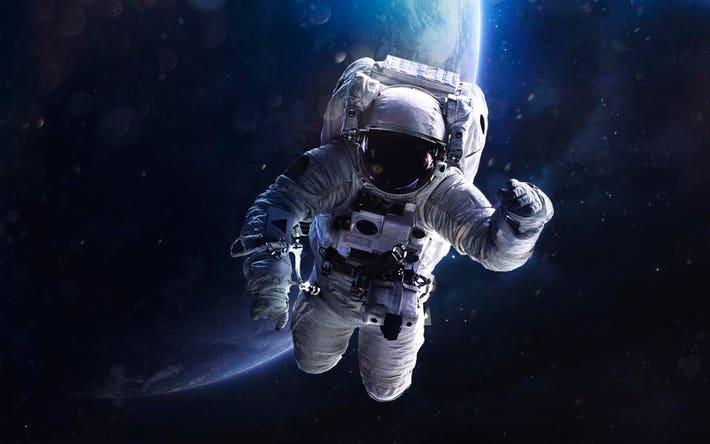
Space is often described in numbers: kilometers per second, degrees Kelvin, micrograys of radiation. But for the men and women who have left Earth behind and floated in orbit, space is not just a set of equations. It is an experience so profound, so disorienting, that even seasoned astronauts struggle to put it into words.
Outside the protective cocoon of Earth’s atmosphere, reality behaves differently. Light bends across blackness without scattering. Colors sharpen. Shadows turn absolute. Silence becomes complete. The familiar rules of motion no longer apply. And sometimes, astronauts witness phenomena that leave them unsettled—not because they are supernatural, but because they are not yet fully understood.
These are not stories of aliens or fantasy. They are scientifically documented experiences and observations reported by trained professionals—engineers, pilots, physicists—who understand the difference between imagination and data. Yet even they have encountered things in space that remain partially unexplained.
Below are seven such mysteries—phenomena seen, felt, or recorded in space that continue to puzzle scientists.
1. The Mysterious Flashes of Light Behind Closed Eyes
Imagine floating in total darkness inside a spacecraft. Your eyes are closed. There is no light source. And yet—suddenly—you see a bright flash.
Multiple astronauts from the Apollo missions and later crews aboard spacecraft have reported seeing brief streaks, flashes, or spark-like bursts of light even when their eyes were shut. These luminous events were not dreams or hallucinations. They were consistent, repeatable experiences shared by different individuals.
During the Apollo missions, astronauts such as those aboard Apollo 11 and Apollo 14 described these light flashes while traveling beyond Earth’s magnetic field on their way to the Moon. The phenomenon was unexpected. Inside the spacecraft, no external light could penetrate their closed eyelids.
Scientists eventually proposed an explanation involving cosmic rays. Outside Earth’s protective magnetosphere, astronauts are exposed to high-energy particles originating from the Sun and distant supernovae. When these charged particles pass through the eye or visual cortex, they can interact with retinal cells or neural tissue, producing the sensation of light.
Experiments were later conducted aboard space stations to test this theory. Detectors were paired with astronaut reports to correlate cosmic ray events with visual flashes. Evidence strongly supports the idea that energetic particles are responsible.
Yet questions remain. Why do the flashes vary in shape—sometimes streaks, sometimes bursts? How do different particle types produce different visual experiences? Could long-term exposure have subtle neurological effects?
The phenomenon is partially explained but not fully understood. It serves as a reminder that in space, even darkness is alive with invisible radiation.
2. The “Overview Effect” and Cognitive Transformation
Not all mysteries are physical. Some are psychological—and just as profound.
Astronauts who see Earth from orbit often describe an overwhelming shift in perception known as the Overview Effect. Looking down at the fragile blue sphere suspended in blackness, they report feelings of unity, interconnectedness, and deep emotional transformation.
This experience is so powerful that many astronauts describe it as life-changing. Political boundaries vanish. Conflicts seem trivial. Earth appears small, vulnerable, and breathtakingly beautiful.
The Overview Effect is not hallucination. It is a psychological response to a radically altered visual and cognitive context. But scientists do not yet fully understand its neurological basis.
Why does viewing Earth from space trigger such profound emotional shifts? Is it purely visual scale? Is it the absence of familiar cues? Is it a cognitive response to isolation combined with awe?
Neuroscientists have begun studying the brain’s reaction to awe and vastness, suggesting that exposure to extreme perspective can temporarily reduce activity in areas associated with self-focus.
Yet the full mechanism remains unclear. The Overview Effect challenges our understanding of human cognition and shows that space can alter not just our bodies, but our minds.
3. Unidentified Orbital Debris and Transient Objects
Space around Earth is not empty. It is crowded with satellites, spent rocket stages, fragments of debris, and natural micrometeoroids. Astronauts are trained extensively to recognize known objects.
And yet, there have been moments when crews observed objects that were not immediately identifiable.
During various missions, astronauts have reported seeing small objects moving in unusual trajectories near their spacecraft. In many cases, these were later identified as ice crystals, paint flakes, or pieces of insulation drifting away.
One well-known example involved early space missions where astronauts saw tiny particles floating nearby, only to later learn they were frost particles released from the spacecraft’s systems.
However, some observations remain ambiguous in detail. Without precise instrumentation aimed at the objects at the time of sighting, it is often impossible to reconstruct their exact nature.
Importantly, no credible evidence supports extraterrestrial spacecraft or alien visitation in these cases. The vast majority of sightings have mundane explanations rooted in orbital mechanics and spacecraft materials.
Yet the experience of seeing an object drifting silently against a background of infinite blackness, with no clear frame of reference, can be deeply unsettling. In orbit, depth perception is distorted, distances are deceptive, and motion behaves differently from Earthly intuition.
Space magnifies uncertainty.
4. Strange Electrical Phenomena Above Storms
From orbit, astronauts have witnessed electrical displays above Earth’s thunderstorms that were unknown to science just decades ago.
These luminous events—now known as sprites, blue jets, and elves—are massive bursts of electrical activity that shoot upward from thunderclouds into the upper atmosphere. They can stretch tens of kilometers high and last only milliseconds.
Before astronauts and satellites observed them, these phenomena were largely undocumented. Pilots occasionally reported unusual lights above storms, but they were often dismissed as optical illusions.
Space-based observation confirmed their reality. Even today, scientists continue to study how these high-altitude discharges form, how they interact with the ionosphere, and what role they play in atmospheric chemistry.
Astronauts observing them from orbit have described surreal, branching red flashes dancing above storm systems.
Though we now understand the basic mechanism—electrical discharges triggered by strong lightning fields—the full dynamics and long-term effects remain areas of active research.
Even Earth, when viewed from space, reveals hidden layers of mystery.
5. The Sound of Silence and Phantom Sensations
Space is silent. Without air, sound cannot travel. Outside a spacecraft, there is absolute acoustic stillness.
Yet astronauts have reported unusual sensory experiences during spacewalks and long-duration missions. Some describe hearing subtle clicking or popping sounds inside their helmets, not linked to known mechanical sources.
In some cases, these may be related to structural materials expanding or contracting due to temperature changes. In others, they may originate within the astronaut’s own body—jaw movement, fluid shifts, or even subtle ear pressure adjustments amplified by the helmet’s acoustics.
Microgravity also alters how fluids move within the body. Astronauts often experience “space adaptation syndrome,” where bodily fluids shift toward the head, changing sinus pressure and sensory perception.
The human brain evolved under gravity. Remove gravity, and the sensory system must recalibrate. Some phantom sensations likely arise from this neurological adaptation process.
While most of these experiences have plausible explanations, the interplay between isolation, altered gravity, and sensory deprivation remains an area of ongoing study.
Space is not only physically extreme. It challenges human perception in ways we are still trying to understand.
6. Unexpected Behavior of Fluids and Fire
In microgravity, fluids behave in ways that can appear almost magical. Water does not pour—it forms floating spheres. Surface tension dominates. Flames become spherical rather than teardrop-shaped.
Astronauts aboard space stations have conducted numerous experiments on fluid dynamics and combustion in microgravity. These experiments sometimes reveal behaviors that were not fully predicted by existing models.
For example, cool flames—low-temperature combustion reactions—have been observed in microgravity environments, persisting in ways rarely seen on Earth. The absence of buoyancy-driven convection changes how heat and fuel mix.
While physics explains these effects in principle, real-world behavior in the complex environment of a spacecraft can surprise even experts.
These are not supernatural events. They are reminders that our intuition is shaped by Earth’s gravity. Remove gravity, and even the simplest phenomena—like pouring water or lighting a flame—become alien.
Astronauts have often described these experiments as both beautiful and disorienting, like watching physics rewrite itself.
7. The True Nature of Deep Space Radiation
Radiation in space is not visible, yet its presence is constant and potentially dangerous.
Astronauts traveling beyond low Earth orbit, such as during the Apollo missions, were exposed to cosmic rays and solar particle events far more intense than anything experienced on Earth’s surface.
While we understand much about radiation physics, the long-term biological effects of deep space exposure remain incompletely understood.
Cosmic rays consist of high-energy particles capable of penetrating spacecraft hulls and human tissue. These particles can damage DNA and potentially increase cancer risk.
Astronauts have reported unusual sensations during solar particle events, including mild tingling or warmth. While these sensations are rare and not fully characterized, they highlight how little direct human data we have on prolonged deep space exposure.
As humanity prepares for missions to Mars, understanding how radiation affects cognition, vision, and long-term health is critical.
We know radiation is there. We know it is powerful. But its full impact on human explorers venturing far from Earth is still being studied.
The Edge Between Known and Unknown
When astronauts describe unexplained experiences in space, they are not invoking fantasy. They are confronting the limits of current scientific knowledge.
In most cases, partial explanations exist. Cosmic rays cause visual flashes. Electrical discharges explain atmospheric lights. Microgravity alters sensory perception. Orbital debris accounts for mysterious objects.
But science does not always have complete answers immediately. Data is gathered. Hypotheses are tested. Models are refined.
Space is not haunted. It is complex.
And complexity can feel mysterious when we stand at its edge.
The true wonder lies not in imagined extraterrestrials lurking beyond spacecraft windows, but in the realization that even familiar physical laws behave differently when removed from Earth’s cradle.
Astronauts do not return with tales of monsters. They return with stories of perspective shifts, sensory anomalies, and natural phenomena that remind us how small our experience truly is.
Space is not empty. It is filled with radiation, charged particles, magnetic fields, electrical storms, gravitational distortions, and psychological transformations.
And as we continue to explore—back to the Moon, onward to Mars, and perhaps someday beyond—we will undoubtedly encounter more moments where reality stretches our understanding.
Not because the universe is supernatural.
But because it is deeper than we have yet fully grasped.
In that depth lies both mystery and meaning.