The story of the universe is the grandest story ever told. It begins with no stars, no planets, no atoms, and no light. It unfolds across unimaginable stretches of time, transforming emptiness into galaxies, chaos into structure, and simple particles into the complexity of life. This is not a myth or a metaphor; it is a scientific narrative reconstructed from faint radiation, distant starlight, and the deep mathematics of physical law. To follow the timeline of the universe is to witness how “nothing” became “everything,” how time itself was born, and how matter learned to organize into worlds that could eventually ask where they came from.
This timeline is not merely a sequence of events. It is an emotional journey from darkness to light, from formlessness to form. Each era adds a layer to reality, building upon what came before. The universe does not leap from void to life in a single step; it grows, cools, and differentiates, guided by physical laws that are astonishingly simple yet capable of producing endless variety. What follows is a scientifically grounded account of that transformation, told as a continuous story from the first instant of time to the present cosmic age.
The Birth of Time and Space
The universe begins with an event we call the Big Bang, though the name can mislead. It was not an explosion in preexisting space; it was the rapid expansion of space itself. At the earliest moment that physics can meaningfully describe, all the energy and matter of the cosmos were compressed into an unimaginably hot and dense state. Space and time were not separate arenas waiting for matter to appear; they emerged together in that initial expansion.
In this earliest fraction of a second, the universe was so hot that familiar particles could not exist. Energy dominated everything. The laws of physics as we know them were unified in ways that remain mysterious, because our current theories break down under such extreme conditions. Time itself began ticking at this moment, making it meaningless to ask what came before. There was no “before” in the ordinary sense, because time was part of what came into being.
As the universe expanded, it cooled. Cooling is the engine of cosmic creation. It allows energy to condense into particles, and particles to form structures. Without this expansion and cooling, the universe would have remained a featureless sea of radiation. Instead, it began a long process of differentiation, setting the stage for everything that would follow.
Inflation and the Smoothing of the Cosmos
Almost immediately after its birth, the universe appears to have undergone a brief but extraordinary episode known as cosmic inflation. During this period, space expanded exponentially in an incredibly short time. This expansion smoothed out irregularities and stretched tiny quantum fluctuations to cosmic scales. Those fluctuations, once microscopic, became the seeds of all future structure.
Inflation explains why the universe looks nearly the same in all directions and why distant regions share similar properties despite never having been in contact. It also accounts for the faint variations in density that later grew into galaxies and clusters. In this sense, inflation is the hidden architect of cosmic structure. It did not create matter, but it created the blueprint for where matter would eventually gather.
After inflation ended, the universe continued expanding, but at a more moderate rate. Energy that had driven inflation transformed into a hot soup of particles and radiation. The universe was now a furnace of creation, ready to begin assembling the basic ingredients of matter.
The Era of Fundamental Particles
In the first seconds of cosmic history, the universe was hot enough to produce particles and antiparticles in abundance. Quarks, leptons, and force-carrying particles flashed into existence from energy, only to annihilate each other in violent interactions. A tiny imbalance between matter and antimatter ensured that some matter survived these annihilations. That small excess would become everything that exists today.
As the universe cooled further, quarks combined to form protons and neutrons. These particles became the building blocks of atomic nuclei. For the first time, the universe contained stable matter rather than fleeting bursts of energy. It was still far too hot for atoms to exist, and light could not travel freely. Photons constantly scattered off charged particles, making the universe opaque like a dense fog.
Even at this early stage, the universe was governed by laws that remain in force today. The same interactions that determine the behavior of subatomic particles in laboratories shaped the cosmic environment. The difference was scale and intensity. The universe itself was the laboratory, and the experiment was creation.
The First Nuclei and the Light Elements
Within the first few minutes, conditions allowed protons and neutrons to fuse into the simplest atomic nuclei. This process, known as primordial nucleosynthesis, produced hydrogen, helium, and small amounts of lithium. These light elements formed the chemical foundation of the cosmos. Heavier elements could not yet exist, because the universe cooled too quickly for them to form in significant amounts.
The abundance of these light elements remains one of the strongest pieces of evidence for the Big Bang model. Their proportions match predictions based on known nuclear physics. In this way, the composition of matter today carries a memory of the universe’s earliest minutes. Every hydrogen atom in your body was forged in that primeval era, long before stars were born.
After nucleosynthesis, the universe continued expanding and cooling. It entered a long period in which matter and radiation remained tightly coupled. Light was trapped, and the cosmos glowed with a uniform, searing brightness. Yet beneath this apparent uniformity, slight variations in density persisted, inherited from inflation. These variations would eventually become the scaffolding of cosmic structure.
The Release of Light and the Birth of Transparency
Roughly 380,000 years after the beginning, the universe cooled enough for electrons to combine with nuclei and form neutral atoms. This event, known as recombination, transformed the cosmos. Photons were no longer constantly scattered by free electrons and could finally travel long distances. The universe became transparent for the first time.
The light released at this moment still exists today as the cosmic microwave background radiation. It is a faint glow that fills all of space, carrying an image of the universe when it was young and simple. Tiny temperature variations in this radiation map the original density fluctuations that would grow into galaxies. In this way, the cosmic microwave background is both a relic and a message from the past, telling us how structure began.
With light free to travel, the universe entered a new era. Matter could now respond primarily to gravity, gathering slowly into denser regions. The stage was set for the formation of stars and galaxies, but the universe would first pass through a long and dark interval.
The Cosmic Dark Ages
After recombination, the universe contained neutral atoms and radiation, but no stars. There were no luminous objects to pierce the darkness. Gravity, however, was quietly at work. Slightly denser regions of matter began to draw in surrounding material, growing gradually over millions of years.
This era is called the cosmic dark ages because there were no sources of visible light. Yet it was not an empty time. It was a period of preparation, when the first gravitational structures took shape. Invisible halos of dark matter provided the gravitational wells into which ordinary matter could fall. Gas slowly accumulated in these regions, heating and compressing until the conditions for star formation were met.
The dark ages remind us that creation often requires patience. The universe did not burst into brilliance immediately; it waited for gravity to weave matter into the first luminous forms. When those forms finally ignited, they would transform the cosmos forever.
The First Stars and the Dawn of Light
Several hundred million years after the beginning, the first stars were born. These stars were massive and short-lived, formed from pristine hydrogen and helium. Without heavier elements to aid cooling, they grew large and burned fiercely. Their intense radiation ended the cosmic dark ages and marked the beginning of a new epoch called cosmic dawn.
The first stars were engines of transformation. In their cores, nuclear fusion forged heavier elements such as carbon, oxygen, and iron. When these stars died in spectacular supernova explosions, they scattered these elements into space. For the first time, the universe contained the raw materials needed for planets and life.
The light from these early stars also altered the surrounding gas, ionizing it and making the universe once again opaque to certain wavelengths. This period, known as reionization, reshaped the intergalactic medium and left subtle imprints that astronomers continue to study. Through the birth and death of the first stars, the universe learned how to recycle matter and create complexity.
The Formation of Galaxies and Large-Scale Structure
As stars formed, they gathered into galaxies. Gravity assembled vast collections of stars, gas, and dark matter into rotating systems of astonishing variety. Some galaxies became graceful spirals, others elliptical swarms of stars, and still others irregular shapes born of collisions and mergers.
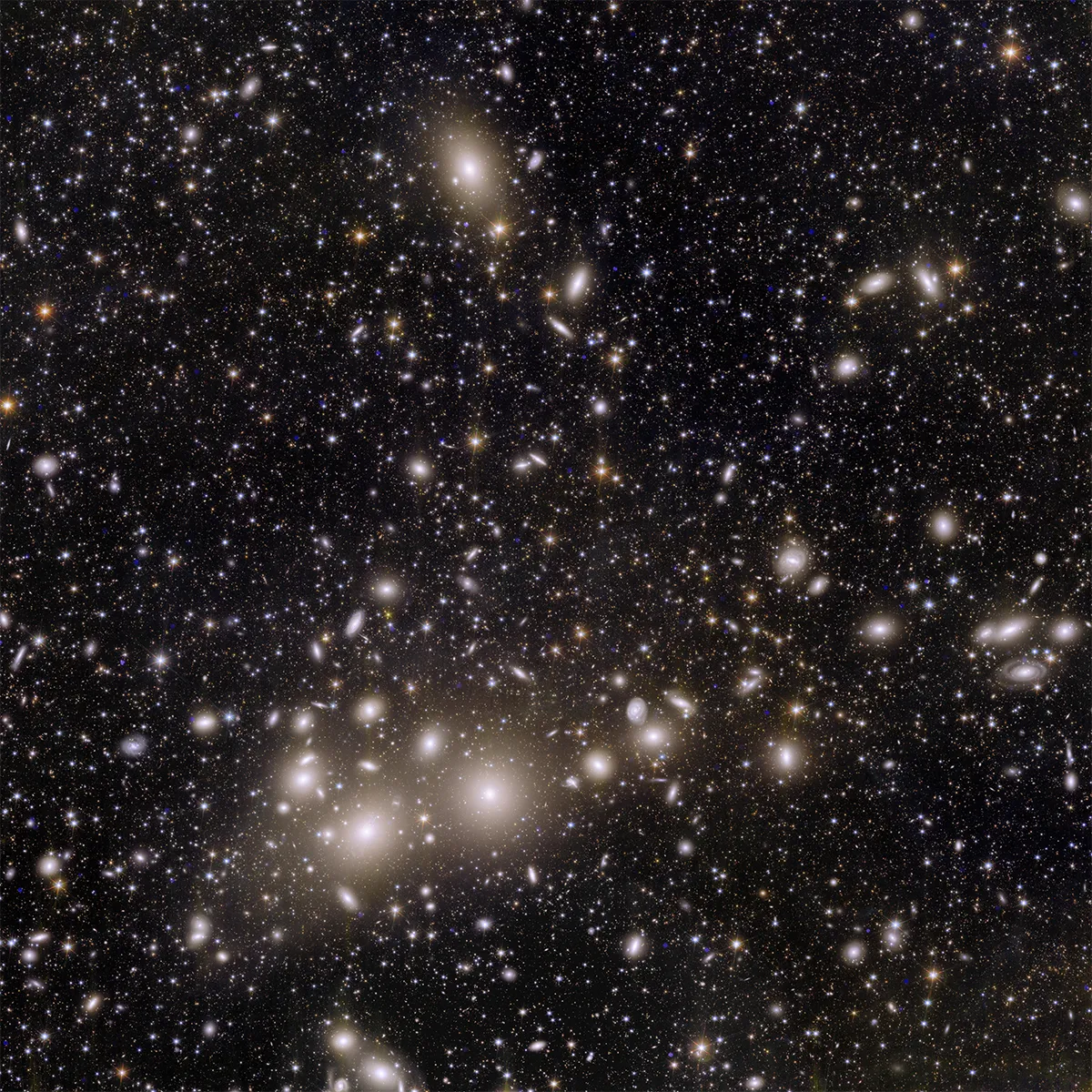
These galaxies did not exist in isolation. They arranged themselves into clusters and filaments, forming a cosmic web that stretches across billions of light-years. This large-scale structure reflects the initial density fluctuations from inflation, amplified by gravity over cosmic time. The universe’s architecture is therefore a frozen record of its earliest moments.
Galaxies evolved through interactions and internal processes. They formed new generations of stars, enriched their environments with heavier elements, and sometimes merged with neighbors to form larger systems. Black holes grew in their centers, shaping their evolution through powerful outflows of energy. Over billions of years, the universe became a tapestry of luminous islands separated by vast oceans of darkness.
The Birth of Planetary Systems
Within galaxies, stars continued to form from clouds of gas and dust enriched by previous generations. Around many of these stars, disks of material flattened into rotating planes. Within these disks, particles collided and stuck together, gradually building larger bodies. Over time, these processes produced planets, moons, asteroids, and comets.
The formation of planetary systems introduced a new level of structure. Matter was no longer merely organized into stars and galaxies but into worlds with surfaces, atmospheres, and internal dynamics. Some planets became scorched by their stars, others froze in distant orbits, and a few occupied regions where liquid water could exist.
Our own solar system formed about 4.6 billion years ago in one such disk within the Milky Way. The heavy elements that make up Earth and its living inhabitants were forged in ancient stars. In this sense, every rock and cell is a product of cosmic history. Planetary systems are the universe’s way of exploring complexity on small scales.
The Emergence of Life and Cosmic Chemistry
Life, as far as we know, arose from the chemistry of planetary environments. On Earth, complex molecules assembled into self-replicating systems that eventually evolved into living organisms. While the origin of life remains an open question, its possibility rests on the universe’s long history of chemical enrichment.
Elements heavier than hydrogen and helium are essential for life as we understand it. Carbon forms complex chains, oxygen enables energetic reactions, and iron helps build planetary cores and magnetic fields. These elements exist only because stars lived and died before Earth was born. Life is therefore not an accident imposed on the universe but an outcome made possible by stellar evolution.
As life evolved, it developed the capacity to observe and reflect. In human consciousness, the universe achieved a form of self-awareness. The atoms that once existed in a primordial fireball came together in brains capable of reconstructing their own history. The timeline of the universe thus includes not only physical events but the emergence of beings who can tell the story.
The Expansion of the Universe and the Role of Dark Energy
While structures formed and life emerged, the universe continued to expand. In the late twentieth century, astronomers discovered that this expansion is accelerating, driven by a mysterious component called dark energy. Unlike matter, which pulls things together through gravity, dark energy appears to push space apart.
This discovery transformed our understanding of cosmic fate. Instead of slowing down, the expansion of the universe is speeding up. Over very long timescales, distant galaxies will recede beyond our observable horizon, leaving only local structures visible. The universe will become increasingly dark and empty on large scales, even as individual galaxies continue their internal evolution.
Dark energy remains one of the deepest mysteries in physics. It may be related to the energy of empty space itself or to new fields and forces not yet understood. Whatever its nature, it dominates the universe today, shaping its future as profoundly as gravity shaped its past.
The Universe Today: A Mature Cosmos
Today, the universe is about 13.8 billion years old. It contains hundreds of billions of galaxies, each with billions of stars. Black holes anchor many galactic centers, and planetary systems circle countless suns. The cosmic microwave background still whispers of the universe’s infancy, while distant quasars reveal its youthful vigor.
Modern astronomy allows us to look back in time by observing distant objects. Because light takes time to travel, we see faraway galaxies as they were billions of years ago. The universe thus offers us a layered view of its own history, with different epochs visible at different distances.
Our understanding of this timeline rests on a combination of theory and observation. General relativity, developed by Albert Einstein, describes the dynamics of space and time, while observations of galaxy motion, pioneered by Edwin Hubble, revealed that the universe is expanding. Together with modern measurements of radiation and elemental abundances, these insights form a coherent picture of cosmic evolution.
The Future of the Universe
The future of the universe depends on the balance between matter, energy, and the mysterious dark energy. Current evidence suggests that expansion will continue indefinitely. Galaxies not gravitationally bound to us will drift farther away, their light redshifted into invisibility. Star formation will gradually decline as gas is used up or dispersed.
In the far future, existing stars will exhaust their fuel, leaving behind remnants such as white dwarfs, neutron stars, and black holes. Over immense timescales, even these structures may decay or evaporate. The universe will approach a state of maximum entropy, where little organized energy remains to drive change.
Yet this distant fate does not diminish the drama of the present. The universe is currently in a richly structured and active phase, filled with stars, planets, and perhaps life in many places. The long arc from nothing to everything has produced a cosmos capable of complexity and reflection.
Meaning in a Cosmic Timeline
The timeline of the universe is not only a scientific account; it is a philosophical and emotional narrative. It shows that order can emerge from chaos, that simplicity can give rise to richness, and that time can transform energy into awareness. In tracing this history, we see that we are not outsiders to the cosmos but participants in its evolution.
Every human life unfolds within this vast context. Our brief moments are nested within billions of years of cosmic change. This perspective can inspire humility, but also wonder. The same laws that governed the birth of the first atoms govern the thoughts forming in your mind right now. The universe is continuous with us, and we with it.
Conclusion: From Nothing to Everything
From an initial state of extreme simplicity, the universe has grown into a realm of galaxies, stars, planets, and living beings. Its timeline is a testament to the creative power of physical law, showing how a few fundamental principles can generate boundless variety. The journey from nothing to everything is not a single leap but a patient unfolding, guided by expansion, gravity, and the deep rules of matter and energy.
To understand this timeline is to glimpse the unity of all things. The atoms in your body were once part of ancient stars. The light from the cosmic microwave background began its journey long before Earth existed. In this sense, the universe is not just the setting of our lives; it is their source.
The story of the universe is still being written. New observations refine our understanding, and new theories reshape our expectations. Yet the central theme remains: out of an initial state beyond imagination came a cosmos capable of producing complexity, beauty, and consciousness. From nothing to everything, the universe has carried itself forward through time, and in doing so, it has made room for us to wonder about its beginning and its fate.