The universe may look calm when we gaze into the night sky, but that stillness is an illusion born of distance and time. On cosmic scales, galaxies are constantly moving, drawn together by gravity in a slow, inevitable dance. These encounters unfold over millions or billions of years, yet they are among the most dramatic events in the universe. Stars are flung into new orbits, gas clouds collapse into brilliant bursts of star formation, and supermassive black holes spiral toward one another in titanic mergers.
Galactic collisions are not rare accidents. They are fundamental to how galaxies grow and evolve. Our own galaxy has experienced many such encounters in the past and will experience more in the future. Right now, across the observable universe, entire star systems are colliding, merging, and transforming.
Below are seven galactic collisions that are happening right now—vast interactions unfolding in real time, even if we can only glimpse them as snapshots frozen in cosmic history.
1. The Milky Way and the Sagittarius Dwarf Spheroidal Galaxy
Our home galaxy, the Milky Way, is not peacefully drifting alone through space. It is actively consuming smaller galaxies, and one of its most dramatic ongoing mergers involves the Sagittarius Dwarf Spheroidal Galaxy.
Discovered in 1994, the Sagittarius Dwarf lies on the far side of the Milky Way’s center from our perspective. It is currently being torn apart by the Milky Way’s immense gravitational pull. Each time it passes through our galaxy’s disk, tidal forces strip away its stars, stretching them into long streams that wrap around the Milky Way like faint ribbons of light.
These stellar streams have been mapped in remarkable detail by missions such as the European Space Agency’s Gaia spacecraft, which measures the precise positions and motions of stars. The data show that the Sagittarius Dwarf has likely passed through the Milky Way multiple times over the past few billion years.
This interaction has not been gentle. Evidence suggests that these repeated collisions may have disturbed the Milky Way’s disk, triggering waves of star formation and possibly contributing to the warped shape of our galaxy’s outer regions.
The Sagittarius Dwarf is being shredded, its identity dissolving as its stars become part of the Milky Way. This is galactic cannibalism in action—a reminder that even our cosmic home is still under construction.
2. The Milky Way and the Large Magellanic Cloud
Another dramatic encounter involves the Large Magellanic Cloud, a satellite galaxy visible from the Southern Hemisphere as a faint smudge of light. This irregular dwarf galaxy orbits the Milky Way and is currently interacting strongly with it.
The Large Magellanic Cloud is not merely a passive companion. It has substantial mass, including its own dark matter halo. Recent measurements suggest it may be more massive than previously thought, possibly containing up to a tenth of the Milky Way’s mass.
As it orbits, it exerts gravitational influence on the Milky Way’s halo and disk. The interaction has created features such as the Magellanic Stream—a long trail of gas stretching across the sky, pulled from the Magellanic Clouds by gravitational forces.
Simulations suggest that the Large Magellanic Cloud may not remain a long-term satellite. Instead, it could eventually spiral inward and merge with the Milky Way in a few billion years. Even now, its gravitational pull may be subtly shifting the Milky Way’s center of mass.
This is not a distant cosmic event. It is happening within our galactic neighborhood, shaping the structure of our galaxy as we speak.
3. The Milky Way and the Andromeda Galaxy
The most famous future collision in our cosmic backyard involves the Milky Way and the Andromeda Galaxy, also known as Messier 31.
Although the full merger lies billions of years in the future, the two galaxies are already moving toward each other at about 110 kilometers per second. This approach is part of an ongoing gravitational interaction within the Local Group of galaxies.
The Andromeda Galaxy is slightly larger than the Milky Way. Both contain hundreds of billions of stars and central supermassive black holes. Their mutual gravitational attraction ensures that a collision is inevitable.
The first close pass is expected in roughly 4 to 5 billion years. During the encounter, tidal forces will distort both galaxies, flinging long streams of stars into space. Over time, repeated passes will lead to a complete merger, likely forming a giant elliptical galaxy sometimes nicknamed “Milkomeda.”
Despite the word collision, direct star-to-star impacts will be rare because of the enormous distances between stars. However, gas clouds will collide and compress, igniting waves of star formation. The central black holes may eventually merge, releasing powerful gravitational waves.
Even now, the Milky Way and Andromeda are engaged in a slow gravitational embrace. The collision has already begun in the sense that their mutual attraction governs their motion.
4. The Antennae Galaxies
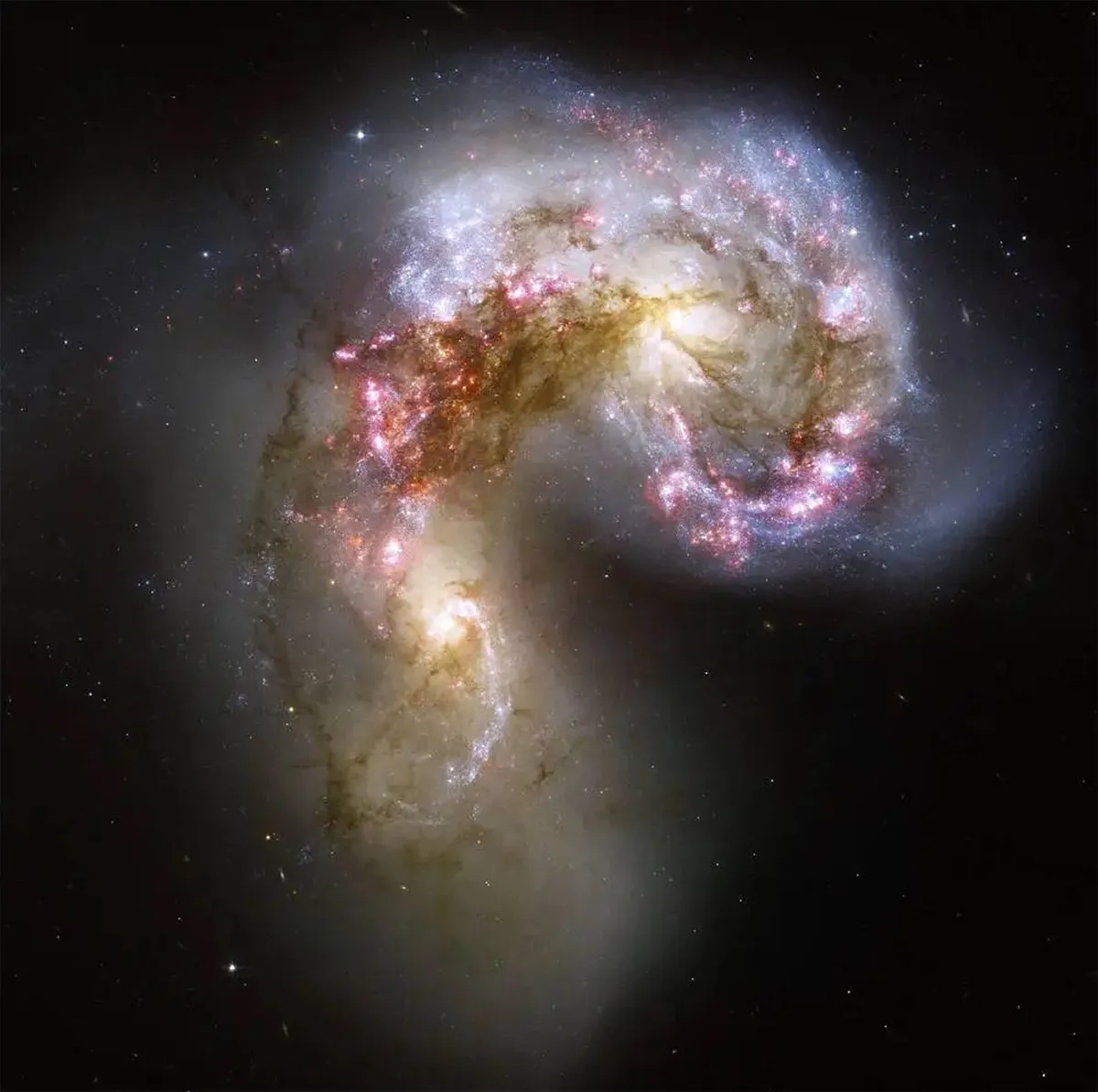
Far beyond our Local Group, one of the most spectacular ongoing mergers involves the Antennae Galaxies.
Located about 45 million light-years away, these two spiral galaxies are in the midst of a dramatic collision. Their interaction has produced long, antenna-like tidal tails of stars and gas, giving the system its name.
As the galaxies pass through each other, gravitational forces compress vast clouds of gas. This compression triggers intense bursts of star formation. The Antennae Galaxies are considered a classic example of a starburst galaxy system.
Within these regions, massive young star clusters are forming at extraordinary rates. Some of these clusters may evolve into globular clusters similar to those seen in older galaxies.
The merger is still underway. Over hundreds of millions of years, the two galaxies will fully coalesce into a single, likely elliptical galaxy. What we see today is a snapshot of a process spanning cosmic time—a violent transformation captured in mid-action.
5. The Whirlpool Galaxy and Its Companion
The iconic spiral arms of the Whirlpool Galaxy are not simply a natural feature of isolation. They are the result of an ongoing interaction with a smaller companion galaxy, NGC 5195.
Located about 23 million light-years away, the Whirlpool Galaxy is one of the most studied interacting systems. Its grand-design spiral structure is enhanced by gravitational forces from its companion.
As the smaller galaxy passes through or near the larger one, tidal forces amplify density waves in the spiral arms. Gas clouds are compressed, leading to active star formation along the arms.
This interaction has likely occurred more than once. The companion galaxy may have already passed through the disk of the Whirlpool Galaxy in the past, reshaping its structure.
The Whirlpool system shows how even relatively minor galactic encounters can dramatically influence morphology and star formation. It is a living laboratory for understanding spiral structure.
6. The Cartwheel Galaxy
The Cartwheel Galaxy is a striking example of a collision that has reshaped a galaxy into an almost surreal form.
Located about 500 million light-years away, the Cartwheel Galaxy appears as a bright ring with spokes radiating inward. This unusual structure likely formed when a smaller galaxy passed directly through the center of a larger spiral galaxy.
The gravitational disturbance sent shockwaves through the disk, compressing gas into a ring of intense star formation that expanded outward like ripples in a pond.
The ring continues to expand, filled with massive, short-lived stars. Meanwhile, the central region shows evidence of disruption and reorganization.
The Cartwheel Galaxy demonstrates that galactic collisions can produce not only mergers but entirely new structural forms. The universe is capable of reshaping entire star systems into cosmic works of art.
7. The Taffy Galaxies
The Taffy Galaxies are named for the unusual bridge of gas stretched between them, resembling pulled taffy candy.
These two galaxies experienced a head-on collision roughly 25 to 30 million years ago. Unlike many mergers where stars mostly pass by unscathed, this collision involved significant interaction between gas clouds.
As the galaxies collided, their interstellar gas clouds slammed into each other at high speeds. This produced a massive bridge of gas connecting the two systems, visible in radio observations.
The collision triggered star formation in unusual regions, including within the bridge itself. Magnetic fields were also amplified and distorted by the interaction.
The Taffy Galaxies provide a vivid example of how direct collisions between galactic disks can dramatically rearrange matter and energy.
Cosmic Evolution Through Collision
Galactic collisions are not rare catastrophes. They are fundamental mechanisms of cosmic evolution. Large galaxies grow by absorbing smaller ones. Structures form through hierarchical merging driven by gravity and dark matter.
Our own Milky Way bears scars of past mergers. Stellar streams crisscross its halo, remnants of long-ago consumed galaxies. The thick disk and central bulge may have been shaped by ancient interactions.
These events unfold over timescales so vast that no human will ever witness a full merger. Yet with telescopes and simulations, we can reconstruct the story.
Collisions trigger star formation, feed central black holes, reshape galactic morphology, and redistribute dark matter. They are engines of transformation.
When we look at distant interacting galaxies, we are not just seeing destruction. We are witnessing creation—new stars, new structures, new cosmic identities emerging from gravitational chaos.
The Universe in Motion
The word collision suggests sudden impact and explosive violence. In reality, galactic collisions are slow, graceful, and relentless. They are governed by gravity’s quiet pull, operating across millions of light-years.
Right now, as you read these words, stars in the Sagittarius stream continue their orbit around the Milky Way. The Large Magellanic Cloud continues tugging at our galaxy’s halo. The Andromeda Galaxy draws closer by a fraction of a kilometer each second. The Antennae Galaxies blaze with newborn stars. The Whirlpool Galaxy’s spiral arms glow under tidal influence.
The universe is not static. It is dynamic, evolving, constantly reshaping itself through interaction.
We live inside one of these stories. Our galaxy’s future is tied to collision and merger. Billions of years from now, the night sky—if anyone remains to see it—will blaze with the distorted forms of Andromeda filling half the heavens.
Galactic collisions remind us that even the largest structures in existence are not permanent. They are part of a cosmic cycle of approach, encounter, transformation, and renewal.
In the vast theater of the cosmos, galaxies are both actors and stage—meeting, merging, and moving on.
And the drama is happening right now.