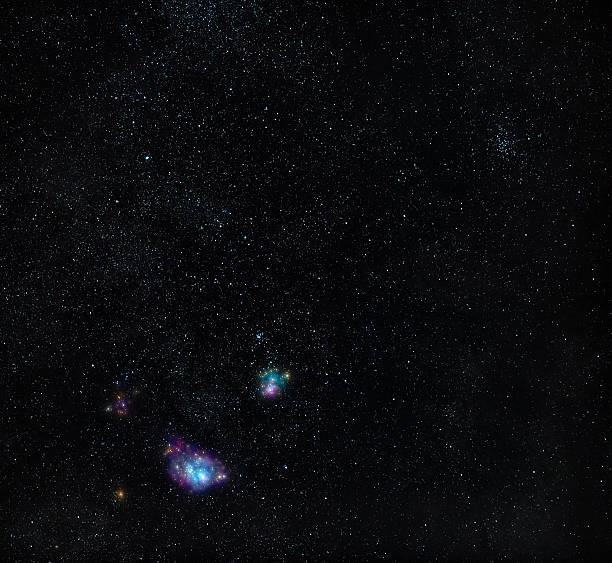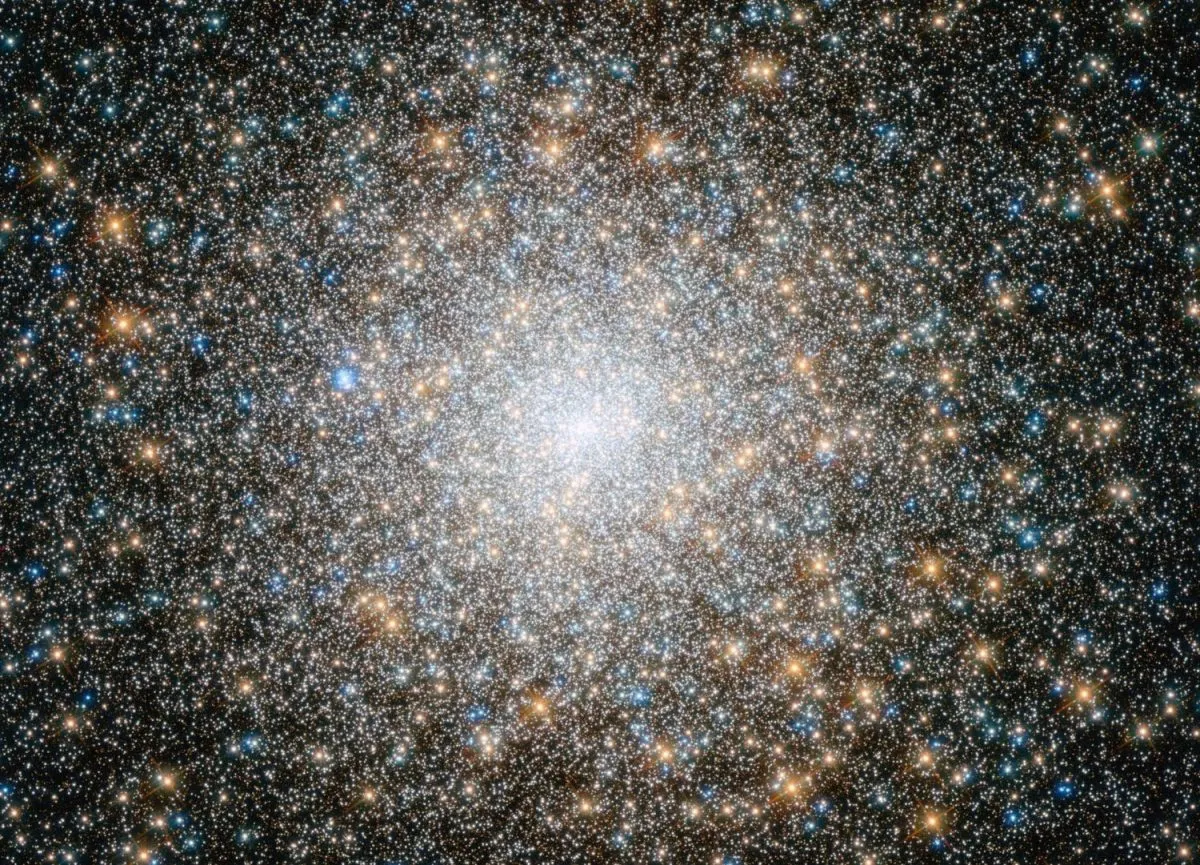
On a clear, moonless night, when the sky deepens into velvet and the Milky Way stretches like spilled stardust overhead, you may notice something subtle—patches of light that seem denser than the rest. Tiny gatherings of stars, shimmering together as if in quiet conversation. These are star clusters: cosmic families bound by gravity, born from the same cradle of gas and dust, traveling through the galaxy as luminous communities.
At first glance, they appear simple—just groups of stars. But star clusters are far more than decorative jewels scattered across the night. They are laboratories of stellar evolution, archives of galactic history, and witnesses to cosmic time on scales that dwarf human imagination.
Here are ten things you may not know about star clusters—ten truths that reveal how these celestial gatherings help us understand the universe itself.
1. Star Clusters Are Stellar Siblings Born From the Same Cloud
Every star cluster begins in darkness.
Deep within galaxies, immense molecular clouds—vast regions of cold hydrogen gas and dust—collapse under their own gravity. Turbulence within these clouds creates dense knots, and within those knots, gravity ignites the birth of stars.
Unlike solitary stars that form in relative isolation, cluster stars are born together from the same collapsing cloud. This means that stars within a cluster are nearly the same age and share a similar chemical composition.
Astronomers classify star clusters primarily into two major types: open clusters and globular clusters.
Open clusters are loose, irregular groupings of dozens to thousands of stars. A famous example is the Pleiades, also known as the Seven Sisters. These clusters are relatively young, often only a few million to a few hundred million years old.
Globular clusters, on the other hand, are ancient and densely packed spherical collections of hundreds of thousands to millions of stars. One striking example is Omega Centauri, the largest globular cluster in the Milky Way.
The shared origin of cluster stars makes them invaluable to astronomers. Because the stars formed at the same time, differences among them reveal how mass influences stellar evolution. In a cluster, the only major variable between stars is mass—nature’s own controlled experiment.
When we look at a star cluster, we are not seeing random lights. We are witnessing a family portrait.
2. Some Star Clusters Are Almost as Old as the Universe
Globular clusters are relics of deep time.
Many formed more than 12 billion years ago, when the universe itself was young—less than two billion years old. Their stars contain very low amounts of heavy elements, indicating they formed before successive generations of stars enriched the cosmos with metals produced in supernova explosions.
One such ancient cluster is Messier 92, whose age approaches that of the Milky Way itself.
Studying globular clusters allows astronomers to estimate the minimum age of the universe. If a cluster is 13 billion years old, the universe must be at least that old.
These clusters orbit the halo of the Milky Way in vast elliptical paths, far above and below the galactic disk. They are not merely decorative companions; they are fossils—survivors from the galaxy’s earliest epochs.
To observe a globular cluster is to peer backward in time almost to the dawn of structure formation.
They are cosmic elders, still shining after billions of years.
3. Open Clusters Are Short-Lived by Cosmic Standards
While globular clusters endure for billions of years, open clusters live comparatively brief lives.
Gravitational interactions with nearby stars, molecular clouds, and tidal forces from the galaxy gradually pull open clusters apart. Over tens to hundreds of millions of years, their stars drift away, dispersing into the galactic disk.
This is why open clusters are found primarily in the spiral arms of galaxies like the Milky Way—regions of ongoing star formation.
The cluster Hyades, one of the closest open clusters to Earth, is about 625 million years old and already in the process of dispersing.
Eventually, its stars will become indistinguishable from the surrounding stellar population.
The Sun itself may once have been born in a cluster that has long since dissolved. Astronomers search for “solar siblings”—stars with chemical fingerprints matching the Sun’s—hoping to reconstruct its long-lost family.
Open clusters remind us that even stars, though long-lived by human standards, are part of dynamic communities that evolve and disperse.
Nothing in the galaxy remains unchanged forever.
4. Star Clusters Reveal How Stars Evolve
One of the most powerful tools in astrophysics is the Hertzsprung-Russell diagram, a graph plotting stellar brightness against surface temperature.
When astronomers plot stars from a cluster on this diagram, a striking pattern emerges. Most stars lie along the “main sequence,” where they fuse hydrogen into helium in their cores.
But in older clusters, the most massive stars have already exhausted their hydrogen and evolved into red giants. The point at which stars begin leaving the main sequence—the “turnoff point”—reveals the cluster’s age.
Because cluster stars share the same age, the main sequence turnoff acts as a precise clock.
In globular clusters, only low-mass stars remain on the main sequence. The more massive stars have long since evolved and died, sometimes as supernovae.
Thus, clusters function as natural laboratories for testing theories of stellar evolution. They confirm predictions about nuclear fusion, energy transport within stars, and the life cycles of different stellar masses.
Every cluster is a chronicle written in starlight.
5. Some Clusters Contain Exotic Stellar Phenomena
In the dense cores of globular clusters, stars are packed so tightly that interactions are common.
Collisions and close encounters can produce unusual objects.
Blue stragglers, for example, are stars that appear younger and hotter than they should be for the cluster’s age. They likely form when two stars merge or when one star siphons mass from another, rejuvenating itself.
Globular clusters also harbor millisecond pulsars—rapidly spinning neutron stars that emit beams of radiation like cosmic lighthouses. These pulsars often gain speed by accreting matter from companion stars.
In extreme cases, clusters may contain intermediate-mass black holes, though evidence remains under investigation.
The dense gravitational environment of clusters makes them breeding grounds for stellar oddities.
They are not static collections. They are dynamic arenas where gravity orchestrates close encounters and dramatic transformations.
6. Star Clusters Help Map the Structure of the Milky Way
The distribution of globular clusters provides clues about the Milky Way’s structure and history.
Unlike open clusters, which lie in the galactic disk, globular clusters form a spherical halo surrounding the galaxy.
Their spatial arrangement helped early 20th-century astronomers determine the Milky Way’s center. By mapping globular clusters, astronomer Harlow Shapley discovered that the Sun is not at the galaxy’s center, but offset within one of its spiral arms.
Clusters thus revealed humanity’s true position in the cosmos.
Additionally, variations in cluster motion and chemical composition suggest that some globular clusters originated in dwarf galaxies that were later absorbed by the Milky Way.
In this way, clusters preserve evidence of galactic mergers and growth.
They are archaeological artifacts of cosmic evolution.
7. Star Clusters Exist Beyond Our Galaxy
The Milky Way contains over 150 known globular clusters and thousands of open clusters. But clusters are not unique to our galaxy.
The neighboring Andromeda Galaxy contains even more globular clusters than the Milky Way. Observations reveal that massive galaxies often host rich cluster systems.
Studying clusters in other galaxies allows astronomers to compare galactic histories and formation processes.
Young massive clusters observed in starburst galaxies resemble ancient globular clusters in formation, suggesting that globular clusters may have formed during intense star-forming epochs in the early universe.
Thus, clusters connect local observations with cosmic history on intergalactic scales.
They are universal structures, not galactic anomalies.
8. Tidal Forces Slowly Tear Clusters Apart
Gravity binds clusters together—but gravity also destroys them.
As clusters orbit within a galaxy, tidal forces stretch them. Stars at the cluster’s edges can be stripped away, forming tidal tails—streams of stars trailing behind.
Recent observations using space telescopes and precise stellar motion measurements have revealed elongated stellar streams associated with dissolving clusters.
These tidal streams provide valuable information about the Milky Way’s gravitational field and dark matter distribution.
When we observe a dissolving cluster, we witness the interplay between local gravity and the vast gravitational structure of the galaxy.
Even tightly bound globular clusters gradually lose stars over billions of years.
The galaxy is both parent and predator.
9. Star Clusters May Have Helped Form Planetary Systems
For a long time, astronomers debated whether planetary systems could form in the crowded environments of clusters. Close stellar encounters might disrupt protoplanetary disks or destabilize young planets.
Yet recent discoveries of exoplanets in open clusters demonstrate that planet formation does occur in these environments.
The cluster Messier 67, which is similar in age and chemical composition to the Sun, has yielded several exoplanet detections.
Because cluster stars share composition and age, they allow scientists to study how environmental factors influence planet formation.
If the Sun formed in a cluster, then Earth’s story began not in solitude but amid stellar siblings.
Clusters may be cradles not only of stars—but of life-bearing worlds.
10. Star Clusters Are Keys to Cosmic Distance Measurement
Measuring cosmic distances is one of astronomy’s greatest challenges.
Certain variable stars, such as RR Lyrae stars, are commonly found in globular clusters. These stars pulsate in brightness with periods directly related to their intrinsic luminosity.
By comparing their intrinsic brightness to observed brightness, astronomers calculate distances to clusters.
Similarly, main sequence fitting—comparing cluster star brightness to theoretical models—helps determine cluster distances.
These techniques anchor the cosmic distance ladder, which extends from nearby clusters to distant galaxies.
Without clusters, calibrating astronomical distances would be far more difficult.
They are stepping stones across the vast abyss of space.
The Living Architecture of the Cosmos
Star clusters are more than decorative features in the night sky. They are dynamic systems shaped by gravity, time, and cosmic history.
They teach us how stars are born, how they age, how galaxies grow, and how the universe evolved. They preserve records from the earliest epochs and reveal processes unfolding in the present.
Within their luminous gatherings, we see the delicate balance between order and change. Stars form together, live together, and gradually drift apart. Some clusters endure nearly as long as the universe itself. Others dissolve like morning mist in galactic sunlight.
To look at a star cluster is to witness community on a cosmic scale.
In their clustered light, we glimpse the architecture of gravity and the quiet persistence of time. They remind us that even in the vast loneliness of space, stars are rarely born alone.
And perhaps that is their most poetic truth of all.