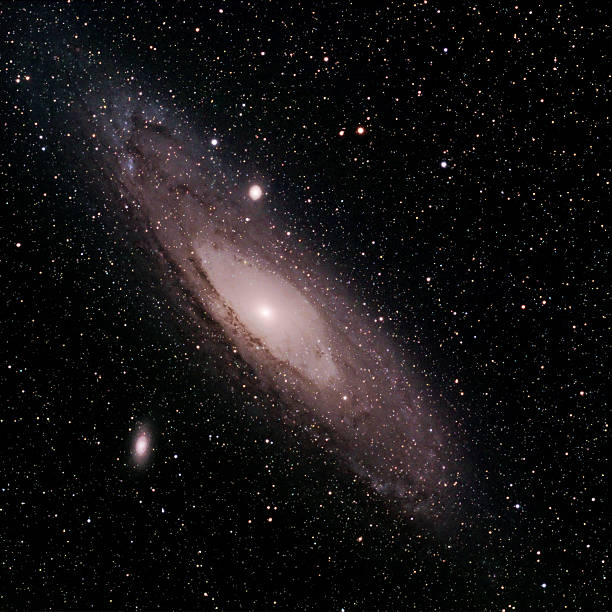
On clear, moonless nights in the Northern Hemisphere, a faint, misty patch of light can be seen stretching across the sky in the constellation Andromeda. To the naked eye, it appears modest—almost unimpressive. But that faint glow is something staggering in scale. It is an entire galaxy, a colossal island of stars, gas, dust, and dark matter drifting through the cosmic ocean roughly 2.5 million light-years away.
This is the Andromeda Galaxy, also known as Messier 31. It is the nearest large spiral galaxy to our own Milky Way, and it is on a slow, inevitable collision course with us billions of years in the future. With an estimated trillion stars—far more than the Milky Way—Andromeda is a sprawling system of beauty and violence, serenity and chaos.
But within its luminous spiral arms and extended halo lie wonders that are largely invisible to the unaided eye. These hidden structures and phenomena reveal the story of Andromeda’s past, its present state, and its eventual fate. Each discovery inside this neighboring galaxy reshapes our understanding of how galaxies live and evolve.
Below are ten of the most extraordinary and hidden wonders inside the Andromeda Galaxy.
1. The Supermassive Black Hole at Andromeda’s Heart
At the very center of Andromeda lies an object of terrifying power: a supermassive black hole millions of times more massive than the Sun. Like nearly every large galaxy studied so far, Andromeda hosts such a gravitational monster at its core.
This black hole anchors the galaxy. Its immense gravity influences the motion of stars in the inner regions. Although it is currently relatively quiet compared to the blazing quasars seen in distant galaxies, it remains a central engine of potential destruction.
Observations show something even more unusual: Andromeda’s nucleus is double-peaked. Instead of a single dense concentration of stars surrounding the black hole, there appear to be two bright components. Astronomers believe this strange configuration may be due to a disk of stars orbiting the black hole in eccentric paths, creating the illusion of two separate clusters.
The heart of Andromeda is not a calm place. It is a region shaped by extreme gravity, stellar crowding, and the long echoes of past galactic mergers. At its center, spacetime itself curves steeply into darkness.
2. A Vast Halo of Dark Matter
Though Andromeda dazzles in visible light, most of its mass is invisible. Surrounding the luminous disk is an enormous halo of dark matter, extending far beyond the galaxy’s visible boundaries.
This halo is not made of stars or gas. It is composed of mysterious, unseen matter that does not emit or absorb light but exerts gravitational influence. The rotation of Andromeda’s outer stars reveals its presence. Without dark matter, the galaxy would spin apart.
The halo extends hundreds of thousands of light-years into space, enveloping the galaxy like an invisible cocoon. It likely overlaps with the Milky Way’s dark matter halo as the two galaxies drift closer together.
This hidden structure shapes the galaxy’s evolution, governs the orbits of satellite galaxies, and will influence the future collision between Andromeda and the Milky Way.
The vast majority of Andromeda’s mass is something we cannot see—an unseen skeleton holding the galaxy together.
3. A Swarm of Ancient Globular Clusters
Orbiting Andromeda are hundreds of globular clusters—dense, spherical collections of ancient stars bound tightly by gravity. These clusters are relics from the galaxy’s early history.
Some of these globular clusters are more than 10 billion years old, formed when the universe itself was young. They contain some of the oldest surviving stars in the galaxy.
Andromeda hosts more globular clusters than the Milky Way. Some are extraordinarily massive, rivaling small dwarf galaxies in size. These stellar spheres drift through the galactic halo, silent witnesses to cosmic time.
Their distribution and composition provide clues about Andromeda’s past mergers. Some clusters may have originated in smaller galaxies that were swallowed long ago, leaving behind these glittering fossils.
Each globular cluster is like a time capsule—an ancient archive of the galaxy’s earliest chapters.
4. Stellar Streams from Cannibalized Galaxies
Andromeda is not a gentle neighbor. Over billions of years, it has devoured smaller galaxies, pulling them apart with tidal forces and scattering their stars into long, faint streams.
These stellar streams arc through the halo like ghostly ribbons. They are difficult to see, requiring deep imaging surveys, but they reveal the violent history of galactic growth.
One of the most prominent is the Giant Stellar Stream, believed to be the remnants of a dwarf galaxy torn apart by Andromeda’s gravity. The stars in these streams retain coherent motions, tracing the orbit of their lost parent galaxy.
Galaxies grow by merging. Andromeda’s halo is filled with the evidence of past feasts. These shredded galaxies now exist only as faint streaks of starlight.
5. A Ring of Star Formation
Unlike the Milky Way, which forms stars throughout its spiral arms, Andromeda displays a prominent ring of star formation roughly 10,000 light-years from its center.
This ring is rich in gas and dust, glowing brightly in ultraviolet and infrared observations. It is a region where new stars are actively being born.
The origin of this ring may lie in a past interaction with another galaxy, possibly a smaller companion that passed through Andromeda’s disk. Such collisions can trigger waves of star formation, compressing gas into dense regions.
This ring is not obvious in simple visual images. It becomes clear only when astronomers observe Andromeda in multiple wavelengths.
Inside this ring, stellar nurseries blaze into existence—brief, brilliant episodes in the galaxy’s long life.
6. A Population of X-ray Binaries
Deep inside Andromeda are numerous X-ray sources—systems where a compact object such as a neutron star or black hole pulls material from a companion star.
As matter spirals inward, it heats to millions of degrees and emits intense X-rays. These X-ray binaries are among the most energetic stellar systems in the galaxy.
Observations from space-based X-ray telescopes have revealed hundreds of such sources in Andromeda. They are often associated with dense stellar environments, including globular clusters.
These systems are reminders that even in a seemingly calm spiral galaxy, extreme astrophysical processes are unfolding. Stars die, collapse, and continue interacting in exotic forms.
Andromeda’s X-ray glow is invisible to human eyes but shines brightly in the high-energy universe.
7. A Thick Disk of Ancient Stars
Beyond its familiar thin spiral disk, Andromeda possesses a thick disk of older stars extending above and below the galactic plane.
This thick disk is composed primarily of ancient stars, moving in slightly different orbits compared to the younger stars in the thin disk.
Its origin may be linked to past mergers or gravitational disturbances that heated the stellar population, puffing it up over time.
This layered structure tells a story of gradual transformation. Galaxies are not static; they are reshaped by interactions, internal dynamics, and cosmic time.
Andromeda’s thick disk is a subtle but crucial component of its architecture, revealing the memory of past events.
8. A Massive Stellar Halo
Beyond the visible disk lies an extended stellar halo—an enormous, diffuse region populated by sparse stars.
This halo stretches far into intergalactic space and contains stars with diverse chemical compositions and motions. Many likely originated in dwarf galaxies that were absorbed long ago.
The halo is faint and difficult to observe, but its structure provides critical insights into galaxy formation. It preserves evidence of Andromeda’s hierarchical growth.
This outer realm is a quiet graveyard of past companions, their identities erased except for the stars they contributed.
9. Dozens of Satellite Galaxies
Andromeda is accompanied by a retinue of satellite galaxies, including dwarf ellipticals and dwarf spheroidals.
Some of these satellites are arranged in a surprisingly thin plane, orbiting the galaxy in coordinated motion. The origin of this planar alignment remains debated.
These companions are laboratories for studying dark matter and galaxy evolution on small scales. Many are dominated by dark matter and contain ancient stellar populations.
Andromeda is not alone in space. It presides over a small galactic empire.
10. The Future Collision with the Milky Way
Perhaps the most dramatic hidden wonder inside Andromeda is not something happening now—but something that will.
Measurements show that Andromeda is moving toward the Milky Way. In about 4 to 5 billion years, the two galaxies will begin to collide.
This will not be a catastrophic smash of stars—stellar collisions are extremely rare due to vast distances between them. But gravitational interactions will reshape both galaxies.
Spiral arms will distort. Gas clouds will collide, triggering intense star formation. Over time, the two galaxies will merge into a single, massive elliptical galaxy.
The future Milky Way–Andromeda merger will be one of the grandest events in our cosmic neighborhood.
And it is already set in motion.
A Galaxy of Depth and Drama
The Andromeda Galaxy is more than a distant smudge of light. It is a dynamic, evolving system filled with structure, history, and mystery.
At its center lurks a supermassive black hole. Around it swirl rings of star birth and disks of ancient suns. Its halo stretches outward in a dark matter embrace, laced with the shredded remains of smaller galaxies. It radiates X-rays from collapsed stars and harbors companions in delicate orbital dances.
Every hidden wonder inside Andromeda tells a story of gravity’s relentless influence, of cosmic evolution, of time measured not in years but in billions of them.
And as it drifts closer to us through intergalactic space, it reminds us that galaxies are not fixed islands. They move. They merge. They transform.
One night, billions of years from now, the sky above whatever beings inhabit Earth—or its descendants—may blaze with a spectacle unlike anything we see today. The stars of Andromeda and the Milky Way will intermingle in luminous arcs across the heavens.
For now, Andromeda remains a distant neighbor. But within it lie wonders both hidden and profound—testaments to the restless creativity of the universe itself.