The life of a star is a story written in gravity and light. For millions or even billions of years, a star shines steadily, balancing two powerful forces. Deep within its core, nuclear fusion produces enormous energy, pushing outward. At the same time, gravity pulls inward, trying to collapse the star under its own weight. As long as these forces remain in balance, the star lives in a stable state, radiating light across the universe.
But this balance does not last forever. When a star reaches the end of its life, something extraordinary can happen. If the star is massive enough, its final act is not a quiet fading, but a dramatic transformation into one of the most extreme objects in existence: a black hole.
Understanding what happens during this transformation reveals some of the most fascinating and mysterious processes in physics.
The Life and Death of Massive Stars
Not all stars end their lives in the same way. The fate of a star depends largely on its mass. Smaller stars, like our Sun, will eventually shed their outer layers and leave behind a dense core known as a white dwarf. These stars do not have enough mass to collapse further.
Massive stars, however, follow a very different path. These stars burn through their nuclear fuel much more quickly. As they age, they fuse heavier and heavier elements in their cores, moving from hydrogen to helium, then to carbon, oxygen, and eventually iron.
Iron marks a turning point. Unlike lighter elements, iron does not release energy when fused. Once a star’s core becomes mostly iron, the outward pressure from fusion weakens. Gravity, which has always been present, suddenly gains the upper hand.
The core begins to collapse rapidly. In a fraction of a second, it shrinks dramatically, and the conditions inside become unimaginably extreme. Temperatures rise, densities increase, and particles are crushed together in ways that defy ordinary understanding.
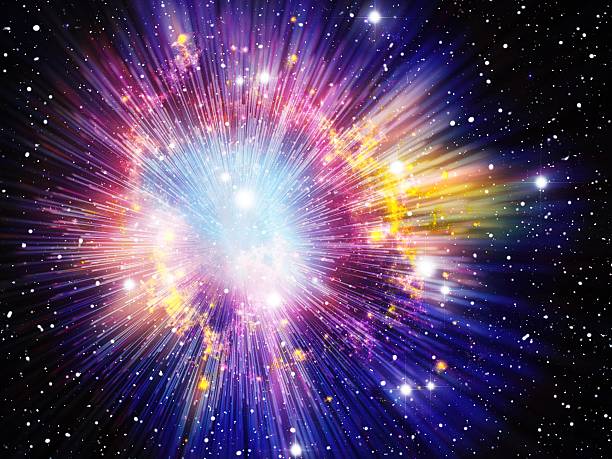
This collapse triggers a powerful explosion known as a supernova. The outer layers of the star are blasted into space, creating a brilliant burst of light that can outshine entire galaxies for a short time.
What remains at the center depends again on mass. If the core is not too heavy, it may form a neutron star, an incredibly dense object made mostly of neutrons. But if the core is massive enough, not even neutron degeneracy pressure can stop the collapse.
At that point, the star becomes something far stranger.
The Birth of a Black Hole
When a collapsing core exceeds a critical mass, gravity overwhelms all known forces. There is no mechanism left to resist the inward pull. The core continues to collapse indefinitely, compressing into an extremely small region.
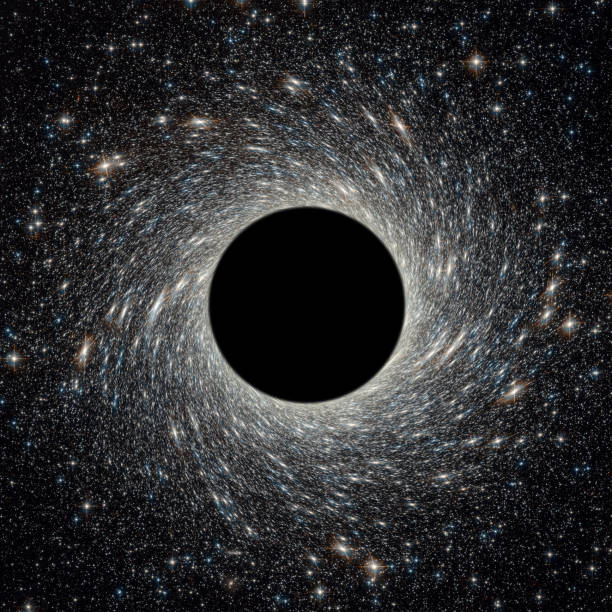
As this collapse proceeds, the gravitational field becomes stronger and stronger. Eventually, it reaches a point where the escape velocity exceeds the speed of light. This boundary is known as the event horizon.
The event horizon marks the edge of the black hole. Once anything crosses this boundary, it cannot return. Not even light can escape, which is why the object appears completely dark.
From the outside, the formation of a black hole may appear relatively simple: a collapsing star that disappears behind an invisible boundary. But the physics inside this boundary is far more complex and not yet fully understood.
According to current theories, the collapsing matter continues inward toward a point of infinite density known as a singularity. At this point, our understanding of physics breaks down. The laws that describe space, time, and matter no longer behave in predictable ways.
What Happens to Matter During Collapse
As the star collapses, the matter within it undergoes extreme compression. At first, atoms are crushed so tightly that electrons are forced into protons, forming neutrons. This process creates a neutron-rich environment typical of neutron stars.
If collapse continues beyond this stage, even neutrons cannot withstand the pressure. The structure of matter itself is pushed beyond known limits. The distinction between particles becomes less clear, and matter is compressed into a state that current physics cannot fully describe.
From an external perspective, something unusual happens due to the effects of relativity. As the collapsing matter approaches the event horizon, time appears to slow down. To a distant observer, the process seems to take longer and longer, never quite completing.
However, from the perspective of the collapsing matter itself, the process happens in a finite amount of time. The core passes through the event horizon and continues toward the singularity.
This difference between perspectives highlights one of the strange consequences of relativity, where time is not absolute but depends on the observer.
The Formation of the Event Horizon
The event horizon is one of the defining features of a black hole. It is not a physical surface like the surface of a planet or star. Instead, it is a boundary in spacetime.
Crossing the event horizon does not necessarily involve any sudden physical sensation. An object falling into a black hole might not notice anything special at the moment of crossing, especially if the black hole is large.
However, once inside, all possible paths lead inward. Escape becomes impossible because spacetime itself is curved in such a way that all directions point toward the center.
The size of the event horizon depends on the mass of the black hole. More massive black holes have larger event horizons. For stellar-mass black holes formed from collapsing stars, the event horizon may be only a few kilometers across.
Despite this relatively small size, the mass contained within creates an immense gravitational pull.
The Effects on Surrounding Space
When a star becomes a black hole, its influence on the surrounding space changes dramatically. However, one important point is often misunderstood. The black hole does not suddenly begin to pull in everything around it more strongly than the original star did.
If the star’s mass remains the same, the gravitational effect at a distance remains the same as well. Planets orbiting far away would continue their motion as before, provided they were not affected by the supernova explosion.
What changes is the behavior of matter that comes very close to the black hole. Near the event horizon, gravitational forces become extremely strong. Differences in gravitational pull between different parts of an object can stretch it into long, thin shapes, a process sometimes referred to as spaghettification.
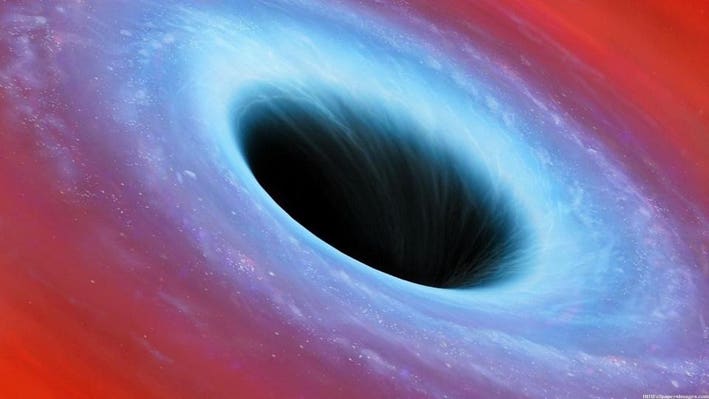
Gas and dust falling toward a black hole often form an accretion disk. As this material spirals inward, it heats up due to friction and gravitational energy, emitting intense radiation. In some cases, black holes can produce powerful jets of particles that shoot out into space at nearly the speed of light.
These phenomena make black holes some of the most energetic objects in the universe, despite their dark appearance.
Time and Gravity Near a Black Hole
One of the most fascinating aspects of black holes is their effect on time. According to general relativity, strong gravitational fields slow down the passage of time.
Near a black hole, this effect becomes extreme. To a distant observer, a clock close to the event horizon appears to tick more slowly. As an object approaches the event horizon, it seems to freeze and fade away.
For the object itself, however, time continues normally. This difference creates a kind of paradox, where two observers experience time in very different ways.
This phenomenon has been confirmed through experiments involving weaker gravitational fields, such as those near Earth. Black holes simply represent the most extreme case of this effect.
What Happens Inside a Black Hole
The interior of a black hole remains one of the greatest mysteries in physics. Current theories suggest that all matter that falls into a black hole is compressed into the singularity.
At the singularity, density becomes infinite, and spacetime curvature becomes infinite as well. These concepts indicate that our current understanding is incomplete. Physicists expect that a more advanced theory, possibly combining quantum mechanics and gravity, will be needed to fully describe what happens in these conditions.
Some theoretical ideas propose that information is preserved in subtle ways, even if it appears lost. Others suggest that black holes may be connected to other regions of spacetime, though there is no experimental evidence for such ideas.
What is certain is that the interior of a black hole represents a frontier where known physics reaches its limits.
The Long-Term Fate of Black Holes
Black holes are not entirely permanent. According to theoretical work, they can slowly lose mass through a process known as Hawking radiation.
This process arises from quantum effects near the event horizon. Over extremely long timescales, black holes can emit tiny amounts of energy, gradually shrinking in mass.
For stellar-mass black holes, this process takes far longer than the current age of the universe. Eventually, however, a black hole could evaporate completely, leaving behind no trace of the matter that formed it.
This idea raises deep questions about the nature of information and whether it is truly lost when a black hole disappears.
The Cosmic Significance of Black Holes
The transformation of a star into a black hole is not just an isolated event. It plays a significant role in the evolution of the universe.
Supernova explosions enrich space with heavy elements that later form new stars, planets, and even life. Black holes themselves influence the structure of galaxies, especially the supermassive ones found at galactic centers.
These objects help regulate star formation and shape the dynamics of their surroundings. In this way, the death of massive stars contributes to the ongoing cycle of cosmic creation and transformation.
Black holes also serve as natural laboratories for testing the laws of physics under extreme conditions. Observations of black holes have confirmed predictions of general relativity and continue to challenge scientists to refine their theories.
A Journey Into the Unknown
When a star turns into a black hole, it undergoes one of the most dramatic transformations in the universe. A brilliant, shining object collapses into a region of darkness where gravity dominates completely.
Yet, this darkness is not empty. It is filled with profound physical processes that push the limits of human understanding. Black holes represent both an ending and a beginning: the end of a star’s life and the beginning of new questions about the nature of reality.
They remind us that the universe is far more complex and mysterious than it appears. Even as we develop deeper knowledge, there remain places where our theories falter and our curiosity grows stronger.
In studying what happens when a star becomes a black hole, we are not just learning about distant cosmic events. We are exploring the boundaries of knowledge itself, standing at the edge of the known universe and looking into the unknown.