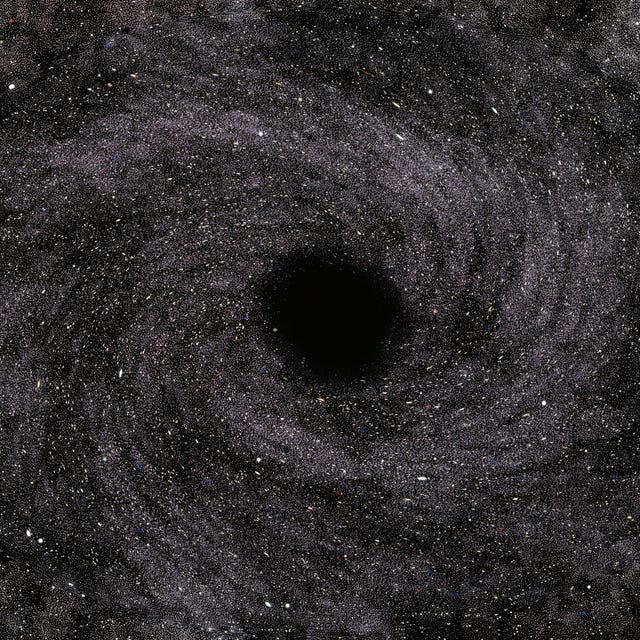
Black holes are among the most extreme objects in the universe, and they challenge the way our minds naturally understand reality. They are not simply “holes” in space, nor are they cosmic vacuum cleaners swallowing everything nearby. A black hole is a region of spacetime where gravity becomes so intense that nothing—not even light—can escape once it crosses a boundary called the event horizon.
But the most fascinating part is not just that black holes trap light. It’s that they distort the very fabric of reality itself. Around a black hole, space bends, time slows, and light curves in ways that seem almost magical. These effects are not caused by some mysterious force unique to black holes. They are the natural outcome of gravity taken to its most powerful extreme.
To understand why black holes bend time and light, we must leave behind the old idea of gravity as a simple pulling force. We must step into Einstein’s vision of gravity as geometry, where the universe is not a rigid stage but a flexible structure that can warp and twist.
Black holes do not merely sit inside spacetime. They reshape spacetime. And when spacetime is reshaped, everything that moves through it—including light and time itself—must obey the new geometry.
Gravity Is Not Just a Force: Einstein’s Spacetime Revolution
For centuries, gravity was described using Isaac Newton’s laws. Newton explained gravity as an invisible force acting between masses. The Earth pulls the Moon. The Sun pulls the planets. Apples fall because Earth pulls them downward.
Newton’s gravity was extremely successful for everyday life and even for planetary motion. But it had a hidden weakness: it treated space and time as fixed backgrounds. Space was a rigid three-dimensional arena. Time flowed the same everywhere. Gravity acted within this stage but did not change the stage itself.
Albert Einstein changed everything with general relativity.
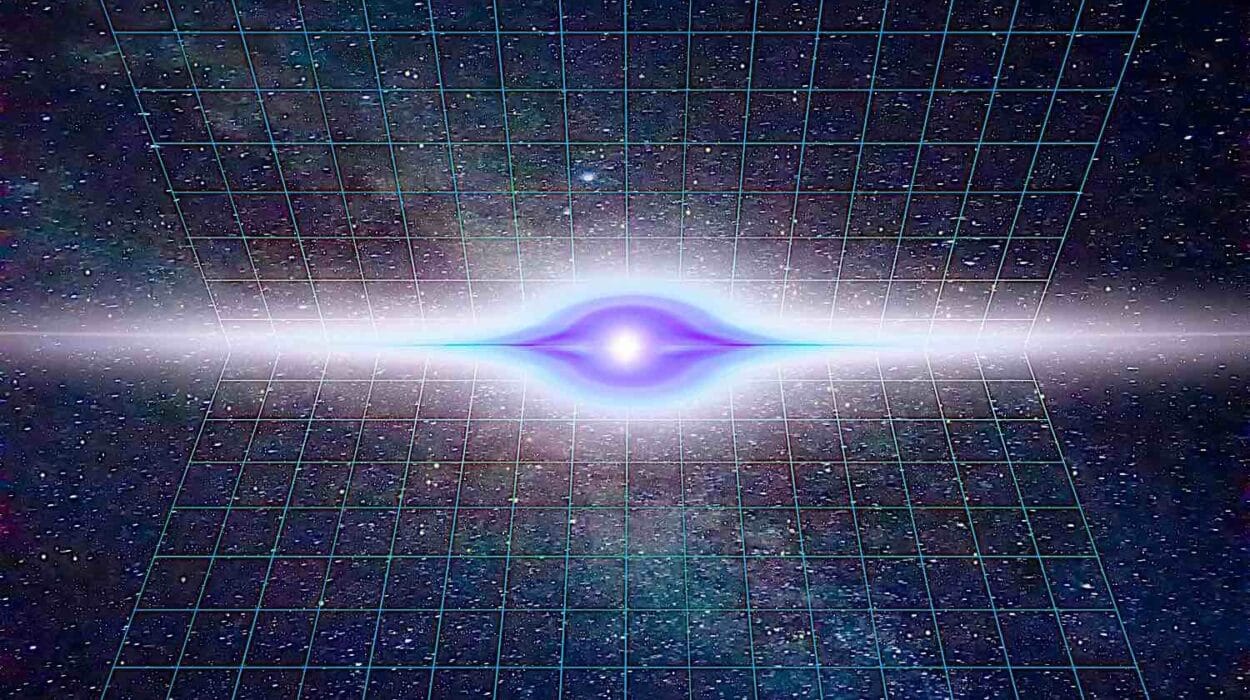
Einstein proposed that gravity is not a traditional force at all. Instead, it is the result of curved spacetime. Mass and energy bend the fabric of spacetime, and objects move along paths determined by this curvature.
A planet orbiting a star is not being “pulled” in the Newtonian sense. It is following the straightest possible path in curved spacetime. That path appears curved to us, just as a straight line drawn on a curved surface can look like an arc.
In general relativity, space and time are woven together into a four-dimensional fabric called spacetime. If spacetime bends, both space and time are affected.
This is the key. When we say black holes bend time and light, we are really saying black holes curve spacetime so strongly that the normal rules of geometry no longer apply in familiar ways.
What Makes a Black Hole So Powerful?
A black hole forms when a large amount of mass becomes compressed into a very small volume. Gravity depends on mass, but it also depends on distance. The closer you get to a mass, the stronger its gravitational influence becomes.
Earth is massive, but its mass is spread out across a large radius. A black hole may contain several times the mass of the Sun, yet squeezed into a region smaller than a city. In some cases, black holes can have millions or billions of solar masses, concentrated into a relatively compact area.
This extreme concentration makes the curvature of spacetime extraordinarily steep near the black hole. It is like a deep pit in the geometry of the universe.
Imagine rolling a marble near a shallow dip in a surface. It curves gently inward. But near a deep funnel, the marble spirals faster and faster, eventually plunging down. A black hole is like the deepest possible funnel in spacetime.
But the analogy has limits, because black holes do not simply warp space. They warp time too.
Why Black Holes Bend Light
Light is usually imagined as traveling in straight lines. In ordinary space, that is true. A beam of light travels in the straightest path available.
But in general relativity, the “straightest path” is not always what we picture. The straightest path in curved spacetime is called a geodesic. It is the equivalent of a straight line on a curved surface.
On a flat plane, the shortest distance between two points is a straight line. But on a sphere, the shortest path is a curved line called a great circle route. This is why airplane routes on Earth appear curved on a map. They are actually the straightest possible paths on a curved planet.
Light behaves the same way in curved spacetime. It always follows the straightest available route, but if spacetime is bent, that route becomes curved.
Black holes bend spacetime dramatically, so light passing near them follows curved geodesics. This causes the light to bend around the black hole, a phenomenon known as gravitational lensing.
Gravitational lensing is not just theoretical. It has been observed many times across the universe. Massive objects like galaxies and galaxy clusters can bend light from more distant sources, creating arcs, rings, and distorted images. Black holes can do the same, but on a much more intense scale.
If light passes close enough to a black hole, it can even orbit the black hole in a circular path. There is a region outside the event horizon called the photon sphere, where light can theoretically travel in unstable circular orbits. A slight disturbance sends it either outward to escape or inward to fall past the horizon.
This is one of the most surreal realities of black holes: gravity can be so strong that even light, which normally travels at the fastest speed possible, can be forced into orbit.
Why Light Cannot Escape the Event Horizon
The event horizon is not a physical surface like a planet’s crust. It is a boundary in spacetime. It marks the distance from the black hole where escape becomes impossible.
To understand why, think about escape velocity. Escape velocity is the speed required to break free from an object’s gravity. For Earth, it is about 11.2 kilometers per second. For the Sun, it is about 617 kilometers per second.
As you compress mass into a smaller radius, escape velocity increases. If you compress enough mass into a small enough region, the escape velocity at that boundary becomes equal to the speed of light.
That boundary is the event horizon.
Since nothing can travel faster than light, nothing can escape once it crosses the horizon. Not particles. Not radiation. Not information. From the outside universe, anything falling in appears to fade away and disappear.
This is why black holes are black. They do not reflect or emit light from within the event horizon. Any light produced inside is trapped, forever unable to reach the outside universe.
Time Is Not Universal: The Reality of Gravitational Time Dilation
The bending of light is astonishing, but the bending of time is even more unsettling.
In everyday life, we assume time flows at the same rate everywhere. A second is a second, whether you are on a mountain or at sea level. But general relativity says otherwise.
Time is affected by gravity. The stronger the gravitational field, the slower time passes relative to a weaker field.
This effect is called gravitational time dilation.
It is not just a strange prediction. It has been measured. Clocks at higher altitudes tick slightly faster than clocks on Earth’s surface because they are in weaker gravity. GPS satellites must account for time dilation because their clocks tick at a different rate than clocks on the ground. Without relativity corrections, GPS would become inaccurate very quickly.
If Earth’s gravity causes measurable time differences, imagine what happens near a black hole.
Near a black hole, gravity is so intense that time dilation becomes extreme. To a distant observer, a clock near the event horizon appears to slow down dramatically. The closer it gets to the horizon, the slower it seems to tick.
In fact, from the perspective of an observer far away, time appears to stop at the event horizon. The falling object never quite crosses it. Instead, it appears to approach the horizon more and more slowly, fading and redshifting until it becomes invisible.
This does not mean the object never falls in. From the object’s own perspective, it crosses the horizon in a finite amount of time. But the outside universe will never see that crossing happen.
This is one of the most mind-bending truths about black holes: different observers experience time differently, and both perspectives are valid.
Why Gravity Slows Time: The Deeper Explanation
Gravitational time dilation happens because gravity is not merely a pull—it is a distortion of spacetime.
In general relativity, the presence of mass-energy changes the geometry of spacetime. That change affects how time intervals are measured.
A useful way to think about it is that spacetime has a kind of “slope” around massive objects. Objects naturally move along the paths that spacetime geometry dictates. The deeper the gravitational well, the more “tilted” time becomes compared to space.
Near a black hole, the distortion becomes so strong that time and space swap roles in a strange way. Outside the event horizon, you can choose to stay at a fixed distance if you accelerate hard enough. But inside the horizon, moving toward the center becomes as unavoidable as moving into the future. You cannot stop it any more than you can stop time.
This is not a metaphor. It is built into the geometry of spacetime. Inside the horizon, the singularity lies in your future direction.
That is one of the reasons black holes are so final. They do not just trap matter; they trap it in time.
The Redshift of Light Escaping a Black Hole
Another clue that black holes bend time comes from the way light behaves when climbing out of strong gravity.
When light escapes a gravitational field, it loses energy. Losing energy means its wavelength increases, shifting toward the red end of the spectrum. This is called gravitational redshift.
If a flashlight shines upward from near a black hole, a distant observer sees that light as redder and weaker than expected. As the flashlight approaches the event horizon, the redshift becomes more extreme.
At the event horizon, the redshift becomes infinite. Light emitted exactly at the horizon would be stretched to an infinite wavelength, meaning it would carry essentially no energy to the outside universe. It becomes undetectable.
This is another reason the event horizon acts like a one-way boundary. Light from inside cannot escape because the energy required to climb out is effectively impossible.
Gravitational redshift is also a time effect. Frequency is tied to time, since frequency measures how many wave cycles pass per second. If light is redshifted, its frequency is lower, meaning the ticking of time near the black hole is slower relative to far away.
Light itself becomes a messenger of time dilation.
Spaghettification: Stretching Space and Time
Black holes do not only slow time and bend light. They also create extreme tidal forces.
Tidal forces occur because gravity gets stronger as you get closer to a mass. If your feet are closer to a gravitational source than your head, your feet are pulled more strongly. This creates stretching.
On Earth, tidal forces are mild but real. They are responsible for ocean tides caused by the Moon’s gravity. The side of Earth facing the Moon is pulled slightly more than the far side, causing bulges in the oceans.
Near a black hole, tidal forces can become enormous. If you fall toward a black hole feet-first, your feet are pulled far more strongly than your head. The difference can stretch your body into a long thin shape, a process often called spaghettification.
At the same time, the black hole compresses you sideways due to the geometry of spacetime. The result is a violent distortion.
This is a spatial effect, but it also relates to time because the gravitational field is not uniform. Different parts of your body experience different rates of time flow.
Black holes do not just warp time. They warp it unevenly.
Rotating Black Holes and Frame Dragging
Most black holes are believed to rotate. Rotation adds another layer of strangeness.
In general relativity, a rotating mass drags spacetime around with it. This effect is called frame dragging. It is as if spacetime itself is being twisted.
Near a rotating black hole, frame dragging becomes extreme. There is a region outside the event horizon called the ergosphere, where spacetime is dragged so strongly that nothing can remain stationary relative to the distant universe. Even light is forced to move in the direction of the black hole’s rotation.
In the ergosphere, it is possible to extract energy from the black hole’s rotation, at least in theory. This is part of what makes rotating black holes central to high-energy astrophysics.
Frame dragging is yet another way black holes bend the rules of motion. They do not just curve spacetime inward; they twist it.
Light paths become more complex, and time dilation becomes asymmetric depending on the direction of motion.
Rotating black holes show that gravity is not simply about attraction. It is about the dynamic structure of spacetime itself.
The Event Horizon as a Boundary of Causality
One of the deepest reasons black holes bend time and light is that they reshape causality.
Causality is the relationship between cause and effect. In ordinary life, causes precede effects. Signals travel through space at finite speed, and information cannot move faster than light.
In relativity, causality is represented by light cones, which define what events can influence what other events. Light cones separate the possible future and past from the unreachable regions of spacetime.
A black hole tilts light cones inward as you approach the horizon. Far away from the black hole, light cones are upright, meaning you can travel in many directions through space while moving forward in time.
But near the horizon, the light cones tilt so much that all possible future paths lead inward. Even light, which defines the boundary of what is physically possible, cannot point outward.
At the horizon, the light cones tip completely. Beyond it, the outward direction is no longer part of your future. It becomes physically impossible to send a signal outward because outward travel would require moving backward in time or faster than light.
This is the real meaning of “nothing escapes.” It is not just that gravity is strong. It is that spacetime geometry makes escape paths vanish.
The event horizon is not a wall. It is a point of no return built into causality itself.
The Singularity: Where Physics Breaks Down
At the center of a classical black hole lies a singularity, a region where density becomes infinite and spacetime curvature becomes infinite.
This is where our current physics breaks.
General relativity predicts singularities, but physicists do not believe singularities represent actual physical reality. Instead, they likely indicate that general relativity is incomplete at extreme scales.
At the singularity, quantum effects should become important. A complete theory of quantum gravity—one that unifies quantum mechanics and general relativity—would be needed to describe what truly happens.
Even so, the singularity concept highlights why black holes bend time and light so intensely. The closer you get to the center, the stronger the curvature becomes. The geometry of spacetime becomes more extreme than anywhere else in the universe.
Black holes are nature’s ultimate stress test for physics. They push gravity to its limit, exposing where our understanding is strong and where it collapses into mystery.
What It Would Feel Like to Fall Into a Black Hole
From far away, watching someone fall toward a black hole is eerie. They appear to slow down. Their movements become delayed. Their light becomes redder. Their image fades until it disappears.
From the falling person’s perspective, something very different happens.
They experience time normally at first. They fall freely, weightless, like an astronaut orbiting Earth. If the black hole is very massive, the tidal forces at the horizon might even be mild, allowing them to cross the event horizon without immediately being torn apart.
Crossing the horizon would not feel like hitting a surface. There is no sudden wall. Locally, the laws of physics still feel normal.
But once inside, escape becomes impossible. Even if they fire rockets, even if they shine a light outward, nothing reaches the outside universe. The singularity is ahead in time, unavoidable.
This is the strange truth: the event horizon is not a dramatic barrier for the person falling in. It is dramatic for the universe watching from outside.
Black holes separate realities. They create a boundary where time itself becomes split between observers.
Why This Matters: Black Holes as Laboratories of Reality
Black holes are not just exotic objects in space. They are cosmic laboratories that teach us what spacetime truly is.
They confirm that gravity is geometry. They demonstrate that time is not universal. They prove that light, which seems unstoppable, can be trapped by curvature.
Black holes also connect the biggest and smallest scales in physics. They involve massive astrophysical objects, but also raise questions about quantum mechanics, entropy, and information.
One of the deepest mysteries in modern physics is the black hole information paradox: what happens to information that falls into a black hole? Quantum mechanics suggests information cannot be destroyed, but classical black holes seem to erase it. Resolving this paradox may require a new understanding of reality itself.
Black holes are where the universe forces us to confront the limits of knowledge.
Conclusion: The Universe’s Most Extreme Warping of Reality
Black holes bend time and light because gravity is not simply a force pulling objects inward. Gravity is the curvature of spacetime. And black holes represent the most extreme curvature nature can create.
Light bends because it follows the straightest possible path in curved spacetime. Near a black hole, those “straight” paths curve dramatically, sometimes even forming orbits.
Time slows because gravity affects the structure of spacetime itself. The stronger the gravitational field, the more time stretches relative to distant observers. Near the event horizon, time dilation becomes so extreme that the outside universe never sees an object cross.
A black hole is not merely an object. It is a region where space becomes distorted, time becomes elastic, and causality becomes one-way.
They are the ultimate reminder that the universe is not built according to human intuition. It is built according to deeper laws—laws that can be understood, tested, and written in mathematics, but that remain profoundly strange.
Black holes do not just bend light and time. They bend our understanding of what reality even means.