For years, fast radio bursts, or FRBs, have arrived like cosmic whispers—brief, brilliant flashes of radio light traveling billions of years before brushing past Earth. They appear suddenly, vanish almost instantly, and leave astronomers with far more questions than answers. Most of these signals are seen only once, as if the universe itself blinked and moved on. Because of this fleeting nature, FRBs have often been imagined as lonely events, born from isolated stars in distant galaxies.
But one repeating signal refused to stay silent long enough to fit that story.
An international team of astronomers, including researchers from the Department of Physics at The University of Hong Kong, has now uncovered the first decisive evidence that at least some FRB sources are not alone at all. Instead, they live in binary stellar systems, locked in a gravitational dance with a companion star. This discovery reshapes how scientists understand the origins of repeating FRBs and opens a new window into the environments that give rise to these extraordinary bursts.
Listening Patiently to a Distant Heartbeat
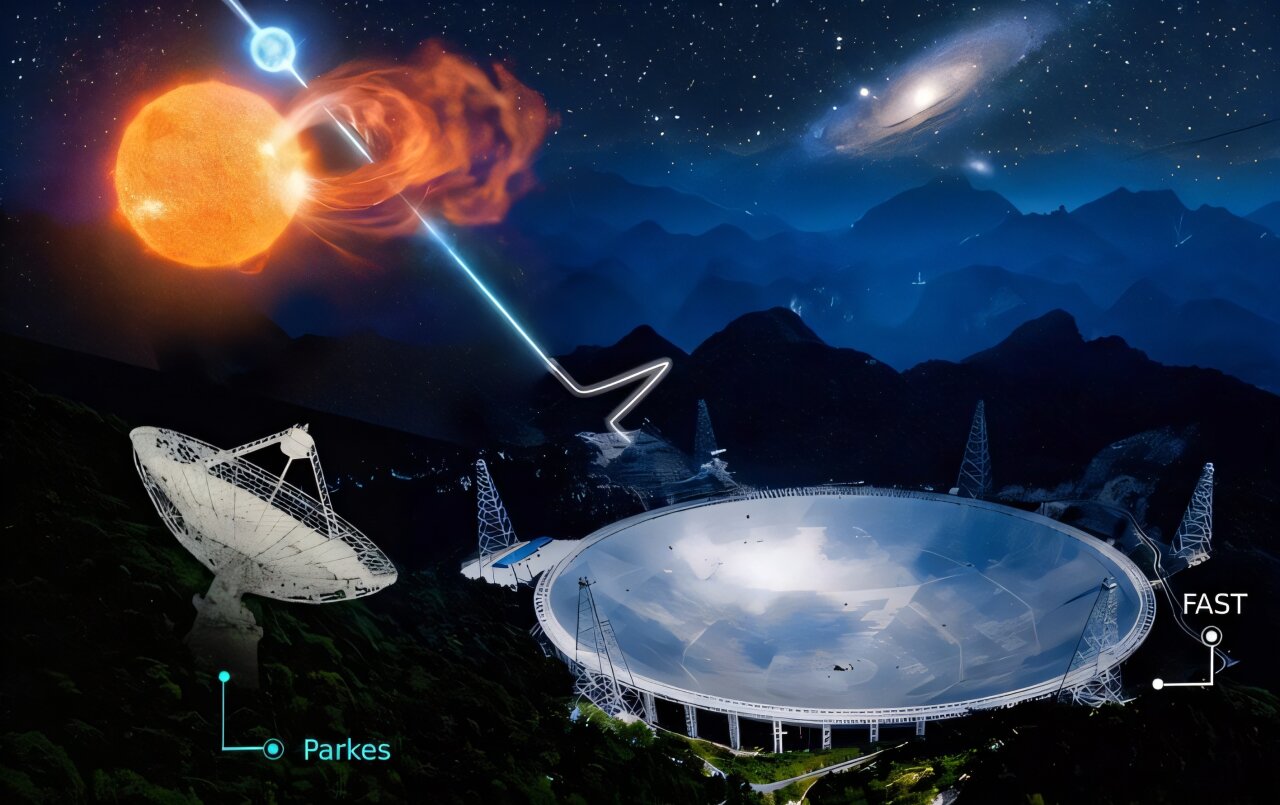
The breakthrough came from nearly 20 months of careful monitoring of an active repeating FRB located about 2.5 billion light-years away. This source, known as FRB 220529A, was observed using the Five-hundred-meter Aperture Spherical Telescope, or FAST, in Guizhou. Often called the China Sky Eye, FAST is one of the most sensitive radio telescopes ever built, capable of catching even the faintest changes hidden in cosmic signals.
Repeating FRBs are rare, but they are invaluable. Because they burst again and again, astronomers can watch them over time, waiting for subtle changes that might reveal what kind of environment surrounds them. Since 2020, repeating FRBs have been closely followed through a dedicated FAST FRB Key Science Program co-led by Professor Bing Zhang.
At first, FRB 220529A did not seem special.
“FRB 220529A was monitored for months and initially appeared unremarkable,” said Professor Zhang. “Then, after a long-term observation for 17 months, something truly exciting happened.”
That moment of excitement would turn out to be a sudden and dramatic shift in the signal’s behavior—one that carried the fingerprint of another star.
The Sudden Twist in the Signal
FRBs are known for their almost 100% linear polarization, meaning their radio waves vibrate in a highly ordered way. As these waves travel through space filled with charged particles and magnetic fields, their polarization angle slowly twists. This effect is called Faraday rotation, and it is measured by a quantity known as the rotation measure, or RM.
For most of the observation period, the RM of FRB 220529A stayed steady. Then, near the end of 2023, everything changed.
“Near the end of 2023, we detected an abrupt RM increase by more than a factor of a hundred,” said Dr. Ye Li, the paper’s first author. “The RM then rapidly declined over two weeks, returning to its previous level. We call this an ‘RM flare.’”
This was not a gentle fluctuation. It was a sharp spike followed by a swift return to normal, suggesting that something dense and magnetized had briefly crossed the path between the FRB source and Earth.
The signal was rare, dramatic, and impossible to ignore.
A Companion Revealed Without Being Seen
The team set out to understand what could cause such a short-lived and intense RM flare. The behavior pointed to a temporary cloud of dense magnetized plasma moving across the line of sight. One explanation stood out as both natural and compelling.
“One natural explanation is that a nearby companion star ejected this plasma,” explained Professor Zhang.
Such an ejection is known as a coronal mass ejection, or CME, a powerful release of plasma and magnetic fields from a star’s outer atmosphere. In this scenario, the FRB source is not isolated. Instead, it orbits alongside another star, and when that companion releases a CME, the expelled plasma briefly contaminates the environment around the FRB source, altering the radio signal detected on Earth.
“Such a model works well to interpret the observations,” said Professor Yuanpei Yang, a co-first author of the study. “The required plasma clump is consistent with CMEs launched by the sun and other stars in the Milky Way.”
At a distance of billions of light-years, the companion star itself cannot be directly seen. Yet its presence was unmistakably revealed through the behavior of radio waves captured by FAST and Australia’s Parkes telescope. The signal carried the story of an unseen partner, written not in light, but in polarization.
The Magnetar at the Center
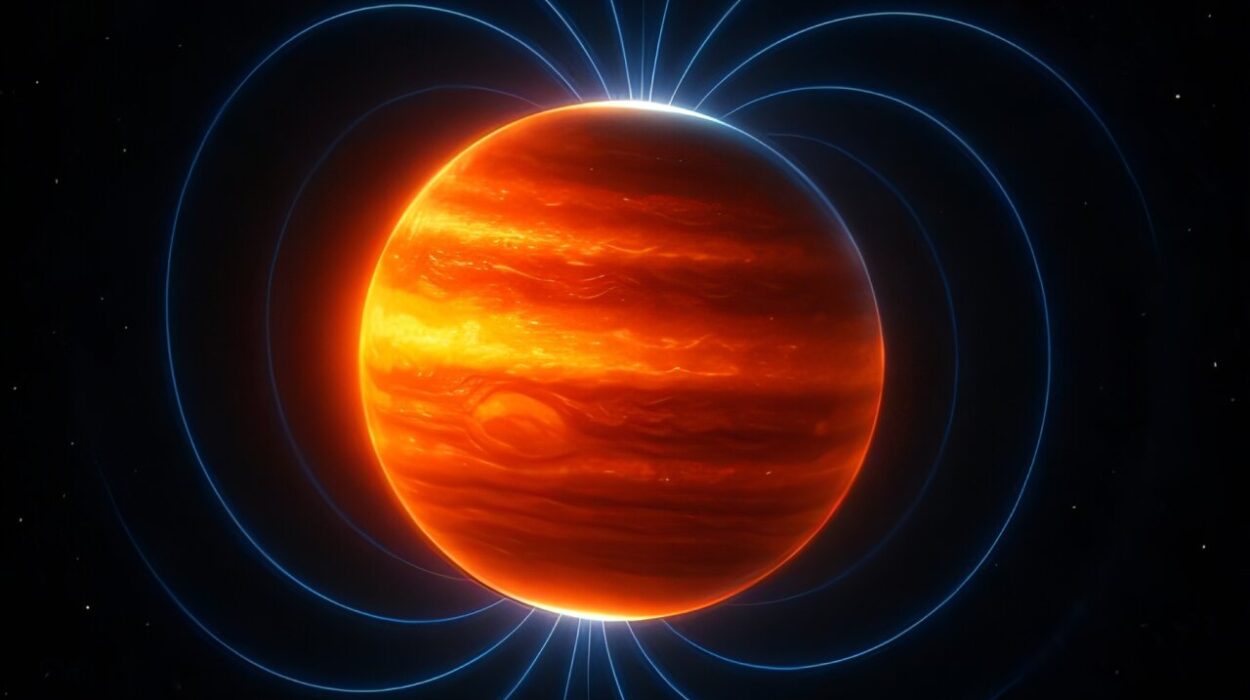
The evidence does more than reveal a companion star. It strongly supports the idea that the FRB source itself is a magnetar, a type of neutron star with an extremely strong magnetic field.
“This finding provides a definitive clue to the origin of at least some repeating FRBs,” said Professor Zhang. “The evidence strongly supports a binary system containing a magnetar—a neutron star with an extremely strong magnetic field, and a star like our sun.”
Magnetars have long been suspected as the engines behind FRBs, but this discovery adds a crucial piece to the puzzle. It shows that interactions within a binary system can shape the environment around a magnetar in ways that directly affect the radio bursts we observe.
The RM flare acts like a cosmic signature, pointing to the presence of a nearby star and revealing how its activity can briefly alter the path of an FRB’s signal through space.
Perseverance Written in Radio Waves
This discovery did not come from a single observation or a lucky coincidence. It emerged from persistent, long-term monitoring, careful analysis, and a willingness to wait for the universe to reveal something unexpected.
“This discovery was made possible by the persevering observations using the world’s best telescopes and the tireless work of our dedicated research team,” said Professor Xuefeng Wu, the lead corresponding author of the paper.
The results were published in Science, marking a significant milestone in FRB research. Beyond explaining one repeating source, the findings lend support to a unified physical picture proposed by Professor Zhang and his collaborator. In this picture, all FRBs originate from magnetars, while interactions in binary systems create a preferred geometry that allows some sources to repeat more frequently.
Rather than being rare exceptions, repeating FRBs may be telling astronomers something fundamental about how these extreme objects live and interact.
Why This Discovery Matters
For a long time, fast radio bursts have been among the most mysterious signals in astronomy. Their extreme brightness, fleeting nature, and distant origins made them difficult to study and even harder to explain. This discovery changes that landscape.
By revealing direct evidence of a binary system associated with a repeating FRB, astronomers now have a concrete way to connect observed signals to real astrophysical environments. The detection of an RM flare provides a powerful new tool for probing what surrounds an FRB source, even when companion stars cannot be seen directly.
Most importantly, this finding shows that patience pays off in cosmic exploration. Continued long-term monitoring of repeating FRBs may reveal how common binary systems truly are among these sources, helping scientists move from isolated explanations toward a coherent understanding of their origins.
Each repeating burst is no longer just a flash in the dark. It is a message shaped by gravity, magnetism, and stellar companionship, traveling billions of years to tell us that even in the most extreme corners of the universe, stars rarely live their lives alone.
Study Details
Y. Li et al, A sudden change and recovery in the magnetic environment around a repeating fast radio burst, Science (2026). DOI: 10.1126/science.adq3225. www.science.org/doi/10.1126/science.adq3225