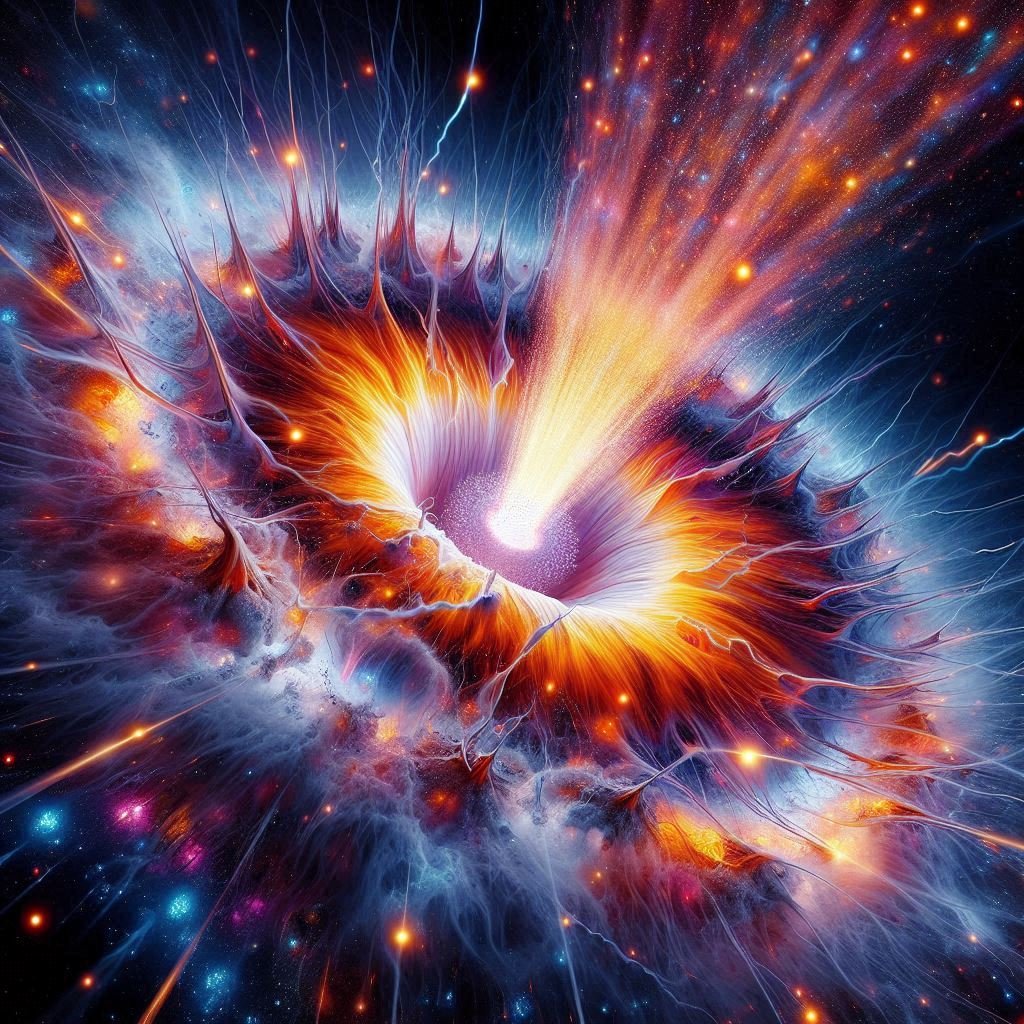
Imagine looking up at the night sky and witnessing an event so energetic that, for a few brief seconds, it releases more energy than our Sun will produce over its entire 10-billion-year lifetime. Imagine an explosion so bright that it could briefly outshine an entire galaxy containing hundreds of billions of stars. It sounds like something from science fiction, yet these astonishing events are real. They are known as gamma-ray bursts, or GRBs, and they are among the most violent and fascinating phenomena ever discovered in the universe.
Fortunately for us, nearly every gamma-ray burst occurs billions of light-years away. If one happened nearby and its powerful jet pointed directly at Earth, the consequences could be devastating for our planet. But because these explosions usually occur at immense cosmic distances, they serve not as threats but as extraordinary windows into the distant universe.
Gamma-ray bursts have transformed modern astronomy. They reveal the deaths of massive stars, the collisions of neutron stars, the birth of black holes, and even clues about the earliest generations of stars that formed after the Big Bang. Every time astronomers detect one, they are not merely observing an explosion—they are witnessing a chapter in the story of the universe itself.
Although gamma-ray bursts are among the most energetic events known, the science behind them can be understood without advanced mathematics. Their story is one of curiosity, technological innovation, and humanity’s determination to understand the most extreme events nature can produce.
What Are Gamma-Ray Bursts?
A gamma-ray burst is a sudden flash of extremely energetic gamma rays that appears somewhere in the sky without warning. These flashes are incredibly bright but usually last only a fraction of a second to several minutes.
Gamma rays are the highest-energy form of electromagnetic radiation. Just as visible light, radio waves, microwaves, infrared radiation, ultraviolet light, and X-rays are all forms of electromagnetic waves, gamma rays belong to the same family. The difference lies in their energy. Gamma rays carry far more energy than visible light and are produced only under the most extreme physical conditions.
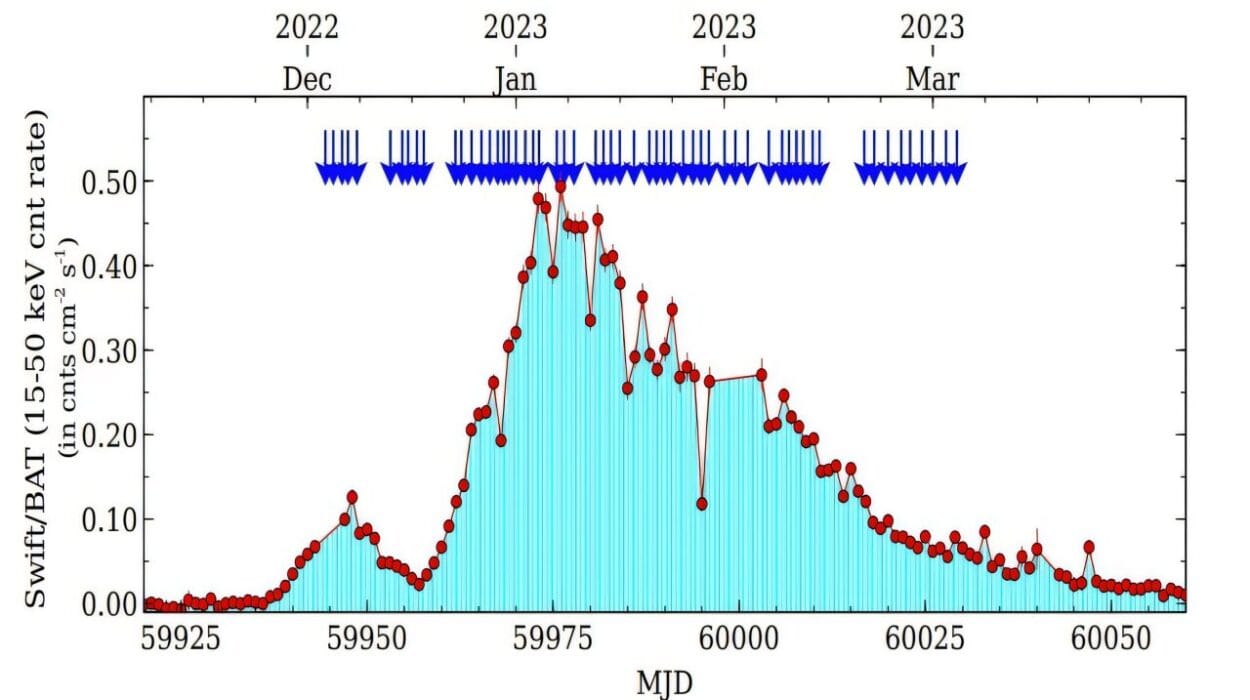
When astronomers detect a gamma-ray burst, they are seeing the first signal from a catastrophic cosmic event. Although the initial flash fades quickly, it is often followed by an “afterglow” that shines in X-rays, ultraviolet light, visible light, infrared light, and radio waves for hours, days, weeks, or even months.
The initial burst is astonishingly brief, but its afterglow allows scientists to study the explosion long after the gamma rays have disappeared.
Why Gamma-Ray Bursts Are So Powerful
The phrase “most powerful explosions in the universe” is not an exaggeration.
During a gamma-ray burst, an enormous amount of energy is released in an incredibly short period. If the explosion emitted energy equally in every direction, it would rank among the most energetic events ever observed.
Fortunately, nature is more efficient.
Instead of radiating energy in all directions, most gamma-ray bursts produce narrow, focused jets traveling at speeds extremely close to the speed of light. Because the energy is concentrated into these narrow beams, the bursts appear extraordinarily bright to observers located within the jet’s path.
This effect is somewhat similar to the difference between a light bulb and a flashlight. A flashlight appears brighter from directly in front because its light is concentrated into a narrow beam rather than spreading equally in every direction.
Gamma-ray bursts operate on the same principle—but on an incomprehensibly larger scale.
The Discovery That Changed Astronomy
The discovery of gamma-ray bursts happened almost by accident.
During the Cold War, the United States launched satellites designed to detect gamma rays from possible nuclear weapon tests in space. These satellites were not intended to study distant galaxies.
Instead, they found something unexpected.
Beginning in the late 1960s, the satellites repeatedly detected mysterious flashes of gamma rays coming from deep space rather than from Earth.
Scientists were puzzled.
The bursts appeared randomly across the sky.
They lasted from milliseconds to minutes.
No one knew what caused them.
For decades, gamma-ray bursts became one of astronomy’s greatest mysteries.
Without knowing how far away they were, researchers could not determine how powerful they truly were.
Only in the 1990s did better satellites begin locating bursts accurately enough for telescopes to observe their afterglows.
Those observations revealed that gamma-ray bursts originate in distant galaxies billions of light-years away.
The mystery suddenly became even more astonishing.
These were not nearby explosions.
They were cosmic giants.
Understanding Gamma Rays
To appreciate gamma-ray bursts, it helps to understand gamma rays themselves.
The electromagnetic spectrum includes every type of electromagnetic radiation.
At one end are radio waves, which have long wavelengths and relatively low energy.
Visible light occupies only a tiny portion of the spectrum.
Beyond visible light lie ultraviolet rays, X-rays, and finally gamma rays.
Gamma rays possess the shortest wavelengths and the highest frequencies, making them the most energetic form of light.
They are produced only in environments involving extreme temperatures, high-energy particles, radioactive decay, or violent cosmic events.
Ordinary stars produce relatively little gamma radiation.
Gamma-ray bursts, however, unleash enormous quantities of these powerful photons in just seconds.
Two Main Types of Gamma-Ray Bursts
Astronomers eventually realized that gamma-ray bursts fall into two major categories.
The first type lasts less than about two seconds.
These are called short gamma-ray bursts.
Some last only a few thousandths of a second.
The second type lasts longer than about two seconds and can continue for several minutes.
These are called long gamma-ray bursts.
Although both produce intense gamma rays, they originate from different cosmic events.
This discovery represented one of the most important breakthroughs in understanding these mysterious explosions.
Long Gamma-Ray Bursts
Long gamma-ray bursts are associated with the deaths of extremely massive stars.
Massive stars live relatively short lives.
They burn through their nuclear fuel rapidly.
Eventually the star can no longer support itself against gravity.
Its core collapses.
Under certain conditions, the collapsing core forms a black hole or possibly an extremely rapidly spinning neutron star.
Meanwhile, enormous amounts of matter fall inward.
Powerful magnetic fields and rotation launch narrow jets traveling almost at the speed of light.
These jets punch through the dying star.
Once they escape into space, they produce the brilliant gamma-ray burst observed by astronomers.
This spectacular process is sometimes called a collapsar.
Not every collapsing massive star creates a gamma-ray burst.
The exact conditions required are still being studied.
Short Gamma-Ray Bursts
Short gamma-ray bursts have a different origin.
They are believed to result primarily from collisions between neutron stars.
A neutron star forms when a massive star explodes as a supernova.
Although only about the size of a city, a neutron star contains more mass than our Sun.
Its matter is compressed to astonishing densities.
Sometimes two neutron stars orbit each other for millions or even billions of years.
As they orbit, they slowly lose energy by emitting gravitational waves.
Their orbit shrinks.
Eventually they collide.
The collision releases enormous amounts of energy.
It produces heavy chemical elements, launches powerful jets, and often forms a black hole.
If one of those jets points toward Earth, astronomers observe a short gamma-ray burst.
The first confirmed connection between neutron-star mergers and short gamma-ray bursts came in 2017, when scientists detected both gravitational waves and a gamma-ray burst from the same event.
That discovery marked the beginning of a new era known as multi-messenger astronomy.
How Black Holes Are Involved
Black holes play a central role in many gamma-ray bursts.
When the core of a massive star collapses, gravity overwhelms every other force.
If enough mass remains, a black hole forms.
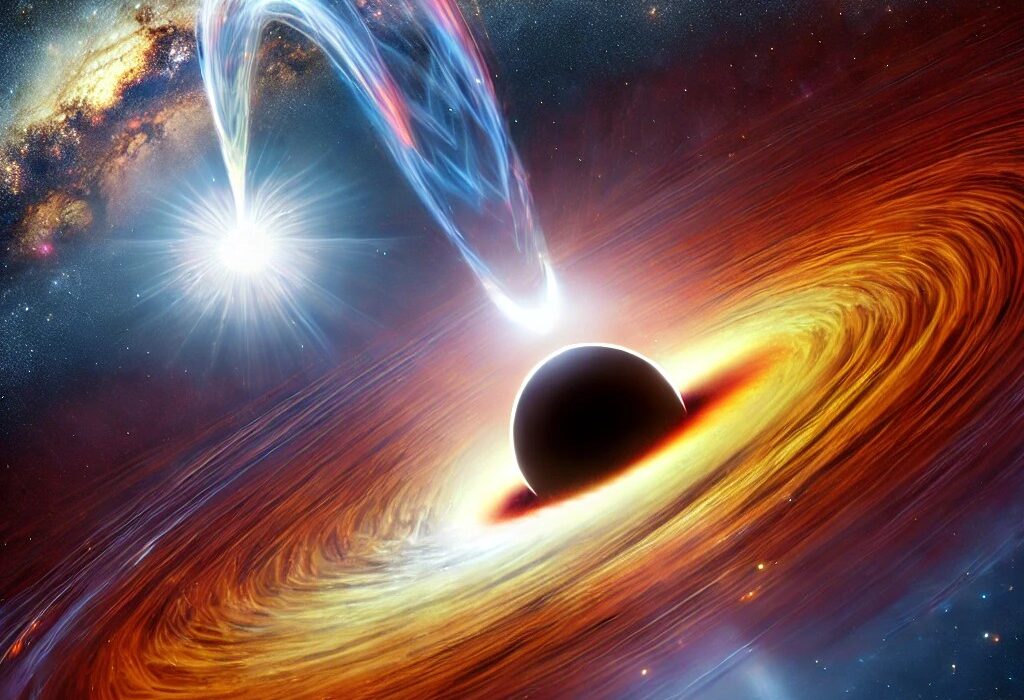
Matter surrounding the newborn black hole spirals inward.
This material forms an accretion disk.
Friction and magnetic forces heat the gas to extraordinary temperatures.
Powerful magnetic fields help launch narrow jets away from the black hole’s poles.
These jets move at speeds exceeding 99 percent of the speed of light.
Within these jets, particles collide, producing gamma rays that travel across billions of light-years before reaching Earth.
Remarkably, the black hole itself does not emit the gamma rays.
Instead, the surrounding environment creates the conditions necessary for the burst.
Jets Moving Near the Speed of Light
One of the most extraordinary features of gamma-ray bursts is the incredible speed of their jets.
These jets travel at velocities so close to the speed of light that Einstein’s theory of relativity becomes essential for understanding them.
Because the jets move so rapidly, their radiation becomes strongly concentrated in the direction of motion.
This effect is called relativistic beaming.
Observers located inside the beam see an extraordinarily bright burst.
Observers outside the beam may see little or nothing at all.
This explains why many gamma-ray bursts probably occur without ever being detected from Earth.
Their jets simply point elsewhere.
The Afterglow
Although the initial burst fades rapidly, the story does not end there.
As the jet plows through surrounding gas, it creates powerful shock waves.
These shocks accelerate charged particles to enormous energies.
The particles emit radiation across many wavelengths.
Astronomers call this emission the afterglow.
Unlike the gamma-ray flash, the afterglow may remain visible for days or months.
Space telescopes observe the X-ray afterglow.
Ground-based telescopes capture visible and infrared light.
Radio telescopes follow the event for much longer.
Together, these observations allow scientists to reconstruct the explosion’s history.
Why Afterglows Are So Important
Without afterglows, gamma-ray bursts would remain mysterious flashes.
Afterglows provide astronomers with valuable information.
They reveal the burst’s distance.
They identify its host galaxy.
They show how the jet interacts with surrounding material.
They allow scientists to estimate the explosion’s energy.
They even help determine whether the burst resulted from a stellar collapse or a neutron-star merger.
Every afterglow becomes a scientific treasure.
Measuring Enormous Distances
Many gamma-ray bursts occur billions of light-years away.
Some originated when the universe was only a few hundred million years old.
Their light has spent most of cosmic history traveling toward Earth.
Astronomers determine these distances by studying the afterglow’s spectrum.
As the universe expands, light stretches toward longer wavelengths.
This effect, known as redshift, provides a measure of cosmic distance.
Some gamma-ray bursts rank among the most distant individual objects ever observed.
They allow scientists to glimpse the early universe shortly after the first galaxies formed.
Cosmic Lighthouses
Because gamma-ray bursts are so bright, they can be seen across enormous distances.
Ordinary galaxies eventually become too faint to detect.
Gamma-ray bursts remain visible.
This makes them valuable probes of the early universe.
Their light passes through gas clouds lying between the burst and Earth.
Those clouds leave fingerprints in the burst’s spectrum.
By studying those fingerprints, astronomers learn about the composition of ancient galaxies and intergalactic gas.
In this way, gamma-ray bursts act like cosmic flashlights illuminating otherwise invisible regions of the universe.
The Role of Supernovae
Many long gamma-ray bursts accompany a special kind of stellar explosion called a broad-lined Type Ic supernova.
These supernovae occur after massive stars lose much of their outer hydrogen and helium layers.
When the core collapses, both a supernova and a gamma-ray burst may occur.
Not every supernova produces a gamma-ray burst.
Likewise, not every gamma-ray burst is associated with a visible supernova.
Scientists continue investigating exactly which stars create these extraordinary events.
Factors such as mass, rotation speed, and magnetic fields likely play important roles.
Gravitational Waves and Gamma-Ray Bursts
One of the greatest achievements in modern astronomy occurred in 2017.
Scientists detected gravitational waves from two merging neutron stars.
Just 1.7 seconds later, satellites observed a short gamma-ray burst from the same region.
This remarkable coincidence confirmed decades of theoretical predictions.
For the first time, researchers observed a single cosmic event using both gravitational waves and electromagnetic radiation.
The discovery opened an entirely new way of studying the universe.
Instead of relying on light alone, astronomers now combine multiple “messengers” to understand cosmic events more completely.
Heavy Elements Born in Violent Collisions
Neutron-star mergers do more than produce gamma-ray bursts.
They also create many of the universe’s heaviest elements.
Gold.
Platinum.
Uranium.
These elements cannot easily form inside ordinary stars.
Instead, they are forged during rapid neutron-capture processes occurring in the extreme conditions of neutron-star collisions.
In a profound sense, the precious metals used in jewelry and electronics may owe their existence to ancient cosmic explosions accompanied by gamma-ray bursts.
Could a Gamma-Ray Burst Affect Earth?
This question naturally captures people’s imagination.
Fortunately, the answer is reassuring.
Known gamma-ray bursts occur at enormous distances.
The probability of a dangerous burst occurring close enough and pointing directly toward Earth is extremely low.
If such an event happened within our galaxy and its jet aligned with Earth, it could damage the ozone layer, increase ultraviolet radiation reaching the surface, and potentially affect ecosystems.
However, astronomers believe such events are exceedingly rare over Earth’s history.
There is no evidence that any known nearby star currently poses an imminent gamma-ray burst threat to our planet.
Gamma-Ray Bursts and Mass Extinctions
Some scientists have proposed that ancient gamma-ray bursts may have contributed to certain mass extinction events.
This idea remains speculative.
While the physics suggests that a sufficiently nearby burst could affect Earth’s atmosphere, no extinction event has been definitively linked to a gamma-ray burst.
Researchers continue studying this possibility using geological evidence and astronomical models.
For now, the hypothesis remains interesting but unproven.
The Space Telescopes That Hunt Gamma-Ray Bursts
Because Earth’s atmosphere blocks gamma rays, astronomers must observe them from space.
Specialized satellites constantly monitor the sky.
When a burst occurs, onboard instruments determine its approximate location within seconds.
Automatic alerts are immediately transmitted worldwide.
Ground-based observatories rapidly turn toward the event.
Other space telescopes join the observations.
This global cooperation allows scientists to study the explosion before its afterglow fades.
The speed of this response has revolutionized gamma-ray burst research.
Why Gamma Rays Cannot Reach Earth’s Surface
Earth’s atmosphere acts as a protective shield.
Gamma rays are absorbed high above the ground.
Without this natural protection, life on Earth would face constant exposure to dangerous high-energy radiation from space.
Although astronomers cannot observe cosmic gamma rays directly from the surface, this atmospheric barrier makes life possible.
Space observatories overcome this limitation by operating above the atmosphere.
What Scientists Still Don’t Know
Despite decades of research, many mysteries remain.
Astronomers continue investigating exactly how jets form.
They seek to understand why only certain collapsing stars produce gamma-ray bursts.
They are studying the detailed structure of magnetic fields inside jets.
Researchers also hope to identify the first generation of stars through extremely distant gamma-ray bursts.
Each new detection answers old questions while raising new ones.
Gamma-Ray Bursts and Einstein’s Relativity
Gamma-ray bursts provide valuable tests of Einstein’s theories.
Because their photons travel billions of light-years, scientists can search for tiny deviations from expected behavior.
So far, observations strongly support Einstein’s predictions.
The bursts also involve matter moving at relativistic speeds, making them natural laboratories for testing extreme physics.
Few environments in the universe allow such dramatic examinations of fundamental laws.
Why Astronomers Love Gamma-Ray Bursts
To astronomers, gamma-ray bursts are much more than spectacular explosions.
They are scientific opportunities.
Each burst reveals information about black holes, neutron stars, massive stars, magnetic fields, relativistic jets, galaxy evolution, and the early universe.
No laboratory on Earth can recreate these conditions.
Nature performs the experiment.
Astronomers simply observe.
Every burst carries new information across billions of years of cosmic history.
Looking Back in Time
Because light travels at a finite speed, every distant object appears as it existed in the past.
When astronomers observe a gamma-ray burst ten billion light-years away, they are seeing an explosion that occurred ten billion years ago.
The event itself has long since ended.
The galaxy that hosted it has continued evolving.
Yet its ancient light is only now reaching Earth.
In this way, gamma-ray bursts allow scientists to study different eras of cosmic history.
They become time machines built from light.
The Future of Gamma-Ray Burst Research
The coming decades promise exciting discoveries.
More sensitive satellites will detect fainter bursts.
Larger telescopes will study more distant afterglows.
Future gravitational-wave observatories will discover many more neutron-star mergers.
Artificial intelligence is helping scientists analyze enormous amounts of observational data more efficiently.
Together, these advances will deepen our understanding of some of nature’s most powerful explosions.
Researchers hope to answer fundamental questions about black hole formation, jet physics, stellar evolution, and the birth of the first galaxies.
A Universe Filled With Extraordinary Violence
The night sky often appears peaceful.
Stars shine quietly.
Galaxies drift gracefully through space.
Yet beneath this calm appearance lies a universe capable of astonishing violence.
Massive stars collapse.
Neutron stars collide.
Black holes are born.
Jets moving nearly at light speed blast across space.
Gamma-ray bursts remind us that the cosmos is both breathtakingly beautiful and unimaginably powerful.
These explosions are not signs of chaos.
They are part of the universe’s natural cycle of birth, death, and renewal.
Through them, new elements are created, galaxies evolve, and scientists gain deeper insight into the laws governing everything around us.
Conclusion
Gamma-ray bursts are among the most extraordinary phenomena ever discovered. In just seconds or minutes, they release enormous amounts of energy, briefly becoming brighter than entire galaxies. Whether born from the collapse of massive stars or the collision of neutron stars, these explosions represent nature operating at its most extreme.
Far from being merely spectacular events, gamma-ray bursts are invaluable scientific tools. They allow astronomers to study newborn black holes, powerful relativistic jets, gravitational waves, the creation of heavy elements, and galaxies from the earliest chapters of cosmic history. Each burst is both a dramatic explosion and a messenger carrying information across billions of light-years.
Although many mysteries remain, every new observation brings us closer to understanding these remarkable events. Gamma-ray bursts remind us that the universe is a place of incredible energy, constant change, and endless discovery. Hidden within their brief flashes is a story that stretches across space and time—a story of dying stars, merging neutron stars, and the extraordinary forces that continue to shape the cosmos.