The vast expanse between stars is rarely empty, but it is even more rarely seen. For over a billion years, a massive chunk of ice and dust drifted through the freezing void of the galaxy, a silent messenger from a planetary system we may never visit. In late 2025, that object—now known as interstellar comet 3I/ATLAS—screeched through our inner solar system at blistering speeds. It offered astronomers a fleeting, high-stakes opportunity to look inside the building blocks of another world. Now, as the visitor retreats past the orbit of Jupiter on its way back into the darkness, researchers have used the James Webb Space Telescope (JWST) to peel back its irradiated layers and discover what lies at its icy core.
The Third Visitor from the Galactic Beyond
Interstellar objects are the ultimate rare catch for astronomers. 3I/ATLAS is only the third such object ever detected by humans, following the mysterious ‘Oumuamua in 2017 and the faint comet 2I/Borisov in 2019. While its predecessors were either inert or difficult to observe, 3I/ATLAS proved to be an exceptionally bright target. This luminosity allowed a team from Caltech to point the most advanced space telescope in history toward the comet, capturing data that would have been impossible to gather just a few years ago.
The comet itself is a behemoth of ancient materials, measuring over a kilometer wide. It is essentially a planetesimal—a small clump of rock and ice that, in its home system, would have served as the raw material to build a planet like Earth. Because it formed around a different star, it carries a unique chemical fingerprint, acting as a time capsule of the specific conditions and elemental ratios present in its birthplace.
Peering into the Mid-Infrared Window
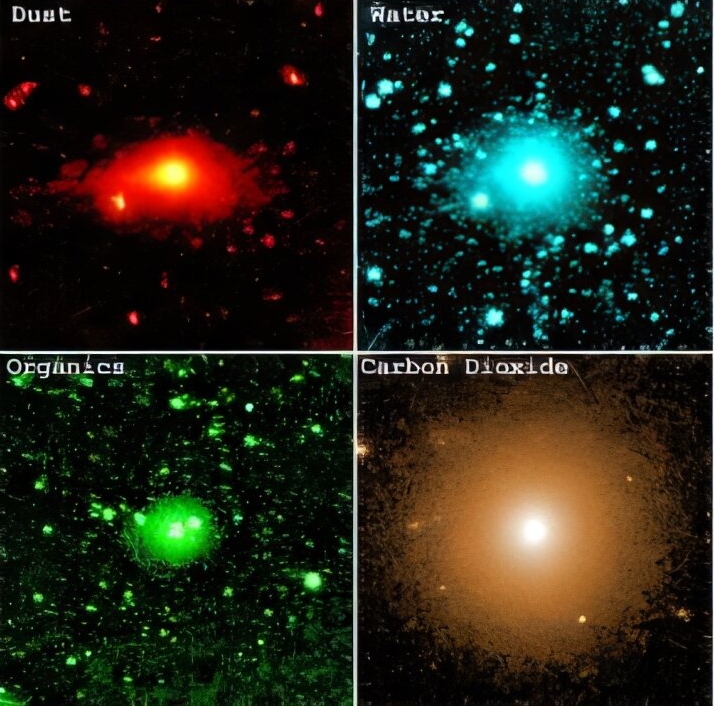
To understand where this traveler came from, the research team focused on mid-infrared signatures. These are wavelengths of light roughly 10 times longer than what the human eye can perceive. By analyzing these signatures with JWST, the scientists could identify and map specific chemical compounds as they were released from the comet.
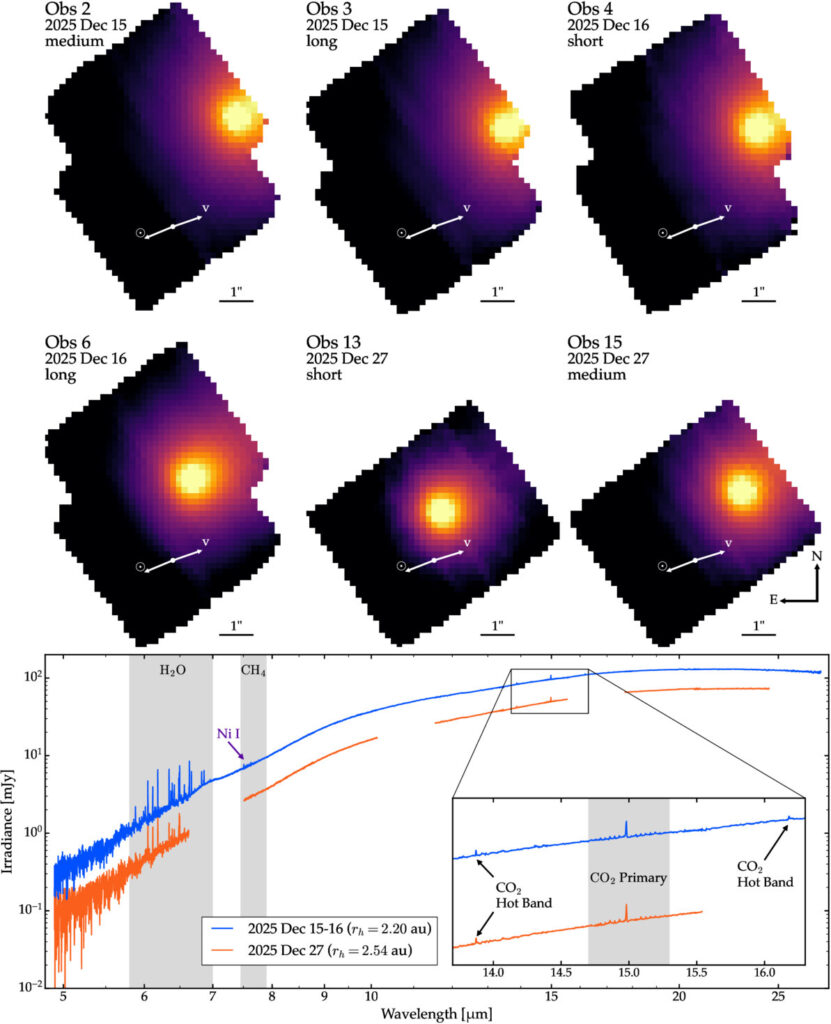
Lead author and Caltech graduate student Matthew Belyakov noted that the comet’s extreme speed created a narrow window for study. After looping around the sun at a distance of 1.5 AU in October 2025, the object began a rapid exit. The research, published in The Astrophysical Journal Letters, highlights how the team capitalized on this short-lived encounter to investigate the distant environment where the comet originally coalesced.
Shedding an Ancient Skin
One of the most significant challenges in studying interstellar objects is their “surface history.” For millions or billions of years, these rocks are bombarded by high-energy cosmic rays, which can fundamentally alter their outermost layers. When 3I/ATLAS first arrived, it appeared somewhat quiet; its most volatile ices, including methane, were only weakly outgassing. It seemed as though its long journey through the cosmos had created a protective, irradiated crust that was hiding its true nature.
However, as the comet was warmed by our sun and began its departure in December, a dramatic change occurred. The JWST data showed a massive spike in methane emissions. This shift indicated that the comet had finally shed its ancient outer surface, exposing the underlying, pristine icy layers that had been frozen solid for eons. By observing the comet after its closest approach to the sun, the Caltech team was able to analyze the internal composition of the object rather than just the damaged chemistry of its surface.
Mapping a Distant Home
The discovery of this internal chemistry is vital for mapping the comet’s origins. In our own solar system, the distribution of chemicals like methane tells us exactly where an object formed—whether it was close to the sun or out in the frigid reaches of the gas giants. By applying the same logic to 3I/ATLAS, researchers can begin to piece together a map of a foreign planetary system.
The team is also currently analyzing the dust composition of the comet, with a second paper expected to detail those findings soon. Each piece of data—from the ratio of ices to the structure of the dust—serves as a piece of a puzzle that describes a world light-years away. Even as the comet moves further away, becoming increasingly difficult to track as it passes Jupiter, JWST is scheduled for one final observation this spring to capture the last bits of data before the traveler vanishes for good.
Why This Matters
The study of 3I/ATLAS is more than just a census of a passing rock; it is a direct look at the “seeds” of planets in other parts of the galaxy. By analyzing this planetesimal, scientists can compare the building blocks of our own home to those of distant stars. The discovery that this comet has a different chemical makeup than local objects confirms that the ingredients for life and planets vary across the universe.
Furthermore, the ability to see past the irradiated surface of an interstellar visitor marks a major technical milestone. It proves that we can use our sun’s heat to “unzip” the protective layers of these travelers, allowing us to sample the deep, frozen history of the galaxy without ever leaving our own solar system. As 3I/ATLAS heads back into the interstellar void, it leaves behind a wealth of data that will redefine our understanding of how planetary systems form and evolve in the dark corners of the Milky Way.
Study Details
Matthew Belyakov et al, The Volatile Inventory of 3I/ATLAS as Seen with JWST/MIRI, The Astrophysical Journal Letters (2026). DOI: 10.3847/2041-8213/ae5700