“Why are we here?” It’s a question as old as humanity itself, one that has inspired endless debate, reflection, and exploration. It’s a question that drives us to understand not just our origins, but the very building blocks that make up life as we know it. For centuries, scientists have turned their gaze toward the stars to unravel this mystery, searching for answers in the vast expanse of the universe. But some fundamental questions have lingered, unanswered for far too long. Where do some of the most essential elements for life come from? How did the building blocks of life—chlorine and potassium—come into existence?
These two elements are odd in more ways than one. Both possess an odd number of protons, and both are essential for life and the formation of planets. But despite their critical role, astrophysicists have long been puzzled by their origins. Stars, which are known to create many elements, produce only a fraction of the chlorine and potassium observed in the universe. This discrepancy has confounded researchers for years.
The Search for Answers Begins
To answer this long-standing puzzle, a group of researchers at Kyoto University and Meiji University decided to dive deep into the heart of supernova remnants. Their goal was to find traces of these elusive elements—chlorine and potassium—and understand how they were created in the first place.
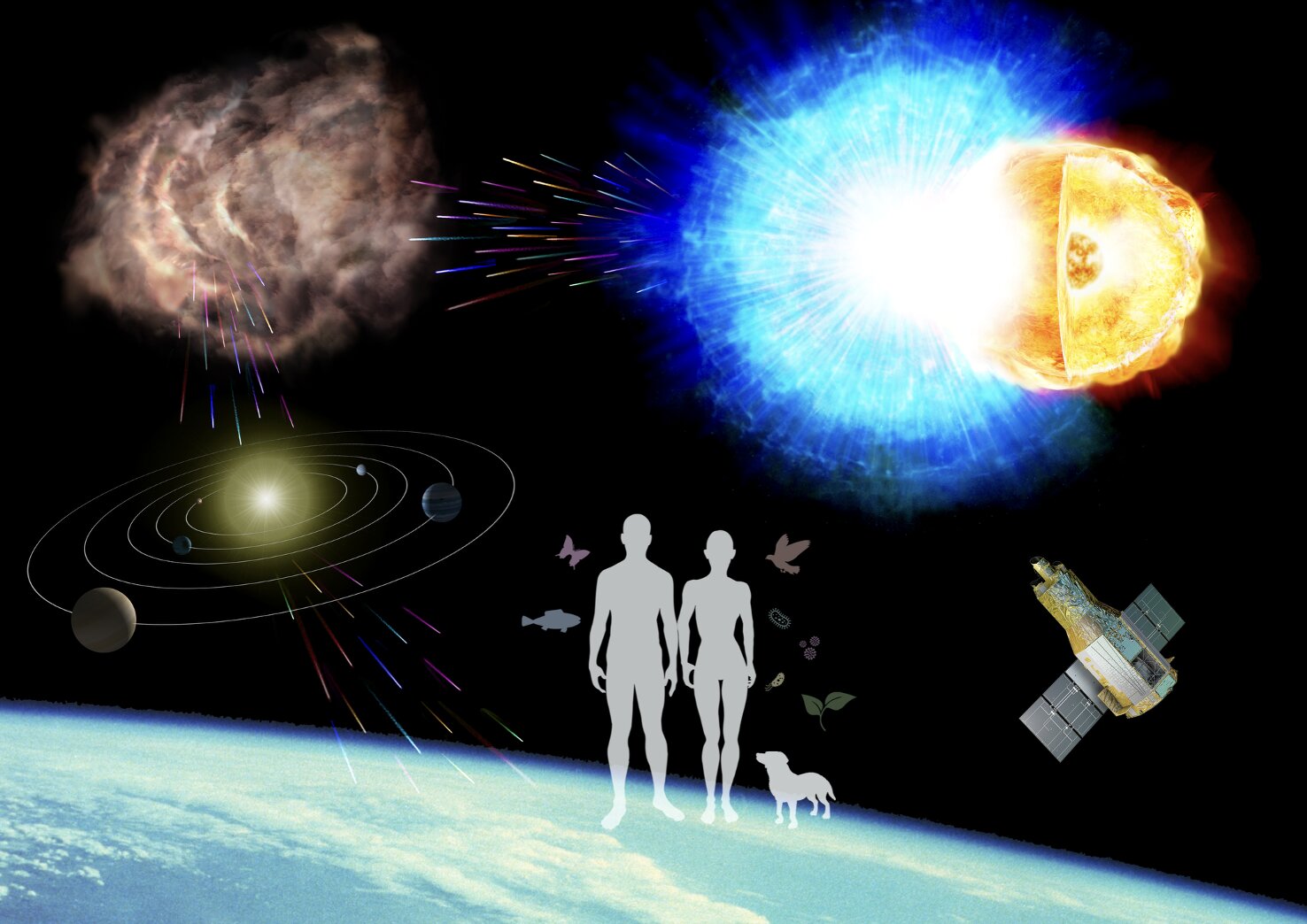
Their quest led them to the Cassiopeia A supernova remnant, a massive explosion in the Milky Way that has fascinated scientists for years. The team used an innovative tool to conduct their research—XRISM, a state-of-the-art X-ray satellite launched by JAXA in 2023. XRISM, which stands for X-ray Imaging and Spectroscopy Mission, offered unprecedented capabilities for studying the faint emissions of rare elements in supernova remnants.
“Using XRISM was like being given a new pair of eyes,” said Hiroyuki Uchida, one of the lead researchers. The high-resolution X-ray spectroscopic observations enabled the team to detect faint emission lines from elements never before seen in such detail.
The Groundbreaking Discovery
When the data started rolling in, the scientists were astounded. The X-ray spectrum from Cassiopeia A revealed something they had never anticipated: clear emission lines of both chlorine and potassium. What’s more, the abundance of these elements was far higher than current supernova models had predicted.
“This was a game-changer for us,” explained Toshiki Sato, another lead researcher on the project. “When we saw the Resolve data for the first time, we detected elements I never expected to see before the launch. Making such a discovery with a satellite we developed is a true joy as a researcher.”
This was the first direct observational evidence that a supernova could create enough chlorine and potassium to account for their observed presence in the universe. But how could this be? How did these elements end up in such a violent explosion, so far removed from the gentle conditions needed for life to form?
A New Theory Takes Shape
The team’s breakthrough observation led them to a startling new theory. They suggest that the key to understanding the production of chlorine and potassium lies in the internal mixing processes inside massive stars. These processes could be triggered by various factors, including the fast rotation of the star, interactions in binary systems, or even shell-merger events.
In these extreme environments, stars undergo powerful mixing, stirring their innermost regions and facilitating the creation of heavy elements like chlorine and potassium. The researchers believe that these processes can significantly enhance the production of these essential elements, even in the intense, inhospitable conditions inside a dying star.
“Making such a discovery was incredibly exciting because it opens up a whole new way of thinking about how elements are produced inside stars,” said Hiroyuki Uchida. “The harsh conditions of supernova explosions may not seem like the kind of place where life-giving elements could be created, but our findings suggest otherwise.”
A Glimpse into the Origins of Life
This research doesn’t just answer a long-standing question about the origins of chlorine and potassium—it also offers a deeper insight into how life, and the elements that sustain it, are connected to the stars.
“These elements, so vital for life, were produced in environments so intense and violent that they couldn’t be further from the peaceful conditions we associate with life on Earth,” said Kai Matsunaga, one of the study’s authors. “But despite their extreme origins, these very elements became part of the building blocks of life itself.”
This discovery highlights the profound relationship between the cosmos and life on Earth, reminding us that the materials we need to exist may have traveled vast distances, formed in the hearts of stars, and been scattered throughout the universe by the explosive force of supernovae. It’s a poetic notion: the very elements that allow life to flourish may have originated in the most destructive events in the universe.
Looking Toward the Future
The team’s discovery is only the beginning of a new chapter in the study of the universe. They plan to observe more supernova remnants with XRISM, with hopes of determining whether the enhanced production of chlorine and potassium is a common phenomenon in massive stars or unique to Cassiopeia A. These observations will offer crucial insights into whether the internal mixing processes the team identified are a universal feature of stellar evolution.
“How Earth and life came into existence is an eternal question that everyone has pondered at least once,” says Matsunaga. “Our study reveals only a small part of that vast story, but I feel truly honored to have contributed to it.”
Why This Discovery Matters
This research is important for several reasons. First, it provides the first direct observational evidence that supernovae are capable of producing significant amounts of chlorine and potassium, essential elements for life. This breakthrough challenges previous models of stellar nucleosynthesis and opens up new possibilities for understanding the chemical evolution of the universe.
Second, the study shines a light on the role of massive stars and their explosive deaths in the creation of the elements that we depend on. It serves as a reminder that life, in all its complexity, is linked to the most extreme processes in nature. Understanding these processes can help us answer profound questions about how life emerged on Earth—and how it might emerge elsewhere in the universe.
Finally, the study demonstrates the power of modern technology in advancing our understanding of the cosmos. XRISM’s high-resolution X-ray spectroscopy offers a new window into the heart of stars, revealing the secrets hidden deep within their fiery interiors. As scientists continue to harness the power of advanced tools like XRISM, they will undoubtedly uncover even more mysteries, expanding our understanding of the universe and our place within it.
In the end, the question of why we are here may not have a single, simple answer—but this groundbreaking research brings us one step closer to understanding the cosmic origins of the elements that make life possible. And in that, we find a deeper connection to the stars, and perhaps, to the story of our own existence.
More information: Chlorine and potassium enrichment in the Cassiopeia A supernova remnant, Nature Astronomy (2025). DOI: 10.1038/s41550-025-02714-4.