Violent changes in brightness, unusual spectral behavior, and the absence of detectable pulsations are giving astronomers a clearer picture of one of the most intriguing ultraluminous X-ray sources in the nearby Whale galaxy. By combining years of observations from multiple space telescopes, researchers have found strong evidence that X-4 is powered by super-Eddington accretion, bringing scientists closer to understanding the nature of the compact object at its core.
The universe’s brightest X-ray sources continue to challenge astronomers, and one mysterious object in a neighboring galaxy has now offered some of its strongest clues yet. By examining years of archival observations, researchers have uncovered dramatic long-term and short-term changes in the ultraluminous X-ray source known as X-4, revealing behavior consistent with one of the most extreme forms of matter falling onto a compact object.
The findings, published on June 22 as a preprint on arXiv, provide the first dedicated investigation of X-4’s spectral and timing properties using observations collected by Chandra, XMM-Newton, and Swift/XRT.
A Rare Target in a Galaxy Rich With Ultraluminous X-Ray Sources
X-4 resides in NGC 4631, also known as the Whale galaxy, located approximately 24.45 million light-years from Earth. The edge-on spiral galaxy is actively forming stars and has become an especially valuable target for astronomers because it hosts an unusually large population of ultraluminous X-ray sources, or ULXs.
These extraordinary objects emit more X-ray radiation than a million suns emit across all wavelengths, making them among the brightest non-nuclear X-ray sources in the universe. Although astronomers have studied many ULXs, their underlying nature remains uncertain.
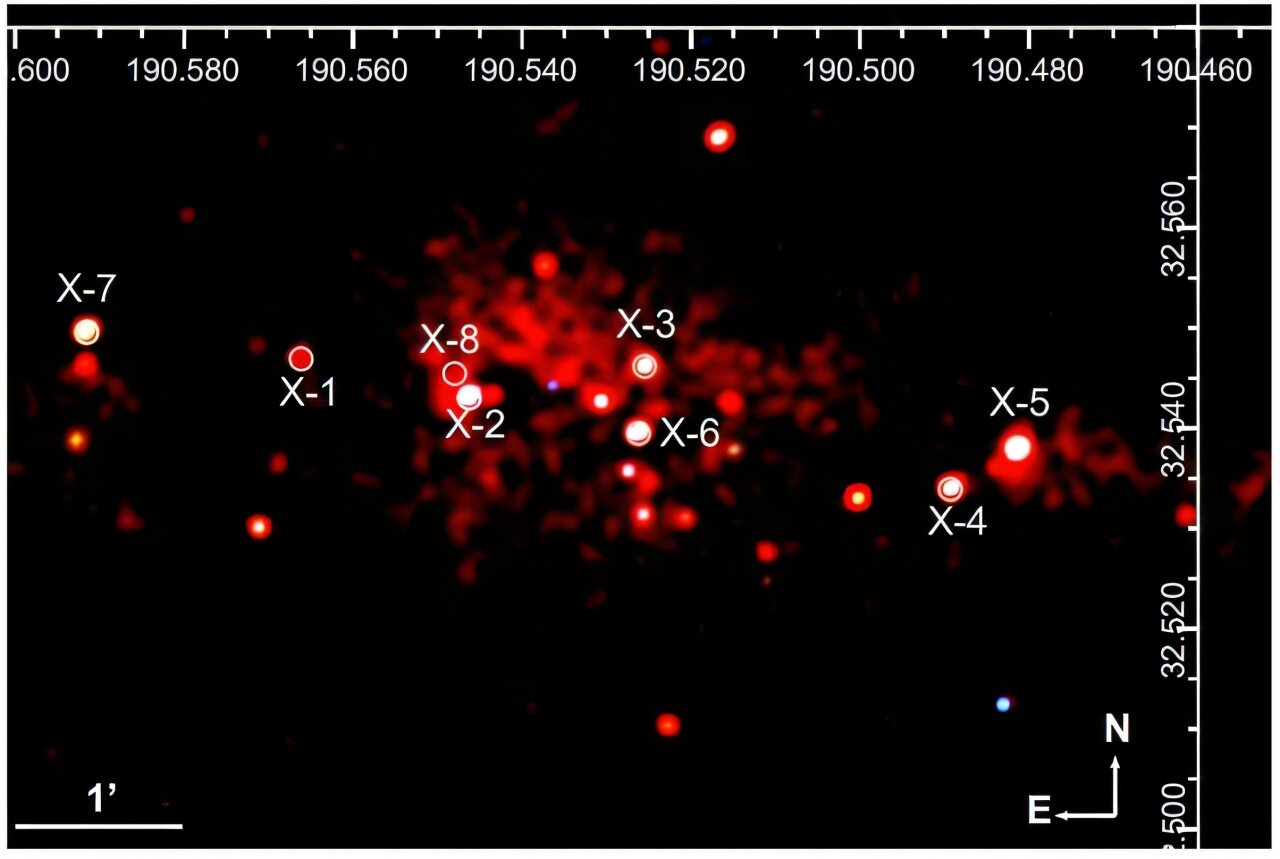
Eight ULXs have been identified in NGC 4631, labeled X-1 through X-8. The latest study focused exclusively on X-4, which already stood out because it is surrounded by a highly asymmetric bubble nebula believed to be powered by shocks created by jets or powerful outflows.
To investigate the source in greater detail, astronomers led by Sinan Allak of the Institute for Astronomy and Astrophysics in Tübingen, Germany, combined observations taken over multiple years and across several space observatories. This approach allowed them to examine changes occurring over timescales ranging from years down to just a few thousand seconds.
X-4 Changes Brightness by More Than Two Orders of Magnitude
One of the study’s most striking discoveries is just how dramatically X-4 changes over time.
The researchers found that its 0.3–10 keV X-ray luminosity varies by more than two orders of magnitude throughout the available observations. Such extreme fluctuations confirm earlier suggestions that X-4 is a transient source rather than one that shines at a relatively steady level.
The observations also revealed significant activity on much shorter timescales.
Data from Chandra showed several distinct peak-like structures lasting roughly 1,000 to 5,000 seconds, accompanied by irregular, non-periodic fluctuations. According to the researchers, this pattern is consistent with emission being influenced by a radiatively driven, optically thick wind.
These winds are thought to play a major role in shaping the radiation escaping from the system, affecting how the source appears to observers.
The Spectrum Does Not Behave Like a Standard Accretion Disk
The study also found that X-4’s spectrum behaves differently from what astronomers would expect if the object were powered by a conventional thin accretion disk.
Specifically, the relationship between luminosity and temperature, along with the source’s changing spectral hardness, does not follow the pattern predicted for a standard disk.
Instead, the researchers conclude that the observations are better explained by super-Eddington accretion flows. In this scenario, matter falls onto the compact object at extremely high rates, producing powerful radiation-driven winds. The way those winds are viewed from Earth can significantly alter the observed spectrum, making viewing geometry an important part of the explanation.
The combination of changing accretion rates and viewing angle appears to account for the unusual spectral evolution seen in X-4.
No Pulsations or Periodic Signals Were Found
Despite the extensive dataset, the researchers found no evidence for several features often searched for in compact objects.
The Chandra and XMM-Newton observations revealed no coherent pulsations, no quasi-periodic oscillations, and no statistically significant periodic signals.
While these non-detections do not identify the nature of the compact object, they provide important constraints that help narrow the range of possible explanations.
Evidence Points to a Stellar-Mass Compact Object
After combining the spectral and timing analyses, the researchers conclude that X-4 fits within the broader population of ULXs powered by super-Eddington accretion.
According to the study, the observed emission is controlled by both the accretion rate and the geometry from which the system is viewed.
The available evidence also suggests that the compact object responsible for the emission is likely a stellar-mass compact object, consistent with either a neutron star or a stellar-mass black hole acting as the accretor.
However, the current observations are not sufficient to distinguish between these two possibilities with confidence.
The researchers emphasize that deeper observations with improved signal-to-noise ratios will be essential for determining the true nature of the compact object and for exploring the structure of the extreme accretion flow in greater detail.
Why This Matters
Ultraluminous X-ray sources remain one of astronomy’s most intriguing classes of extreme objects because they push matter and radiation to extraordinary limits. Every well-studied system helps researchers test how compact objects behave under conditions that cannot be reproduced in laboratories.
The new analysis of X-4 significantly strengthens the case that its remarkable X-ray emission is powered by super-Eddington accretion rather than a standard accretion disk. By documenting its dramatic variability, unusual spectral evolution, and lack of detectable periodic signals, the study provides valuable constraints on the physical processes shaping these powerful systems. Future observations could finally reveal whether X-4 is powered by a neutron star or a stellar-mass black hole, bringing astronomers one step closer to solving the long-standing mystery of ultraluminous X-ray sources.