Hidden behind thick clouds of dust for decades, the starburst galaxy Messier 82 has come into sharper focus than ever before thanks to NASA’s James Webb Space Telescope. A 65-hour imaging survey uncovered approximately 16.5 million individual stars, a distorted galactic structure, and fresh clues that could help astronomers unravel how one of the local universe’s most unusual galaxies formed and evolved.
The universe often hides its most intriguing stories behind layers of dust, and Messier 82 has long been one of the best examples. Located about 12 million light-years from Earth, this edge-on spiral galaxy is experiencing an extraordinary burst of star formation that has transformed it into one of astronomy’s most valuable natural laboratories. Now, NASA’s James Webb Space Telescope has delivered its most detailed view yet, exposing features that had remained invisible to previous observatories.
The newly completed imaging survey offers astronomers an unprecedented look inside the galaxy, revealing millions of stars, an unexpectedly distorted disk, and dramatic outflows of gas and dust that are reshaping the galaxy itself.
Webb’s Deepest Look Yet Into a Starburst Galaxy
Messier 82, also known as the Cigar Galaxy, is undergoing an intense period of star formation believed to have been triggered by a galaxy merger. Although spectacular, this phase is expected to be temporary on cosmic timescales, lasting only a few hundred million years.
Its combination of rapid stellar birth and relative proximity makes M82 a uniquely valuable target for studying how galaxies grow and change.
To investigate the galaxy in greater detail, astronomers conducted a 65-hour observing campaign using Webb’s Near-Infrared Camera (NIRCam). The telescope’s infrared capabilities allowed it to penetrate the dense dust that has long obscured the galaxy’s interior, revealing structures and stellar populations that had never been seen before.
The observations uncovered the galaxy’s stretched disk structure while resolving millions of individual stars across its main plane, providing researchers with a much richer record of its history.
Millions of Stars Tell the Story of Galactic Evolution
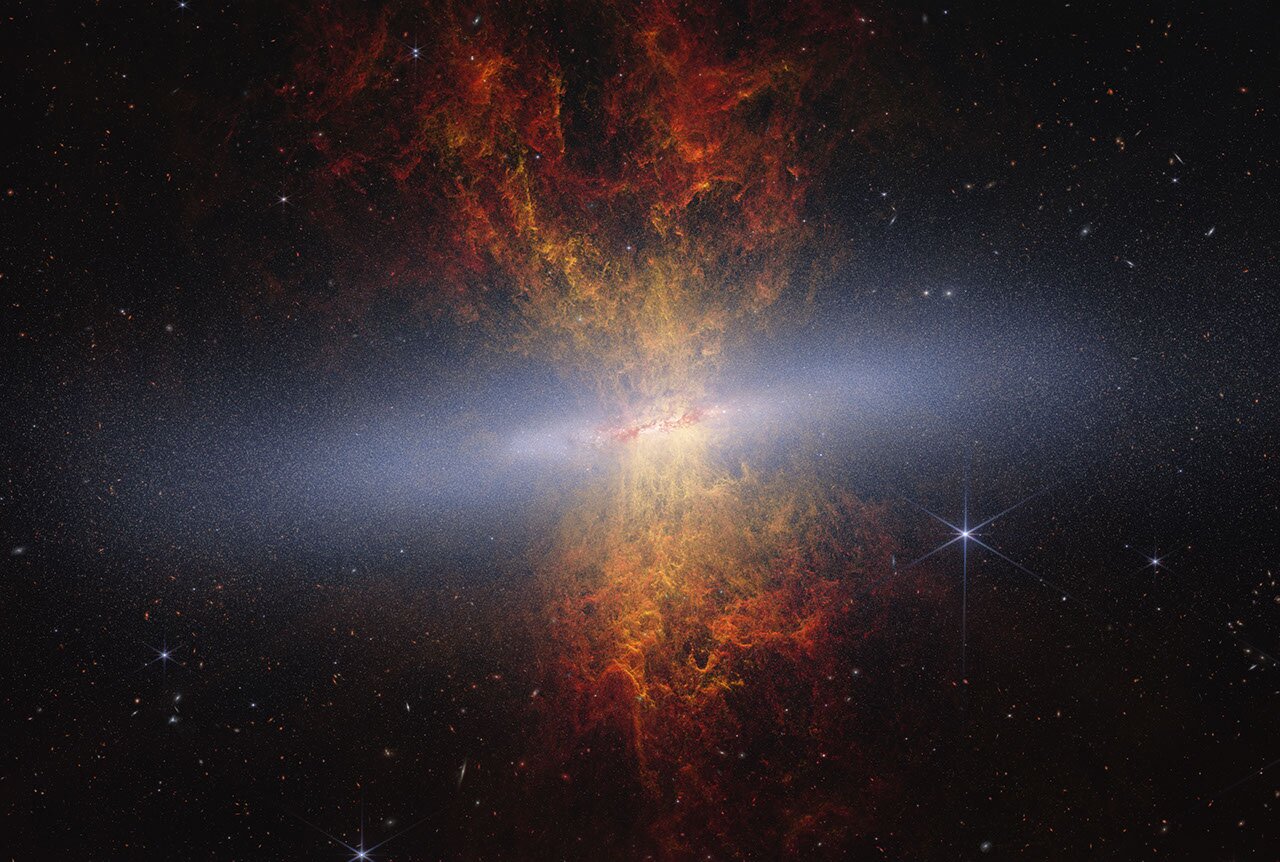
One of the survey’s most remarkable achievements is the detection of approximately 16.5 million individual stars throughout M82. These stars appear as bright blue points in Webb’s near-infrared image.
Researchers emphasize that this represents only a fraction of the galaxy’s total stellar population, as countless fainter stars remain beyond the telescope’s detection limit.
According to team member Benjamin Williams of the University of Washington, resolving such an enormous number of stars creates an entirely new opportunity to study the galaxy’s past.
Rather than simply producing a striking image, these stars collectively preserve what researchers describe as a detailed fossil record of how M82 formed and evolved over time. By examining their distribution and characteristics, astronomers can better reconstruct the galaxy’s history.
A Distorted Disk Reveals a Turbulent Past
Webb’s observations also uncovered important clues about the galaxy’s underlying structure.
Toward the center of M82, the galactic disk becomes noticeably brighter while displaying a distinctly asymmetrical shape. Researchers found that the two sides of the disk extend to different radii, suggesting the galaxy has become significantly distorted.
Such deformation is consistent with the effects of an intense galaxy merger, which is believed to have triggered the exceptional rate of star formation now taking place.
Principal investigator Adam Smercina explained that despite decades of study, many fundamental questions about M82 remain unanswered. Scientists still hope to determine what initiated such an unusually high rate of star formation and how long the galaxy has been ejecting enormous plumes of material from its center.
He described M82 as a uniquely valuable laboratory for galaxy evolution because it allows astronomers to investigate multiple physical processes simultaneously, including how stars form in extreme environments and how that activity drives powerful galactic outflows.
Infrared Vision Pierces Thick Cosmic Dust
Previous missions, including NASA’s Hubble Space Telescope and the retired Spitzer Space Telescope, had already studied M82 extensively. However, thick dust throughout the galaxy prevented those observatories from obtaining similarly detailed, high-resolution views of its interior.
The combination of Webb’s exceptional infrared sensitivity and the lengthy observing campaign enabled astronomers to look through those dusty regions with unprecedented clarity.
As a result, scientists can now examine the galaxy’s main disk in far greater detail, providing new information about both its past formation history and the physical processes still shaping it today.
Team member Eric Bell noted that although Webb’s ability to see through dust may initially make the galaxy’s disk appear less visually dramatic, the observations actually reveal an extraordinarily complex system whose hidden structure raises new scientific questions.
Powerful Stellar Birth Is Reshaping the Galaxy
Star formation inside M82 is occurring at a rate 10 times faster than that of the Milky Way, creating an environment unlike most nearby galaxies.
This intense activity is also driving enormous bipolar plumes of material above and below the galactic disk. Rather than appearing chaotic, Webb’s observations show that these hourglass-shaped outflows possess a layered structure.
The material closest to the disk appears as yellow tendrils representing ionized gas. Farther from the disk, orange regions trace tiny dust particles known as polycyclic aromatic hydrocarbons.
These dust grains help astronomers trace material moving through the interstellar medium, providing valuable insight into how energetic star formation influences the surrounding galaxy.
Eventually, researchers expect this extraordinary period of stellar production to disrupt further star formation, bringing the current starburst phase to an end.
Combining Space Missions to Solve Remaining Mysteries
Although Webb has dramatically expanded scientists’ view of M82, researchers emphasize that the new observations represent only one part of a much larger investigation.
The newly collected data will be combined with observations from other telescopes to reconstruct the galaxy’s formation history more completely.
Team member Kristen McQuinn explained that galaxies function as highly intricate ecosystems, making it impossible for a single mission to answer every scientific question. By combining observations from Webb with data collected by Hubble and other telescopes, astronomers can probe deeper into the galaxy’s evolution while asking increasingly sophisticated questions about how systems like M82 develop over time.
Why This Matters
Messier 82 represents a rare opportunity to observe multiple stages of galaxy evolution within a single nearby system. Webb’s ability to penetrate dense cosmic dust has transformed what scientists can learn from this remarkable galaxy, revealing 16.5 million resolved stars, a distorted galactic structure, and layered outflows produced by intense star formation. As researchers combine these observations with data from other missions, M82 will continue serving as one of the most important laboratories for understanding how galaxies form, evolve, and respond to periods of extraordinary stellar activity.