Scientists have successfully demonstrated that the European Space Agency’s upcoming Rosalind Franklin rover can distinguish subtle molecular signatures in two highly durable organic compounds that may help identify traces of ancient life on Mars. The tests also uncovered an unexpected mystery inside a famous meteorite, raising new questions about how organic contamination spreads through space and Earth’s atmosphere.
Could signs of ancient Martian life be hiding in molecules that have survived for billions of years?
That question sits at the heart of a new study that puts one of Mars exploration’s most important life-detection tools through a demanding test. Researchers found that the instrument aboard the European Space Agency’s Rosalind Franklin rover can successfully separate and analyze two promising organic molecules—an achievement that could prove crucial when the rover begins exploring Mars in 2030.
The findings, published in Earth and Planetary Science Letters, offer encouragement for future missions searching for evidence that life may once have existed on the Red Planet.
Searching for Traces of a More Hospitable Mars
Billions of years ago, Mars was a very different world. Scientists believe the planet was warmer, wetter, and surrounded by a much denser atmosphere than it has today.
Whether simple microorganisms ever emerged under those conditions remains unknown.
NASA rovers have already detected organic molecules in Martian rocks. However, none of those discoveries has provided clear evidence that life was responsible for producing them. Organic compounds can form through both biological and nonbiological processes, making it difficult to determine their true origin.
To address this challenge, researchers are focusing on specific molecules that could serve as reliable indicators of past life.
Why Pristane and Phytane Matter
The new study concentrated on pristane (C19H40) and phytane (C20H42), two hydrocarbon molecules derived from living organisms and commonly found in petroleum on Earth.
Scientists consider these compounds particularly promising because they are highly stable. That durability means they may be capable of surviving for immense periods of time, even under harsh planetary conditions.
Lead author Guillaume Leseigneur of the Max Planck Institute for Solar System Research explained that if life once existed on Mars, molecules such as pristane and phytane could represent important molecular biosignatures that have persisted until today.
Yet stability alone is not what makes these molecules valuable.
The Importance of Molecular Handedness
Pristane and phytane possess a property known as chirality.
Chiral molecules can exist in two mirrored forms called enantiomers. These forms contain the same atoms but arranged in slightly different three-dimensional configurations, similar to the relationship between left and right hands.
According to the researchers, chirality may be one of the most powerful tools available for detecting signs of past extraterrestrial life.
Living organisms tend to produce chiral molecules in overwhelmingly one mirror configuration. This pattern results from the self-replicating nature of life. In contrast, molecules formed through nonliving processes are generally expected to occur in roughly equal amounts of both mirror forms.
That distinction could provide an important clue when examining Martian samples.
Testing the Rover’s Life-Detection Instrument
The work focused on the Mars Organic Molecule Analyzer (MOMA), one of the key scientific instruments aboard the Rosalind Franklin rover.
MOMA combines a gas chromatograph, mass spectrometer, laser system, and miniature furnaces. After rock samples are heated, the instrument analyzes gases released from the material. Special coated capillary tubes then separate molecules based on how they interact with the coating surfaces.
Because different chiral forms move through these tubes at different rates, scientists can distinguish between them.
Using replicas of MOMA’s capillary tubes, the research team successfully achieved chiral separation of pristane and phytane for the first time.
This accomplishment was particularly significant because both molecules are extremely unreactive and difficult to analyze.
Researchers say the results demonstrate that MOMA possesses the sensitivity and measurement precision needed to detect these challenging compounds.
Meteorite Samples Produced an Unexpected Surprise
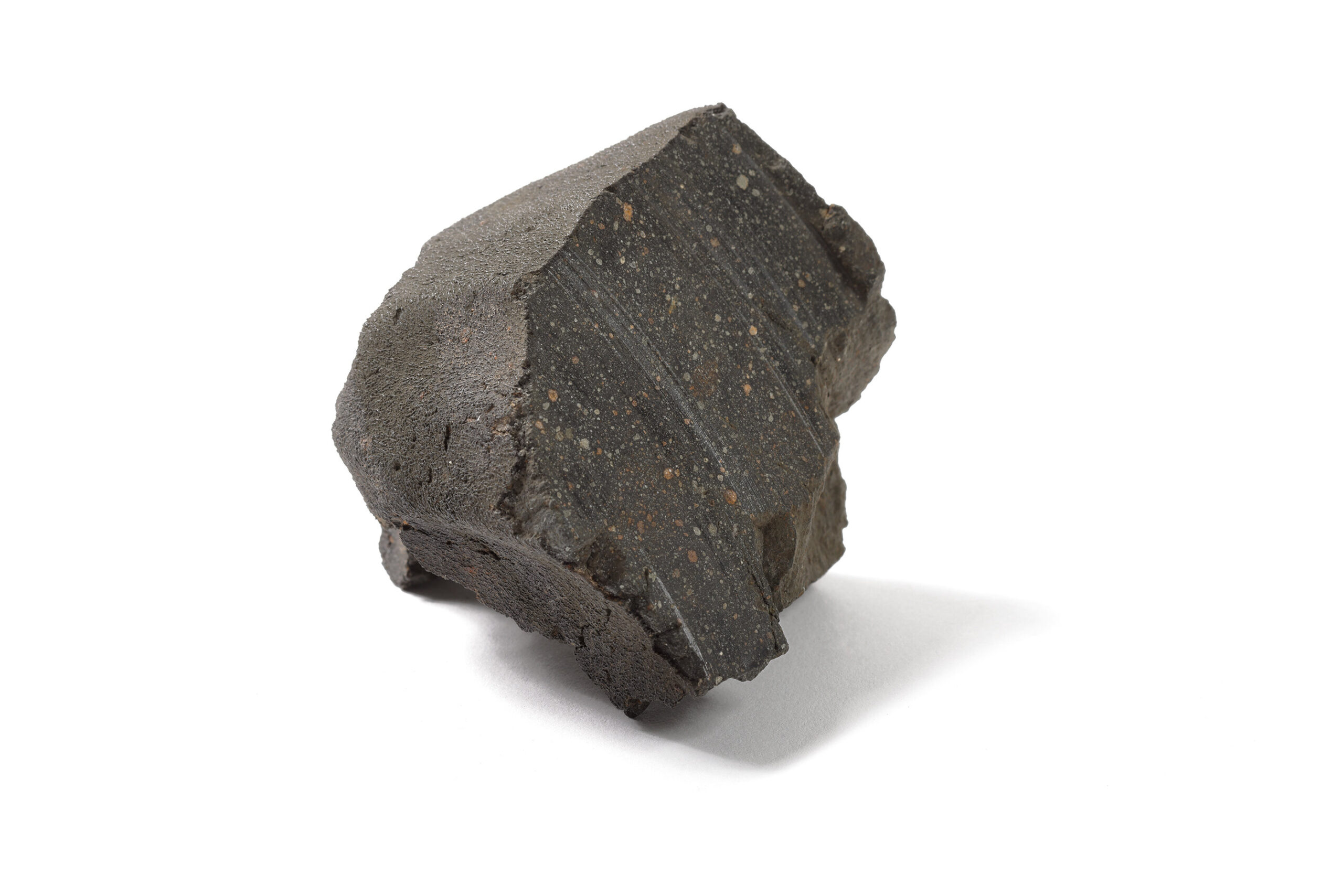
To simulate Martian material, scientists analyzed samples from the Murchison meteorite, a space rock that fell in Australia in 1969.
The meteorite contains a wide variety of organic molecules. Some originated in space, while others likely entered the meteorite through contamination after it arrived on Earth.
Researchers initially suspected that any pristane and phytane present would belong to the contamination category.
What they found, however, was unexpected.
Instead of showing a biological signature dominated by one mirror form, the meteorite contained all chiral variants of pristane and phytane in equal proportions.
That pattern did not resemble contamination from ordinary biological material.
A Possible Link to Fossil Fuel Emissions
To explain the puzzling results, the team compared the meteorite measurements with analyses of oil shales, sedimentary rocks that contain petroleum precursors.
The comparison suggested a possible explanation.
Over millions of years, petroleum forms deep underground under intense heat and pressure. Under those conditions, the original imbalance between chiral forms disappears, leaving equal proportions of each mirror variant.
Researchers concluded that the meteorite may have acquired contamination from atmospheric aerosols generated by fossil fuel combustion during its descent through Earth’s atmosphere.
If correct, that scenario would explain why the meteorite contained equal amounts of all chiral forms rather than displaying the imbalance typically associated with biological material.
More Than a Mars Mission Rehearsal
The scientists view the experiment as much more than a technical validation of MOMA.
On one level, it demonstrates that Rosalind Franklin’s life-detection instrument is capable of performing the highly sensitive measurements needed for future Martian investigations.
On another level, it highlights unanswered questions about the origins of organic molecules found in meteorites and the extent to which petroleum-derived contaminants may be accumulating in Earth’s atmosphere.
Those questions emerged unexpectedly from a study originally designed to prepare for Mars exploration.
Why This Matters
The search for ancient life on Mars depends on more than simply finding organic molecules. Scientists must determine whether those molecules were produced by living organisms or by ordinary chemistry.
This study shows that the Rosalind Franklin rover’s Mars Organic Molecule Analyzer can distinguish subtle chiral signatures in two durable candidate biosignatures, pristane and phytane. That capability could become a powerful tool when the rover begins examining Martian rocks.
At the same time, the surprising meteorite results remind researchers that organic molecules can have complicated histories. Understanding contamination, molecular origins, and chirality will be essential if scientists are ever to confidently answer one of humanity’s biggest questions: Did life once exist on Mars?