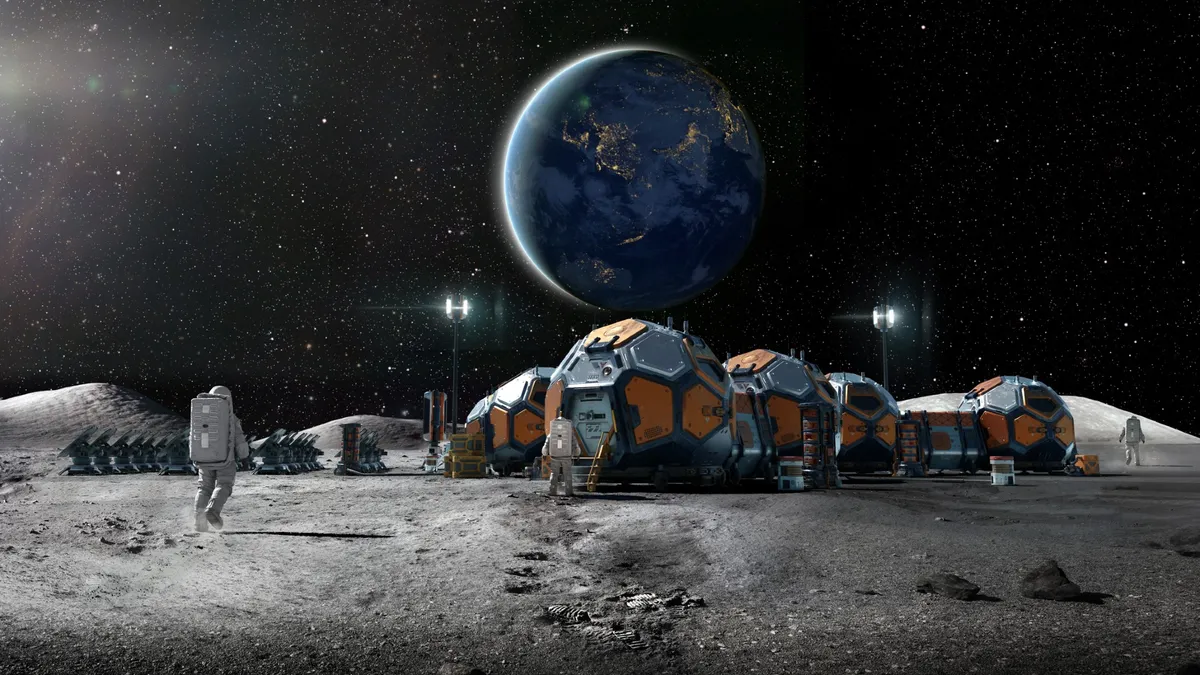
Growing plans to bring material back from the Moon, Mars, and beyond have prompted scientists to propose an unprecedented safeguard: a secure biocontainment facility on the Moon. The concept would require all extraterrestrial samples to be quarantined and studied off Earth first, creating a protective barrier against any potentially hazardous organisms that might accompany future space missions.
What if humanity’s greatest search for life beyond Earth carried risks that no facility on our planet could fully contain?
That question is at the center of a new policy paper arguing that future samples returned from space should never come directly to Earth. Instead, researchers propose building a specialized biocontainment and research facility on the Moon, where extraterrestrial materials could be isolated, analyzed, and monitored before any decision is made to transport them closer to Earth’s biosphere.
The proposal comes as space exploration accelerates and missions aimed at collecting samples from other worlds become increasingly ambitious.
Scientists Call for a Lunar “Firewall” Against Biological Risks
The paper, published in Ambio, was authored by Frederick I. Moxley, Director of Strategic Threat Analysis and Research Laboratories, and Anthony Ricciardi, a biologist and Director of McGill University’s Bieler School of Environment.
According to the authors, current planetary protection strategies have not evolved quickly enough to match the risks associated with future sample-return missions.
Moxley argues that humanity is entering a new phase of exploration in which materials from distant environments may eventually be transported back for scientific study. To address the uncertainties involved, the researchers propose a lunar facility that would function as a biological barrier between Earth and any unknown organisms that could potentially accompany extraterrestrial samples.
Under their proposal, the facility would serve as a quarantine checkpoint, preventing direct transfer of collected materials from space to Earth.
All Samples Would Stop at the Moon First
The researchers recommend that extraterrestrial materials gathered from the Moon, Mars, or even more distant destinations should first be delivered to a secure lunar-based quarantine and research center.
There, samples would undergo examination and containment procedures before any consideration of transport to Earth.
A key aspect of the proposal is the use of advanced robotic systems to handle incoming materials. By relying on robotic operations rather than direct human interaction, the facility would reduce the chances of accidental exposure or unintended release of potentially hazardous biological contaminants.
The authors argue that minimizing human contact would be a critical component of any long-term planetary protection strategy.
Lessons From Earth’s Invasive Species
Although no extraterrestrial life has been confirmed, the researchers emphasize that uncertainty itself is a reason for caution.
Ricciardi points to decades of research on invasive species as an important lesson. Throughout Earth’s history, organisms introduced into unfamiliar environments have sometimes spread rapidly, producing ecological effects that were difficult or impossible to reverse.
The authors contend that an organism originating beyond Earth would represent an entirely novel biological introduction. Because its characteristics and interactions with Earth’s ecosystems would be unknown, predicting the consequences would be extremely difficult.
For that reason, they advocate a strong precautionary approach when dealing with materials collected from other worlds.
Growing Space Activity Raises New Concerns
The proposal arrives during a period of expanding activity in space.
Government space agencies and private aerospace companies are pursuing increasingly complex missions beyond Earth’s orbit. As international and commercial competition intensifies, the researchers argue that biosafety considerations deserve greater attention.
The paper highlights several potential worst-case scenarios. These include spacecraft malfunctions, crashes involving contaminated materials, or astronauts who may have been exposed to extraterrestrial environments during missions.
According to the authors, such possibilities make rigorous containment measures more important as exploration efforts continue to grow.
Why Earth-Based Facilities May Not Be Enough
One of the paper’s central arguments is that no existing facility on Earth can guarantee absolute containment, eradication, or control of an unknown alien microorganism in the event of an accident.
Because scientists cannot fully predict the properties of a hypothetical extraterrestrial organism, designing fail-safe containment systems on Earth presents significant challenges.
The Moon, the authors argue, offers a unique advantage. By keeping potentially hazardous materials off Earth altogether during the initial stages of examination, any risk of contamination to Earth’s biosphere could be substantially reduced.
In this framework, the lunar facility would act as a protective buffer zone, allowing scientific research to continue while maintaining a physical separation from Earth’s environment.
The Moon as Humanity’s First Biological Defense Line
The researchers stress that the search for life beyond Earth remains one of the most important scientific pursuits of the modern era. Discovering evidence of life elsewhere in the universe would be a landmark achievement with profound implications for science and humanity.
At the same time, they argue that preparation for even low-probability biological risks should begin before large-scale sample-return missions become routine.
Their conclusion is straightforward: if humanity plans to bring materials back from distant worlds, it should first create a secure system capable of managing the unknowns that may accompany them.
In their view, the Moon could become far more than a destination for exploration. It could serve as humanity’s first biological safeguard.
Why This Matters
As plans for returning samples from the Moon, Mars, and other destinations advance, questions about planetary protection are becoming increasingly important. The proposed lunar biocontainment facility represents a shift from reacting to potential threats after they arrive on Earth to preventing exposure in the first place.
Whether extraterrestrial life exists remains unknown. But the authors argue that the consequences of introducing an unfamiliar organism into Earth’s ecosystems could be impossible to predict. By establishing a quarantine and research station on the Moon, humanity could continue pursuing one of science’s greatest goals while reducing the risks associated with bringing pieces of other worlds back home.