For decades, a distant star in the constellation Monoceros lived a quiet, predictable life. Sitting roughly 3,200 light-years from Earth and shining at about twice the size of our sun, it showed no sign that it would one day become the center of an astronomical mystery. It glowed steadily, faithfully, as stars often do.
Then, at the end of 2024, something extraordinary happened.
The star, known as ASASSN-24fw, began to fade.
At first, the change was subtle, almost hesitant. But what followed left astronomers stunned. The star dimmed by an astonishing 97%, as though someone had pulled a cosmic curtain across its face. And unlike typical stellar eclipses that last days or weeks, this darkness lingered for nearly 200 days—more than nine months of deep, persistent shadow.
Events like this are rare. Events this long are almost unheard of.
Confusion spread through the research community. What could possibly block so much starlight for so long?
A Cosmic Eclipse Unlike Any Other
Most eclipses in distant star systems follow a rhythm. A companion body—perhaps a planet or another star—passes in front, briefly dimming the light before moving on. These cosmic crossings are fleeting.
But this was different.
This dimming didn’t simply happen and end. It unfolded gradually. The star’s light ebbed slowly, as if something vast and layered were drifting across it.
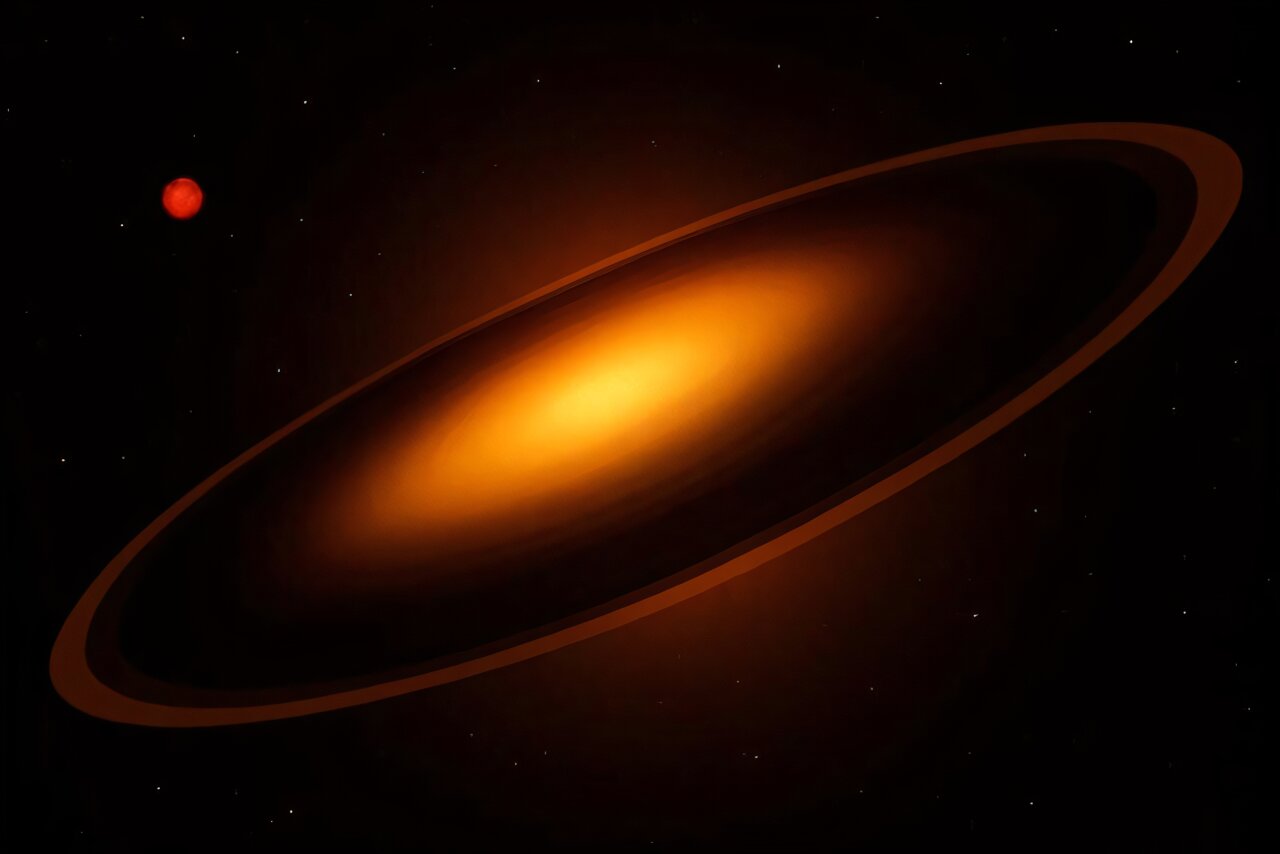
In a new study published in Monthly Notices of the Royal Astronomical Society, an international team of researchers offered what may finally be an answer. According to their models, the most likely culprit is a brown dwarf surrounded by an enormous, dense ring system.
Dr. Sarang Shah, a post-doctoral researcher at the Inter-University Centre for Astronomy and Astrophysics (IUCAA) in Pune, India, explained that various simulations point toward this explanation. The object, heavier than a planet but lighter than a true star, appears to be orbiting at a considerable distance, carrying with it a vast system of rings.
The rings, researchers believe, are not small decorative halos. They may stretch out to 0.17 astronomical units, roughly half the distance between our sun and Mercury. To grasp that scale is to realize just how monumental this structure would be. It is a saucer-like formation on a planetary scale.
And when such a giant ring system drifts into perfect alignment with its host star, something remarkable happens.
The Perfect Line-Up in Deep Space
Long-lasting dimming events like this require an almost miraculous geometry. Dr. Shah described them as “exceptionally uncommon,” because they depend on nearly perfect alignment between Earth, the star, and the orbiting object.
The gradual nature of the dimming provides an important clue. The outer regions of the rings appear to be thin, allowing light to filter through gently at first. Only when the denser inner regions crossed the star’s face did the dramatic darkening become obvious.
This layered structure explains why the star’s light faded slowly before plunging into near-darkness.
But what exactly is this mysterious companion?
A Brown Dwarf—or Something Even Bigger?
A brown dwarf occupies a strange middle ground in the universe. It is too massive to be considered a planet, yet too small to sustain the nuclear fusion that powers true stars. It exists in a kind of cosmic in-between state, glowing faintly but never fully igniting.
The team’s analysis suggests the companion object has a mass of more than three times that of Jupiter. That places it comfortably above the mass of typical gas giants.
There is another possibility. The object could be what astronomers call a super-Jupiter—a massive gas giant exoplanet that exceeds Jupiter’s mass and bridges the gap between planets and brown dwarfs.
Both explanations fit the available data. Both could host enormous ring systems. And both would represent structures far more dramatic than anything in our own solar system.
Clues Hidden in Starlight
To unravel the mystery, researchers turned to detailed photometric and spectroscopic studies of the event. By analyzing changes in brightness and examining the star’s light spectrum, they could piece together hints about the size and mass of whatever passed in front.
These measurements revealed more surprises.
ASASSN-24fw appears to have a circumstellar environment very close to it—possibly debris left over from past or ongoing planetary collisions. That detail is unusual because the star is likely more than 1 billion years old, an age at which such nearby debris is not typically expected.
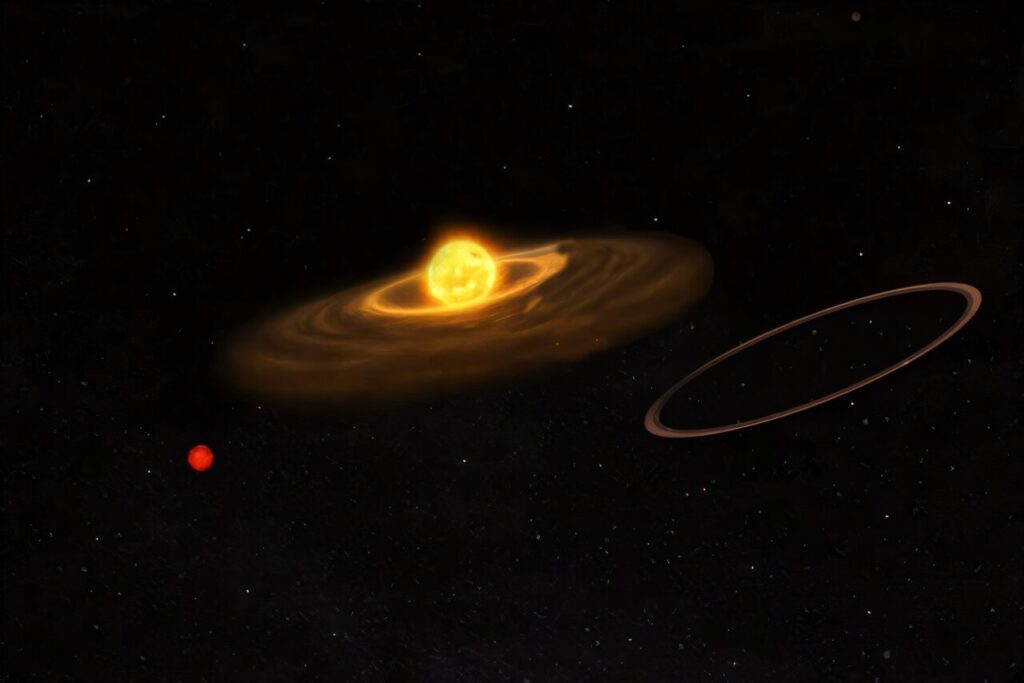
As researchers studied the dimming, they made an additional, serendipitous discovery. The system also contains a nearby red dwarf star.
Dr. Jonathan Marshall, affiliated with Academia Sinica in Taiwan, emphasized how difficult it is to observe large ring systems directly. Massive rings are expected around substantial objects, but catching them in action—especially in such exquisite detail—is extraordinarily rare.
This event, he explained, allows scientists to study a complex planetary-scale system in remarkable depth.
A Glimpse Into Planetary Architecture
Ring systems are more than decorative features. They are clues to formation and evolution.
By observing how this enormous ring structure behaves, astronomers gain insight into how planetary systems develop around other stars. The scale of the rings suggests processes that can create and sustain massive, extended structures far beyond what we see around Saturn.
The dimming event becomes more than an astronomical curiosity. It becomes a laboratory.
Each subtle change in brightness carries information. Each spectral signature hints at composition. Together, they help build a portrait of a distant, intricate system shaped by forces we are only beginning to understand.
Waiting for the Next Shadow
The story is far from over.
Researchers now plan to measure the star’s temperature, chemical composition, age, and evolutionary status. They hope to gather more detailed observations using the European Southern Observatory’s Very Large Telescope in Chile and the James Webb Space Telescope.
And perhaps most intriguingly, they expect the star to dim again in about 42 or 43 years.
That prediction transforms this mystery into a long-term investigation. When the next dimming arrives, astronomers will be ready, armed with more advanced tools and sharper questions.
The universe, it seems, has scheduled a sequel.
Why This Research Matters
At first glance, this may sound like a distant drama unfolding thousands of light-years away. But the implications reach far beyond a single star.
This event offers a rare opportunity to observe an immense ring system around a massive companion object. Such systems are notoriously difficult to detect directly. Here, nature aligned them perfectly, allowing astronomers to watch the rings carve their shadow across a star.
By studying ASASSN-24fw, scientists gain a clearer understanding of how brown dwarfs, super-Jupiters, and their rings form and evolve. They also gather clues about the architecture of planetary systems beyond our own.
The discovery of a nearby red dwarf star and the unusual circumstellar environment further deepen the system’s complexity, hinting that planetary formation and interaction can continue long after a star’s early years.
In a universe filled with steady lights, it is often the sudden darkness that teaches us the most.
ASASSN-24fw’s nine-month fade reminds us that even stars that seem calm and predictable can harbor dramatic secrets. And sometimes, when the alignment is just right, those secrets briefly pass between us and the light—revealing, in shadow, the vast and intricate structures that shape distant worlds.
Study Details
The nature of ASASSN-24fw’s occultation: modelling the event as dimming by optically thick rings around a sub-stellar companion, Monthly Notices of the Royal Astronomical Society (2026). DOI: DOI: 10.1093/mnras/staf2251. academic.oup.com/mnras/article … .1093/mnras/staf2251