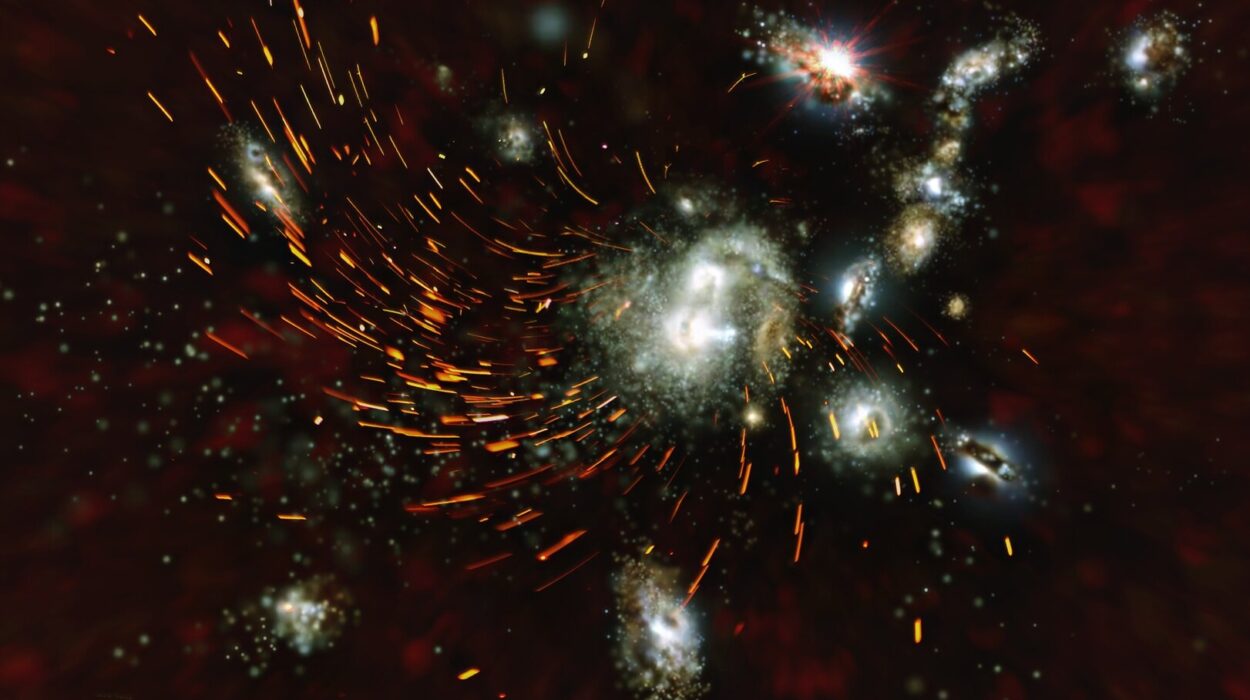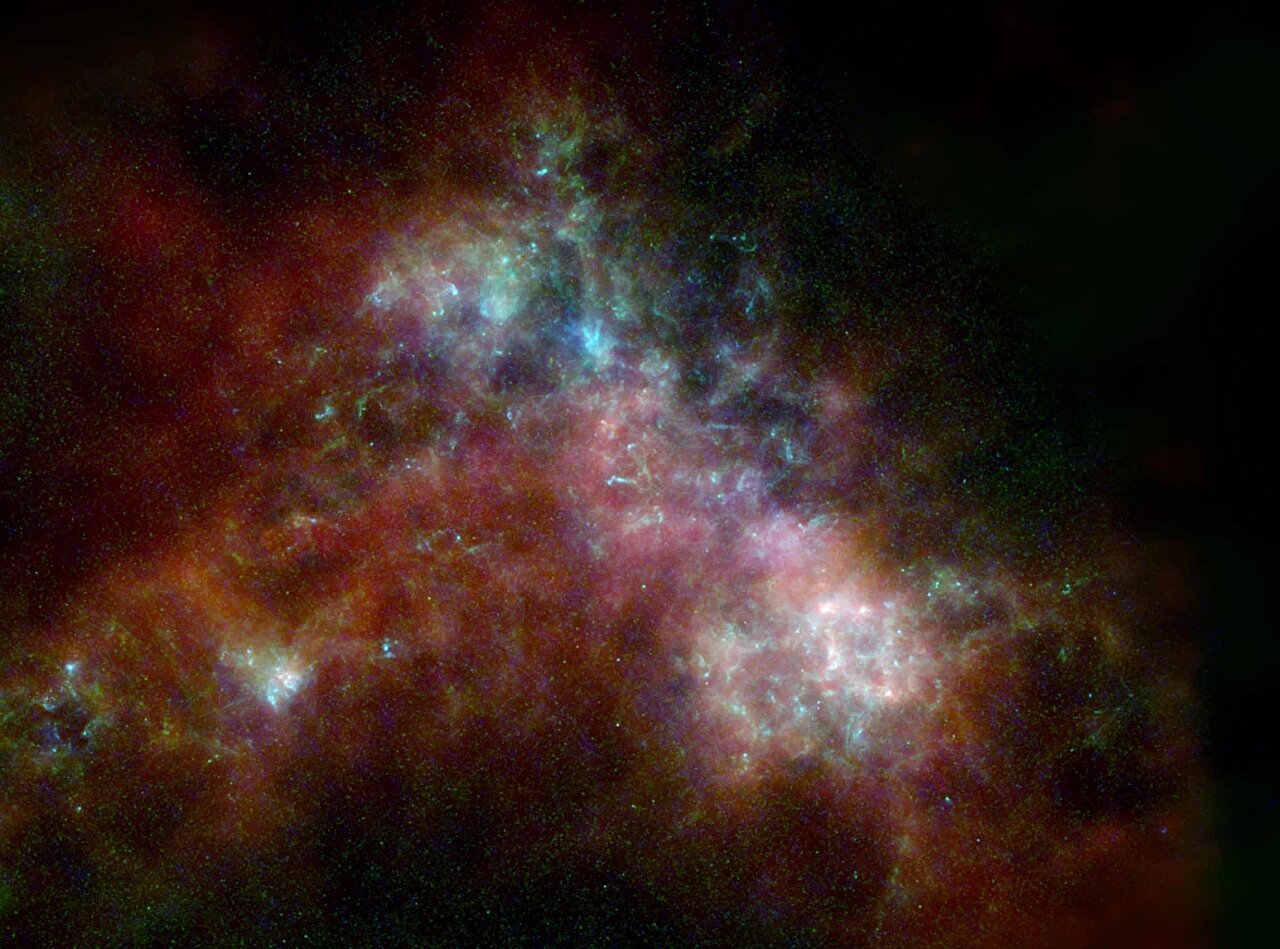
In the vast, velvet expanse of the southern sky, two ghostly patches of light have long captivated the human imagination. Known as the Magellanic Clouds, these nearby neighbors are not just static ornaments of the night; they are the protagonists of a cosmic drama hundreds of millions of years in the making. For decades, astronomers viewed the smaller of the two, the Small Magellanic Cloud (SMC), as a serene, gas-rich laboratory—a perfect “normal” specimen to help us understand how galaxies were born in the early universe. But new evidence suggests we have been watching a survivor of a catastrophic hit-and-run.
The Mystery of the Stationary Stars
The Small Magellanic Cloud is a literal heavyweight of gas, bound to our own Milky Way by the invisible tether of gravity. Because it is so rich in raw materials, it has been one of the most meticulously catalogued objects in the heavens. For over half a century, scientists have mapped its stellar populations, tracked its drift, and measured its chemical makeup. Yet, a fundamental riddle remained: the galaxy’s stars refused to behave.
In most galaxies, stars follow a predictable choreography, orbiting a central hub much like planets circle a sun. This rotation is the natural result of gas cooling, contracting, and spinning into a disk. However, when researchers at the University of Arizona used high-precision data from the Hubble Space Telescope and the European Space Agency’s Gaia satellite, they found a scene of total chaos. The stars of the SMC were not orbiting at all; they were moving in random, disordered directions, as if the galaxy’s internal clockwork had been smashed to pieces.
A High-Speed Collision in the Dark
The explanation for this celestial disorder, according to a study published in The Astrophysical Journal, is a direct, violent impact. A few hundred million years ago—a mere blink in cosmic time—the Small Magellanic Cloud did not just pass by its larger sibling, the Large Magellanic Cloud (LMC). It punched directly through it.
As the SMC careened through the LMC’s dense disk, the gravitational wake of the larger galaxy acted like a giant blender, disrupting the SMC’s internal structure and scattering its stars into the erratic patterns we see today. But the stars weren’t the only things affected. The LMC is filled with its own gas, and as the SMC moved through that environment, it experienced a phenomenon similar to “ram pressure.”
Lead author Himansh Rathore describes it through a relatable earthly image: imagine holding water droplets on your hand and thrusting it through the air. The rushing wind would blow the droplets away. In the same way, the LMC’s gas applied such tremendous pressure to the SMC that it effectively “blew off” the smaller galaxy’s ability to rotate its own gas. The collision stripped the SMC of its equilibrium, leaving it a galaxy in flux.
The Illusion of the Spinning Disk
This discovery finally untangles a “decades-old puzzle” regarding the galaxy’s appearance. For years, telescope observations seemed to show that the gas within the SMC was rotating. This created a massive logical knot for astronomers: if the gas was spinning, the stars born from that gas should have inherited that motion. Since the stars were clearly not spinning, the data didn’t make sense.
The research team, including senior author Gurtina Besla, discovered that the perceived rotation was actually a cosmic trick of the light. The collision is physically stretching the SMC, pulling it apart like taffy. From our specific viewing angle on Earth, gas moving toward us and away from us along that stretch creates the optical illusion of rotation. In reality, the galaxy is not spinning; it is being distorted and reshaped in “live action.”
To prove this, the team utilized complex computer simulations tailored to the specific masses and gas contents of both galaxies. By pairing these simulations with theoretical calculations of the pressure exerted during the crash, they developed new methods to read “scrambled” star motions. These tools allow scientists to finally see past the distortion and understand the true, post-collision state of the SMC.
Shattering the Cosmic Yardstick
The revelation that the Small Magellanic Cloud is a victim of a “catastrophic crash” has sent ripples through the field of cosmology. Because the SMC is small and lacks heavy elements, it has long been used as a standard yardstick. Astronomers looked at it to understand the “normal” behavior of primitive galaxies that existed billions of years ago.
However, if the SMC is currently reeling from a transformative trauma, it may no longer be a reliable reference point. It isn’t a “normal” galaxy at all; it is a system injected with massive amounts of external energy, making it an outlier rather than a benchmark. This forces scientists to reconsider how they interpret data from the distant, early universe when using the SMC as a comparison.
Why This Galactic Transformation Matters
While the collision may have ruined the SMC’s reputation as a “normal” galaxy, it has opened a new door to understanding the most mysterious substance in the universe: dark matter.
The impact left a permanent scar on the Large Magellanic Cloud as well, tilting the bar-shaped structure at its center out of the galaxy’s main plane. In a related 2025 study, the team found that the specific degree of this tilt is directly tied to the amount of dark matter contained within the SMC. Since dark matter cannot be seen—only felt through its gravitational effects—this collision provides a rare, physical tool to measure it.
Ultimately, this research reminds us that the universe is not a static snapshot. It is a place of movement and transformation where even the closest neighbors can collide and change one another’s destiny. By watching the SMC transform in real-time, we gain a front-row seat to the violent, beautiful processes that have shaped every galaxy in the cosmos, including our own.
Study Details
Himansh Rathore et al, A Galactic Transformation—Understanding the SMC’s Structural and Kinematic Disequilibrium, The Astrophysical Journal (2026). DOI: 10.3847/1538-4357/ae4507