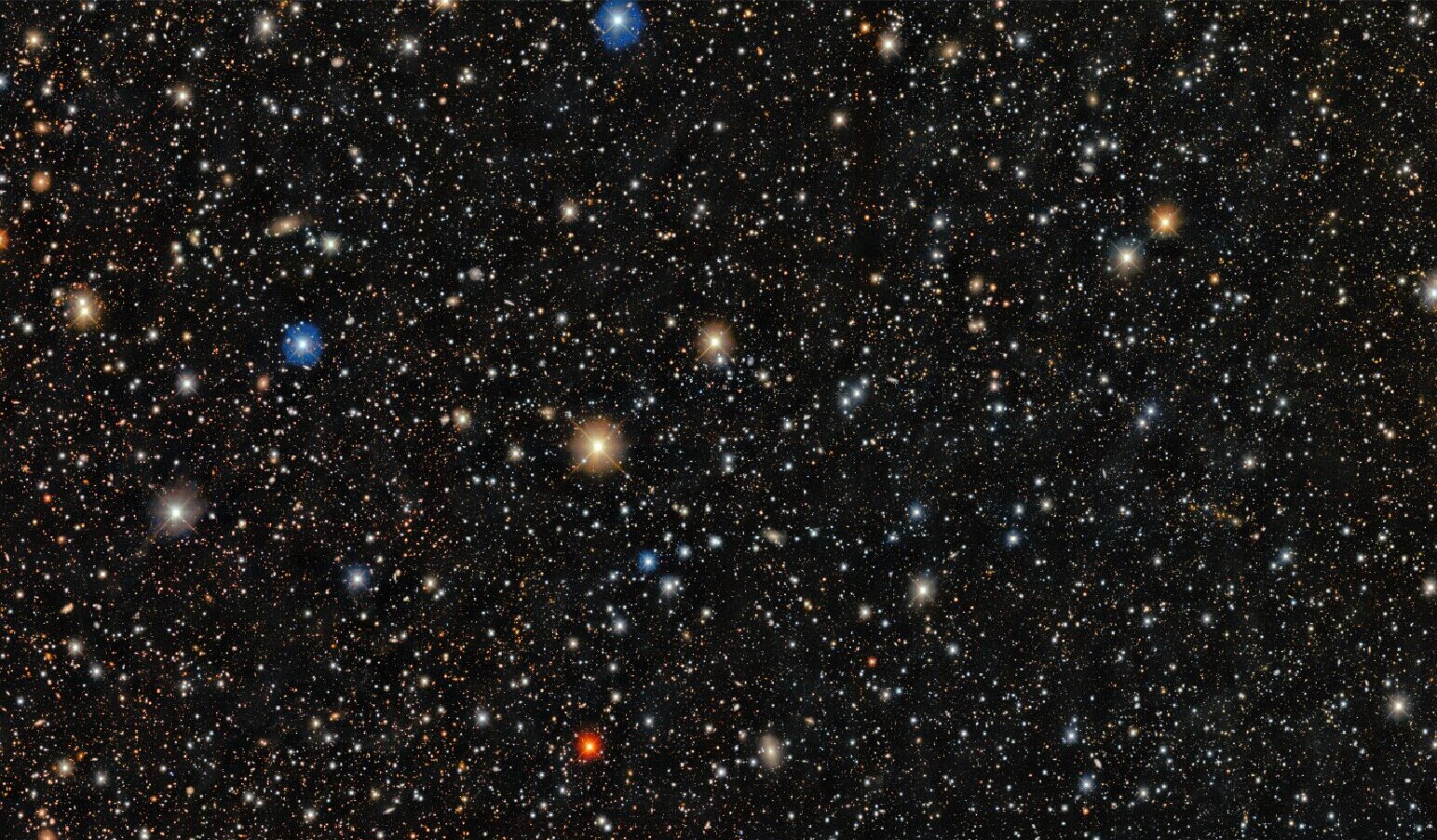
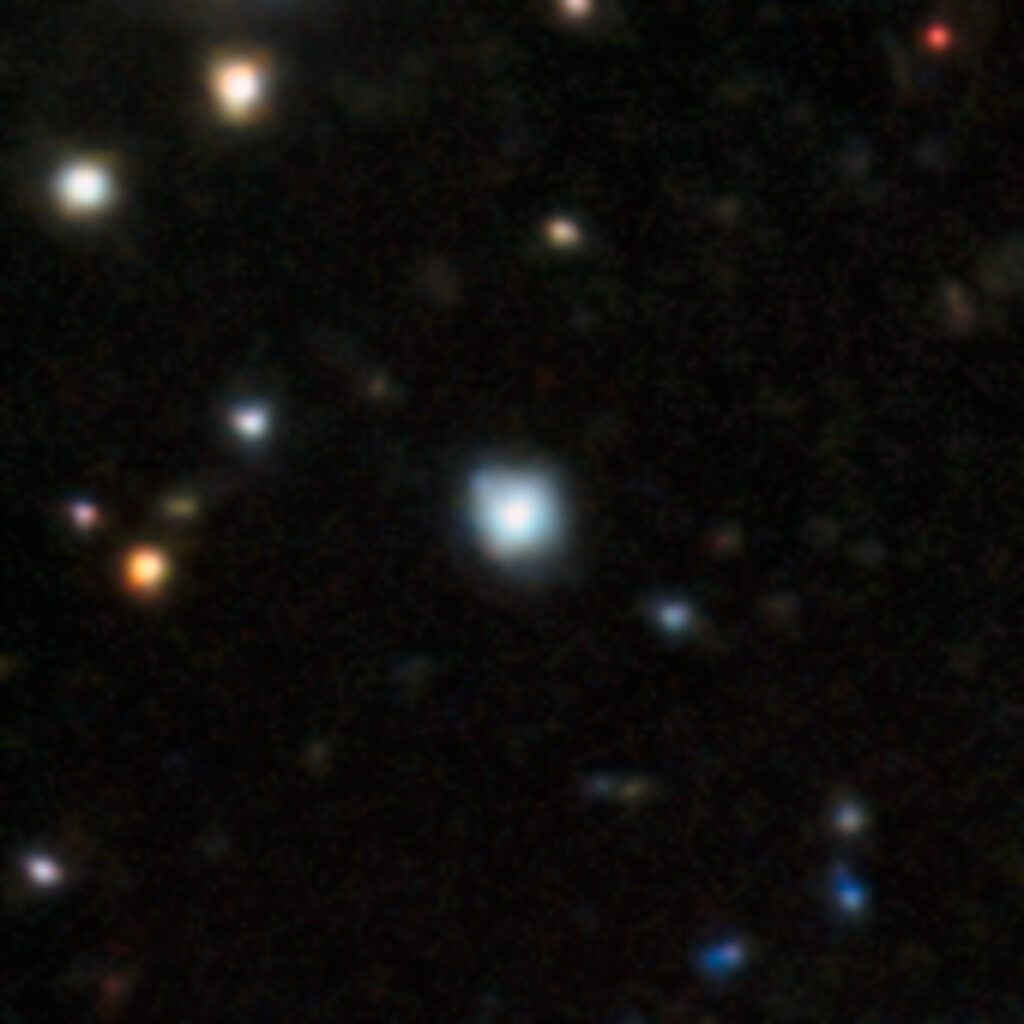
In the quiet, shimmering expanse of the constellation Pictor, a tiny, ancient galaxy known as Pictor II drifts through the cosmos. This “ultra-faint” dwarf galaxy is home to only a few thousand stars and has existed for more than ten billion years. Deep within its outskirts, astronomers have identified a single, remarkable inhabitant: a star named PicII-503. This star is not merely a distant sun; it is a pristine stellar fossil, a chemical time capsule that carries the fingerprints of the very first stars to ever ignite in the darkness of the early universe.
For years, the origins of the universe’s chemical complexity have been shrouded in mystery. The first generation of stars formed from a simple mixture of hydrogen and helium. Inside their scorching cores, these pioneers forged the first “metals”—the heavier elements like carbon and iron. When these first stars eventually died in explosive supernovae, they scattered these new elements into space, seeding the clouds of gas that would eventually collapse to form a second generation of stars. PicII-503 is a rare, unambiguous survivor of that second generation, preserving a chemical recipe that has remained unchanged for eons.
A ghost from the dawn of time
Finding a needle in a cosmic haystack requires specialized tools. To isolate this ancient relic, a team led by Anirudh Chiti, a Brinson Prize Fellow at Stanford University, turned to the Dark Energy Camera (DECam). Mounted on the Víctor M. Blanco 4-meter Telescope at the Cerro Tololo Inter-American Observatory in Chile, this powerful instrument allowed researchers to peer into the heart of Pictor II.
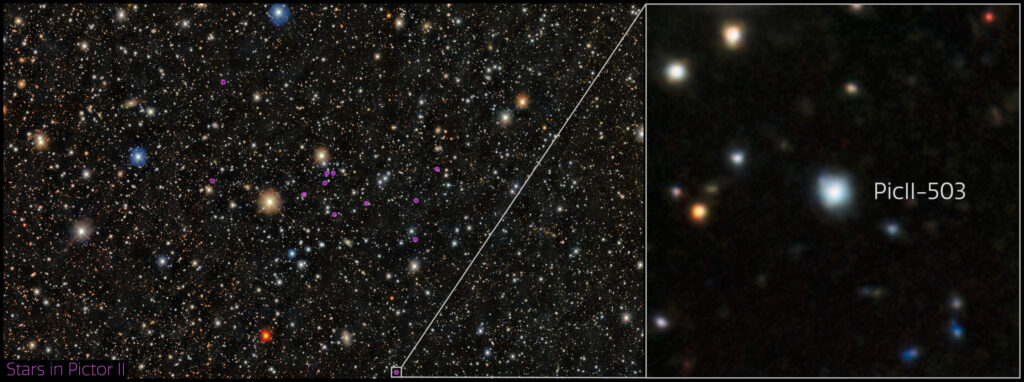
The discovery was part of the MAGIC survey—Mapping the Ancient Galaxy in CaHK—a 54-night mission designed specifically to hunt for the oldest and most chemically primitive stars. Using a specialized narrow-band filter sensitive to calcium absorption, the survey could estimate the metal content of thousands of stars by analyzing light alone. Out of the hundreds of candidates near Pictor II, the MAGIC data flagged PicII-503 as an exceptional outlier.
By following up with the Magellan/Baade Telescope and the Very Large Telescope (VLT), the team confirmed that this star was unlike almost any other. It contains less iron than any star ever measured outside of our own Milky Way—specifically, less than 1/40,000th of the iron found in our sun. This extreme deficiency in iron and calcium marks it as the clearest example of a star that preserves the pure chemical enrichment of the universe’s first stellar inhabitants.
The secret language of carbon
While the lack of iron was staggering, it was the star’s carbon content that provided the most shocking revelation. PicII-503 possesses an extreme overabundance of carbon, with a carbon-to-iron ratio that is over 1500 times that of the sun. This specific chemical signature—high carbon and extremely low iron—matches a mysterious class of “carbon-enhanced” stars previously observed in the Milky Way halo. For decades, the origin of those stars was unknown, but PicII-503 provides the missing link.
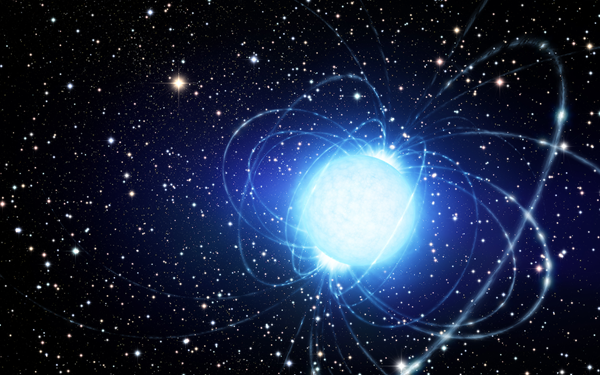
The chemistry of PicII-503 supports a fascinating theory regarding how the first stars died. Scientists believe these chemical patterns are the result of low-energy supernovae. In these relatively “gentle” explosions, the heavier elements like iron that form deep in the star’s interior fall back into the remaining compact object (like a neutron star or black hole). Meanwhile, lighter elements like carbon, located in the star’s outer layers, are successfully ejected into space.
The fact that PicII-503 exists in such a small galaxy is the “smoking gun” for this theory. Because Pictor II is so tiny, its gravitational pull is weak. If the metals in PicII-503 had come from a high-energy supernova, the explosion would have been powerful enough to blast those elements right out of the galaxy. The presence of these elements inside PicII-503 proves that the first-generation star that seeded it must have died in a low-energy event, allowing the Pictor II dwarf galaxy to hold onto its precious chemical cargo.
Fragments of a broken history
This discovery does more than just explain the life of one star; it tells the story of how our own Milky Way was built. The striking similarity between PicII-503 and the carbon-rich stars in our own galaxy’s halo suggests that those stars were not born in the Milky Way. Instead, they likely originated in ancient, tiny relic dwarf galaxies that were eventually swallowed up and merged into our galaxy over billions of years.
This realization connects the small-scale evolution of individual stars to the grand-scale assembly of giant galaxies. As Chris Davis, the NSF Program Director for NOIRLab, describes it, this research is a form of cosmic archaeology. By uncovering these rare stellar fossils, astronomers are pieceing together the fingerprints of the universe’s first stars and the chaotic processes that shaped the early cosmos.
Why this ancient light matters
The study of PicII-503 is fundamental because it offers a direct, pristine window into the very first chapter of the universe’s chemical history. Every element in our bodies, from the carbon in our DNA to the iron in our blood, was originally forged inside the hearts of stars. By finding a star that preserves the immediate aftermath of the universe’s first atomic production, we are looking at the foundational moments that set the stage for everything that followed.
This research bridges the gap between the theoretical “first stars” and the observable stars we see today. It proves that even the smallest, most distant galaxies hold vital clues to our own origins. As astronomers prepare for the upcoming Legacy Survey of Space and Time at the Rubin Observatory, PicII-503 stands as a beacon, reminding us that the secrets of the early universe are still out there, etched into the light of the most ancient stars, waiting to be read.
Study Details
Anirudh Chiti et al, Enrichment by the first stars in a relic dwarf galaxy, Nature Astronomy (2026). DOI: 10.1038/s41550-026-02802-z