Deep in the fabric of our universe lies a secret that dates back to the very first fraction of a second after the Big Bang. For decades, scientists have hunted for a phantom substance known as dark matter, an invisible “gravitational glue” that makes up roughly 85% of all matter in the cosmos. Without it, galaxies would fly apart, yet it has never been seen or touched. Now, a pair of astrophysicists from the University of Miami believe they are standing on the threshold of a discovery that could solve this mystery by proving the existence of primordial black holes.
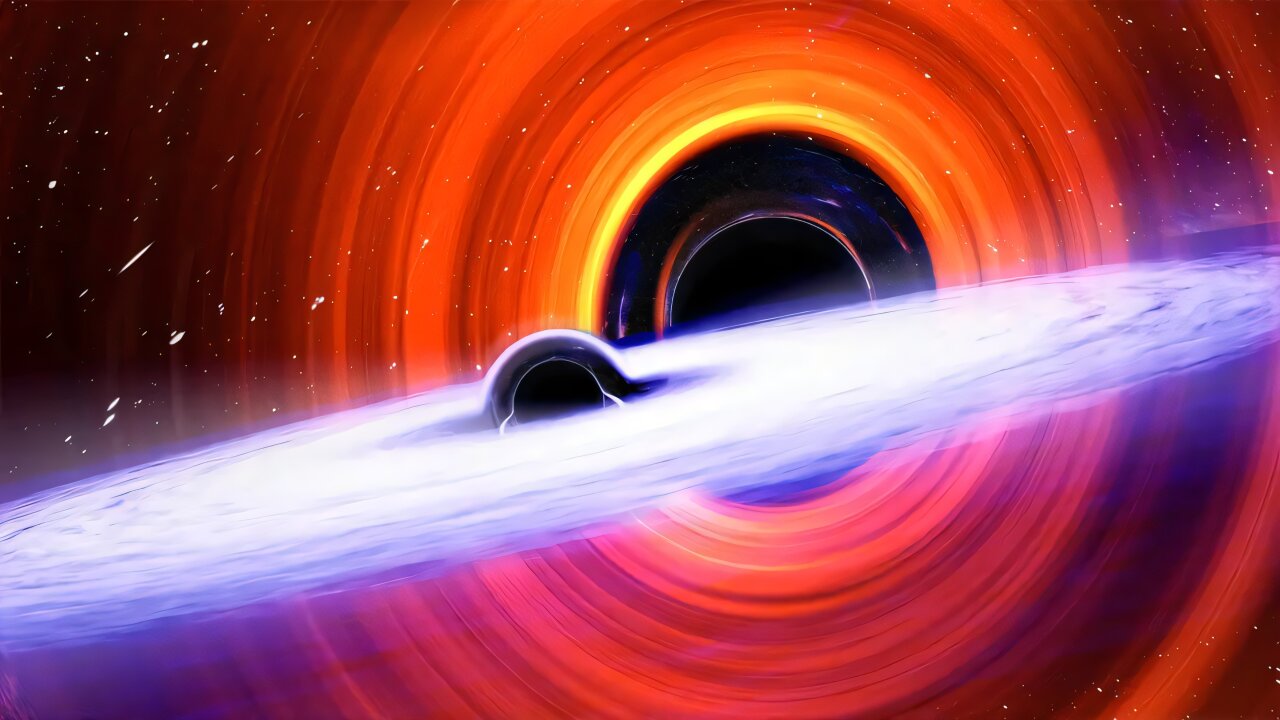
Unlike the black holes we typically study, which are the corpses of massive collapsed stars, these primordial versions are purely theoretical artifacts of the infant universe. They weren’t born from stars because, at the time of their suspected creation, stars didn’t even exist. Instead, they would have formed from the high-density environment of the early cosmos, ranging in size from tiny asteroids to massive giants. If they are real, they might not just be a cosmic curiosity; they could be the very source of the universe’s missing mass.
A Ghostly Signal from the Deep
The journey toward this potential breakthrough began late last year with an automated alert from LIGO, the Laser Interferometer Gravitational-Wave Observatory. This massive facility, which uses miles of vacuum arms to detect gravitational waves—ripples in spacetime caused by violent cosmic collisions—picked up a signal that didn’t fit the usual mold.
Typically, when LIGO detects a merger, the objects involved are several times the mass of our sun. This is because a supernova, the death of a massive star, is the standard way a black hole is born. However, this specific signal suggested a merger involving an object weighing less than one solar mass. Since no known star is small enough to collapse into such a tiny black hole, the detection pointed toward something much older and much stranger. While some skeptics argue the signal might just be detector noise, others see it as the “smoking gun” for a primordial black hole.
Calculating the Invisible Population
Driven by the curiosity of this subsolar signal, researchers Nico Cappelluti and Alberto Magaraggia set out to determine if such an event was a fluke or a predictable part of our universe. They attempted to estimate exactly how many primordial black holes might be drifting through space and how often a detector like LIGO should actually hear them collide.
Their findings, soon to be shared in The Astrophysical Journal, suggest that the math actually adds up. The rarity of the signal LIGO observed matches their predictions for how often these ancient objects should cross paths. By their estimation, there is no conventional astrophysical explanation for a black hole of that size other than a primordial origin. Most provocatively, their research indicates that these objects could account for a significant portion, or perhaps even the entirety, of dark matter.
Standing on the Shoulders of Giants
The idea of these ancient traps for light is not new. During the Cold War, Soviet scientists Yakov Zeldovich and Igor Novikov were the first to propose that the early universe might have been dense enough to collapse into black holes immediately. In the 1970s, Stephen Hawking expanded this theory, suggesting these mysterious objects existed in vast numbers and could be the key to the dark matter puzzle.
For years, these ideas remained trapped in the realm of mathematics. It wasn’t until LIGO first detected gravitational waves in 2015 that humanity gained the ears to hear the universe’s most violent whispers. Today, LIGO works alongside the Virgo detector in Italy and the KAGRA observatory in Japan, forming a global network known as the LVK that hunts for the collisions of these compact regions of space where gravity is so intense that not even light can escape.
The Dawn of a New Cosmic Era
While the evidence is mounting, the scientific community is now playing a waiting game. To move from a “potential discovery” to a confirmed scientific fact, researchers need to hear more. One signal is a hint; several signals would be an undeniable confirmation that these ancient remnants of the Big Bang are real.
Fortunately, the tools for this hunt are getting sharper. Future upgrades to LIGO will increase its sensitivity, but the real leap will come from the next generation of observatories. In 2035, the European Space Agency plans to launch LISA (the Laser Interferometer Space Antenna) into space. Because it will be free from Earth’s noise, LISA will be able to detect waves from the earliest epochs of time. Closer to home, the Cosmic Explorer is being designed to be ten times more sensitive than our current tools, capable of looking back to the very dawn of the first stars.
Why This Ancient Hunt Matters
This research is about more than just finding small black holes; it is about identifying the fundamental building blocks of our reality. If primordial black holes are confirmed to be the source of dark matter, it would resolve a decades-long crisis in physics. We would finally understand the “gravitational glue” that allows galaxies to form and hold together. Proving their existence would provide a direct window into the first second of the universe’s life, confirming theories about the Big Bang that have, until now, remained beyond our reach. Identifying these objects would fundamentally rewrite our map of the cosmos and our understanding of where everything—including the matter that makes up our own world—originally came from.
Study Details
Alberto Magaraggia et al, Implications for PBH Dark Matter from a single Sub-Solar–Mass GW Detection in LVK O1–O4, The Astrophysical Journal (2026). DOI: 10.3847/1538-4357/ae48f9. On arXiv: DOI: 10.48550/arxiv.2602.21295