Deep in the cold, expansive reaches of the cosmos, about 10 billion light-years away from our own planetary doorstep, a giant has suddenly gone quiet. For eons, this distant galaxy served as a lighthouse in the dark, powered by a central engine of unfathomable intensity. But in a span of time that wouldn’t even cover a single human career, its brilliant light has plummeted, leaving astronomers to wonder how a structure so massive could lose its luster so fast.
This isn’t a story of a slow, multi-millennial decline. Instead, an international team led by researchers at the Chiba Institute of Technology has caught a rare, real-time transformation. They have watched a galaxy’s heart dim to just one-twentieth of its original brightness in a mere 20 years. In the grand timeline of the universe, where changes usually take millions of years, this is the astronomical equivalent of a camera flash fading into a dull ember in the blink of an eye.
The Heart of the Celestial Engine
To understand how a galaxy loses its glow, one must first look at what makes it shine. At the core of almost every massive galaxy lies a supermassive black hole, a gravitational titan with a mass hundreds of millions of times that of our sun. While black holes are famous for letting nothing escape, the regions immediately surrounding them are some of the brightest places in existence.
As the black hole’s gravity pulls in surrounding gas, the material doesn’t just fall straight in. It spirals, much like water circling a drain, forming a flat, spinning structure known as an accretion disk. Inside this disk, particles of gas rub against each other at incredible speeds. This friction heats the gas to temperatures so extreme that it releases enormous amounts of energy across the electromagnetic spectrum. These radiant galactic centers are known to scientists as active galactic nuclei, or AGN.
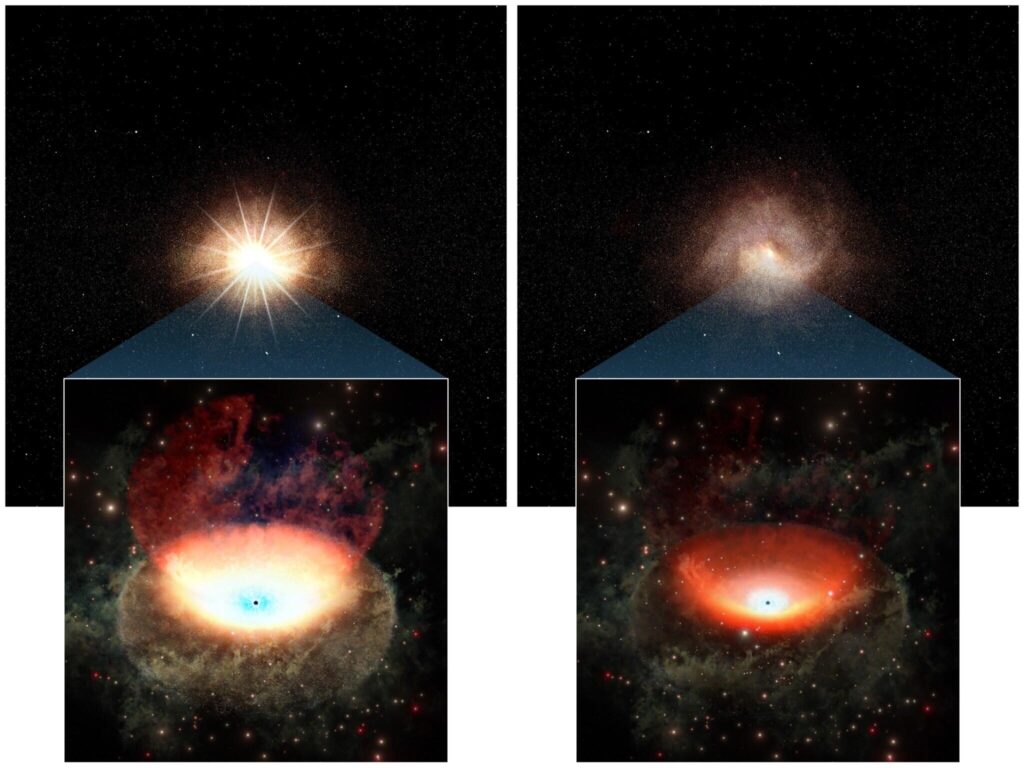
For a long time, the scientific consensus was that these engines were steady, if not permanent, fixtures. It was believed that the flow of fuel into the black hole—the mass accretion rate—varied only over tens of thousands of years. But the discovery of this fading galaxy, documented in the Publications of the Astronomical Society of Japan, has turned that long-standing view on its head.
A Ghost in the Digital Archives
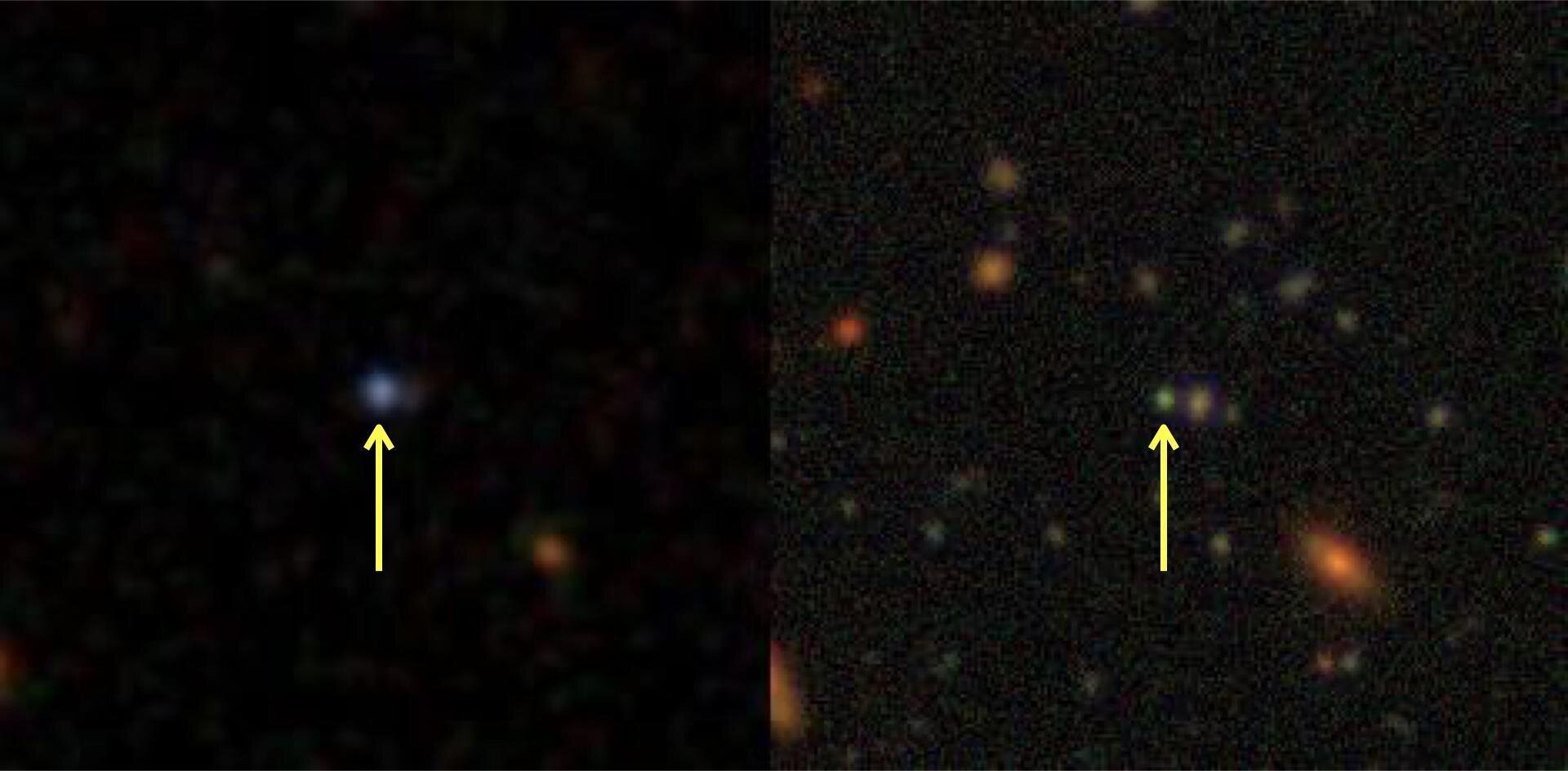
The mystery began when researchers started hunting through the vast “digital libraries” of the sky. They compared historical images from the Sloan Digital Sky Survey (SDSS) with modern, high-resolution data from the Hyper Suprime-Cam (HSC) on the Subaru Telescope. The discrepancy was jarring. The galaxy, which once blazed with the intensity of billions of suns, had withered.
While most AGN are known to flicker or vary in brightness by about 30%, a drop of 95% (to one-twentieth of its peak) is an extraordinary anomaly. To ensure this wasn’t a glitch or a passing cloud of space dust, the team mobilized a global network of “eyes” on the sky. They conducted follow-up observations using the Gran Telescopio Canarias (GTC) and combined optical and near-infrared data from the W. M. Keck Observatory with radio, X-ray, and infrared archives. They even went back as far as 70 years, examining old photographic plates to reconstruct the galaxy’s long-term history.
The data confirmed the impossible: the light wasn’t being blocked; it was being extinguished at the source. The team explored the idea that a passing cloud of dust might have temporarily shielded the accretion disk from our view. However, dust acts like a filter that affects different colors of light in specific ways. The observed fading happened across a wide range of wavelengths, from optical to infrared, which the dust theory could not explain. The conclusion was inescapable: the physical state of the accretion disk itself had fundamentally changed.
The Hunger that Suddenly Vanished
By comparing their observations with complex theoretical models, the researchers were able to calculate just how quickly the “fuel” was running out. They estimated that the mass accretion rate—the speed at which gas flows from the disk into the black hole—plunged to one-fiftieth of its previous level in just seven years.
Imagine a massive river that has been flowing for millennia suddenly reduced to a mere trickle in less than a decade. This rapid “shutting-down event” suggests that the supply of material feeding the black hole is being cut off by a mechanism that scientists don’t yet fully understand. Toshihiro Kawaguchi of the University of Toyama, who focused on the theoretical side of the study, noted that this behavior simply cannot be explained by standard models of how black holes eat.
The galaxy has essentially entered a dormant phase, a cosmic “sleep” that arrived far faster than any textbook predicted. It provides a rare, high-stakes test case for astronomers trying to build a new understanding of how these celestial monsters behave when their food supply fluctuates.
Why This Glimpse into the Dark Matters
This discovery is a paradigm shift for astronomy because it proves that the most massive objects in the universe are not static or slow-moving relics. They are dynamic, temperamental, and capable of radical change within a human lifetime. Seeing a supermassive black hole change its behavior so drastically in just 20 years reminds us that the universe is far more “alive” and fast-moving than we once dared to imagine.
The research, led by Tomoki Morokuma, highlights the incredible power of wide-field surveys. By scanning massive swaths of the sky and comparing them over different epochs and wavelengths, astronomers can find these rare “needles in the haystack”—the moments of transition that reveal the true nature of galactic evolution.
Understanding how a black hole shuts down—and potentially how it restarts—is a key piece of the puzzle in learning how galaxies grow and change over billions of years. If these “fading” events are more common than we think, they may explain how galaxies regulate their growth and why some stay active while others go quiet. This single, dimming light 10 billion light-years away has opened a new window into the life cycles of the giants that anchor our universe, proving that even the most powerful engines in the cosmos can, in an instant, run out of gas.
Study Details
Tomoki Morokuma et al, A possible shutting-down event of mass accretion in an active galactic nucleus at z ∼ 1.8, Publications of the Astronomical Society of Japan (2025). DOI: 10.1093/pasj/psaf115