For as long as humans have looked at the stars, we have dreamt of living among them. We imagine sprawling cities on the Moon or dusty outposts on Mars, envisioning a future where humanity is a multi-planetary species. But behind the grand architectural renderings of space colonies lies a fundamental, biological question: can we actually create life out of this world? New research from the University of Adelaide suggests that while the spirit is willing, the sperm might be getting lost along the way.
Scientists at the Robinson Research Institute, the School of Biomedicine, and the Freemasons Center for Male Health and Wellbeing have pulled back the curtain on the silent challenges of extraterrestrial conception. Their investigation into the earliest moments of life—from the frantic swim of a sperm cell to the delicate formation of an embryo—reveals that the absence of gravity might be one of the greatest hurdles to our survival in the cosmos.
The Maze in the Machine
To understand how a lack of gravity affects reproduction, the researchers didn’t actually have to leave Earth. Instead, they brought the conditions of the void to the lab using a specialized piece of technology called a 3D clinostat. Developed by Dr. Giles Kirby at Firefly Biotech, this machine acts as a high-tech disorientation device. By constantly flipping and rotating cells in three dimensions, it effectively cancels out the constant pull of Earth’s gravity, simulating the microgravity environment experienced by astronauts in orbit.
Inside this spinning simulation, the team placed sperm samples from three different mammals, including humans. But they didn’t just watch them swim in a dish. To truly test their mettle, the researchers forced the sperm to navigate a complex chamber maze designed to mimic the twists, turns, and narrow channels of the female reproductive tract.
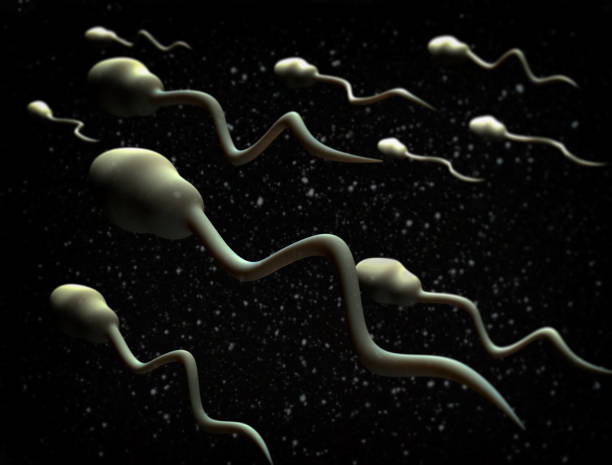
What they discovered was a biological mystery. In the simulated weightlessness of space, the sperm became profoundly disoriented. There was a significant reduction in the number of sperm cells that successfully reached the end of the maze compared to those tested under normal Earth gravity. The most surprising part, according to senior author Dr. Nicole McPherson, was that the sperm didn’t seem to be “broken” or moving slower. Their physical motility—the way they wagged their tails and propelled themselves—remained unchanged. They simply couldn’t find their way. It appears that gravity is a silent navigator, providing a crucial sense of “up” or “down” that these microscopic travelers rely on to reach their destination.
A Chemical Compass in the Dark
If the loss of gravity leaves sperm wandering aimlessly, the researchers wondered if there was a way to give them a map. They turned their attention to progesterone, a vital sex hormone known for its role in establishing pregnancy. In the natural journey toward life, progesterone is released by the egg itself, acting as a chemical beacon that calls out to the sperm.
When the team introduced progesterone into the simulated microgravity environment, they saw a glimmer of hope. The hormone helped more human sperm overcome their navigational confusion, guiding them through the maze despite the lack of gravitational cues. This suggests that the egg plays an even more active role in space than it does on Earth, potentially serving as a chemical lighthouse for “lost” sperm. Dr. McPherson notes that while this warrants much more exploration, it could eventually lead to medical solutions for couples hoping to conceive in off-Earth environments.
The Fragile Spark of the Embryo
The journey doesn’t end when the sperm finds the egg; in many ways, the challenges are just beginning. The Adelaide team, collaborating with the Andy Thomas Center for Space Resources, pushed their research further to see what happens after fertilization occurs in zero gravity. Using animal models, they monitored the very first hours and days of development.
The data painted a sobering picture of the extraterrestrial womb. After just four to six hours of exposure to microgravity, there was a 30% reduction in the number of mouse eggs that were successfully fertilized. It seems that the window of opportunity for life to begin narrows significantly when the tether of gravity is cut.
Even more concerning was the impact of prolonged exposure. For the lucky few eggs that were fertilized, the lack of gravity continued to cause trouble. The researchers observed significant developmental delays. In some cases, there was a reduction in the specific cells that are destined to form the fetus. These early “building blocks” of the body appeared to struggle with the physics of weightlessness, suggesting that the architecture of life itself is calibrated to the specific pull of our home planet.
Designing a Future Among the Stars
As we look toward the next phase of this research, the questions become even more nuanced. The team is now investigating how varying gravitational environments—such as the light pull of the Moon or the intermediate gravity of Mars—compare to the total weightlessness of deep space. They are also looking into artificial gravity systems, which use rotation to create a centrifugal force that mimics Earth’s pull.
One of the most pressing questions for the future of space settlement is whether these biological changes happen on a sliding scale. Does a small decrease in gravity cause a small decrease in fertility, or is there a threshold effect—an “all or nothing” response where the body functions normally until a certain point of weightlessness is reached? Finding the answer is essential for Associate Professor John Culton and his team as they plan for long-term planetary living. We need to know exactly how much “gravity” a developing human needs to grow healthy and strong.
Why This Research Matters
This study is far more than a curiosity about space biology; it is a fundamental assessment of our viability as a species. For decades, space agencies have focused on the physics of rockets and the chemistry of life-support systems, but the Robinson Research Institute has reminded us that our most basic biological drives are also tied to the physics of Earth.
If we truly intend to build permanent settlements on the Moon or Mars, we cannot rely on a constant supply of people from Earth. A truly multi-planetary species must be able to reproduce independently. By identifying that microgravity disrupts the “GPS” of sperm and slows the growth of embryos, scientists can now begin to work on the solutions—whether through hormonal supplements like progesterone or the engineering of artificial gravity habitats.
Despite the obstacles discovered in the lab, there is reason for optimism. Even under the disorienting conditions of simulated space, many healthy embryos were still able to form. This resilience suggests that while the path to reproducing in the stars is complex and fraught with biological hurdles, the spark of life is persistent. Understanding these challenges today is the only way to ensure that the first children born on other worlds have the best possible start to their lives.
Study Details
Simulated microgravity alters sperm navigation, fertilization and embryo development in mammals, Communications Biology (2026). DOI: 10.1038/s42003-026-09734-4