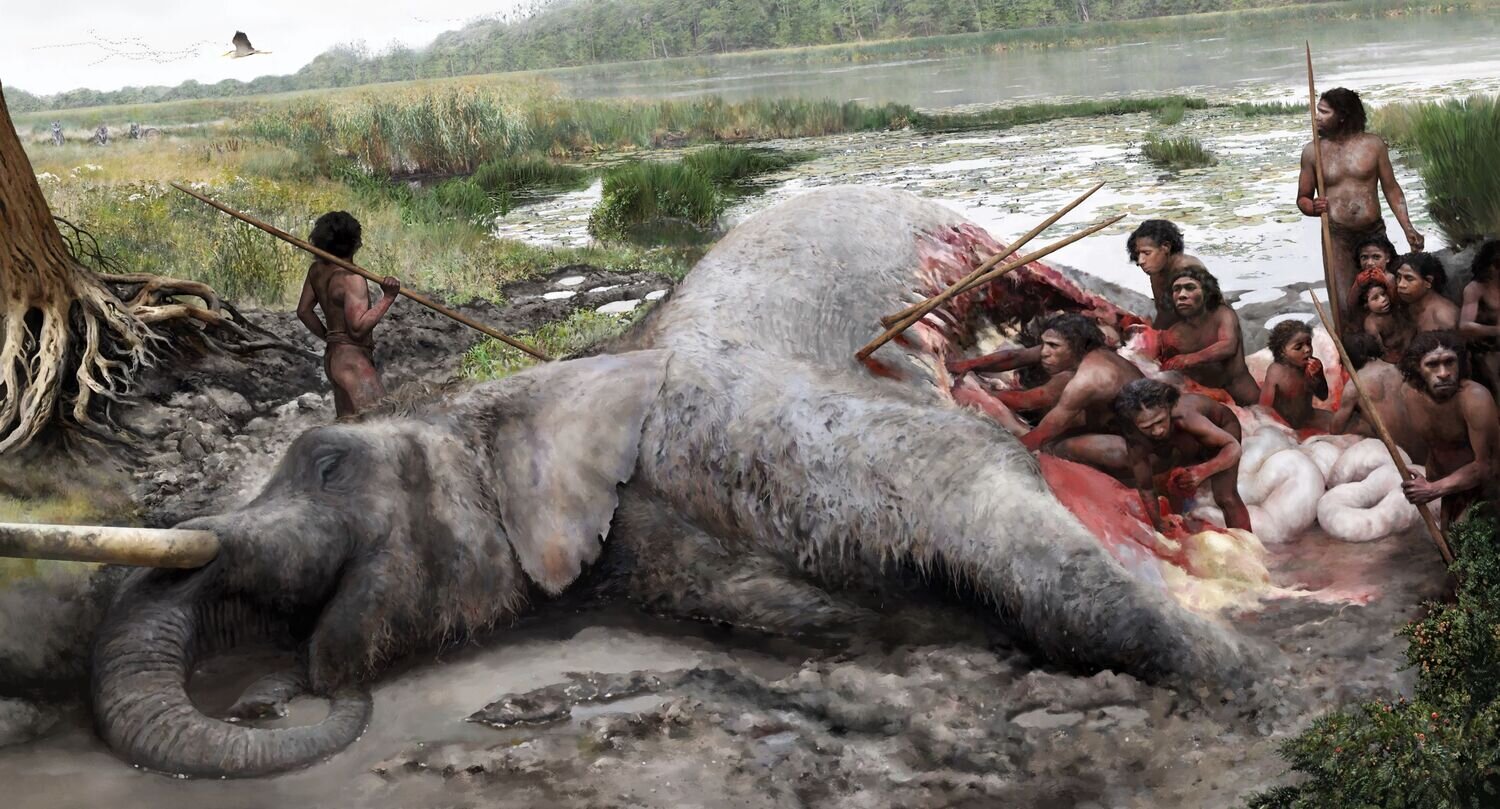
The year was 1948, and in the quiet landscape of Lehringen, Germany, a local headmaster and a group of curious amateurs were about to pull a secret from the earth that had been buried for 125,000 years. As they brushed away the sediment from the last interglacial period, they uncovered the towering skeleton of a straight-tusked elephant. This was no ordinary find; the creature was the largest land mammal ever to walk the European continent. But the real shock lay nestled between the massive ivory ribs: a complete wooden spear.
For decades, the discovery remained a point of intense debate. Was this a scene of an ancient, calculated kill, or merely a fluke of history where a spear and a carcass happened to settle in the same patch of mud? Scientists at the University of Göttingen and the Lower Saxony State Office for Heritage (NLD) decided it was time to let the bones speak for themselves. Through the first detailed analysis of the site, they didn’t just find a skeleton; they found a crime scene that rewrites what we know about our ancient cousins, the Neanderthals.
A Giant Falls Beneath the Canopy
Imagine a Europe much different from the one we know today. The air was slightly warmer, with average annual temperatures higher than our modern era, supporting a landscape of dense deciduous forests. In this lush world, the straight-tusked elephant reigned supreme. The specific individual found in Lehringen was a formidable male elephant, approximately 30 years old. He was a mountain of muscle and bone, weighing in at a staggering 3,500 kilograms of meat, organs, and fat.
The presence of the thrusting spear among the ribs was the first clue, but the definitive proof of a hunt came from the microscopic level. Researchers identified numerous cut marks etched into the ribs and vertebrae. These weren’t accidental scratches; they were the precise signatures of butchery. The location of these marks revealed a grim but efficient process: the Neanderthals had used flint tools to slice through the thick hide and cut open the elephant’s chest cavity. Their goal was the high-energy organs and the vast supply of food that such a massive kill provided. This discovery stands as the most convincing evidence to date that Neanderthals were capable of successfully hunting the largest prey on the continent.
Life and Death on the Ancient Lakeshore
The hunt did not happen in isolation. The site at Lehringen was once the shore of a former lake, a hub of biodiversity that provided a bounty for those skilled enough to take it. Alongside the elephant, archaeologists recovered around 2,000 bones belonging to 16 different animal species. The remains of fish, birds, and turtles suggest that the Neanderthals were not just big-game hunters, but opportunistic foragers who likely utilized the lake for mussels and plants as well.
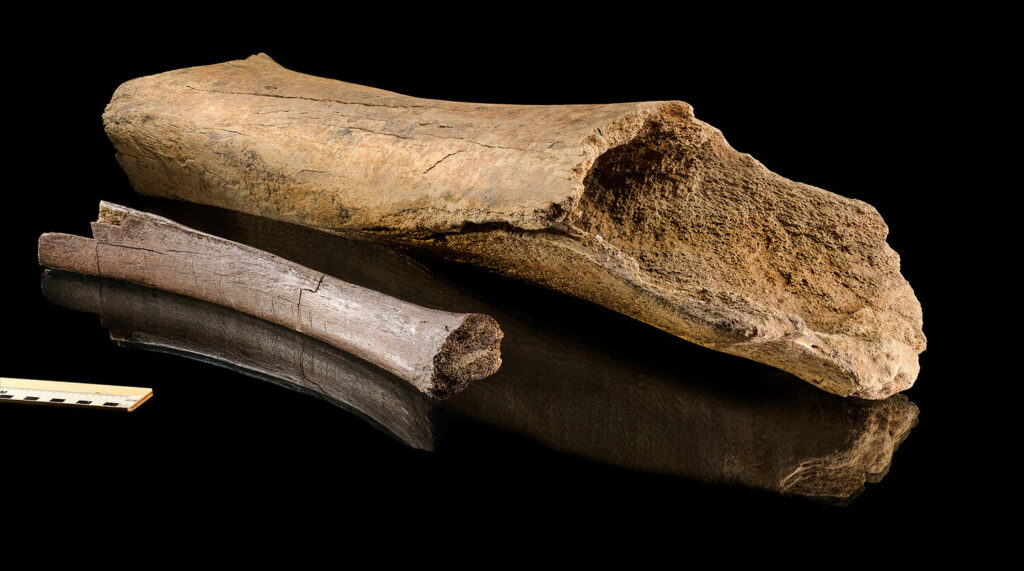
The evidence shows that these ancient people were not wandering aimlessly; they were experts at living off the land during this warm period. They returned to this lakeshore repeatedly, spending long periods of time there. They were masters of their environment, using wooden weapons and highly cooperative behavior to navigate a world filled with dangerous prehistoric residents.
Beyond the Elephant the Wild Giants
While the elephant was the ultimate prize, it wasn’t the only giant the Neanderthals faced. The research team also found evidence that they hunted and butchered the aurochs, the extinct ancestor of modern wild cattle. This was no easy task; the aurochs stood up to 1.8 meters at the shoulder and brandished massive, elongated horns. Despite the danger, the reward was a carcass rich in meat.
The Neanderthals’ survival strategy was thorough. On the bones of brown bears, the team identified cut and impact marks that told a story of deep extraction—they weren’t just after the meat, but were breaking the bones to reach the nutrient-dense bone marrow. Even smaller inhabitants of the lake were part of their economy. Marks on beaver bones proved that these creatures were harvested for both their meat and their fur, highlighting a sophisticated understanding of animal resources that extended beyond simple calories.
Why These Ancient Echoes Matter Today
This research is a crucial building block in our “up-to-date” understanding of our evolutionary relatives. For a long time, Neanderthals were viewed as primitive, but the Lehringen finds prove they possessed a strategic hunting ability and a level of skill that rivaled that of anatomically modern humans living 125,000 years ago.
By proving that they could organize a group to take down a 3,500-kilogram elephant and systematically harvest everything from bear marrow to beaver pelts, we see a portrait of a highly intelligent, social, and adaptable species. They didn’t just survive in the dense forests of ancient Germany; they mastered them, using diverse hunting strategies and cooperative behavior to thrive in a world of giants. The spear in the ribs wasn’t a coincidence—it was a testament to a sophisticated culture that has finally been given its due.
Study Details
Ivo Verheijen et al, Faunal exploitation at the elephant hunting site of Lehringen, Germany, 125,000 years ago, Scientific Reports (2026). DOI: 10.1038/s41598-026-42538-4