Eight thousand years ago, long before stone cities rose and farmers carved fields from forests, the banks of Portugal’s Tagus River echoed with the voices of people living on the threshold of change. These were the last hunter-gatherers of western Europe, communities who relied on the brackish waters of the estuary for survival. They fished, gathered shellfish, hunted wild boar, and buried their dead among the dunes and riverine sands.
Today, the site of Cabeço da Amoreira stands as a bridge between their world and ours. Discovered in 1864, it has been the subject of over a century of excavation and debate, and yet large portions of the site remain untouched. Each new investigation peels back another layer of the Mesolithic past, revealing not only the material traces of daily life but also the intimate stories of loss, ritual, and remembrance.
A recent study by Dany Coutinho-Nogueira and colleagues, published in Childhood in the Past, has turned the spotlight on the most vulnerable members of this ancient community—the children whose lives ended far too soon. Three non-adult burials uncovered at Cabeço da Amoreira offer us a haunting glimpse into how hunter-gatherer groups cared for their young in death, and by extension, what they may have meant in life.
Life Along the Estuary
Cabeço da Amoreira was part of a broader cluster of settlements along the Tagus River estuary. These sites emerged after the dramatic 8.2-kiloyear climatic event, a global cooling that reshaped coastlines and altered ecosystems. For the communities of the Iberian Peninsula, the retreat of coastal resources forced a turn inward, toward estuaries teeming with fish and shellfish.
For centuries, life here revolved around the waters. Shell middens—the towering mounds of discarded shells that still mark the landscape—testify to the importance of aquatic resources. But survival was not eternal. Around 7100 years ago, as the salinity of the estuary decreased, fish stocks dwindled. It was at this same time that waves of Neolithic farmers and herders pressed into the region, bringing ceramics, domesticated animals, and entirely new ways of life.
This moment of transition—the Mesolithic meeting the Neolithic—remains one of the central puzzles in European prehistory. Were the hunter-gatherers displaced, absorbed, or transformed? Did they mingle with farmers or resist them? The bones buried at Cabeço da Amoreira may yet hold the answers.
The Silence of the Children
Among the hundreds of individuals uncovered at Cabeço da Amoreira, three stand apart: CAM 2022-6, CAM 2019-5, and CAM 2023-7. All were non-adults, children who never reached the fullness of life. Their burials, carefully recorded in recent excavations led by Nuno Bicho and Célia Gonçalves, provide rare insight into how Mesolithic societies treated their young dead.
The youngest, CAM 2022-6, never drew a breath or survived only a few fleeting hours. At roughly thirty-eight weeks gestation, this perinatal infant was placed in the ground with limbs tightly flexed, though no grave goods accompanied the burial. The absence of adornment or structure does not diminish its meaning; rather, it underscores the fragility of life in the Mesolithic world, where every birth was both a triumph and a risk.
A second child, CAM 2019-5, died between the ages of seven and eleven. This burial reveals a more elaborate farewell. The child was laid on its back, head turned to the south-southwest, body tightly arranged as if wrapped in a shroud of perishable material. A single lithic artifact and a perforated shell lay nearby, perhaps tokens placed intentionally. Whether these objects were personal possessions, ritual offerings, or simple chance remains unknown, but they speak of care, of recognition that this child belonged to a community that mourned.
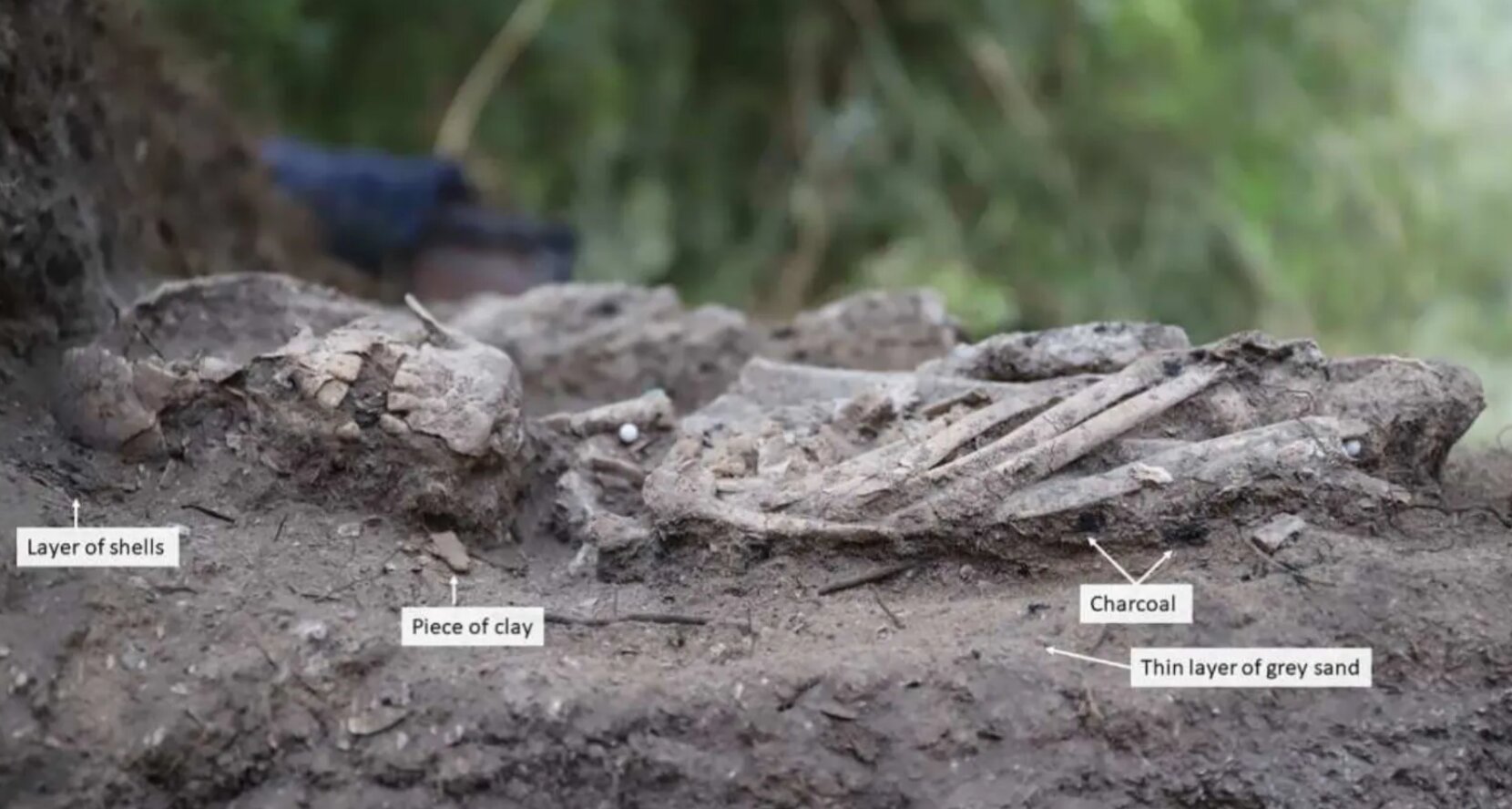
The final case, CAM 2023-7, tells a story unlike any other. This child’s burial was exceptional, unique even among the many adult burials excavated at the site. Layers of clay—imprinted with traces of plants—were carefully arranged, followed by gray sand and a bed of shells beneath the head. Around the body, closed cockle shells, turtle shells, and wild boar jaws were deliberately placed. This was no ordinary interment. It was a carefully staged ritual, rich in symbolism, as if this child required not only burial but a passage, a transformation.
Echoes of Ritual and Meaning
What do these differences tell us about Mesolithic society? For Coutinho-Nogueira and colleagues, the answer is not simple. All three children were buried with limbs flexed, a common trait across the site. But the variation in grave goods, structures, and preparation suggests a more complex story.
Perhaps these differences reflected age, with older children receiving more elaborate rites. Perhaps they signaled status within the group, or spiritual beliefs tied to individual destiny. Or perhaps they mark the passage of time, with burial practices shifting across generations as the community adapted to environmental and cultural change.
One comparison stands out: the burial of CAM 2023-7 echoes that of an earlier adult female, CAM 2011-2, whose grave was layered with pebbles, shells, and animal bones. This parallel hints at a shared symbolic framework, where certain individuals—whether child or adult—were given extraordinary treatment. Were they revered? Set apart? Chosen for reasons we may never grasp? The soil preserves the gestures, but not always the intentions.
Science at the Threshold
The bones of these children hold secrets yet to be uncovered. Precise dating will determine whether they lived and died within the same generations or across centuries of change. Isotopic studies may reveal whether their diets differed from adults, or from one another—perhaps reflecting shifts in resource use or even social distinctions. DNA analysis could trace kinship, showing whether they were related, part of family groups, or outsiders brought into the community.
These investigations are underway, promising to shed new light not only on the lives of these three children but also on the broader questions of population continuity, cultural transmission, and genetic admixture during the Mesolithic–Neolithic transition. Every test is a step closer to hearing the faint voices of those who once lived by the Tagus.
The Human Story Beneath the Data
What makes these discoveries so powerful is not merely their scientific significance, but their human resonance. The people of Cabeço da Amoreira lived in a world both harsh and beautiful, where survival hinged on tides, seasons, and skill. Yet when their children died, they did not discard them. They paused. They buried them with care, sometimes with adornment, sometimes with reverence bordering on ritual.
These gestures transcend time. Across millennia, they remind us that grief is ancient, that love and loss are constants of the human story. In the shells placed beneath a child’s head, in the clay arranged with delicate intention, we see echoes of parents, siblings, and communities striving to give meaning to mortality.
Lessons from the Past
The study of Cabeço da Amoreira is not only about archaeology. It is about recognizing the continuity of human experience. We, too, live in a time of transition, facing climate change, shifting resources, and cultural upheaval. Just as Mesolithic communities adapted, struggled, and blended with new groups, so too do we navigate transformation.
The children of Cabeço da Amoreira remind us that even in the face of uncertainty, what endures is care—the rituals that give shape to grief, the acts of remembrance that tether us to one another. They remind us that science is not cold dissection of the past but a way of reconnecting with the humanity of those who came before us.
The Unfinished Story
Cabeço da Amoreira still holds countless secrets beneath its unexcavated soil. With every season of digging, new discoveries emerge: bones, tools, shells, the faint outlines of lives once lived. Each burial, each artifact, adds another line to the story of Europe’s last hunter-gatherers.
The children—CAM 2022-6, CAM 2019-5, and CAM 2023-7—are part of that unfinished story. They speak softly but insistently across the centuries, reminding us that history is not only the tale of kings and farmers, but also of children whose lives ended too soon, and of the families who loved them enough to mark their passing with ritual and reverence.
Through their remains, we glimpse not only the end of childhood in the Mesolithic world but also the enduring truth that even in the face of death, humanity seeks meaning, memory, and connection.
More information: Dany Coutinho-Nogueira et al, The Non-Adult Burials of Cabeço da Amoreira, Muge (Portugal): Recent Discoveries and New Insights into Mesolithic Funerary Practices, Childhood in the Past (2025). DOI: 10.1080/17585716.2025.2538922