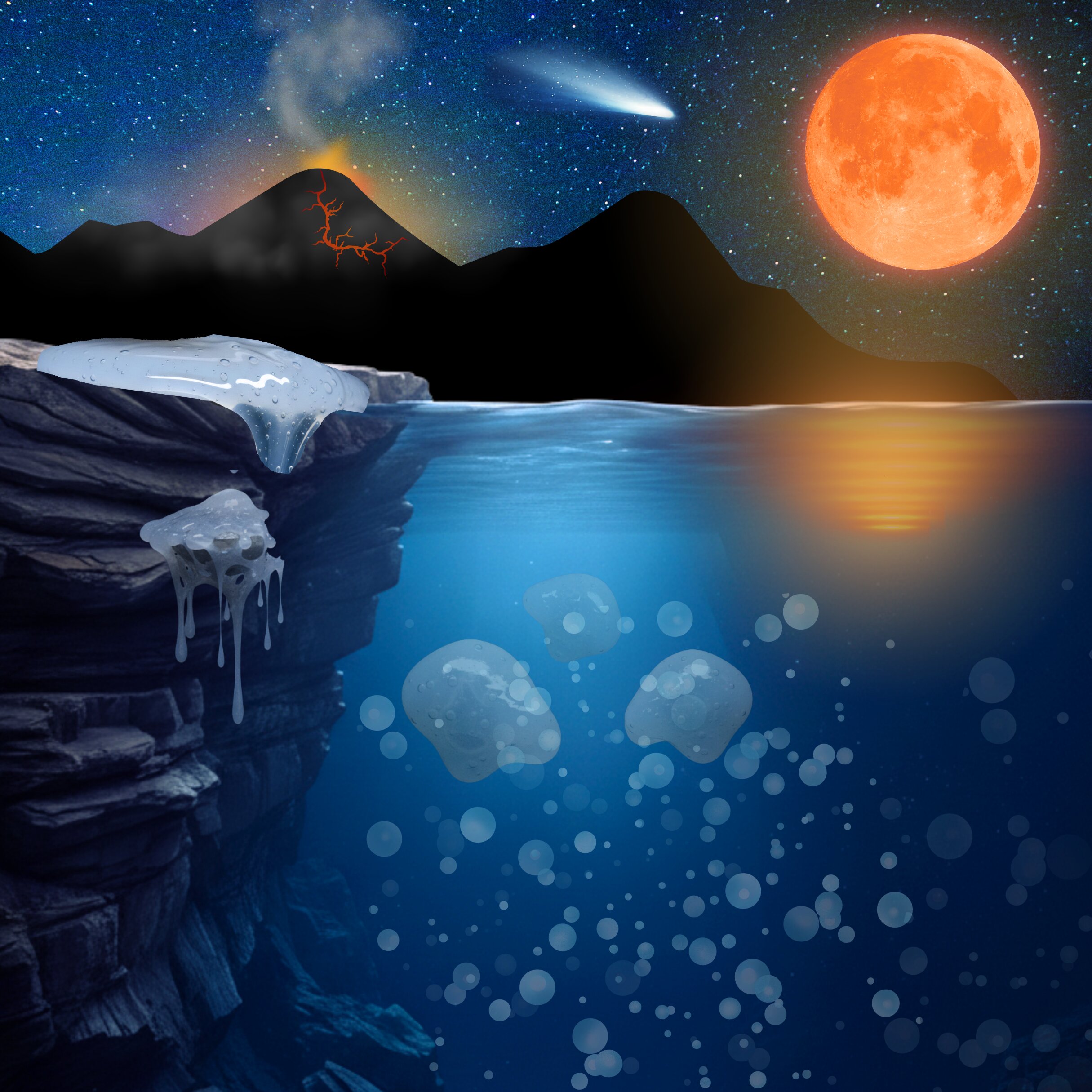
How did life on Earth begin? It’s a question that has baffled scientists and philosophers for centuries. Despite decades of research, the exact moment when non-living chemistry became living biology remains elusive. But now, a group of researchers from Japan, Malaysia, the UK, and Germany have proposed a fresh and fascinating theory that could bring us closer to answering this age-old mystery. Their groundbreaking idea centers around sticky, surface-bound gels—substances that may have been the birthplace of life long before the first cells ever appeared.
The Sticky Puzzle of Life’s Beginnings
Tony Z. Jia, a professor at Hiroshima University, and his international team have shifted the focus of origin-of-life research. For years, much of the scientific community has concentrated on the role of biomolecules—proteins, nucleic acids, and other complex molecules—as the driving force behind the emergence of life. But Jia and his colleagues suggest something different. Instead of focusing solely on these molecules, they propose that gels—those gooey, semi-solid materials—may have played a critical role in the early stages of life.
“We believe that life may have originated within surface-attached gel matrices,” Jia says, referring to the sticky substances that coat many surfaces today, much like the microbial biofilms found on rocks, ponds, and even man-made objects. These biofilms, so familiar to us in the modern world, could have been the first “homes” for life’s earliest chemical systems. The theory is called the “prebiotic gel-first” framework, and it represents a major shift in thinking about how life could have emerged.
Gels, according to the researchers, might have provided the ideal environment for the basic chemicals of life to interact, become organized, and slowly develop into the complex systems necessary for biological processes. Their properties—sticky, yet flexible—might have allowed these early molecules to concentrate, retain, and interact with each other in ways that were otherwise impossible in the open, harsh conditions of early Earth.
A Place for Chemistry to Grow
The idea of life beginning in gels isn’t as strange as it may sound. Gels, in their simplest forms, are sticky materials that can trap molecules, much like how a sponge absorbs water. In the early stages of life, these gels could have acted as a sort of molecular “glue,” holding essential building blocks of life close together, allowing them to concentrate and interact more effectively. The researchers believe that, within these gel matrices, primitive chemical systems could have developed early forms of metabolism and self-replication—the building blocks of life itself.
“These primitive gels could have overcome key barriers in pre-life chemistry,” says Kuhan Chandru, a research scientist at the Space Science Center at the National University of Malaysia, and co-lead author of the study. “They may have allowed for molecular concentration, selective retention, and environmental buffering—all essential features for the emergence of life.”
In their study, the team highlights how these gels could have provided the stability and structure that early chemical reactions needed to evolve. It’s easy to imagine how, in a watery primordial soup, molecules could have been scattered and far apart, making it difficult for complex chemical reactions to occur. Gels, on the other hand, could have been a kind of molecular scaffold, a place where essential building blocks could gather and form into more complex systems.
A Theory That Expands Beyond Earth
One of the most exciting aspects of this research is how it might reshape the way we think about life beyond Earth. If primitive gels played a role in the origins of life on our planet, might similar structures exist elsewhere in the universe? Could there be alien “Xeno-films,” gel-like substances that serve as the cradle for life on distant planets? The idea is tantalizing. Rather than looking for specific molecules or compounds as signs of life, scientists might start searching for the unique structures that could act as the foundation for alien life forms.
“This idea extends the search for life beyond Earth,” says Chandru. “Instead of focusing solely on specific chemical ingredients, we suggest that scientists might start looking for structures—gel-like systems—that could be the foundation for life, even if they’re based on entirely different building blocks than what we find on Earth.”
The concept of “Xeno-films” expands the scope of astrobiology, which has traditionally focused on detecting familiar life-forms or their chemical signatures. By suggesting that life could exist in forms vastly different from anything we recognize, this theory opens up entirely new avenues for exploration.
The Road Ahead
While this theory is a fascinating and novel approach, the team is careful to note that it’s just one of many possible explanations for how life could have started. The question of life’s origins remains one of the most profound mysteries in science, and researchers are continually exploring different possibilities.
“We don’t claim to have all the answers,” says Ramona Khanum, co-first author of the study and a former intern at UKM. “But we hope that our work inspires others to explore the potential role of gels in the origins of life.” Khanum and the team’s next step will be to conduct experiments to explore how such gels, formed from simple chemicals, might have emerged under the conditions of early Earth. They are particularly interested in understanding what properties these gels could have had and how they might have facilitated the rise of complex chemical systems.
The team’s work promises to be a catalyst for future research. As scientists continue to probe the deepest mysteries of how life began, this gel-first theory could provide crucial insights, potentially shaping the next phase of origin-of-life research.
Why This Research Matters
At first glance, the idea of life beginning in sticky gels might seem unconventional. But this theory matters because it offers a fresh perspective on one of science’s most perplexing questions. Life, it turns out, might not have started in the way we imagined—through a solitary molecule or a complex protein—but in humble, sticky environments that helped foster the necessary conditions for life to evolve.
This research has profound implications not just for understanding how life began on Earth but for how we search for life elsewhere in the universe. It pushes the boundaries of what we think of as possible in the search for alien life and challenges us to think beyond traditional ideas of life as we know it. Whether on Earth or on a distant exoplanet, the discovery of “Xeno-films” could be the key to identifying life forms that are truly out of this world.
As the team of researchers continues their work, the world watches with anticipation. The sticky, gel-filled origins of life may just be the answer that unravels one of the universe’s greatest mysteries.
More information: Ramona Khanum et al, Prebiotic Gels as the Cradle of Life, ChemSystemsChem (2025). DOI: 10.1002/syst.202500038